Week 2 Challenge
Question 1:
Compare four different types of fuel cells and state their applications.
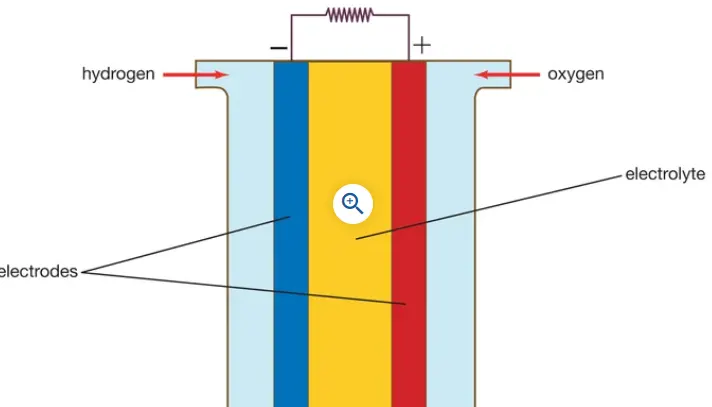
Diagram of Fuel cell
Types of fuel cells
Types of Fuel Cells
Despite working similarly, there exist many varieties of fuel cells. Some of these types of fuel cells are discussed in this subsection.
The Polymer Electrolyte Membrane (PEM) Fuel Cell
- These cells are also known as proton exchange membrane fuel cells (or PEMFCs).
- The temperature range that these cells operate in is between 50oC to 100o
- The electrolyte used in PEMFCs is a polymer which has the ability to conduct protons.
- A typical PEM fuel cell consists of bipolar plates, a catalyst, electrodes, and the polymer membrane.
- Despite having eco-friendly applications in transportation, PEMFCs can also be used for the stationary and portable generation of power.
Phosphoric Acid Fuel Cell
- These fuel cells involve the use of phosphoric acid as an electrolyte in order to channel the H+
- The working temperatures of these cells lie in the range of 150oC – 200o
- Electrons are forced to travel to the cathode via an external circuit because of the non-conductive nature of phosphoric acid
- Due to the acidic nature of the electrolyte, the components of these cells tend to corrode or oxidize over time.
Solid Acid Fuel Cell
- A solid acid material is used as the electrolyte in these fuel cells.
- The molecular structures of these solid acids are ordered at low temperatures.
- At higher temperatures, a phase transition can occur which leads to a huge increase in conductivity.
- Examples of solid acids include CsHSO4 and CsH2PO4 (cesium hydrogen sulfate and cesium dihydrogen phosphate respectively)
Alkaline Fuel Cell
- This was the fuel cell which was used as the primary source of electricity in the Apollo space program.
- In these cells, an aqueous alkaline solution is used to saturate a porous matrix, which is in turn used to separate the electrodes.
- The operating temperatures of these cells are quite low (approximately 90oC).
- These cells are highly efficient. They also produce heat and water along with electricity.
Solid Oxide Fuel Cell
- These cells involve the use of a solid oxide or a ceramic electrolyte (such as yttria-stabilized zirconia).
- These fuel cells are highly efficient and have a relatively low cost (theoretical efficiency can even approach 85%).
- The operating temperatures of these cells are very high (lower limit of 600oC, standard operating temperatures lie between 800 and 1000oC).
- Solid oxide fuel cells are limited to stationary applications due to their high operating temperatures.
Molten Carbonate Fuel Cell
- The electrolyte used in these cells is lithium potassium carbonate salt. This salt becomes liquid at high temperatures, enabling the movement of carbonate ions.
- Similar to SOFCs, these fuel cells also have a relatively high operating temperature of 650o
- The anode and the cathode of this cell are vulnerable to corrosion due to the high operating temperature and the presence of the carbonate electrolyte.
- These cells can be powered by carbon-based fuels such as natural gas and biogas.
Fuel cells are categorised according to their type of electrolyte, since it is the property-determining component. The six main types of fuel cells are outlined below.
|
Fuel cell type |
DMFC |
AFC |
PAFC |
|||
|
Electrolyte type |
Polymeric ion exchange membrane |
Polymeric ion exchange membrane |
Immobilised alkaline salt solution |
Immobilised liquid phosphoric acid |
Immobilised liquid molten carbonate |
Ceramic |
|
Operating temperature (°C) |
20 – 90 |
30 – 100 |
50 – 200 |
~220 |
~650 |
500 – 1000 |
|
Charge carrier |
H+ |
H+ |
OH– |
H+ |
H32– |
O2– |
|
Power range (W) |
1 – 100 |
1 – 100k |
500 – 10k |
10k – 1M |
100k – 10M+ |
1k – 10M+ |
|
Applications and main advantages: |
||||||
|
Portable electronics |
Higher energy density than batteries and faster recharge. |
|||||
|
Cars boats and spaceships |
Zero emissions and higher efficiency. |
|||||
|
Domestic CHP |
Efficiency and reliability |
|||||
|
Distributed power generation, CHP, busses |
Efficiency, emissions and less noise |
|||||
|
Able to internally reform CH4 |
× |
× |
× |
× |
√ |
√ |
The phosphoric acid fuel cell (PAFC) is not covered in detail in this package. It was however the first type of fuel cell to be commercially produced and enjoys widespread terrestrial use. Many 200 kW systems are in place in USA and Europe.
This package also doesn’t cover the alkaline fuel cell (AFC) in any detail. These particular cells use potassium hydroxide solution as the electrolyte. This means that any CO2 at the cathode, even the levels present in the air, will react with the OH– in the solution to produce carbonates and prevent the cell functioning. This isn’t a huge problem in spacecraft, where pure oxygen can be supplied to the cathode reliably, but this characteristic flaw makes the AFC unsuitable for practical terrestrial use.
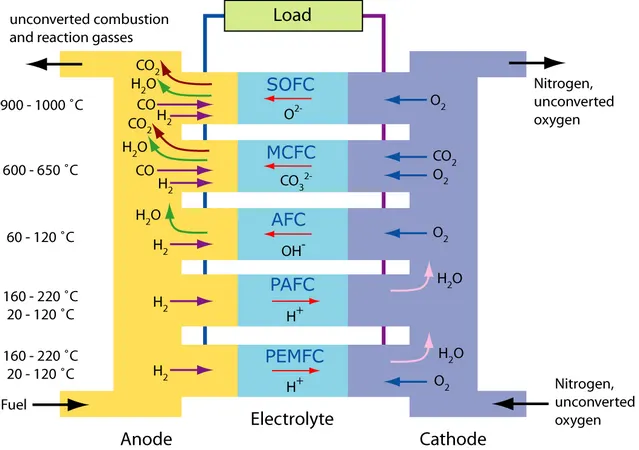
The diagram below shows the mechanisms by which the different fuel cell types operate:
Applications of fuel cell
Fuel cell technology has a wide range of applications. Currently, heavy research is being conducted in order to manufacture a cost-efficient automobile which is powered by a fuel cell. A few applications of this technology are listed below.
- Fuel cell electric vehicles, or FCEVs, use clean fuels and are therefore more eco-friendly than internal combustion engine-based vehicles.
- They have been used to power many space expeditions including the Appolo space program.
- Generally, the by products produced from these cells are heat and water.
- The portability of some fuel cells is extremely useful in some military applications.
- These electrochemical cells can also be used to power several electronic devices.
- Fuel cells are also used as primary or backup sources of electricity in many remote areas.
Question 2:
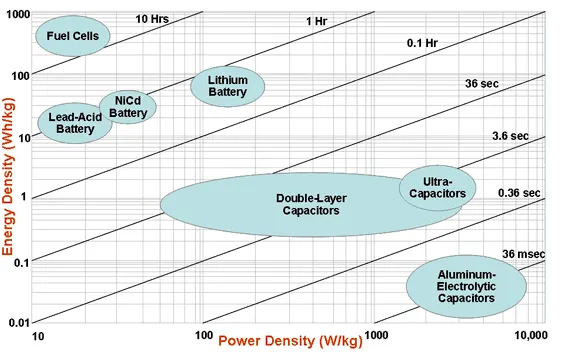
Using a plot with energy density and power density on the X and Y axis, arrange various battery types like lithium ion, lead acid, Nickel Cadmium, Ultracapacitor, fuel cell.
Fuel cell:
Fuel cells work like batteries,but they do not run down or need recharging.They produce lectricity and heat as long as fuel is supplied.A fuel cell consists of two electrodes ,a negative elctrode(or anode)and a positive electrode(or cathode)-sandwiched around an electrolyte.A fuel ,such as hydrogen,is fed to the anode,and air is fed to cathode.In a hydrogen fuel cell,a catalyst at the anode seperates hydrogen molecules into protons and elctrons,which take difference paths to the cathode,where they unite with oxygen and the electrons to produce water and heat
Observation:In this graph we can see that fuel cells has highest energy density which means we can travel long with a fuelcell equipped electric vehicle but it consists of lowest power density which results in slower acceleration and vehicle runs under a speed limit.
UltraCapacitor:
Like a battery ,a single ultracapacitor cell consists of negative electrode,seperated by an elctrolyte.However,ultracapacitors store energy electrostatically,like a regular capacitor,not chemically like a battery-ther is a dielectric seperator dividing the electrolyte also like a capacitor.
observation:It is completely opposite to the fuel cell ultra capacitor have highest power densitybut lowest energy density and cannot be used as standalone fuel source,it is either used with fuel cell or li ion batteries.
Lead Acid:
A lead acid battery consists of a negative electrode made of spongy or porous lead.The lead is porous to facilitate the formation and dissolution of lead.The positive electrode consists of lead oxide.Both the electrodes are immersed in a electrolytic solution of sulphuric acid and water.In case the electrodes come into contact with each other through physical movement of the battery or through changes in thickness of the electrodes,an electrically insulating ,but chemically permeable membrane seperates the two electrodes.This membrane also prevents electrical shorting through the electrolyte.
Observation:In comparision to the ultracapacitor lead acid battery has higher energy density but low power density which means it has capacity to run a vehicle upto a distance bus has less power.
Li-ion battery:
A battery is made up of an anode,cathode,seperator,electrolyte and two current collectors(positive and negative).The anode and cathode store the lithium.The electrolyte carries positively charged lithium ions from the anode to the cathode and vice versa through the seperator.The movement of the lithium ion creates free electrons in the anode which creates a charge at the positive current collector.The elctrical current then flows from the current then flows from the current collector through a device being powered (cell phone,computer,etc.)to the negative current collector.The seperator blocks the flow of elctrons inside the battery.
Observation:The revolutionary invention that changed the energy storage issue and space required to store high capacity of energy with in a limlited space.Li-ion battery has a sweet spot between the graph of energy and power compared to other storage option already available in the market li-ion is most suitable and more economical for every purpose and every voltage rating it is used in combination of series and parallel to carry out the required voltage rating.
Nickel Cadmium:
The chemical reaction that occurs between the layers is what makes the nickel cadmium battery work.The battery which is a DC voltage source,is made up of two ports:anode and cathode.The cadmium coating is kept on the redox first when producing the battery.The cathode terminal is the cadmium layer.Cadmium is a heavy metal of excellent electrical conductivity seperators layer are held above the cadmium layer.The seperator layers job is to provide the required OH ions for the chemical reaction.The reaction between the cathode layer and the seperatorsrequires OH ions.It produces Nickel oxide OH ion as an output as previously stated ,the seperator layer is soaked in water to provide H2O.As a result ,one of the byproducts is H2O .The cadmium layer is also mixed with OH ions derived from the seperator layer on the anode side.Calcium oxide and electrons are generated as a result of this process.Its worth nothing that the elctrons in both equations balance out OH ions are also canceled.The third equation,in which nickel is mixed with cadmium and water,is the reminder equation.Nickel oxide and calcium oxide are the end A surge of electrons follows the chemical reaction ,causing a potential difference between the two terminals.
Observation:Nickel Cadmium are better than lead acid battery but in comparision to the li-ion batteries they are similar or we can say as near as lead acid batteries rather than that this batteries are used for following things,portable power tools,photography equipments,flashlights,emergency lighting,poratble electronic devices.
Conclusion:Since we have discussed the types of fuel cells and their applications,energy and power density graph of different types batteries