Week 2 Challenge
Question 1:
Compare four different types of fuel cells and state their applications.
Proton Exchange Membrane Fuel Cell :-
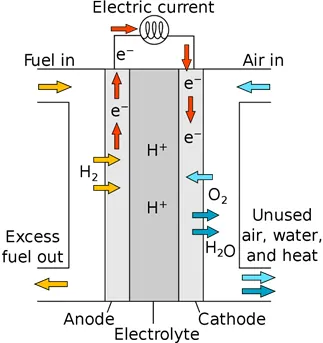
The proton exchange membrane fuel cell is unusual in that its electrolyte consists of a layer of solid polymer which allows protons to be transmitted from one face to the other. It basically requires hydrogen and oxygen as its inputs, though the oxidant may also be ambient air, and these gases must be humidified. It operates at a low temperature because of the limitations imposed by the thermal properties of the membrane itself. The operating temperatures are around 90 °C. The PEMFC can be contaminated by carbon monoxide, reducing the performance by several percent for contaminant in the fuel in ranges of tens of percent. It requires cooling and management of the exhaust water in order to function properly.
Anode reaction: H2 → 2H+ + 2e-
Cathode reaction: ½O2 +2H+ + 2e- → H2O
Overall reaction: H2 + ½O2 → H2O
Solid Oxide Fuel Cells :-
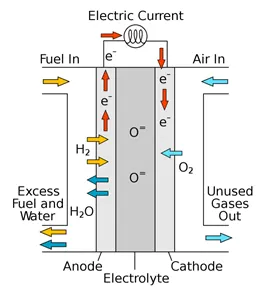
Solid oxide fuel cells are constructed entirely from solid-state materials, using an ion-conducting oxide ceramic as the electrolyte, and are operated in the temperature range of 900-1000 °C. SOFC provide several advantages compared to other fuel cell types: they generate few problems with electrolyte management (to compare with liquid electrolytes, which are often corrosive and difficult to handle), they have the highest efficiencies of all fuel cells (50-60 %) and for combined heat and power applications internal reforming of hydrocarbon fuels is possible.
Current technology employs several ceramic materials for the active fuel cell components. The anode is typically constructed from an electronically conducting nickel/yttria-stabilised zirconia cermet (Ni/YSZ). The cathode is based on a mixed conducting perovskite, lanthanum manganate (LaMnO3). Yttria-stabilised zirconia (YSZ) is used as the oxygen ion conducting electrolyte. To generate a suitable voltage, fuel cells in the same stack are interconnect with a doped lanthanum chromate (eg La0.8Ca0.2CrO3) joining the anodes and cathodes of adjacent units. Although several stack designs are being considered around the world, the most common configuration is the planar (or "flat-plate") SOFC.
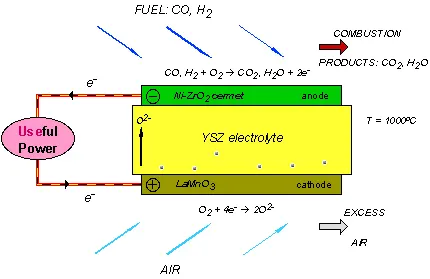
Anode reactions: H2 + O2- → H2O +2e-
CO + O2- → CO2 + 2e-
Cathode reaction: O2 + 4e- → 22-
Overall reaction: H2 + O2 + CO → H2O + CO2
Alkaline Fuel Cell :-
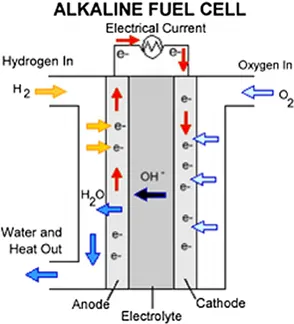
Low temperature aqueous alkaline electrolyte cells have the advantage of being able to start up easily from cold, and operate usually at 60-80 °C, where the water vapour pressure of the electrolyte is appopriately high for a controlled removal rate. At these temperatures, highly active catalysts are required, usually of the platinum family. Silver and high-surface nickel have been used, however, as catalysts in these system; nickel is conventionally used as a conducting structural material.
The intolerance of this type of cell to carbon dioxide is a major problem; it restricts the choice of fuel to pure hydrogen of hydrazine, and requires that the air filter removes 0.04% of the CO2 present in the air. The internal reforming cell is an attempt to get rid of this problem : the fuel electrode is made of palladium plus silver, and the fuel is either alcohol or a hydrocarbon which is reformed with steam on a nickel catalyst on one side of the electrode. The hydrogen formed passes through the electrode and reacts with the electrolyte, but the palladium prevents the CO2 to passes through and get into the electrolyte.
Anode reaction: H2 + 2OH- → 2H2O + 2e-
Cathode reaction: ½O2 + H2O + 2e- → 2OH-
Overall reaction: H2 + ½O2 → H2O
Molten Carbonate Fuel Cell :-
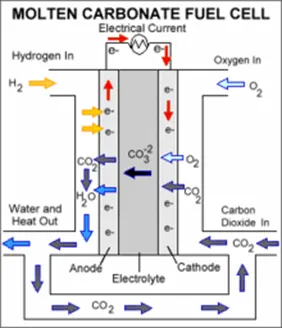
Molten Carbonate Fuel Cells (MCFCs) are another type of high temperature fuel cell. A molten mixture of salts: lithium, sodium, potassium carbonate is used as the electrolyte. These salts melt and conduct carbonate ions (CO32–) from the anode to the cathode when heated to about 600°C. Hydrocarbons have to be used as part of the fuel since the charge carriers in the electrolyte are carbonate ions. Hydrogen is also needed at the anode. It is gained by internal reforming of hydrocarbon based fuels. The electrodes should be resistant to poisoning by carbon. The high exhaust temperature makes cogeneration of electricity with turbines possible; hence the efficiency (60% without and 80% with hybrid technology) is relatively high compared to other fuel cell systems. MCFCs are mainly used for stationary power generation in the 50 kW to 5 MW range. Since it uses a liquid and high temperature electrolyte, it is rather unsuitable for mobile applications. The main problem with MCFC is the slow dissolution of the cathode in the electrolyte. Most of the research is therefore in the area of more durable materials and cathodes.
Anode reaction: H2 + CO32- → CO2 + H2O + 2e-
Cathode reaction: ½O2 + CO2 + 2e- → CO32-
Overall reaction: H2 + ½O2 → H2O
|
Fuel cell type |
Common electrolyte |
Operating temperature |
Typical stack size |
Electrical efficiency (lhv) |
Applications |
Advantages |
Challenges |
|
Proton exchange membrane (PEM) |
Perfluoro- sulfonic acid |
<120°C |
<1 kW–100 kW |
60% direct H2; a |
Backup power Portable power Distributed generation Transportation Specialty vehicles |
Solid electrolyte reduces corrosion and electrolyte management problems Low temperature Quick start-up and load following |
Expensive catalysts Sensitive to fuel impurities |
|
Solid oxide (SOFC) |
Yttria stabilized zirconia |
500°–1,000°C |
1 kW–2 MW |
60% f |
Auxiliary power Electric utility Distributed generation |
High efficiency Fuel flexibility Solid electrolyte Suitable for CHP Hybrid/gas turbine cycle |
High temperature corrosion and breakdown of cell components Long start-up time Limited number of shutdowns |
|
Alkaline (AFC) |
Aqueous potassium hydroxide soaked in a porous matrix, or alkaline polymer membrane |
<100°C |
1–100 kW |
60% c |
Military Space Backup power Transportation |
Wider range of stable materials allows lower cost components Low temperature Quick start-up |
Sensitive to CO2 in fuel and air Electrolyte management (aqueous) Electrolyte conductivity (polymer) |
|
Molten carbonate (MCFC) |
Molten lithium, sodium, and/or potassium carbonates, soaked in a porous matrix |
600°–700°C |
300 kW–3 MW, |
50% e |
Electric utility Distributed generation |
High efficiency Fuel flexibility Suitable for CHP Hybrid/gas turbine cycle |
High temperature corrosion and breakdown of cell components Long start-up time Low power density |
Question 2:
Using a plot with energy density and power density on the X and Y axis, arrange various battery types like lithium ion, lead acid, Nickel Cadmium, Ultracapacitor, fuel cell.
Energy density vs power density:-
Energy density is the amount of energy in a given mass (or volume) and power density is the amount of power in a given mass. The distinction between the two is similar to the difference between Energy and power. Batteries have a higher energy density than capacitors, but a capacitor has a higher power density than a battery. This difference comes from batteries being able to store more energy, but capacitors can give off energy more quickly.
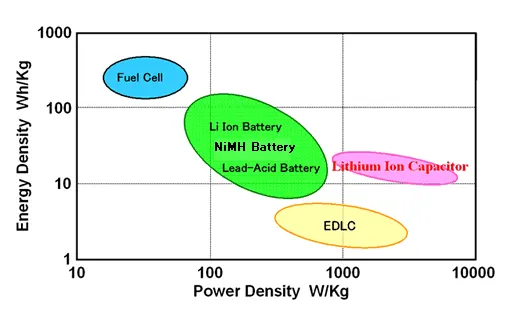
If a system has a high energy density then it is able to store a lot of energy in a small amount of mass. A high energy density does not necessarily mean a high power density. An object with a high energy density, but low power density can perform work for a relatively long period of time. An example of this type of energy storage is a mobile phone. Its power will last most of the day, but to recharge the device, it must be connected to another power source for an hour or more.
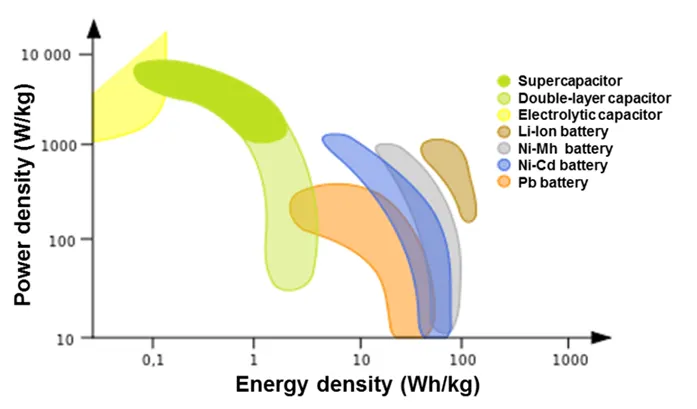
If a system has a high power density, than it can output large amounts of energy based on its mass. For example, a tiny capacitor may have the same power output as a large battery. However, since the capacitor is so much smaller, it has a higher power density. Since they release their energy quickly, high power density systems can also recharge quickly. An example application of this type of energy storage is a camera flash. It has to be small enough to fit inside the camera (or cell phone) but have a high enough power output to light up the subject of your photo. this makes a system with a high power density ideal.
references :-
https://www.sciencedirect.com/topics/chemical-engineering/fuel-cell-types
https://www.doitpoms.ac.uk/tlplib/fuel-cells/mcfc_history.php
https://www.britannica.com/technology/fuel-cell/Types-of-fuel-cells
https://www.energy.gov/eere/fuelcells/comparison-fuel-cell-technologies
https://www.ceb.cam.ac.uk/research/groups/rg-eme/Edu/fuelcells/types-of-fuel-cells