Week 2 Challenge
Week 2 Challenge
1) Comparison of types of fuel cells
Aim:
To compare the types of fuel cells and their applications.
Fuel cell:
A fuel cell is an electrochemical cell that converts the chemical energy of a fuel and an oxidizing agent into electricity through a pair of redox reactions. Fuel cells are different from most batteries in requiring a continuous source of fuel and oxygen to sustain the chemical reaction.
At the anode a catalyst causes the fuel to undergo oxidation reactions that generate positively charged hydrogen ions and electrons. The ions move from the anode to the cathode through the electrolyte. At the same time, electrons flow from the anode to the cathode through an external circuit, producing direct current electricity. At the cathode, another catalyst causes ions, electrons, and oxygen to react, forming water and possibly other products.
Individual fuel cells produce relatively small electrical potentials, about 0.7 volts, so cells are stacked, or placed in series, to create required voltage to meet application requirements.
Types of fuel cell:
- Proton Exchange Membrane Fuel cell
- Solid Oxide Fuel cell
- Direct Methanol Fuel cell
- Alkaline Fuel cell
- Phosphoric acid fuel cell
- Molten carbonate fuel cell
Proton Exchange Membrane Fuel cell:
In Proton exchange membrane fuel cell, the proton conducting polymer membrane called nafion is used. It basically requires hydrogen and oxygen as its inputs, though the oxidant may also be ambient air, and these gases must be humidified. It operates at a low temperature because of the limitations imposed by the thermal properties of the membrane itself. The operating temperatures are around 90 °C. The PEMFC can be contaminated by carbon monoxide, reduce the. It requires cooling and management of the exhaust water in order to function properly. The main focus of current designs is transport applications, as there are advantages to having a solid electrolyte for safety, and the heat produced by the fuel cell is not adequate for any form of cogeneration. Daimler-Benz has taken a high profile in developing cars powered by Ballard fuel cells, while Toyota has recently presented a vehicle that is using a fuel cell of their own design.
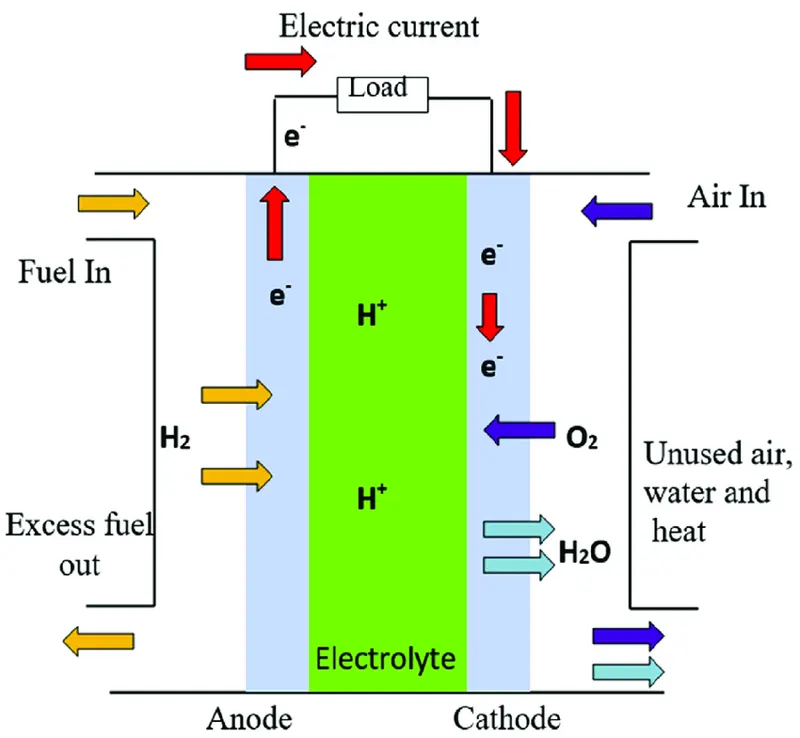
Anode reaction,
H2 -> 2H+ + 2e-
Cathode reaction,
½O2 +2H+ + 2e- → H2O
Overall reaction,
H2 + ½O2 -> H2O
Efficiency: 60%
Advantages:
- Solid electrolyte reduces corrosion and electrolyte management problems
- Low temperature
- Quick start-up and load following
Shortcomings:
- Expensive due to the use of platinum
- Requires water management, the membrane must be evaporated precisely at the same rate that is produced.
- The same temperature must be maintained throughout the cell in order to prevent destruction of the cell through thermal loading.
- Automotive fuel cells require a 5,000-hour lifespan under extreme temperatures while current service life is 2,500 hours.
Applications:
- Backup power
- Portable power
- Distributed generation
- Transportation
- Specialty vehicles
Solid Oxide Fuel cell:
Solid oxide fuel cells are constructed entirely from solid-state materials, using an ion-conducting oxide ceramic as the electrolyte, and are operated in the temperature range of 800-1000 °C. SOFC provide several advantages compared to other fuel cell types that generate few problems with electrolyte management. They have the highest efficiencies of all fuel cells (50-60 %) and for combined heat and power applications internal reforming of hydrocarbon fuels is possible.
Current technology employs several ceramic materials for the active fuel cell components. The anode is typically constructed from an electronically conducting nickel/yttria-stabilised zirconia cermet (Ni/YSZ). The cathode is based on a mixed conducting perovskite, lanthanum manganate (LaMnO3). Yttria-stabilised zirconia (YSZ) is used as the oxygen ion conducting electrolyte. To generate a suitable voltage, fuel cells in the same stack are interconnect with a doped lanthanum chromate (eg La0.8Ca0.2CrO3) joining the anodes and cathodes of adjacent units.
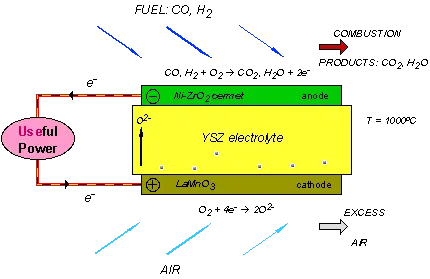
Anode reaction,
H2 + O2- -> H2O +2e-
CO + O2- -> CO2 + 2e-
Cathode reaction,
O2 + 4e- -> 2O2-
Overall reaction,
H2 + O2 + CO ->H2O + CO2
UK SOFC fuel cell manufacturer, has developed a method of reducing the operating temperature of their SOFC system to 500–600 degrees Celsius. They replaced the commonly used YSZ electrolyte with a CGO (cerium gadolinium oxide) electrolyte. The lower operating temperature allows them to use stainless steel instead of ceramic as the cell substrate, which reduces cost and start-up time of the system.
Efficiency: 60%
Advantages:
- High efficiency
- Fuel flexibility
- Solid electrolyte
- Suitable for CHP
- Hybrid/gas turbine cycle
Shortcomings:
- High temperature corrosion and breakdown of cell components
- Long start-up time
- Limited number of shutdowns
Applications:
- Auxiliary power
- Electric utility
- Distributed generation
Direct Methanol Fuel cell:
This type of fuel cell is based on solid polymer technology but uses methanol directly as a fuel. If it works, that would be a big step forward in the automotive area where the storage or generation of hydrogen is one of the big obstacles for the introduction of fuel cells. Prototypes exist, but the development is at an early stage. There are principal problems, including the lower electrochemical activity of the methanol as compared to hydrogen, giving rise to lower cell voltages and, hence, efficiencies. The direct methanol fuel cell is an interesting proposition and a number of places are working on it, including Siemens in Germany. There are also efforts to develop a low-temperature DMFC (500 °C) that would also allow the direct use of methanol, as well as using stainless steel components.
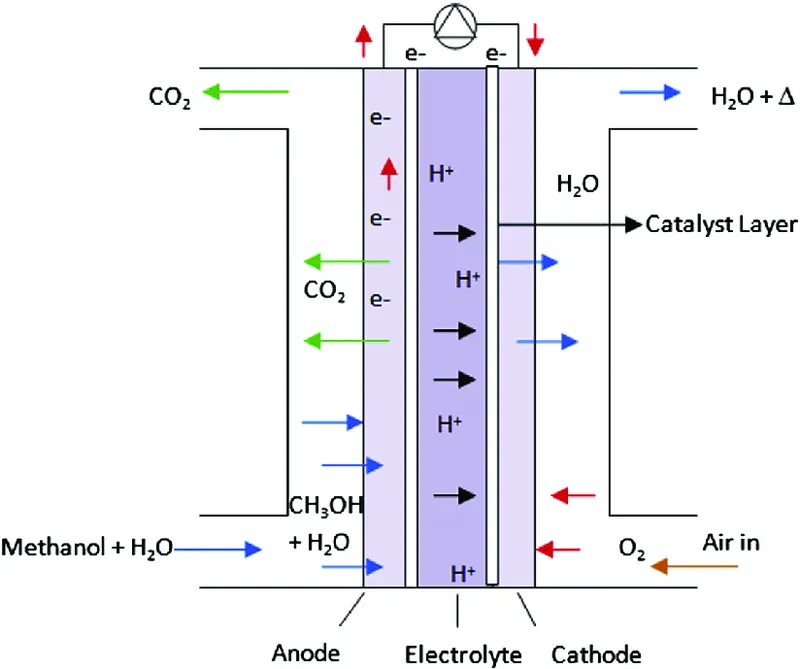
Anode reaction,
CH3OH + H2O -> CO2 + 6H+ + 6e-
Cathode reaction:
3(½O2) + 6H+ + 6e- ->3H2O
Overall reaction:
CH3OH + H2O+ 3(½O2) -> CO2 + 3H2O
Shortcomings:
- Methanol is miscible in water, so some of it is liable to cross the water-saturated membrane and cause corrosion and exhaust gas problems on the cathode side.
Alkaline Fuel cell:
The cell consists of two porous carbon electrodes impregnated with a suitable catalyst such as Pt, Ag, CoO, etc. The space between the two electrodes is filled with a concentrated solution of KOH or NaOH which serves as an electrolyte. H2 gas and O2 gas are bubbled into the electrolyte through the porous carbon electrodes. Thus, the overall reaction involves the combination of hydrogen gas and oxygen gas to form water. The cell runs continuously until the reactant's supply is exhausted. This type of cell operates efficiently in the temperature range 343–413 K and provides a potential of about 0.9 V. Alkaline Anion Exchange Membrane Fuel Cell (AAEMFC) is a type of Alkaline Fuel cell (AFC) which employs a solid polymer electrolyte instead of aqueous potassium hydroxide (KOH) and it is superior to aqueous AFC. The intolerance of this type of cell to carbon dioxide is a major problem; it restricts the choice of fuel to pure hydrogen of hydrazine, and requires that the air filter removes 0.04% of the CO2 present in the air. The hydrogen formed passes through the electrode and reacts with the electrolyte, but the palladium prevents the CO2 to passes through and get into the electrolyte.
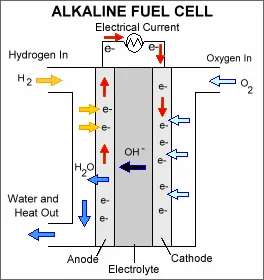
Anode reaction,
H2 + 2OH- -> 2H2O + 2e-
Cathode reaction,
½O2 + H2O + 2e- -> 2OH-
Overall reaction,
H2 + ½O2 -> H2O.
Efficiency: 60%
Advantages:
- Wider range of stable materials allows lower cost components
- Low temperature
- Quick start-up
Shortcomings:
- Sensitive to CO2 in fuel and air
- Electrolyte management (aqueous)
- Electrolyte conductivity (polymer)
Applications:
- Military
- Space
- Backup power
- Transportation
Phosphoric acid Fuel cell:
Acid electrolyte cells are more tolerant to CO2 and allow the use of normal air and non-pure hydrogen. But the corrosion problem restricts the choice of construction materials especially for the electrodes and the catalysts. The electrodes can be made out of gold, tatalum, titanium and carbon and only the platinum group metals can be used as catalysts. The acid used as the electrolyte must be non-volatile, such as sulfuric and phosphoric acids, so that only water is lost by evaporation.
The electrolyte in the PAFC is a paper matrix saturated with phosphoric acid, transporting the hydrogen ions. The operating temperature is around 200 °C. The operating temperature require platinum as catalyst which is supported being dispersed on graphite material. But platinum at this temperature is sensitive to CO-poisoning.
Cells which use hydrocarbons directly as fuel around 150 °C have low efficiency and current density, thus have been restricted to research investigations. Alcohol fuels and impure hydrogen have been used by various companies.
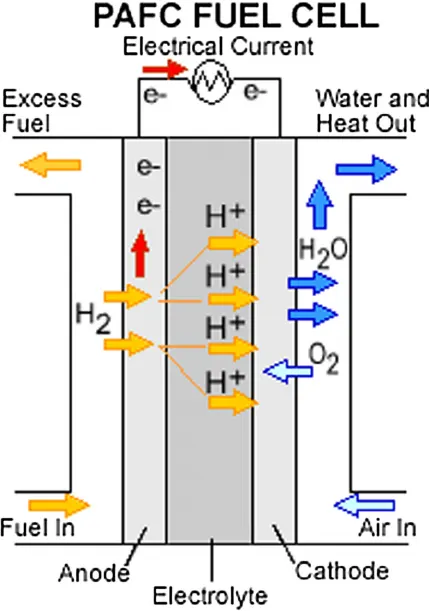
Anode reaction,
H2 -> 2H+ + 2e-
Cathode reaction,
½O2 +2H+ + 2e- → H2O
Overall reaction,
H2 + ½O2 -> H2O
Efficiency: 40%
Advantages:
- Suitable for CHP
- Increased tolerance to fuel impurities
Shortcomings:
- Expensive catalysts
- Long start-up time
- Sulphur sensitivity
Applications:
- Distributed generation
Molten Carbonate Fuel cells:
In the molten carbonate fuel cell, the electrolyte consists of a molten mixture of potassium carbonate and lithium carbonate to transport carbonate-ions from the cathode to the anode. The CO32- transport needs supply of CO2 at the cathode side of the cell which is generally be obtained by recycling the anode off side gas. The operating temperature is about 850 °C which allows nickel to be used as catalyst material. The process occurs in a hydrogen-oxygen fuel cell operating at higher temperatures without an aqueous electrolyte might well be considered as oxide ions produces at the air electrode.
O2 + 4e- → 2O2-
which then move to the fuel electrode to oxidise the hydrogen.
H2 + O2- → H2O + 2e-
and it might therefore be considered that a molten ionic oxide would provide the best electrolyte to encourage this process. However, simple ionic oxides have melting points greater than 1000 °C and therefore attention has been focussed on salts melting at lower temperature. These salts are generally those with oxygen-containing anions. eg., nitrates, sulfates, carbonates. At high temperature it is likely that the direct reaction of hydrocarbons at the fuel electrode is quite favourable. But consideration must be given to the effect of hydrocarbon oxidation at the fuel electrode on the choice of electrolyte.
Hence it is most satisfactory to consider as electrolyte a molten carbonate or mixture of carbonates. A mixture of salts may have a considerable advantage since it will have a lower melting point than either of its components. A convenient way of maintaining the carbonate composition of the electrolyte invariant is to remove carbon dioxide as a gaseous product from the fuel electrode and transfer it to the oxidant electrode in the air or oxygen stream. Thus, for a fuel such as carbon monoxide the overall electrode processes will be:
O2 + 2CO2 + 4e- → CO32- and
CO + CO32- → 2CO2 + 2e-
Thus, carbonate ion transferred within the electrolyte may be balanced by carbon dioxide transfer outside of it.
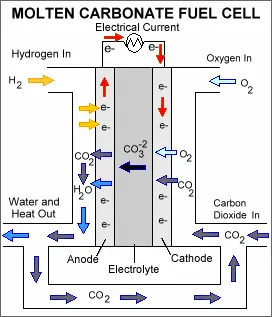
Anode reaction,
H2 + CO32- -> CO2 + H2O + 2e-
Cathode reaction,
½O2 + CO2 + 2e- -> CO32-
Overall reaction,
H2 + ½O2 -> H2O
Efficiency: 50%
Advantages:
- High efficiency
- Fuel flexibility
- Suitable for CHP
- Hybrid/gas turbine cycle
Shortcomings:
- High temperature corrosion and breakdown of cell components
- Long start-up time
- Low power density
Applications:
- Electric Utility
- Distributed generation
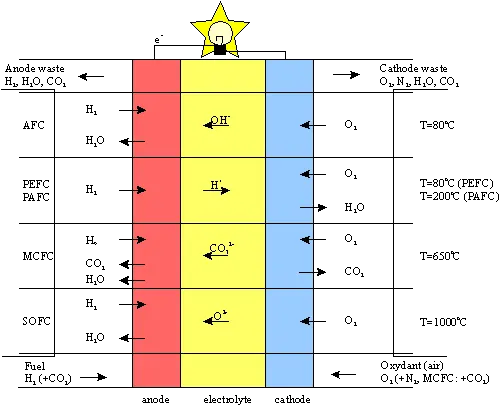
Comparison:
2) Plot for comparison of lithium ion, Nickel cadmium, Lead acid, Supercapacitor and Fuel cell:
Aim:
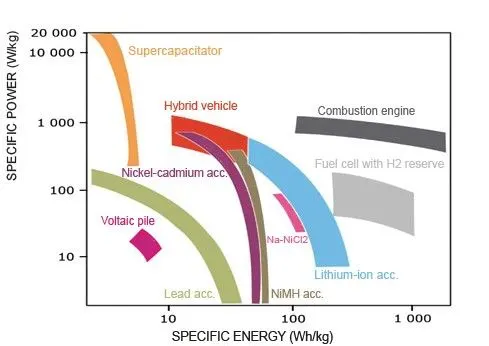
To plot the Energy density in X axis and Power density in Y axis for of lithium ion, Nickel cadmium, Lead acid, Supercapacitor and Fuel cell.
Plot:
Explanations:
- Supercapacitors have very high power density and very low energy density. It can meet the peak load and provide instantaneous high current but for shorter duration only. Hence it is used as a addition energy storage element in hybrid electric vehicle to meet the peak loads.
- Hydrogen Fuel cell has very high energy density but low power density. It can meet the constant load for long duration of time but cannot able to meet the peak load, hence it has to be backed up by battery or supercapacitor.
- Lithium-ion battery has high energy density but less than fuel cell and high power density but less than supercapacitor. Hence lithium-ion batteries are mostly used in Battery electric vehicle.
- Nickel Cadmium batteries has moderate energy and power density which is less than Lithium-ion battery.
- Lead acid Battery (Accumulator) has more energy density than supercapacitor and less than nickel cadmium battery and has more or less equal power density of fuel cell but less than nickel cadmium battery.