Week 2:- BiW Fixture Basics Challenge
1.What is the process of project execution activity?
1)RFQ received - This id the first step in any project. RFQ stands for Request for Quotation. In this customer specifies his requirements,specifications etc. in form of documents or data. Also customer specifies its Technical offer, commercial offer, how the project will be executed & timeline to complete the project in it.
2) 1st spec discussion & offer submission - In this the documents related technical offer, commercial offer, project execution, Timeline required to complete the project are prepared. The time required to 3D design,Analysis of design, drawing & detailing, manufacturing, Assembly & commisioning etc. is considered. Then the cost of all the operation is also considered. By considering these kind of things the offer is prepared & submitted to the customer.
3) LOI/PO Receipt - The customer will study the offer submitted. He will also take quotations from others. The customer will study all the offers, compare offers & then select oner offer which suits best. The customer will generate po means Purchase order to start the work.
4) Schedule preparation - After receiving the PO the project officially start. The timeline is fixed so there should be plan to beat the deadline & to complete the project. All the activities step by step are taken into account like po receipt, 1st meeting, design date analysis, 3D design preparation & simulation etc. the time required to finish the individual activity is calculated. By calculating all the steps the total time required is calculated. It should beat the timeline & if not then modifications is done in schedule to beat the timeline of the project. We should have some back up plan for this Because due to some reasons our tasks not complete on the fixed date or the next task is dependant on previous task.
5)BOM preparation - Bill of material is prepared for the project like the BO parts, grippers, cylinders, motors etc. which are required.
6) Design concept preparation - The customer gives data or the specifications for the design. Based on that data design process is start which fulfills all the customer requirements.
7) Customer approval - After designing the concept the approval of the customer is required. Customer checks the design fulfills the requirements or not according to the technical offer. If yes the customer gives approval for the design or customer will also ask for some addition or the changes in the design. By doing the necessary changes final approval is taken from the customer.
8) Detailing & DWG release - After the approval from customer DWG are released whic shows the detailed specifications of all the parts required. Like dimensions, Qty, Specifications etc.
9) Manufacturing BOP ordering - The BO parts like motors, cylinders, sensors, gripper etc. required for manufacturing are ordered as per the design specifications.
10) Mechanical/ Electrical assembly- Once the parts are received they goes for the prior Quality control checking. In this all the parts are checked as per the specification. After QC checking the Mechanical or electrical assemblis are prepared as per the design.
11)Quality inspection - After the assembly again the quality is checked. In this all the dimensions, positional accuracy, Coordinates are checked by using CMM machine.
12) Internal trial & testing & online trial - After the QC check internal trials are taken to check the fixture can do the operation or not for what it is designed. The simulation is done for this purpose at early stage. In this the fixture is checked for the clamping of the part, welding ,proper loading & unloading of the part etc.
After this online trial is taken in which all the operations done in automated mode by using electrical connections. The process sequence is checked as per the defined way in design in automated mode. Customer is also involved in online trial for taking the approval.
13) Packaging & dispatch - The assemblies are packed in proper manner. Because in trasportaion the fixture will be damaged hence it distorts the geometry of the fixture & also the functionality of the fixture. Hence the proper packaging is very important. Once the packaging is done the fixture is dispatched to the customer address.
14) Installation as per layout - layout is the space defined for the parts like fixture, robots etc, according to the functionality,application, process sequence etc. The layout is done at very initial level & according to that installation is done.
15) Trials & training at customer - Production trials are taken at customers end. In tecnical offer we have specified the quality benchmarks for the fixture, the capability of the fixture for production etc. The trials are taken to check the capability of the fixture. Once it is done then training is given to the operator, staff & engineer for the process sequence, how the fixture works, loading & unloading of the part etc.
16)Buy off meeting & Final handover - After production trial & training Customer check all the prescribed things in the offer are done or not. Sometime customer want some addition work also, so according to the rquirement all the points are closed & after that project finally handovered to the customer.
2.What are the types of joining processes?
Welding
- Welding is a fabrication process whereby two or more parts are fused together by means of heat, pressure or both forming a join as the parts cool.
- Welding is usually used on metals and thermoplastics but can also be used on wood.
- The completed welded joint may be referred to as a weldment.
Adhesive Bonding
- Adhesive Bonding is the process of joining two surfaces together, usually with the creation of a smooth bond.
- This may involve the use of glue, epoxy, or one of a wide range of plastic agents which bond either through the evaporation of a solvent or through curing via heat, time, or pressure.
- Bonding adhesives are much stronger adhesives, used for bonding to most materials in addition to timber and is used around the edges of the EPDM, on any up-stands, bonding to brickwork or stone where an effective and quick hold is required to keep the EPDM in place.
Hemming
- Hemming is a forming operation in which the edges of the sheet are folded or folded over another part in order to achieve a tight fit. Normally hemming operations are used to connect parts together, to improve the appearance of a part and to reinforce part edges.
- This is a sheet metal forming process in which sheets are joined by bending it to 180°.
- Automotive body panels and automotive parts such as deck-lids, trunk-lids, doors, hoods and tailgates are formed by hemming process.
- In this process, usually a sheet is bent with the help of inner sheet in three different stages.
- Firstly the edge of sheet is bent to 90° degree known as flanging process, followed by bending it further to 135° which is known as pre-hemming process and finally the sheet is bent to further to 180° to form a hem and the process is known as hemming process. Bending of sheet is achieved by using a conventional punch in classical (conventional) hemming process whereas a roller is employed in bending of sheet during roller hemming process for formation of hems.
Mechanical joining
- Mechanical Joining is a process for joining parts through mechanical methods, which often involve threaded holes. Joining parts using screws or nuts and bolts are common examples of mechanical joining.
- The threaded holes employed for mechanical joining are vulnerable to fractures.
- In ductile materials, the fracture can come from fatigue, while in brittle materials, the fracture can simply result from mechanical overloading.
- Thus, mechanical joints must be designed with fatigue failure and brittle fracture in mind.
- Another issue to be considered when designing mechanical joints is galvanic corrosion, which is a type of corrision that affects different types of metals that are in contact with each other.
3.What is Resistance Welding & its application in the automotive sector?
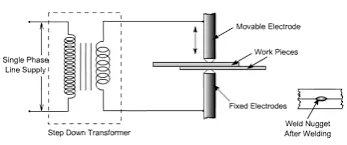
- Resistance welding is the joining of metals by applying pressure and passing current for a length of time through the metal area which is to be joined. The key advantage of resistance welding is that no other materials are needed to create the bond, which makes this process extremely cost effective.
Spot Welding
- Resistance Spot Welding, like all Resistance Welding Processes, creates welds using heat generated by resistance to the flow of welding current between the faying surfaces, as well as force to push the workpieces together, applied over a defined period of time.
- Resistance Spot Welding uses the face geometries of the welding electrodes themselves to focus the welding current at the desired weld location, as well as to apply force to the workpieces.
- Once sufficient resistance is generated, the materials set down and combine, and a weld nugget is formed.
Applications
- Sheet metal welding.
- Home improvement, automobile, and automotive industry.
- Fabrication work of pressure vessels and steel structures.
- Heavy constructions such as building materials and bridges.
- Welding of pipelines.
- Repair of automotive.
4.What is fusion welding & types of fusion welding with its application in the automotive sector?
- There are several different types of fusion welding processes available today. These include Shielded Metal Arc Welding(SMAW), gas tungsten arc welding (GTAW), gas metal arc welding (GMAW), flux-cored arc welding (FCAW), submerged arc welding (SAW), and plasma cutting/arc cutting.
- Each type has its own unique characteristics and advantages over the others, depending on the application it is being used for.
- For example, SMAW and FCAW are ideal for outdoor use due to their low-temperature requirements, while GTAW is best suited for precision work due to its high accuracy rate.
Applications
- Heat and pressure from an arc, laser, or electron beam cause the pieces to melt and mix together.
- Commonly used in industries such as aerospace or automotive manufacturing, fusion welding can also be useful for general repairs around the home or office.
5.What is the 3-2-1 principle?
Locating a part to be machined involves mainly three steps: Supporting, Positioning, and Clamping.
Two main intentions when placing a job on a jig/fixture are:
- Precisely positioning the part at the desired coordinates.
- Curbing all six degrees of movement so that the part cannot budge.
An extensively used method for obtaining these objectives is the 3-2-1 principle or six degrees of freedom for part location.
- The 3-2-1 method is a work-holding principle where three pins are located on the 1st principle plane, i.e., either XY, YZ, ZX.
- And two pins are located on the 2nd plane perpendicular to the 1st plane, and at last, one pin on the plane is mutually perpendicular to the 1st and 2nd planes.
- The aim is to constrain the movement of the workpiece along all three axes.
In order to completely specify the position in space of a three-dimensional
object (such as the cube that’s shown), we refer to six coordinates:
- Translational position along the X-axis
- Translational position along the Y-axis
- Translational position along the Z-axis
- Rotational position about the X-axis
- Rotational position about the Y-axis
- Rotational position about the Z-axis
- These six coordinates are known as the six degrees of freedom of a three-dimensional object. As the double-headed arrows indicate, the translational and rotational positions can vary in either direction with respect to each of the three axes.
- To completely prevent movement, all six degrees of freedom must be restricted.
6.Define Body coordinate system?
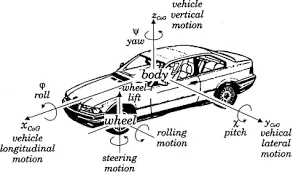
- The orientation of the body coordinate axes is fixed in the shape of body. The x-axis points through the nose of the craft. The y-axis points to the right of the x-axis (facing in the pilot's direction of view), perpendicular to the x-axis.
7.Elaborate Body plane system & its essentials?
- Body planes are three mutually perpendicular imaginary planes. These are reference planes in automotive car. These are used to define GD & T of all parts in automotive domain.
Bodylines dimensions are essential for below reason
- It defines exact position of each product in the vehicle w.r.t a fixed origin.
- It ensures flawless design for assembly.
- While designing lines, all the designs are carried out relative to the bodylines viz.fixtures, Turntables etc.
- It assist in easy location of different parts in the vehicle.
- It aims in creating a standardized system.
- It assist in quality checks.