Week 2:- BiW Fixture Basics Challenge
- Process of Project Execution Activity:
The goal of project execution is to put the already-designed strategy into action. It entails carrying out all of the actions that were planned during the previous project cycle processes. To meet the requirements of the project, the activities are carried out in accordance with the established plans, sequence, and processes. project. The goal of project implementation or execution is to achieve the desired outcomes.
The objectives of the project execution process are
- Make sure that activities being carried out follows the management plan
- Assemble the team involved, advance and maintain it during the life cycle of the project
- Create deliverable using the project plan, assess processes and plans involved to deliver the overall output.
- Ensure that the project team is managed effectively so that their performance is maximized and all issues are promptly addressed.
- Ensure that there is no gap in the communication channels to enable information to be received and responded on time.
- Guarantee that excellence project execution is undertaken to ensure that quality is obtained
Conclusion
The players in the project execution process should carefully and effectively implement all actions in order to realise the project plan and provide expected outcomes. As a result, project managers and other stakeholders who are directly involved in project implementation want this information.
- What are the types of joining processes?
- Resistance spot welding
- Resistance Projection welding
- Resistance seam welding
- Arc welding (Manual metal arc welding, Metal inert gas (MIG) welding, Tungsten inert gas(TIG welding), Submerged arc welding, Plasm arc welding)
- Mechanical Fastening
- Self-piercing riveting
- Hemming process
- Adhesive Bonding
- What is resistance welding & its application in the automotive sector?
Resistance Welding commonly divided in three types
1 Resistance spot welding
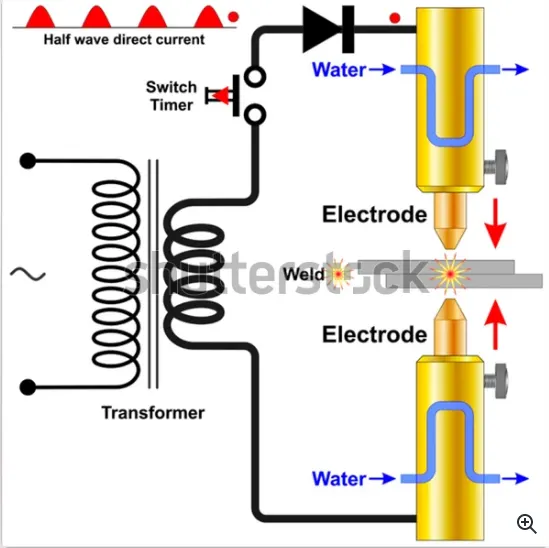
It's used to combine sheet metal with a shaped copper-chromium or zirconium alloy electrode that applies pressure and conducts electricity through the work-pieces. The interface between two sheets generates the most heat, and the interface material melts. The sheets will be bonded together by applying force. It takes a short amount of time to complete leads in a very quick procedure with high strength.
2 Resistance Projection welding
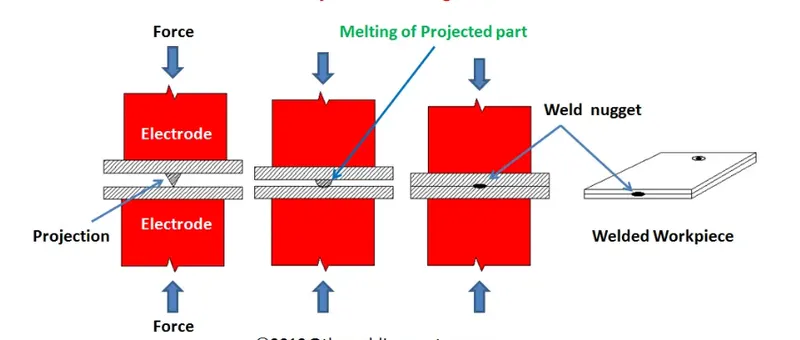
It's used to combine sheet metal components with embossments by directly applying opposing forces with an electrode that's tailored to the workpiece's shape. In the projection part of the workpiece, there will be a lot of distortion.
3 Resistance seam welding
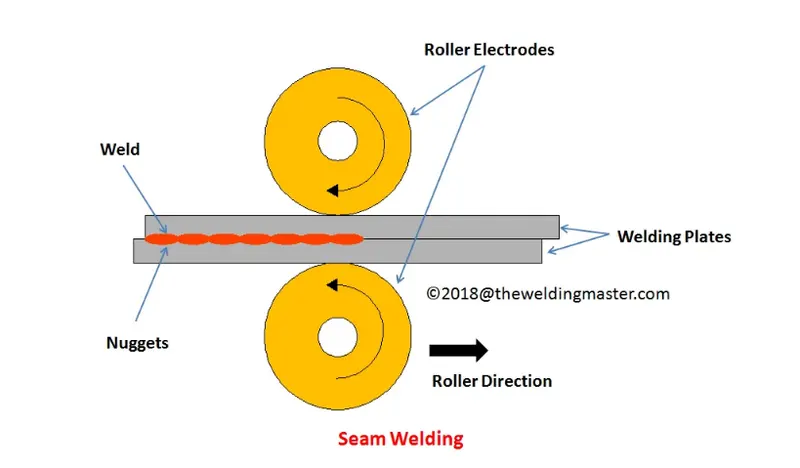
It is a continuous sheet metal joining procedure for a large area. The opposing force is applied through the electrodes, which are made up of rotating wheels, in this welding. It is primarily utilised in the manufacture of containers, radiators, and heat exchangers, among other things.
- What is fusion welding & types of fusion welding with its application in the automotive sector?
Fusion welding is a procedure that involves heating two or more materials to their melting point in order to join or fuse them together. A filler material may or may not be required for the process. Except for resistance welding, where substantial contact pressure is necessary during welding for sound joining, fusion welding procedures do not require external application of pressure. A heat-affected zone is formed in the material as a result of the high-temperature phase transitions inherent in these processes. Do you know what fusion welding is? It's used to unite two or more things using heat, just as other welding procedures.Fusion welding, on the other hand, is distinct in that it has the potential to "fuse" the two things together. If the objects are constructed of the same or similar materials, the heat from a welding equipment will melt their surfaces, allowing them to fuse together. As a result, there are five distinct forms of fusion welding, including the ones listed below.
Types
Arc welding
One of the numerous types of fusion welding is arc welding. Using an intermediate filler metal, arc welding connects two pieces of metal together. This operates by creating an electrical arc by completing an electrical circuit. The core of this electrical arc is 6500 °F (3593 °C). At the tip of the filler metal, an electrical arc is formed. As the arc melts the metal, it is carried along the space between the metals by a human or a machine, forming a connection.
Arc welding is the most common method of fusion welding. By using an electric arc to unite two or more things, arc welding lives up to its name. This fusion welding technology can melt even the toughest metals thanks to electric arcs that reach temperatures of up to 6,000 degrees Fahrenheit. Arc welding may also be done underwater, making it an excellent choice for offshore welding operations.
Resistance welding
Two electrodes are used in resistance welding. Each one makes touch with one of the welded pieces. An electric current is then passed through the two pieces of metal squeezed together between the electrodes. At the place where the metal pieces come into contact, they begin to heat up. The current is carried through the metal until it becomes hot enough to melt and unite the two parts.
Conduction welding
Conduction welding, also known as laser beam welding or radiation welding, is a type of fusion welding that is extremely exact. Light Amplification by Stimulated Emission of Radiation, or "LASER," is an acronym for "Light Amplification by Stimulated Emission of Radiation." Pumps are light bursts produced by the laser. These bursts are focused at the seam between the metals that will be connected. The laser is steered along the seam as it bursts. The metal is melted by these strong explosions. When the two metals are melted together, they become one. When the seam has cooled, it forms a strong bond. Lasers are efficient because they may be set up to perform numerous welds at the same time. The laser beam can be split and sent to various sites, lowering the cost and energy consumption significantly. Laser beam welding finds applications in the automotive industry.
Another type of fusion welding is laser welding. Also known as laser welding, it involves the use of light radiation to produce heat. The laser welding rig essentially blasts the surfaces with radiated light. With each blast, the surfaces become a little hotter. As the objects melt, they fuse together.
Induction welding
Resistance welding is a type of induction welding. The metal being welded, on the other hand, has no points of contact with the electrical supply or the welder. A coil is wrapped around a cylinder in induction welding. This coil generates a magnetic field across the metal's surface. The magnetic field on the outside of the cylinder flows in the opposite direction as the magnetic field on the inside. These magnetic currents obstruct each other. [6] The metal is heated, causing the edges to melt together.
Induction welding is a fusion welding technology that is similar to arc and laser welding. Because there is no direct contact between the surface of an object and the heat source, induction welding stands out from all other methods of fusion welding. A coiled coil is used to create a magnetic field that warms metal in induction welding. The metal is swiftly heated by the magnetic field, causing it to melt and fuse together.
Oxyfuel Welding
A type of chemical-based fusion welding, oxyfuel welding involves the use of a flame to heat and join surfaces, with oxygen as the fuel source. Fire, of course, needs oxygen, which is the basis on which oxyfuel welding works. The oxygen fuels the fire to create a hot flame in excess of 4,500 degrees Fahrenheit. Oxyfuel welding typically uses a combination of oxygen and a flammable gas to create a hot flame to join objects.
Applications
Fusion welding has been a key factor of in the creation of modern civilization due to its key role in construction practices. Besides bolts and rivets, there are no other practical method for joining pieces of metal securely. The Fusion welding is used in the manufacture of many everyday items including airplanes, cars, and structures. A large community uses both arc and flame contact welding to create artwork.
- What is the 3-2-1 principle?
Any three-dimensional body or part has three axes: x-axis, y-axis, and z-axis. Any of these axes can be used to move it, or any of its movement can be released to these three axes. The body can also spin around these axes at the same time. So the overall degree of freedom with which the body can move is six. It is necessary to constrain all degrees of freedom (DOF) when processing the body by arranging appropriate locating points and then clamping it in a fixed and required position. The essential technique for locating the points can be found below.
Locating a part to be machined involves mainly three steps: Supporting, Positioning, and Clamping.
Two main purposes of placing a part on a jig/fixture are:
- Accurately positioning the part at the required coordinates.
- Restricting all six degrees of movement so that the part cannot move.
An extensively used method for obtaining these objectives is the 3-2-1 principle or six degrees of freedom for part location.
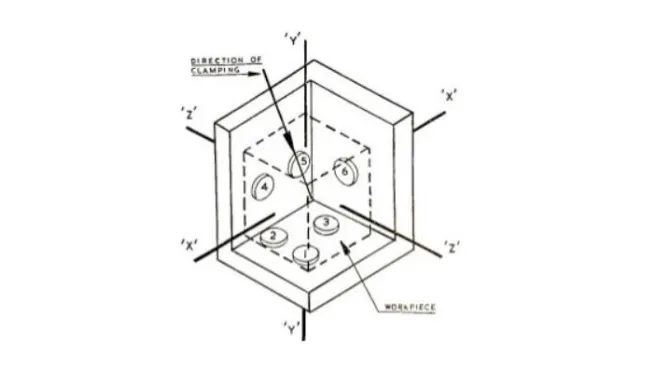
The 3-2-1 method is a work-holding principle where three pins are located on the 1st principle plane, i.e., either XY, YZ, ZX. And two pins are located on the 2nd plane perpendicular to the 1st plane, and at last, one pin on the plane is mutually perpendicular to the 1st and 2nd planes. The aim is to constrain the movement of the workpiece along all three axes.
- Define body coordinate system?
Body co-ordinate system (BCS) is reference system consisting of a group of points, lines and surface and same is used for the defining the position of point in space in either two or three
dimension. It is widely used in the automobile industries for drawing of parts, product and process design. It is also known as car line and body line in the automobile industries. The origin of the BCS OX is defined at the front center of a vehicle, it indicates length of the car. The co-ordinate system OZ is below its underbody indicates height of car and the coordinate system OY indicts width of the car.
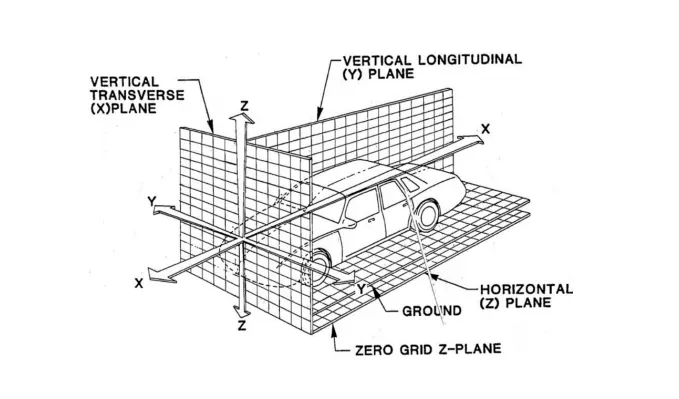
- Elaborate body plane system & its essentials.
Body planes are the reference planes in an automotive car presented in the above Figure and used to define the GD&T of all car parts/components. These plane are mutually perpendicular to each
other as seen the above figure with the grids. The measurements done from the body planes to parts known as bodyline dimensions.
Why it is required
- It define the exact position of each product in the vehicle w.r.t. a fixed origin.
- It ensures faultless design for assembly.
- All the design are carried out relative to the bodyline.
- It aims are to create a standardized system.
- Due to these all its helps in proper quality check.