Week 2 Bevel Gear Challenge
Objective: We will perform the Grid Dependency Test on Bevel Grear using element sizes 4mm, 5mm, and 6mm, and Analyze the Total Deformation, Stress, and Strain produced for different element sizes.
Grid Dependency Test: In Finite Element Analysis, we divide the geometry into small parts with the help of meshing.
The algorithm of simulation software is such that it will calculate the required quantities ( Results) at every corner point of the elements called Nodes.
But, how can we decide which element size is giving the accurate results ( here accurate means minimum error or the results close to the actual analytical results.)
One thing that is clear from our previous experience is that the results are more accurate when the mesh is finer. But finer mesh needs more computational time and need more resources. Hence, we have to choose the optimum size for meshing so that the results are near accurate and it will consume optimal or minimum resources.
Hence, we perform the Grid Dependancy test which gives us an idea about which is the best suitable mesh size for the analysis.
1) Geometry:
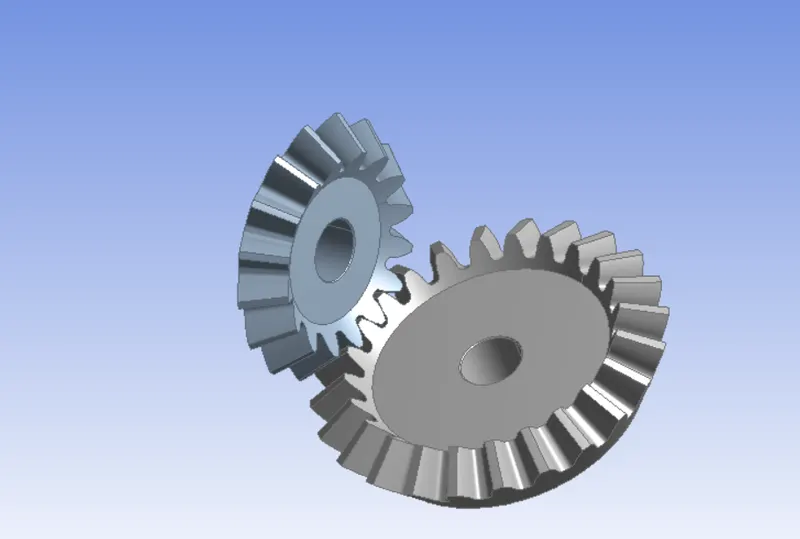
The geometry shown in the above figure is provided by us, but we are interested to analyse the tooth of both pinion and gear. Hence, we can remove the areas which are not in the analysis.
If we keep this geometry as is then it will take more time to complete the simulation. So it is advisable to consider only that area for analysis which is of our interest.
Considered geometry is shown in fig. below.
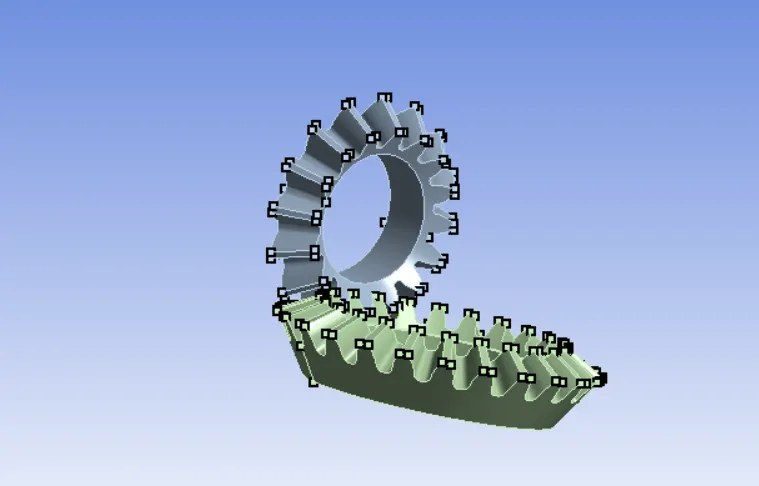
Whenever we import the geometry always check its properties and material. and make sure all required properties are assigned to the components.
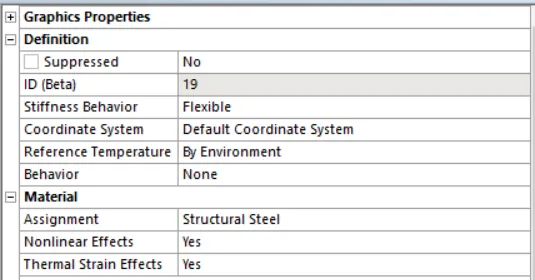
2) Contacts: When we import the geometry the contact is automatically assigned to it but these may not be proper so it is advisable to define the contacts on your own by considering physical situations.
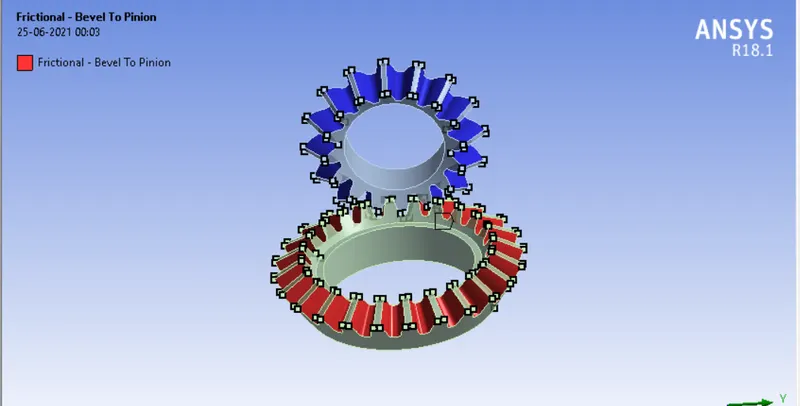
Whenever we are giving contacts other than Bonded and Non-Separation we are performing non-linear analysis. so we have to be careful while giving appropriate inputs to the contacts like Formulation, Behaviour, and Interface Treatment.
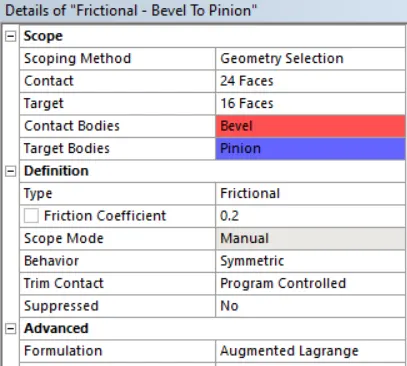
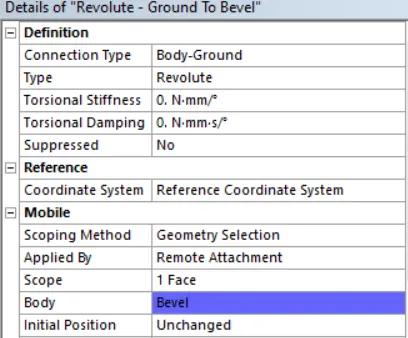
3) Joints: This depends on the physical situation or client requirement to define joints. We did not define joints in every analysis.
In the case of Bevel gear simulation, we need to define revolute joints as gears are going to rotate.
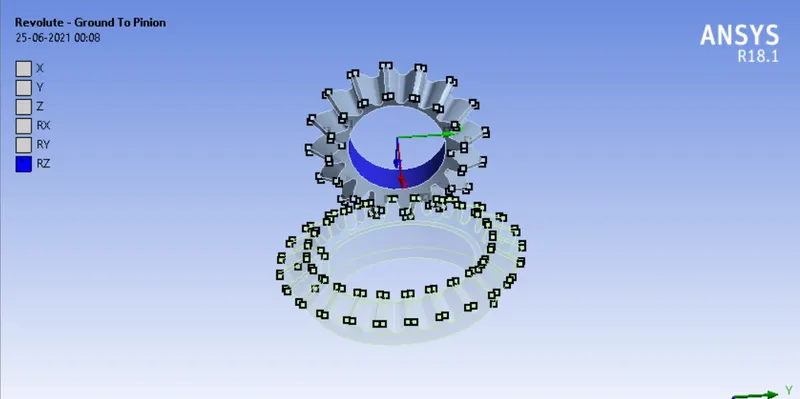
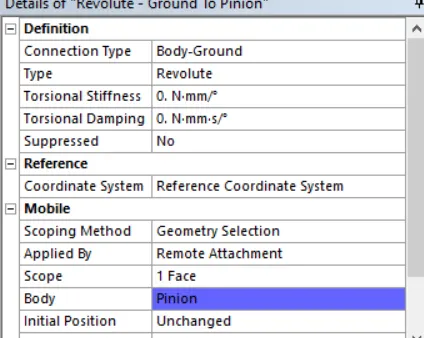
Fig. Revolute Joint for Pinion
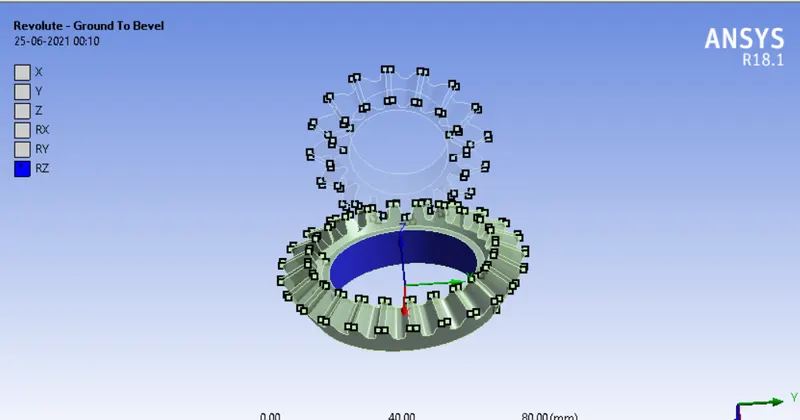
4) Meshing: We are going to mesh the components with an element size of 6mm, 5mm, and 4mm.
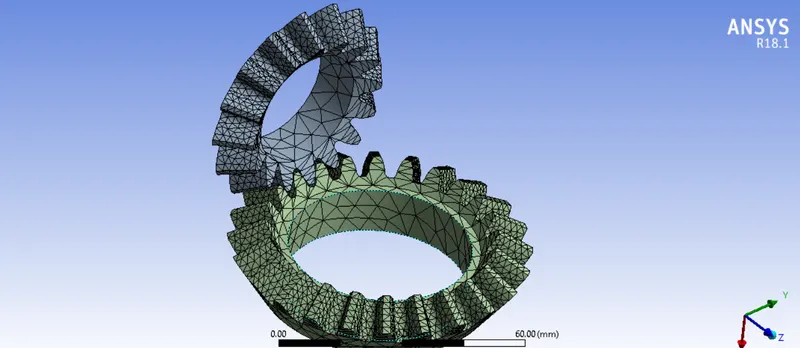
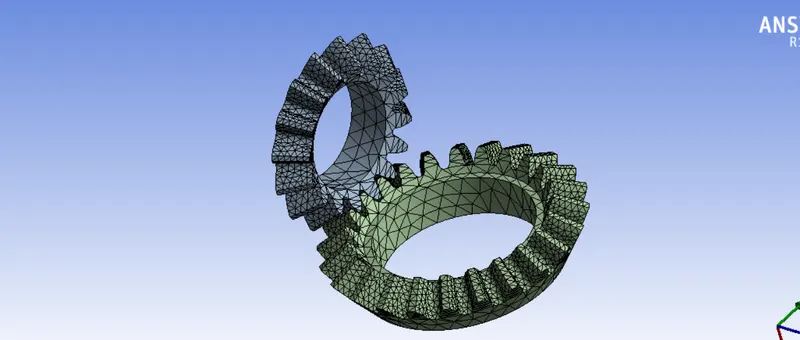
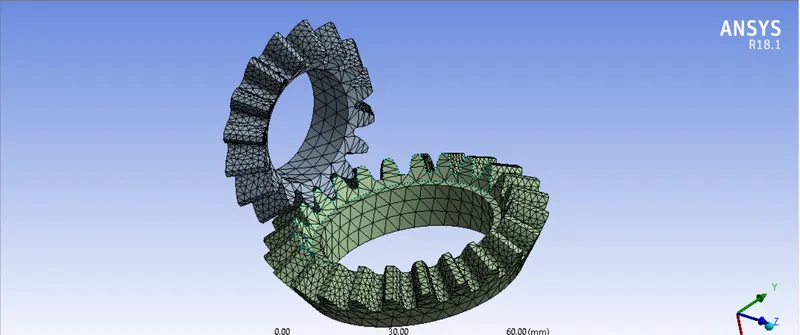
We have performed the face sizing of 1.75 mm on tooths of both gears to capture the tooth geometry accurately.
Node and Element Count for the mesh is shown in fig. below
| Element Size | Nodes | Elements |
| 6mm | 25154 | 13866 |
| 5mm | 25723 | 14190 |
| 4mm | 27710 | 15419 |
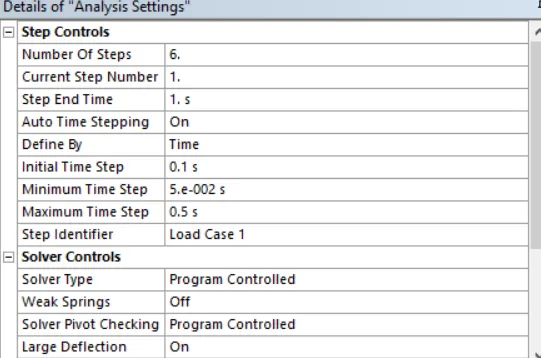
5) Analysis Settings: We are going to perform this analysis in 6 steps in which we rotate the pinon to 120 degrees in 6 steps and apply the moment of 100 N-mm to the bevel.
6) Defining The Loads: We are applying the Joint loads. 1) Rotate the pinon to 120 degrees in 6 steps, 2) the moment of 100 N-mm to the bevel.
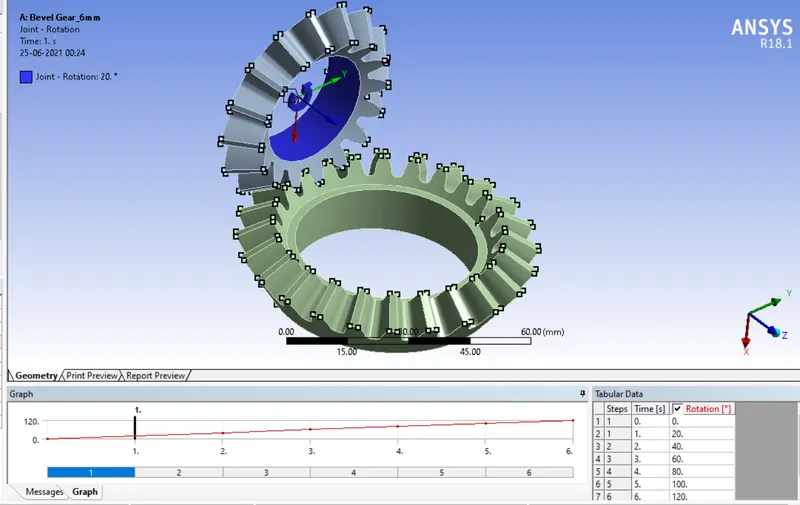
Fig.Joint Load on Pinion.
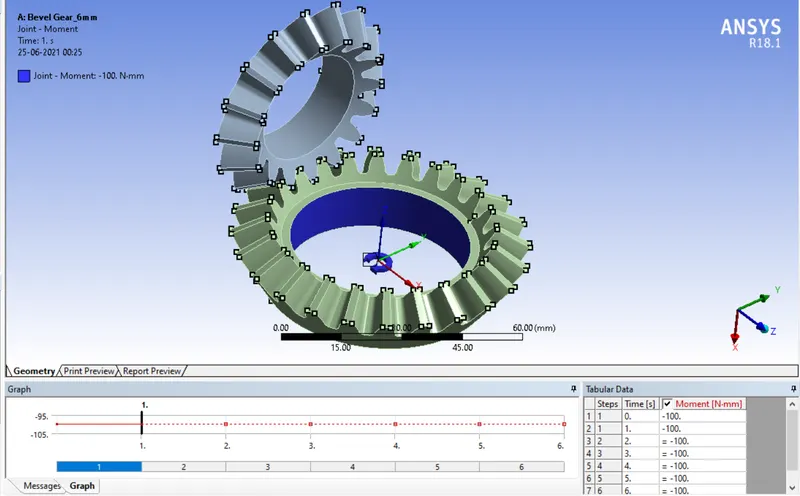
Fig.Joint Load on Gear.
6) Results:
a) 6mm Mesh Size:
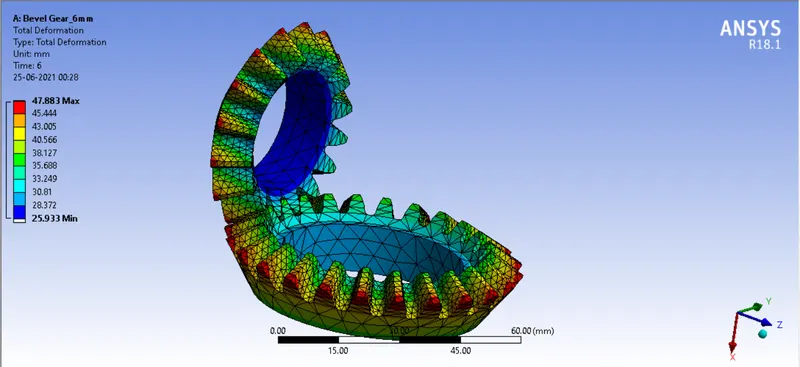
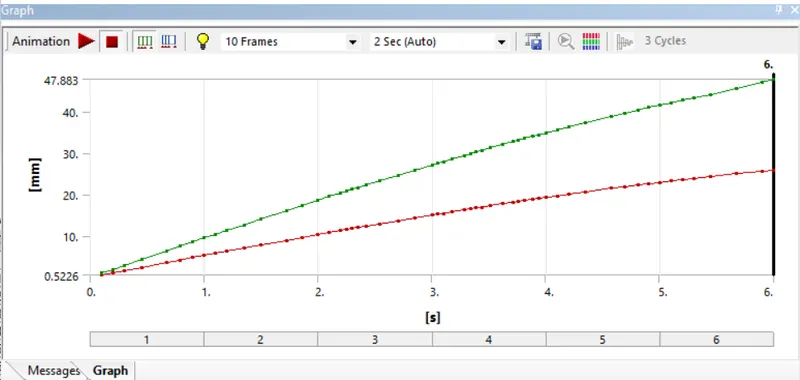
1) Total Deformation:
2) Equivalent Stress:
3) Equivalent Strain:
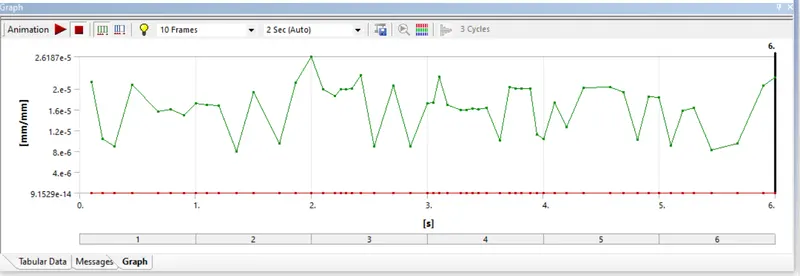
b) 5mm Mesh Size:
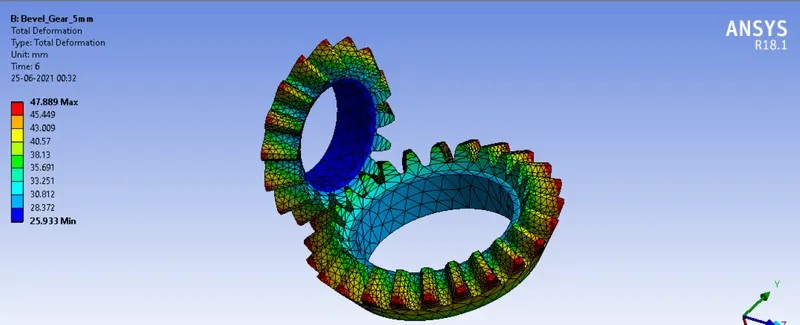
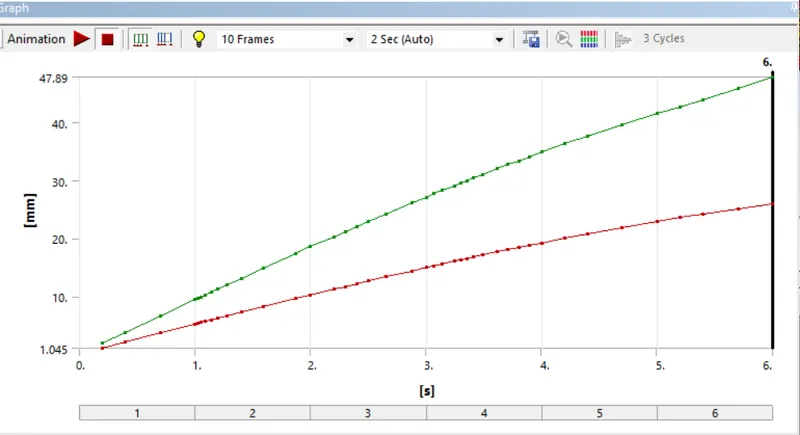
1) Total Deformation:
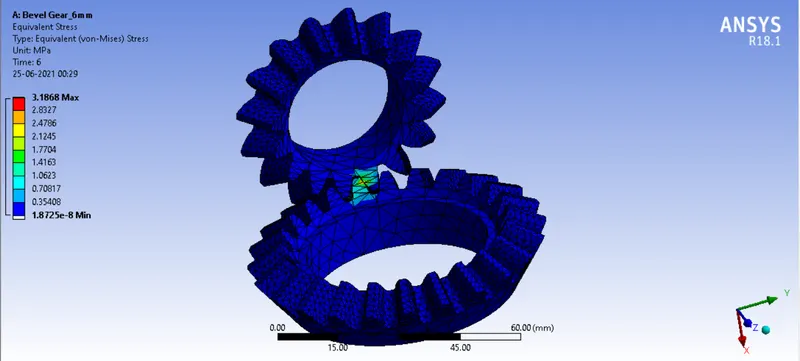
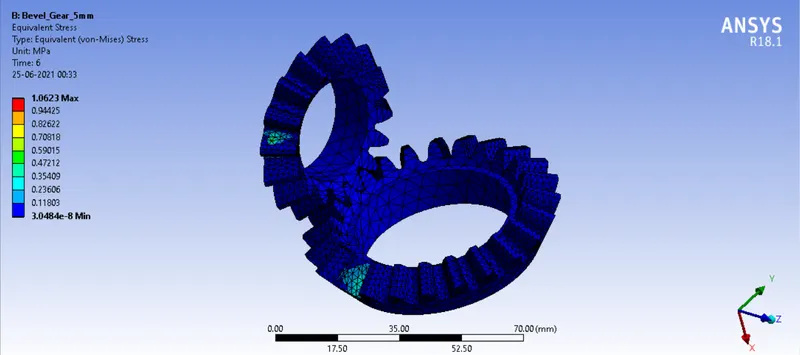
2) Equivalent Stress:
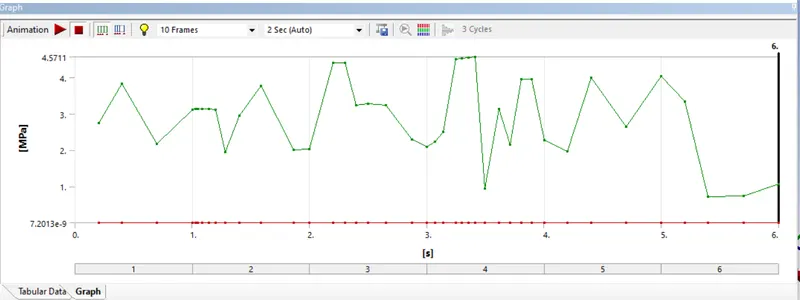
3) Equivalent Strain:
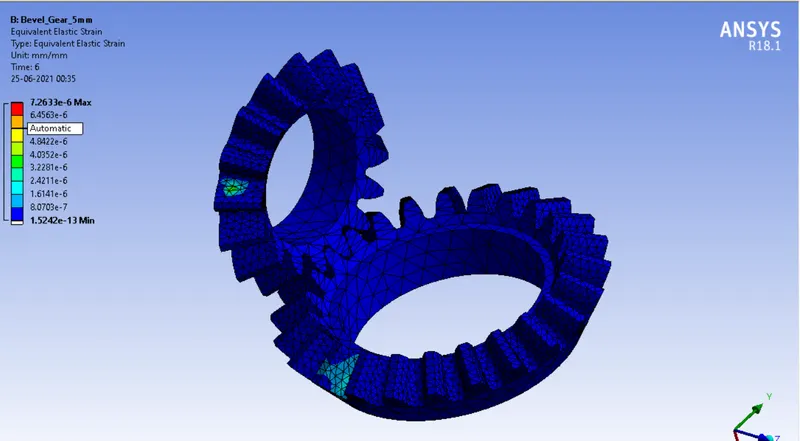
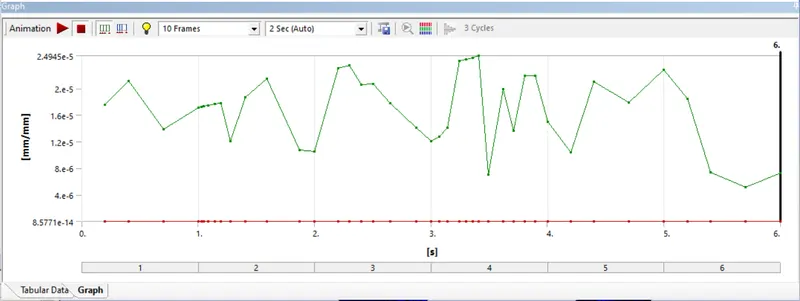
c) 4mm Mesh Size:
1) Total Deformation:
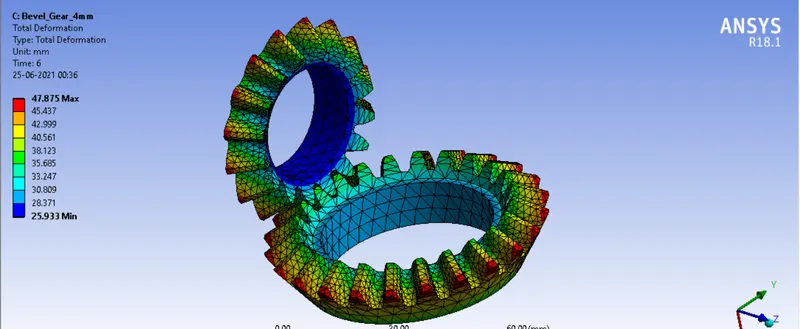
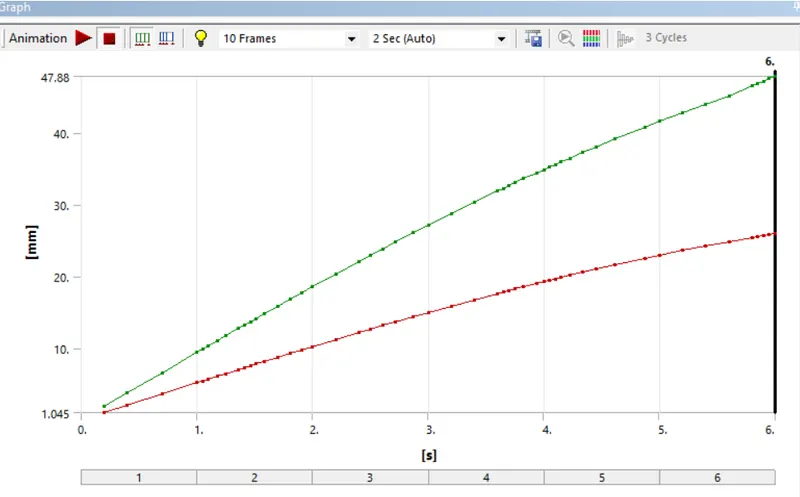
2) Equivalent Stress:
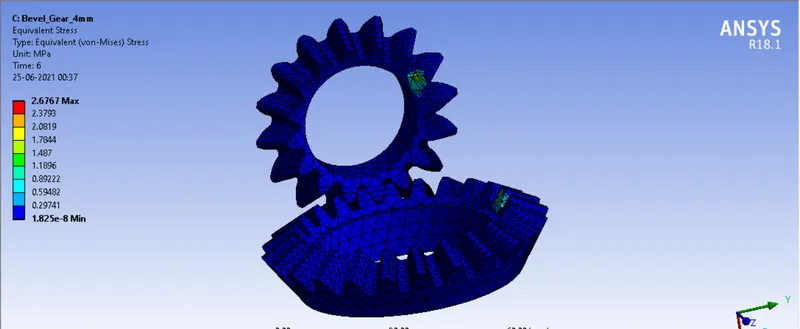
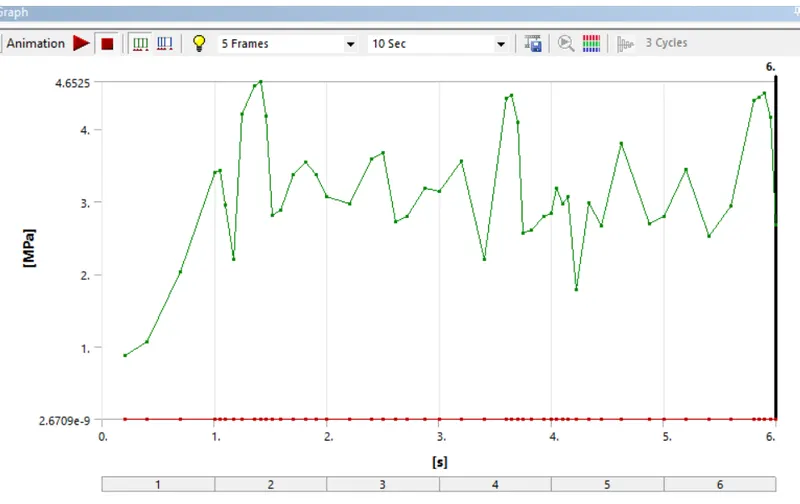
3) Equivalent Strain:
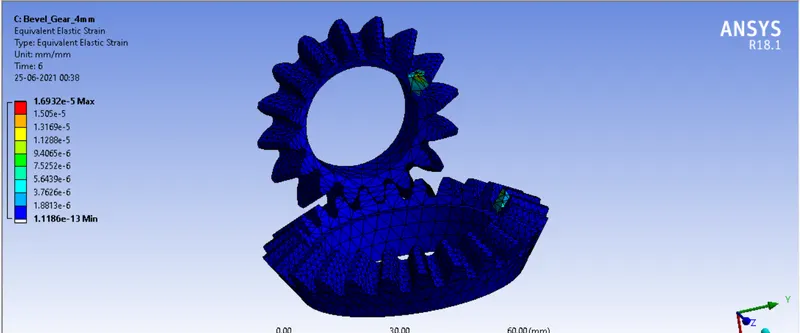
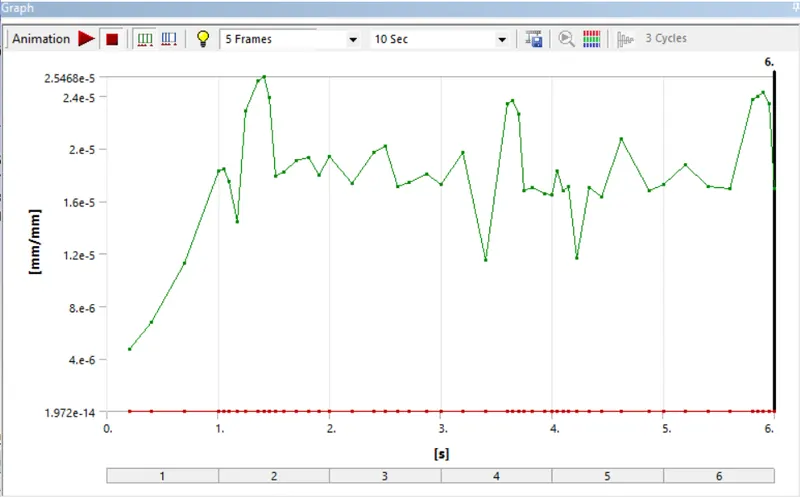
The Total Deformation, Stress, and Strain are listed in the table below
| Element Size | Total Deformation ( mm) | Max. Equivalent Stress ( Mpa) | Max. Equivalent Strain |
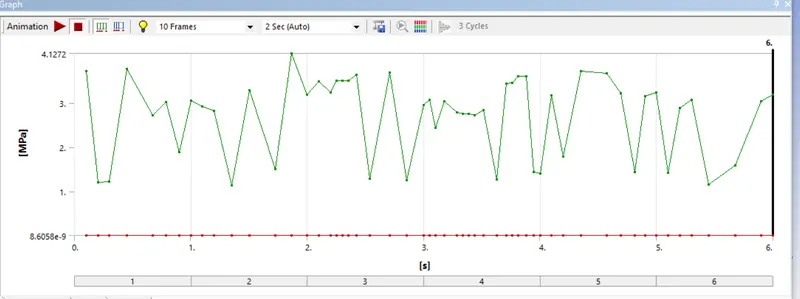
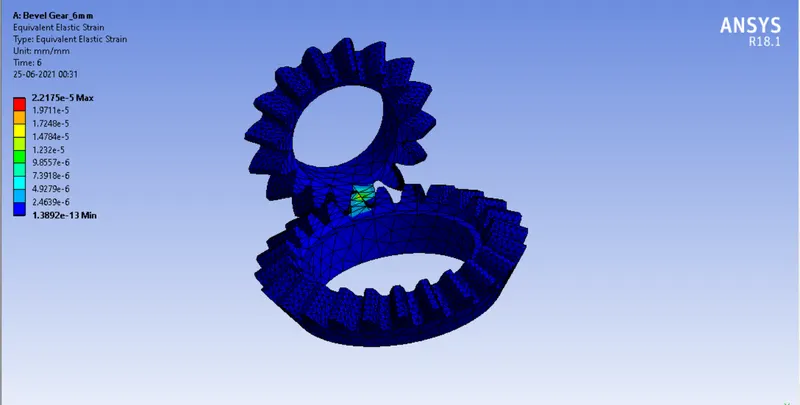
| 6mm | 47.88 | 3.18 | 2.21 E-5 |
| 5mm | 47.88 | 1.06 | 7.26 E-5 |
| 4mm | 47.87 | 2.67 | 1.69E-5 |
.
7) Conclusion:
1) Total Deformation is the same for all the cases.
2) The stress is maximum in the case of 6 mm Element size. and min. for 5 mm size.
3) The Strain is not consistent and very negligible changes are there.
4) So for the design to be safe we will go with the case of 6mm element size as it will give us the design for high stresses and as node count is less so the analysis will be faster and need fewer resources.