Week 2 Bevel Gear Challenge
GRID DEPENDENCY TEST:-
Grid dependency test, a test on a test-piece or model where an analysis starts with the coarser mesh and it is then refined for better results. A solution can never be trusted, unless we check whether, the result depends on the grid or not. The output result of a coarser mesh and the finer mesh can never be the same, also a finer mesh gives better results comparatively. Thus In grid dependency test a mesh is refined to acceptable limits.
Objective:-
To perform a grid dependency test for the given bevel gear model for mesh sizes of 6 mm, 5 mm & 4 mm. And then solve for Von-mises stress, Equivalent elastic strain & Total deformation.
Procedure :-
Starting with the workbench, first of all we will select the engineering data i.e. material for the model. In my model I will be selecting the structural steel as the material for my simulation. There after import the model in static structural. After importing check for any type of discrepancy in the model imported. Through space-claim model has to be checked. And post checking it is found that the model is good enough for further simulation to proceed with. But it has a middle portion of the gear which is not of utmost importance to us, so removing that middle part of the gearing arrangement.
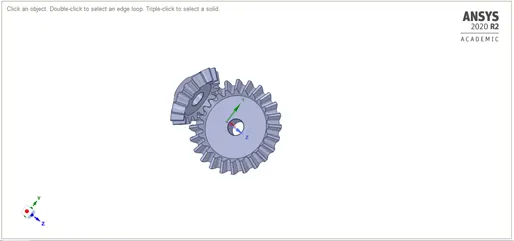
Remove the extra part using space-claim
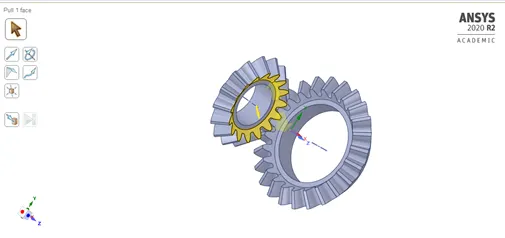
After the editing of geometry, we will be going with editing the model in mechanical workbench, where the actual simulation will start.
Starting with mechanical workbench, the first thing we will be doing is to rename the part according to our interest, and also which can be easily accessible,
After renaming the parts, cross check for material assigned. Now its time for contact region. Properly assigning the teeths of both the gears to their respective faces.
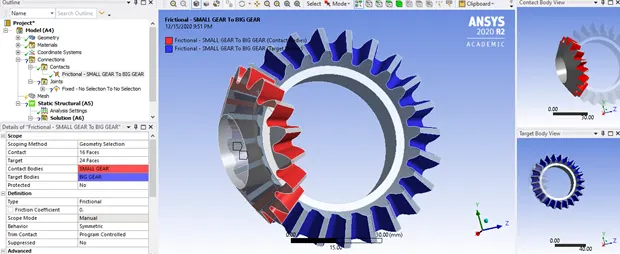
Now, Inserting the joint for both the gears,
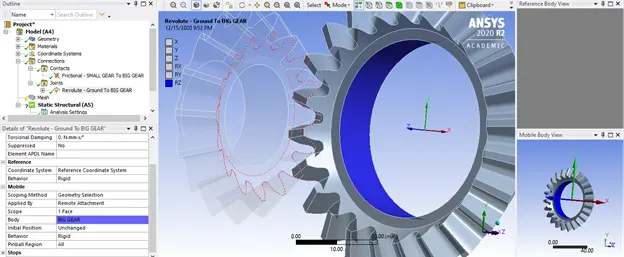
Another joint
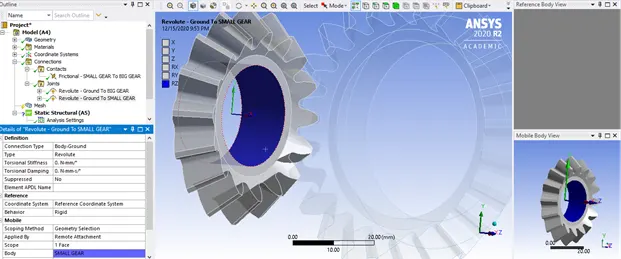
Analysis setting has to be done, and steps, solver type, and large deflection, etc parameters has to be set.
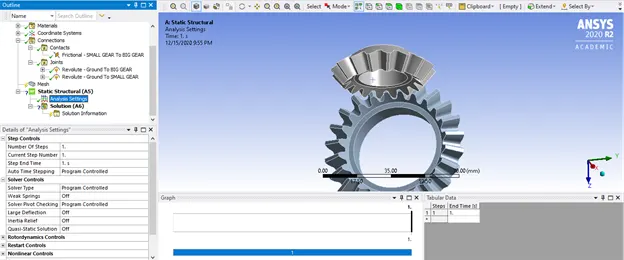
After the analysis setting, Joint load for rotation has to be assigned
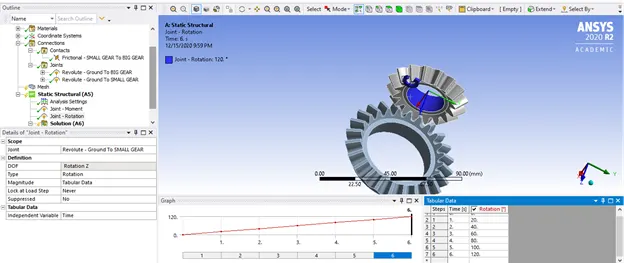
Also Joint load for moment, need be assigned.
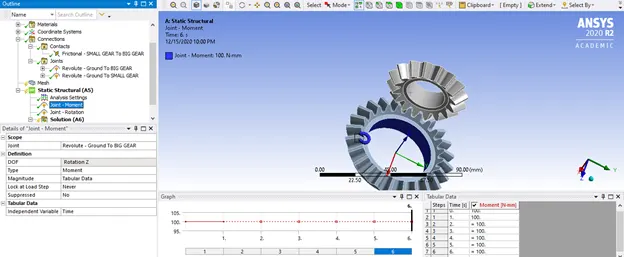
Since after assigning the rotation and moment it has been noticed that the axis of rotation for both the gears don’t pair with each other, and hence when the analysis will be run it will destroy the teeth, thus using Coordinate system changing the axis of rotation of any one gear.
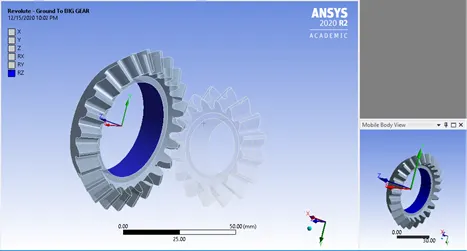
After all the setting are done, proceeding towards the Grid dependency test,
Starting with 6mm mesh size, we will also be going for 5 mm and 4 mm mesh, and analyze the results.
6 MM MESH SIZE:-
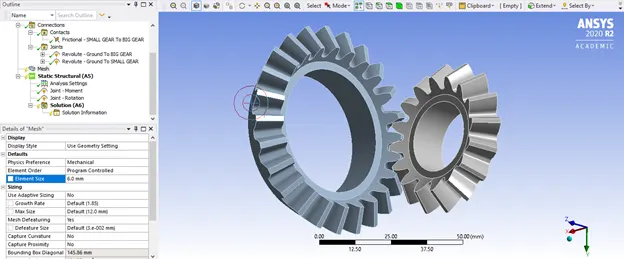
Coarser mesh at teeths so refining them and assigning a mesh size of 1.75 at teeth faces.
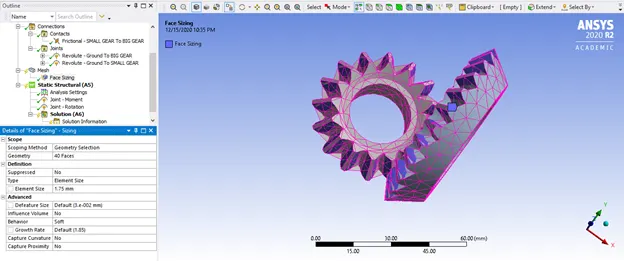
Finer teeth area
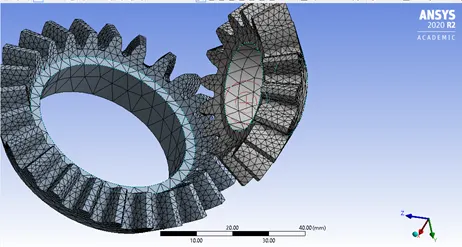
But on checking statistics it is seen that the no of nodes exceeded the limits for academic version, so remeshing the faces for 2 mm mesh size
Solving for analysis:
Total deformation
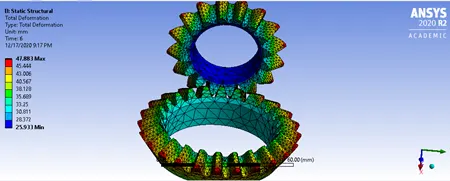
https://youtu.be/tcINVfC27qU
Von-mises stress
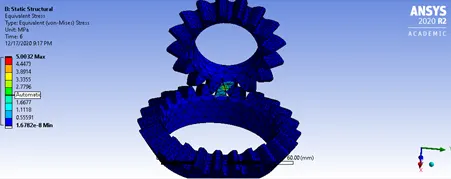
https://youtu.be/HZMlVszD5Vg
Equivalent elastic strain
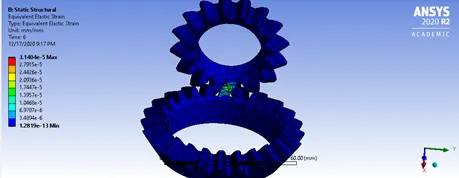
https://youtu.be/_KDiZH_RZjM
After the 6mm mesh size we will be proceeding towards mesh size 5mm mesh analysis.
5 MM MESH SIZE
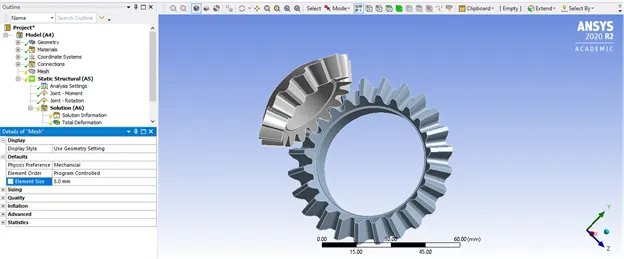
Coarser mesh, teeth sector of 1.75 mm mesh
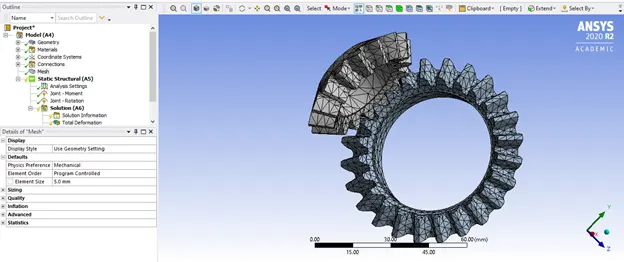
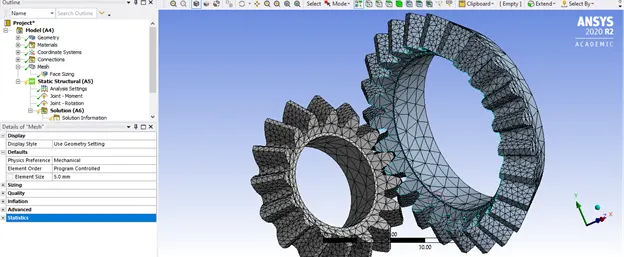
Solving for analysis
Total deformation
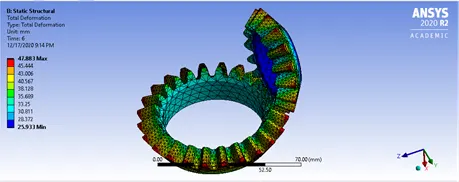
https://youtu.be/1Qo34q7DVM0
Equivalent elastic strain
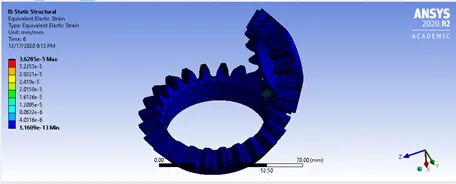
https://youtu.be/JQecIQXicJU
Equivalent stress
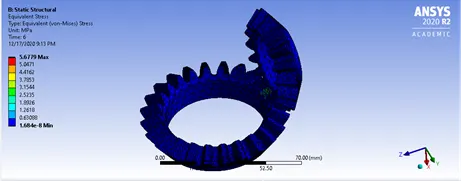
https://youtu.be/1Qo34q7DVM0
4MM MESH SIZE:-
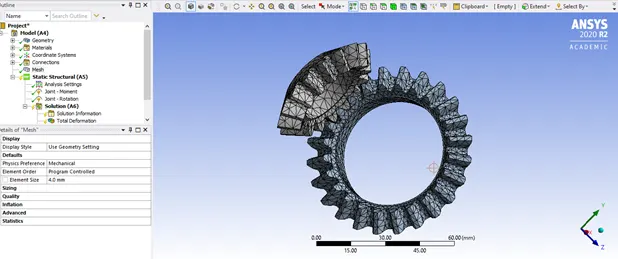
Fining the mesh at teeths
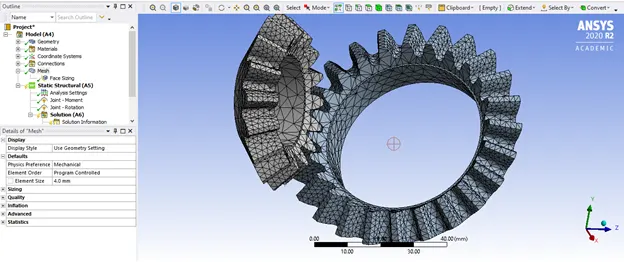
Face sizing resized to 1.9mm
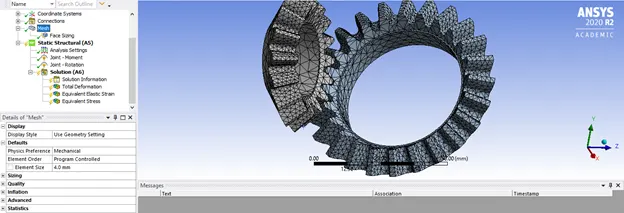
Solving for analysis
Total Deformation
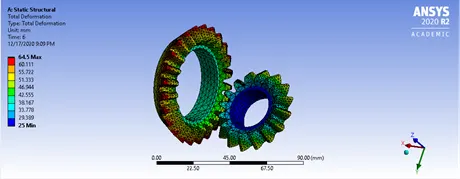
https://youtu.be/3xdovFS4vp4
Von-mises stress
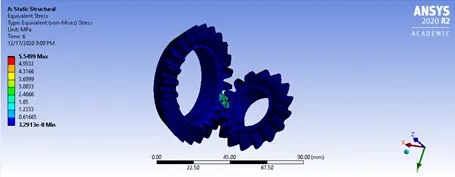
https://youtu.be/vpqyXW02gXQ
Equivalent elastic strain
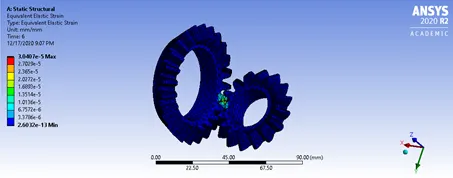
https://youtu.be/pVXL8oZOJXA
CONCLUSION:-
Maximum values of total deformation, Von mises stress & Equivalent elastic strain are tabulated below:
|
Total Deformation(mm) |
Von-Mises Stress(MPa) |
Equivalent Elastic Strain(mm/mm) |
|
|
6 mm Mesh |
47.883 |
5.0032 |
3.1404e-5 |
|
5 mm Mesh |
47.883 |
5.6779 |
3.6285e-5 |
|
4 mm Mesh |
64.5 |
5.5499 |
3.0407e-5 |
From the result it can be seen that:-
- The total deformation for 6 mm and 5 mm mesh is same as 47.883, but for 4 mm mesh its value increases.
- For Von-mises stress the value increases from 6 mm mesh to 5 mm mesh but then gradually decreases from 5 mm mesh to 4 mm mesh.
- In equivalent elastic strain as the value increases for 6 mm to 5 mm mesh, but then it decreases from 5 mm ot 4 mm mesh size.
Thus, the grid dependency test for 6mm, 5mm & 4mm mesh has been performed and the results are tabulated above.
The final workbench file can be accessed through this link:-
https://drive.google.com/file/d/1rqiV2aNUezRGxVjhsVkEr6bz4f7fwLvs/view?usp=sharing