Week 2 Bevel Gear Challenge
Grid Dependency Test :
’Grid Independence Test’ and 'Grid Dependency Test', ‘Mesh Refinement Test’ are synonyms and they all mean the same. While performing Finite Element Analysis, one of the most common questions is finite element mesh quality. How can one know if the mesh is good enough for the analysis? Mesh density is a significant metric used to control accuracy (element type and shape also affect accuracy). Assuming no singularities are present, a high-density mesh will produce results with high accuracy. However, if a mesh is too dense, it will require a large amount of computer memory and long run times, especially for multiple-iteration runs that are typical of nonlinear and transient analyses.
The most fundamental method of checking the mesh quality is to refine a mesh until a critical result such as Equivalent stress does not change significantly with each refinement (i.e. it converges). This is the Grid dependency test, where, analysis begins with a coarse mesh and it is refined to a finer mesh for each run until the results do not change significantly and depend on the grid size anymore. As the grid or mesh size approaches zero, the approximate solution is almost equal to the actual solution. The aim of this test is to find the optimum mesh size for the solution, where it is neither too coarse to produce inaccurate results, nor where it will consume a lot of computing effort and time.
There are different mesh refinement techniques are used which have advantages and disadvantages and some depend on the experience and technical expertise of the FEA analyst. These techniques include- Reducing the element size, Increasing the element order, Global Adaptive mesh refinement, local adaptive mesh refinement, manually adjusting the mesh, Time adaptive mesh refinement, wavelength adaptive mesh refinement, etc.
Objective:- Set up the Case of Grid Dependency to find out the best possible mesh size for Bevel Gear Analysis.
Methodology
-Called out the respective system from the Ansys Workbench for the respective Simulation (In our case it's Static Structural)
-Set the material cards for the simulation
-Import the geometry, mesh it, and set appropriate conditions for the simulation.
Case 1 Mesh size 6mm
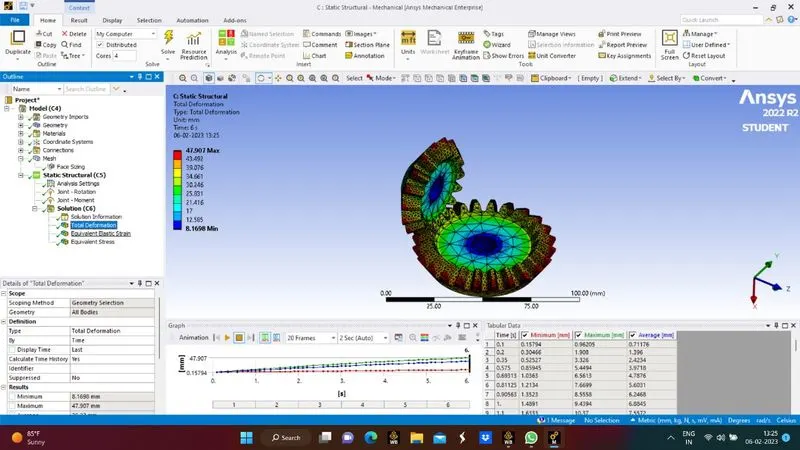
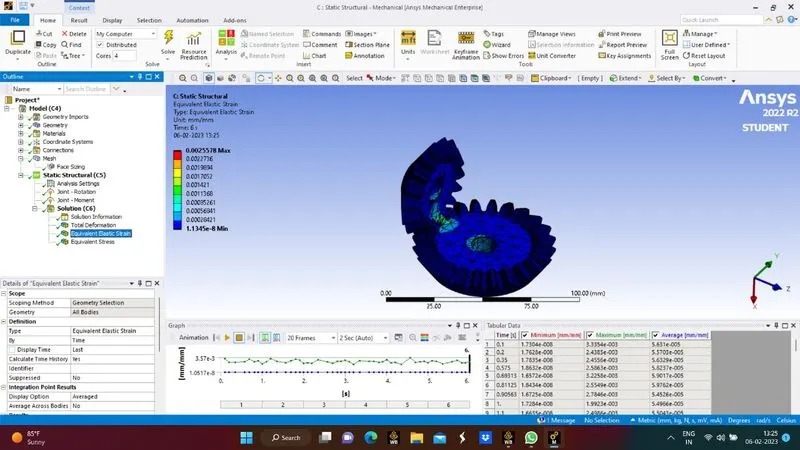
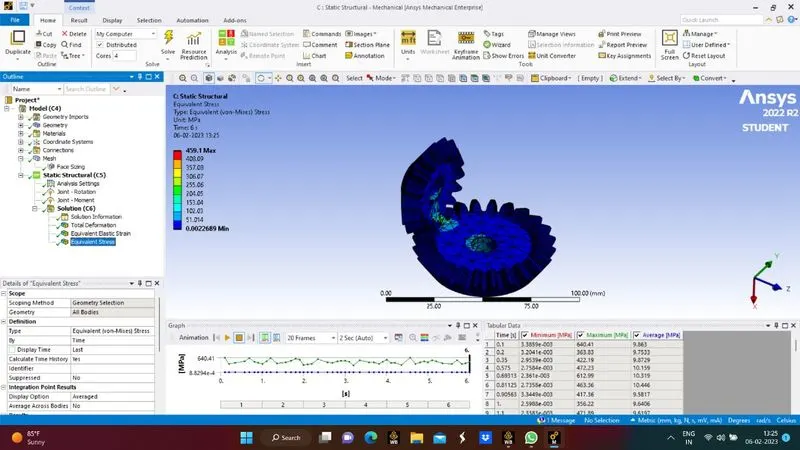
Case 2 Mesh size 5mm
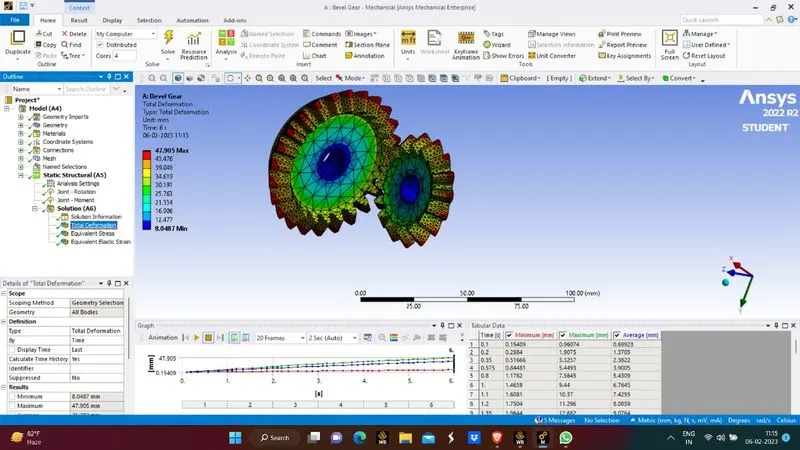
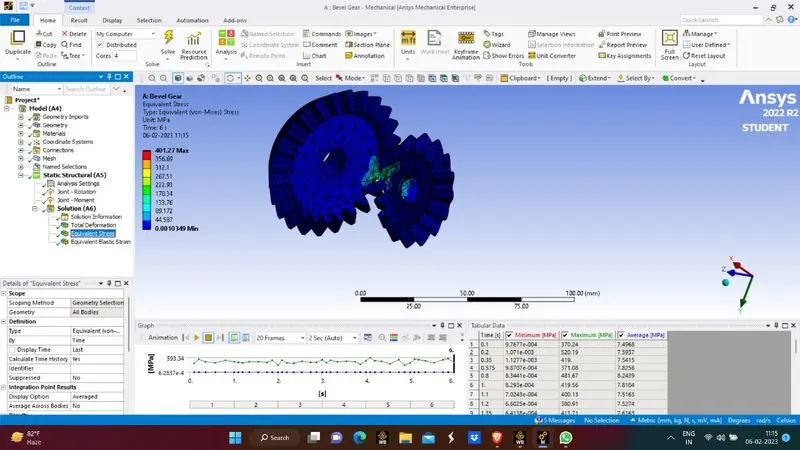
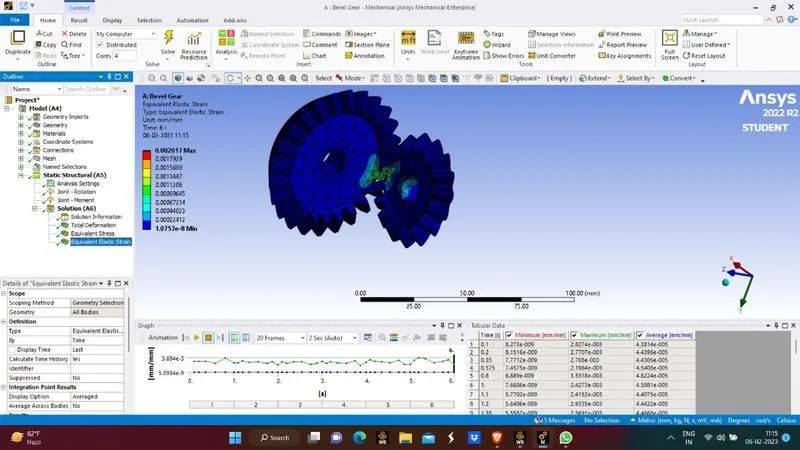
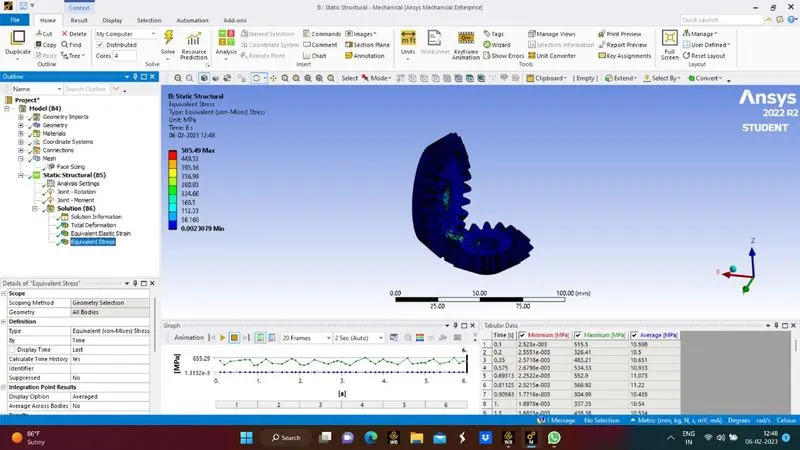
Case 3 Mesh size 4mm
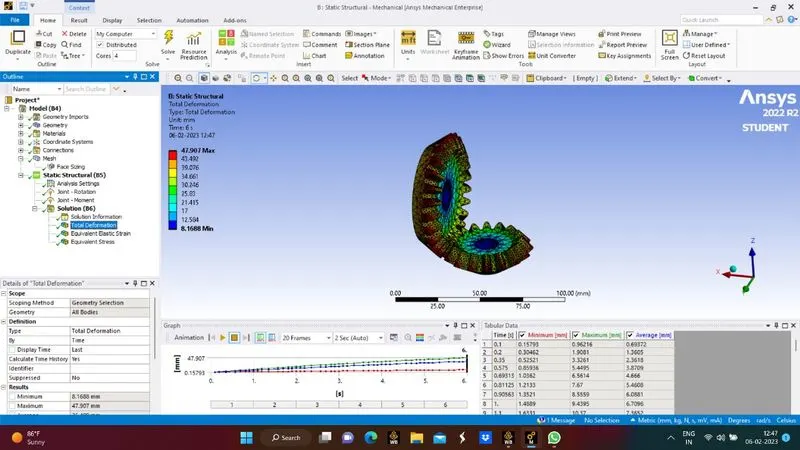
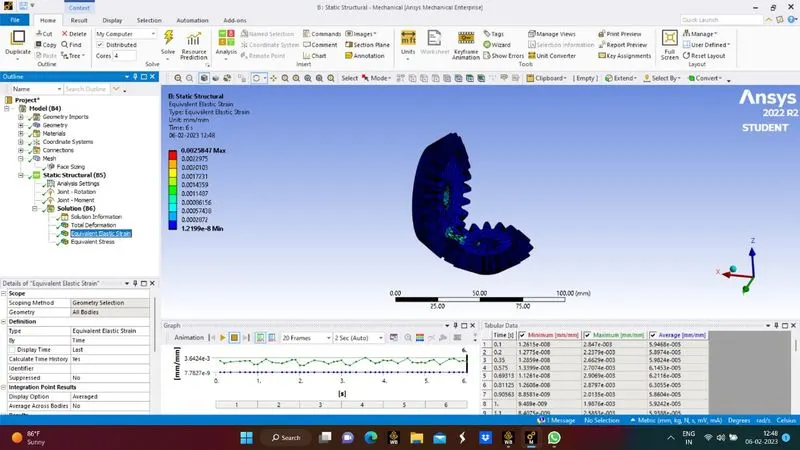
Result
| Case (Mesh Size) | Total deformation(mm) | Equivalent Stress(MPa) | Equivalent Strain |
| 6mm | 47.907 | 459.1 | 0.0025578 |
| 5mm | 47.905 | 401.27 | 0.002017 |
| 4mm | 47.907 | 505.49 | 0.0025847 |
Here we can see 4mm mesh size has produced more stress based on observation and deformation is same
Conclusion :
The difference between 6mm and 5mm mesh size is not that significant. But there is a huge difference in stress values of 4mm element mesh. And as per the definition of the Grid dependency the 4mm mesh is the optimum mesh size for the solution, where it is neither too coarse to produce inaccurate results nor too Fine to consume a lot of computing effort and time.