Week 2 Bevel Gear Challenge
Grid Dependency Test On Bevel Gear.
Objective:
The objective of this project is to perform grid dependency test for bevel gear with different mesh sizes, i.e., 6, 5, and 4 mm. Evaluate and Compare their von-mises stress, equivalent elastic strain, and total deformation.
what is the Grid Dependency Test?
Grid dependency test is to investigate how the solution depends on the grid size by running the simulation with refined mesh that is finer the mesh, higher is the accuracy of the result but with additional cost on computation time and computational power. Since, solutions are interpolated at the nodes to get an approximate result, higher the number of nodes and elements higher is the computational time and power required to complete the simulation.
So, the grid dependency test helps in determining optimal mesh size where the accurate result could be obtained keeping in the mind the cost of time and power. Since the result obtained are approximate,
Refining mesh further would result in negligible per cent change is the result but only increase the computational cost.

Fig 1: CAD geometry of bevel gear
The material used is Structural Steel and below are the properties of the material.
Young’s modulus – 211 MPa
Poisson’s Ratio – 0.3
Tensile Yield Strength – 250 MPa
Ultimate Strength – 460 MPa
Simulation Setup:
The pre-processing steps are followed for all the cases (i.e., mesh size 6, 5, and 4 mm) are shown below.
Meshing:
Meshing is performed with tetrahedral elements with 4mm,5mm and 6mm resp. and with face meshing of 1mm.
Fig 2: Table for Nodes/element with different element size
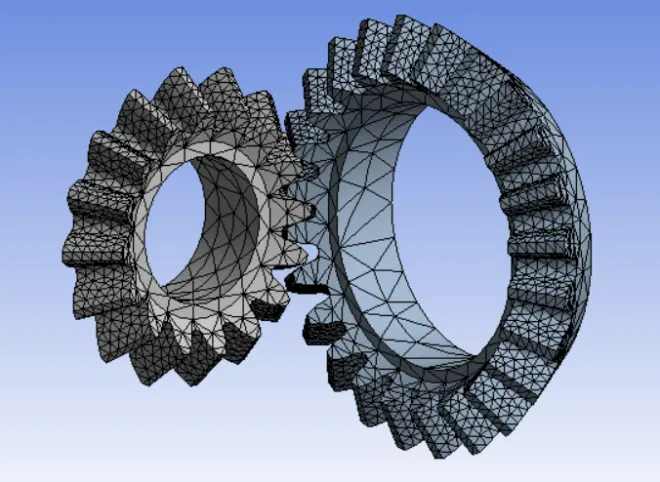
Fig 3: Meshed Model
Contact setup:
Contacts at the interface were set up between two gears with small gear having 16 faces and the big gear having 24 faces with type frictional with Coefficient of frction 0.2 with Normal Langrange with detection method normal to target.
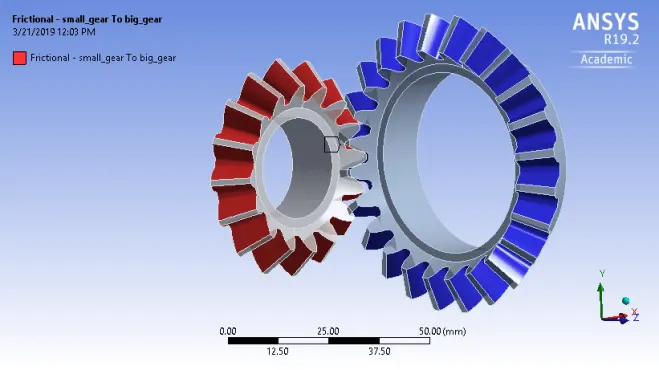
Fig 4: Frictional Contact between Gears.
Joints Setup:
Revolute joints were set up with connection type ‘body-ground’ for each gear. Big gear is given a constant moment of 100 N-mm and small gear is given rotation on 120 degrees in 6 steps (i.e. 20-degree increment per step).
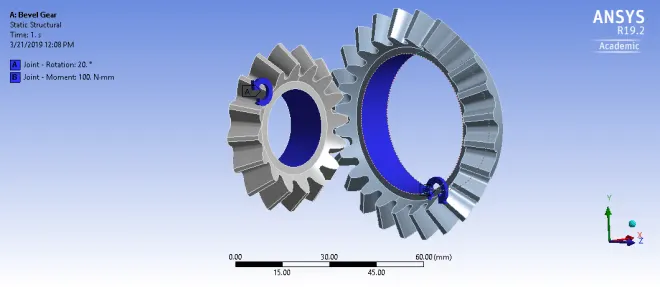
Fig 5: Frictional contact

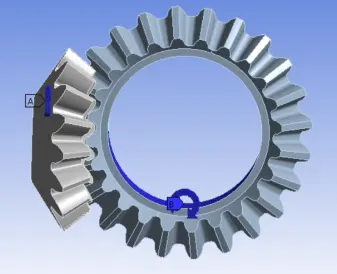
Fig 4: Small Gear with joint type Rotation (left) and Big Gear with joint type Moment (right).
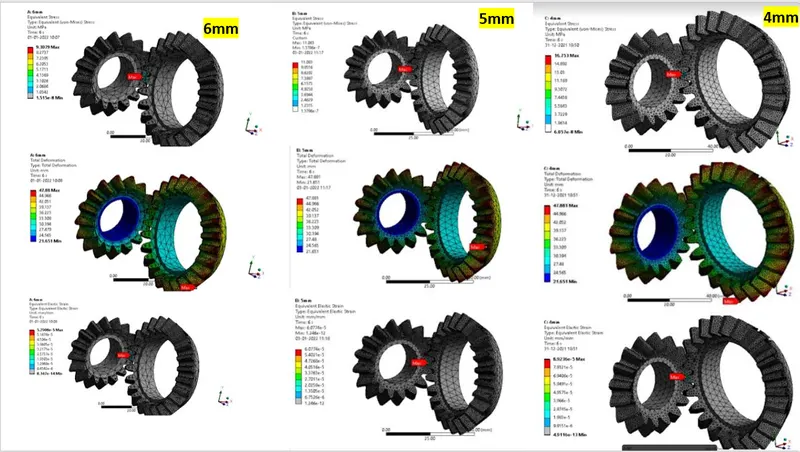
Simulation Result for different mesh size is shown below in order 6mm, 5mm and 4mm respectively.
Conclusion:
Grid Dependency test has been performed and From the above table, we can conclude performing grid dependency test on bevel gear by varying the global size of the mesh we achieve much better accuracy of the result. We can observe that as the mesh is refined from e.g 5mm to 4mm we achieve better approximate of the result for equivalent elastic strain and equivalent stress, however, performing the simulation with further refining the mesh would result in a very close approximation of the result but with very negligible change in the result with an additional on the computational power and time.