Week 2 Railwheel and Track
The material used is Structural Steel and below are the properties of the material.
Young’s modulus – 211 MPa
Poisson’s Ratio – 0.3
Tensile Yield Strength – 250 MPa
Ultimate Strength – 460 MPa
Preprocessing steps:
The preprocessing steps are followed for loading with 100000N and 500000 N is shown below.
The Railwheel and Track model are imported in the ANSYS workbench is shown below.
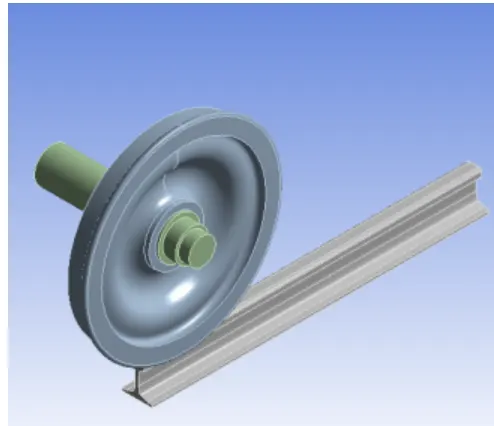
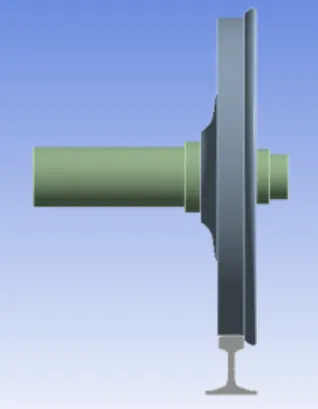
Fig RailWheel and Track Setup
Meshing:
Meshing is performed with tetrahedral elements and the number of nodes/elements is kept below 32,000 which is the size limit for software (academic version). The element size and face sizing are also set to 35mm.
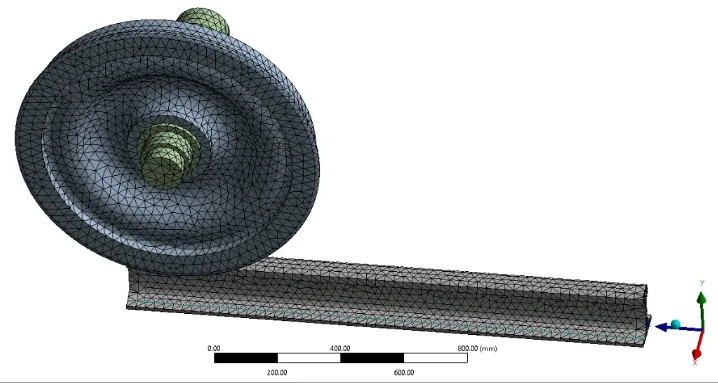
Fig : Meshed Model
Contact setup:
Contacts at the interface were set up between the wheel and track with contact type frictional and friction coefficient 0.2 and between the wheel and the shaft with contact type frictional. The figure below shows the contact setup with normal Lagrange -Normal to Target settings.
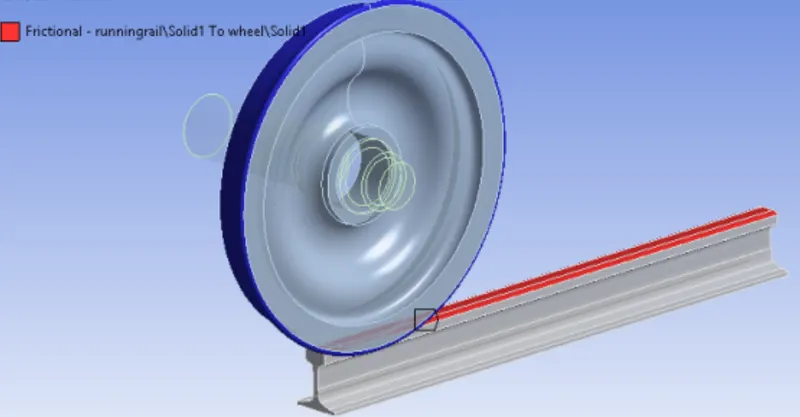
Fig : Wheel and Track Contact
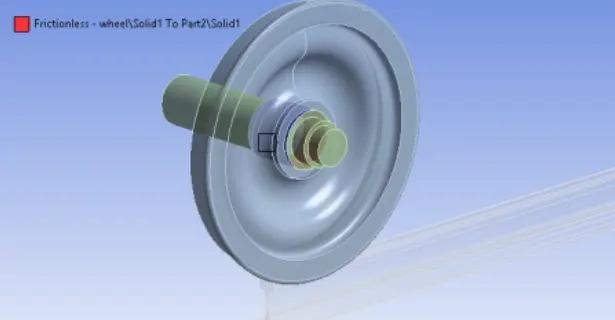
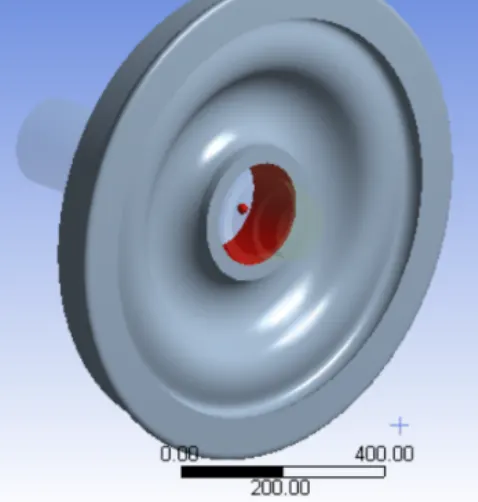
Fig : Contact with wheel and shaft.
Joints Setup:
joints are set up with fixed joint is given to Track and Translational joint is given to the shaft that indeed turns the wheel to a total of 500 mm displacement in 5 steps (i.e. 100 mm per step) and planer joint is given on the side face of the wheel to maintain contact with the plane in the fixed joint (Track).
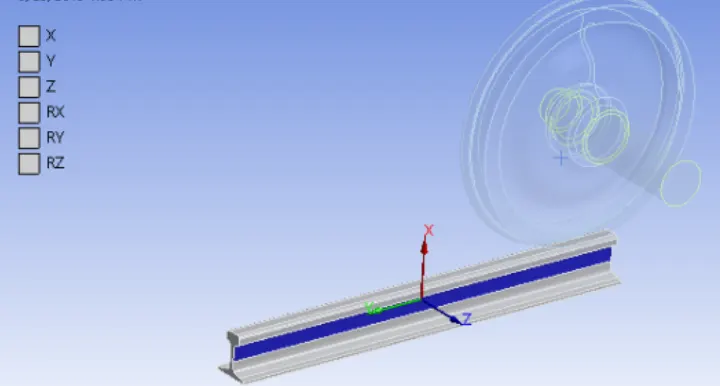
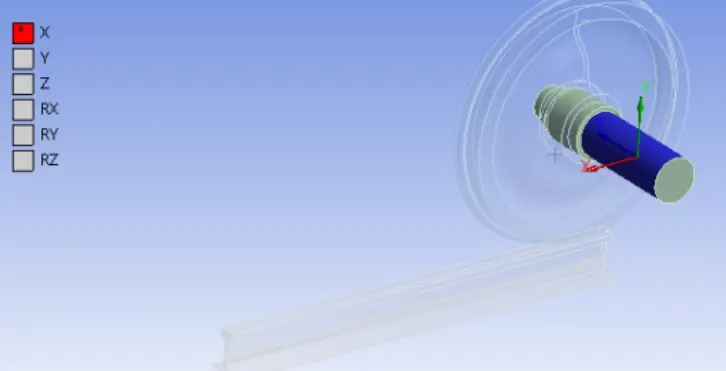
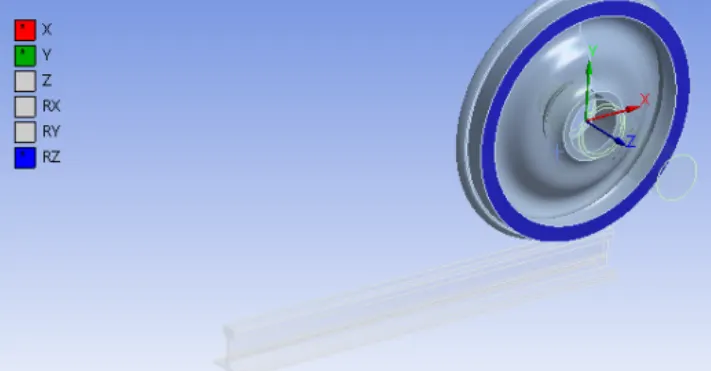
Fig : Fixed joint, Translational Joint and Planar Joint (top to bottom)
RESULT:
Simulation Result with different loading is shown below in order 100000N and 500000N respectively.
Case 1: Result with 100000 N
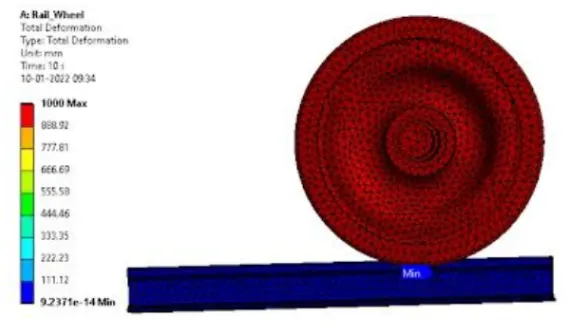
Fig : Total Deformation
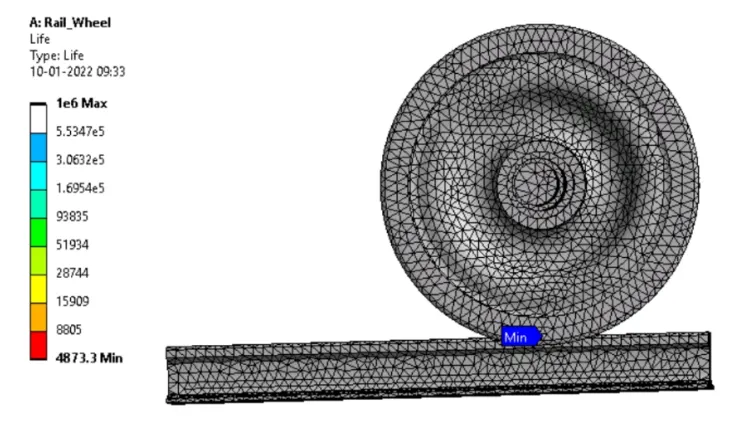
Fig : Fatigue LIfe
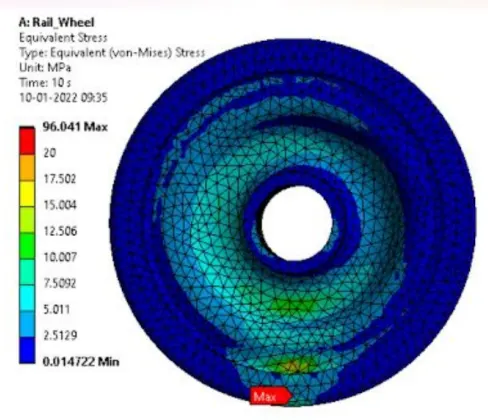
Fig : Von-Mises on 1 Body (wheel)
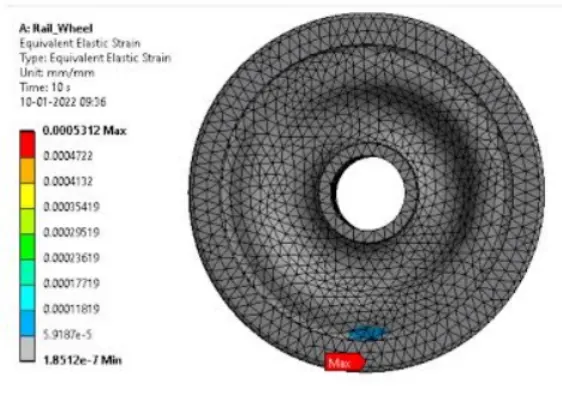
Fig: Equivalent strain 1 body (Wheel)
Case 1: Result with 500000 N
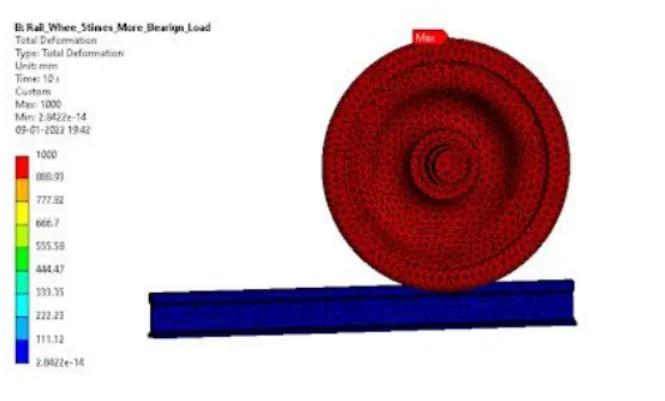
Fig : Total Defromation
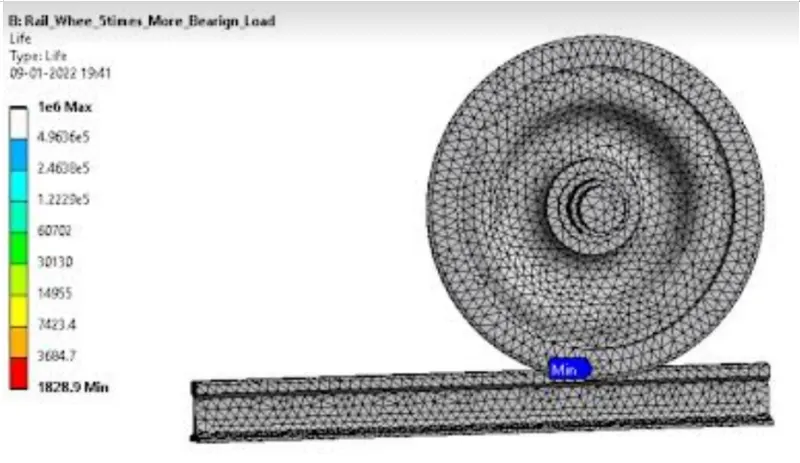
Fig : Fatigue Life
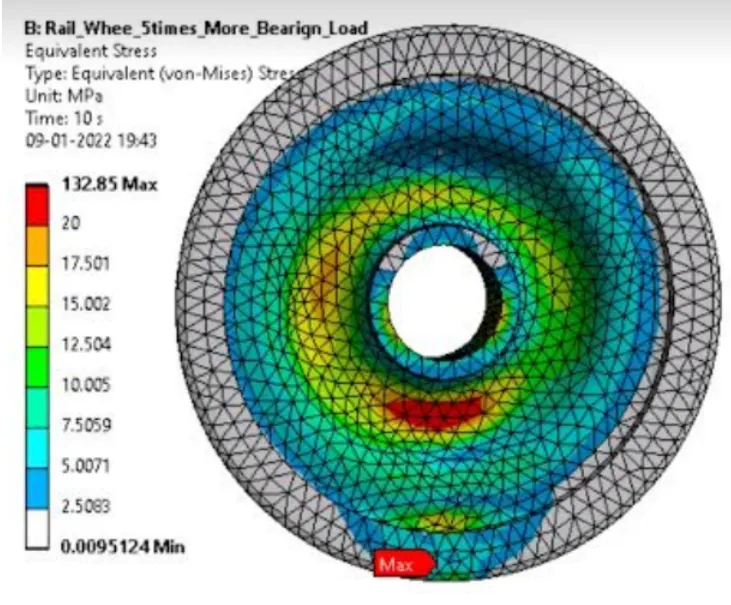
Fig: Von-Mises Stress on 1 body (Wheel)
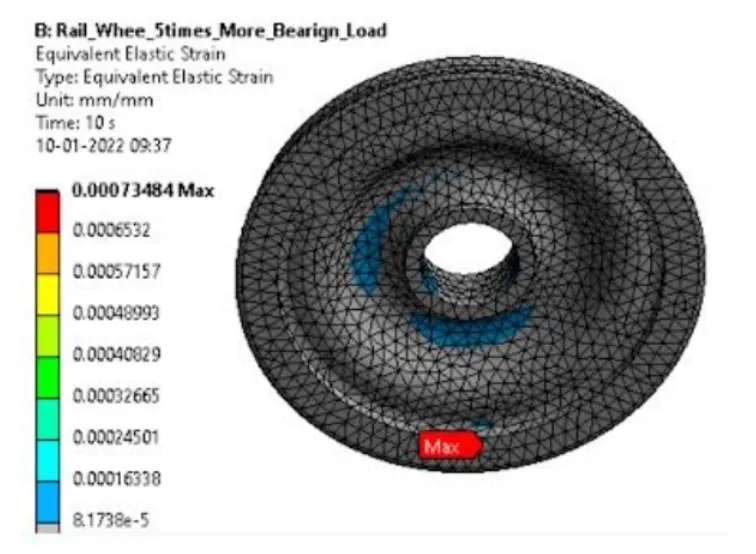
Fig: Equivalent strain 1 body (Wheel)
Comparison of the Result :
|
|
Maximum |
Max |
Min |
||
|
Load |
Total Deformation (mm) |
Equivalent Stress (MPa) |
Equivalent Strain (%) |
Fatigue Life |
|
|
100 KN |
1000 |
96 |
0.053 |
1.00E+06 |
4873 |
|
500 KN |
1000 |
132.85 |
0.073 |
1.00E+06 |
1829 |
Fig: Data Table
From the above table, we can see that for a load of 500000 N we get equivalent stress of wheel 132 MPa which much larger compared to the load of 100000 N which is only 96 N. Also the Minimum fatigue life reduced in case of an increased load in comparison to 100000 N load.
Case : Total Deformation with the user-defined result and inbuilt result in ANSYS.
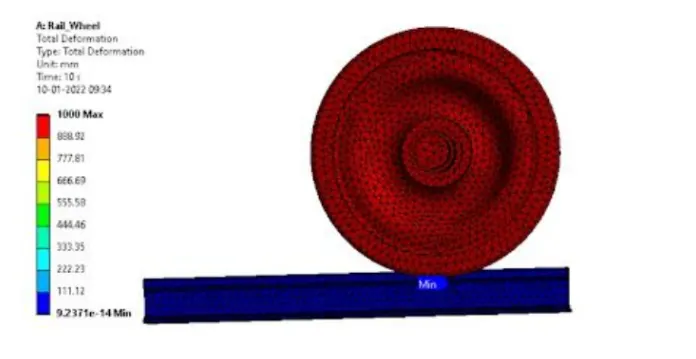
Fig : Inbuilt Result for Total Deformation
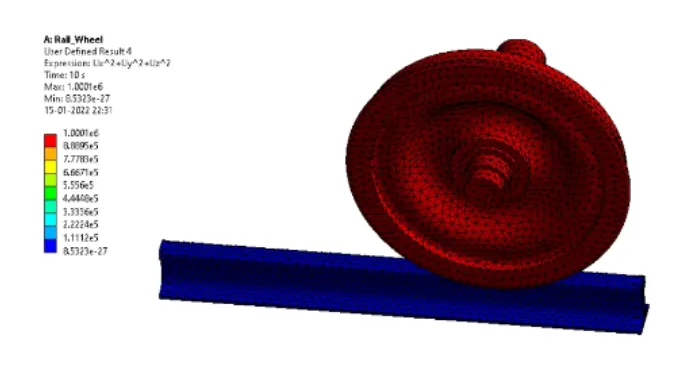
Fig : User Defined Result for Total Deformation
For Case 2 we get the same Total Deformation with an inbuilt result and user-defined result and the expression used for the user-defined result is (sqrt(Ux^2 + Uy^2 + Yz^2)).