Week 2 : Basic Calibration of Single cylinder SI-Engine
AIM :
- To run the single cylinder SI engine setup at 1800 rpm and list down parameters such as air flow rate, BSFC, BMEP, In cylinder pressure.
- To run the same setup at 3600 rpm and to increase the output by 10%.
Introduction
A spark-ignition engine (SI engine) is an internal combustion engine generally a petrol engine, where the combustion process of the air-fuel mixture is ignited by a spark from a spark plug. This is in contrast to compression-ignition engine, typically diesel engines, where the heat generated from compression together with the injection of fuel is enough to initiate the combustion process, without needing any external spark.
Four stroke SI engine
The 4-storke SI engine is an Otto cycle engine and consists of 4 strokes as shown in the figure. These comprise an intake stroke when a fuel-air mixture is drawn into the engine, a compression stroke where the mixture is compressed, a power stroke when a mixture is ignited and expands and an exhaust stroke when the combustion products are expelled from the engine. During each stroke, the crankshaft completes 180 degrees of rotation and hence the entire 4 strokes are completed in 720 degrees of crankshaft rotation. Therefore, for every cycle the crankshaft completes two revolutions whereas there is only one power stroke [1]. This is in-contrast to 2-stroke engine where a power-stroke takes place during a single rotation of the crank-shaft.
Air- fuel ratio:
Air–fuel ratio (AFR) is the mass ratio of air to a solid, liquid, or gaseous fuel present in a combustion process. The combustion may take place in a controlled manner such as in an internal combustion engine or industrial furnace, or may result in an explosion.It is also called stoichiometric ratio.
1.Run the case at 1800 rpm and list down important parameters
- air flow rate
- BMEP
- BSFC
- In-cylinder pressure
The model is imported from tutorials > modelling applications > engine_performance > 1cylSi-final.gtm
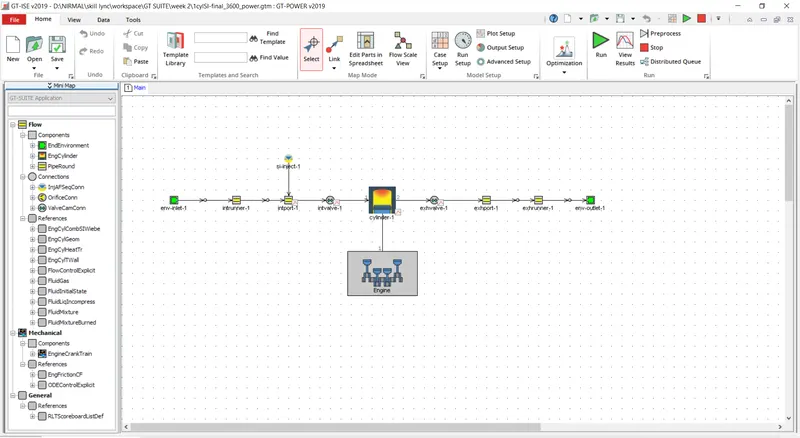
- AIR FLOW RATE:
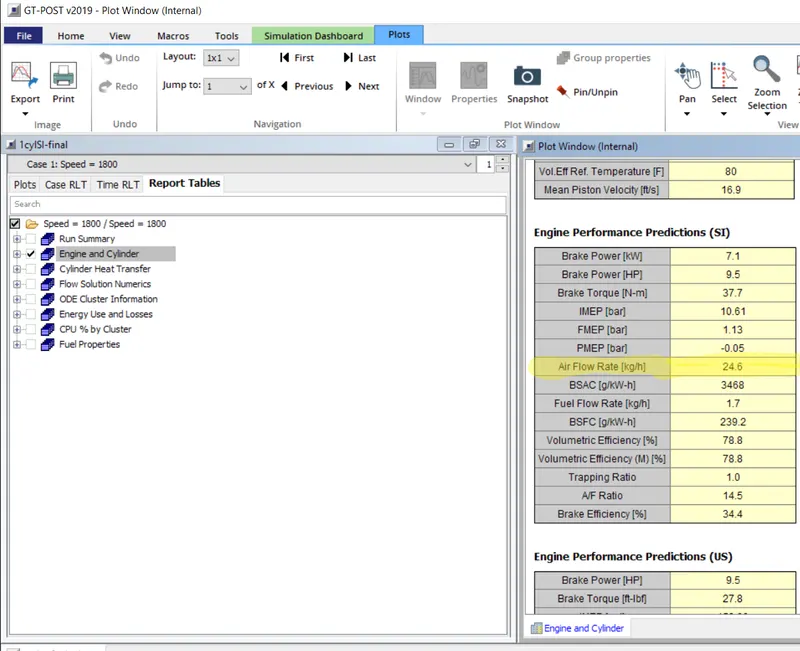
Air flow rate: 24.6 kg/h
- BRAKE MEAN EFFECTIVE PRESSURE:
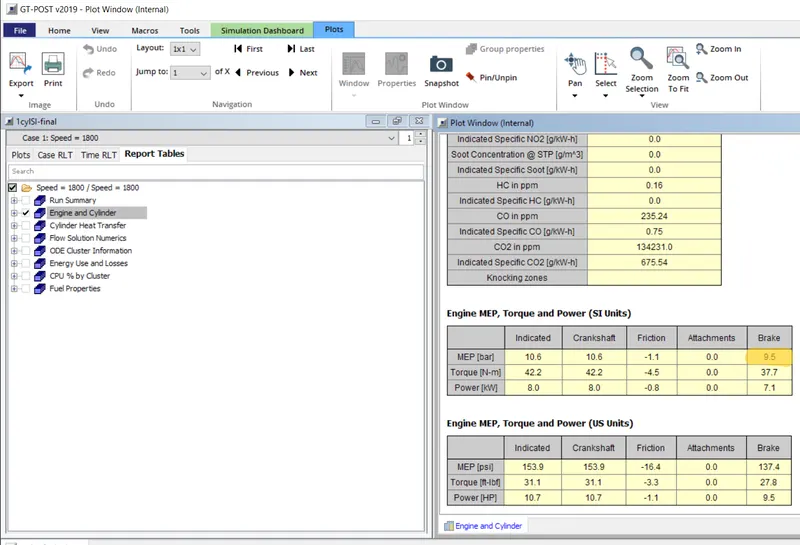
Break mean effective pressure: 9.5 bar
- BRAKE SPECIFIC FUEL CONSUMPTION:
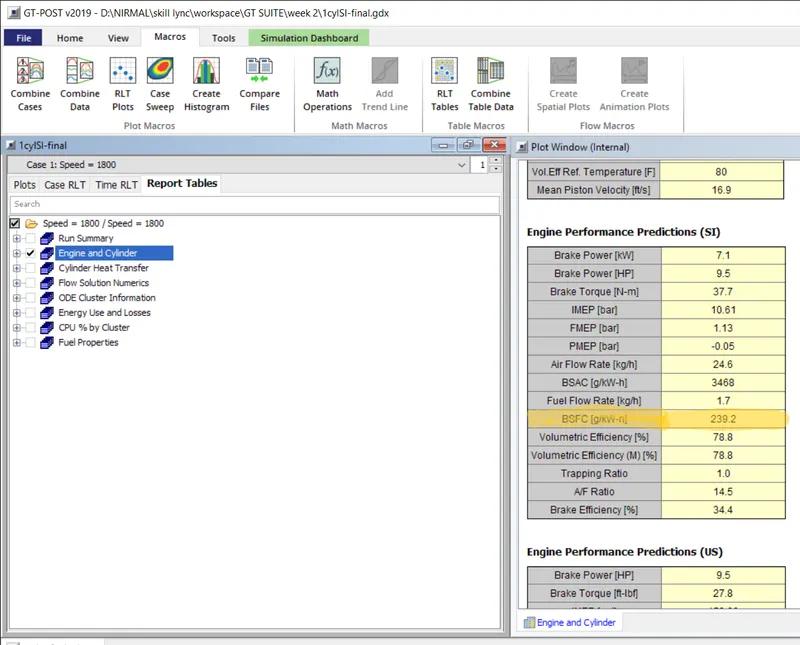
Brake specific fuel consumption: 239.2 g/kw-h
- IN-CYLINDER PRESSURE:
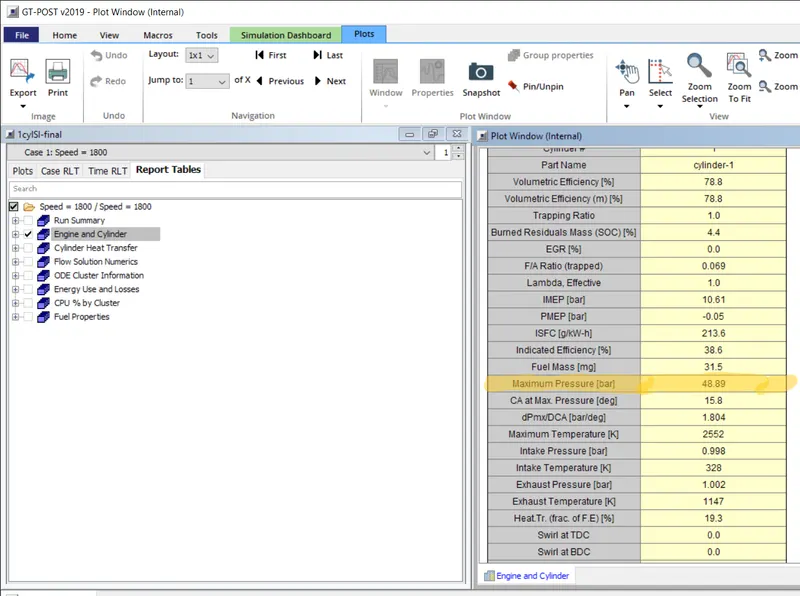
In-cylinder pressure: 48.89 bar
RUNNING THE ENGINE AT 3600 RPM:
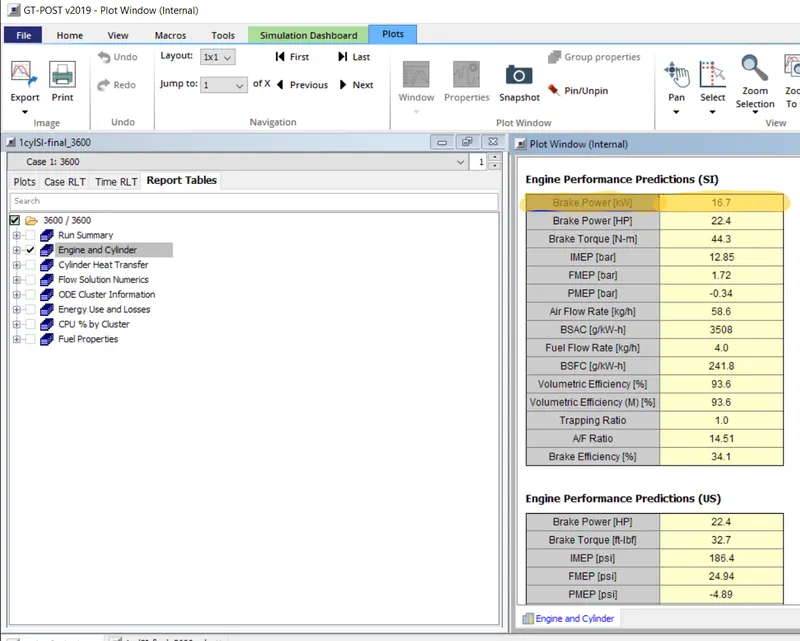
Brake power output: 16.7 KW
INCREASING THE POWER OUTPUT BY 10%:
The output power can be increased by changing the various parameters,
- By increasing the bore
- By increasing the stroke
- By increasing bore, stroke and connecting rod
- By increasing inlet pressure
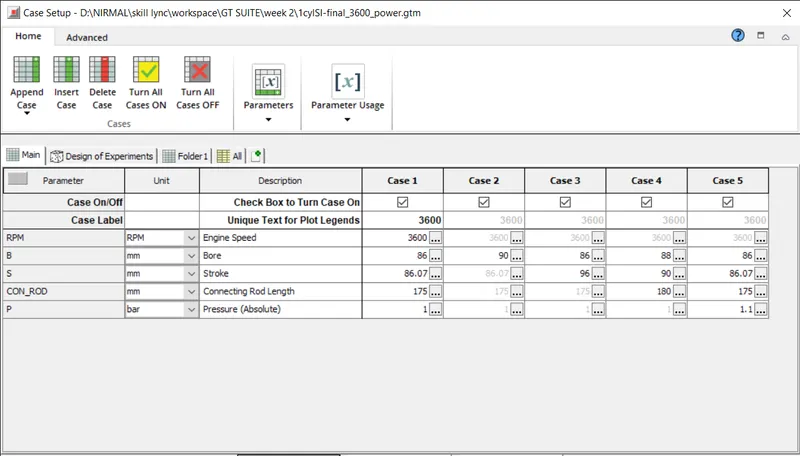
- In case 1, RPM is changed from 1800 to 3600 RPM.
- In case 2, bore is changed from 86 to 90 mm.
- In case 3, stroke is changed from 86 to 96 mm
- In case 4, bore is changed from 86 to 88 mm, stroke is changed from 86 to 90 mm and connecting rod length is changed from 175 to 180mm.
- In case 5, intake pressure is changed from 1 to 1.1 bar.
RESULTS:
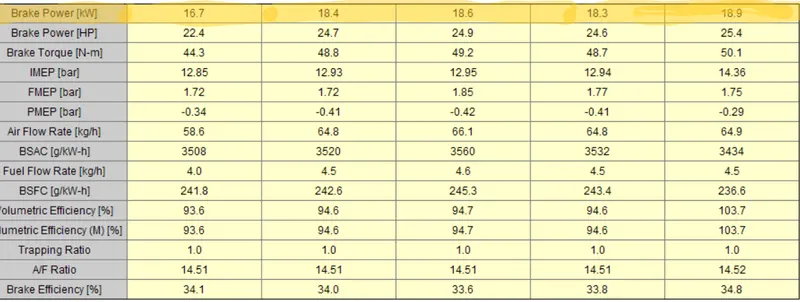
By changing the inputs as specified above, the brake power obtained is increased by 10% at a constant RPM of 3600.
- In case 1, the brake power obtained is 16.7 KW.
- In case 2, the brake power obtained is 18.4 KW.
- In case 3, the brake power obtained is 18.6 KW.
- In case 4, the brake power obtained is 18.3 KW.
- In case 5, the brake power obtained is 18.9 KW.
CONCLUSION:
- By increasing the cylinder volume by changing the bore and stroke more burning of air and fuel can takes place.
- By increasing the connecting rod length, better torque can be obtained.
- By increasing the intake pressure better combustion can be obtained, But increasing the intake air pressure requires turbocharger or supercharger which increases the cost of an engine.
The above steps increases the power output of the engine by 10%.