Week 2 : Basic Calibration of Single cylinder SI-Engine
Aim
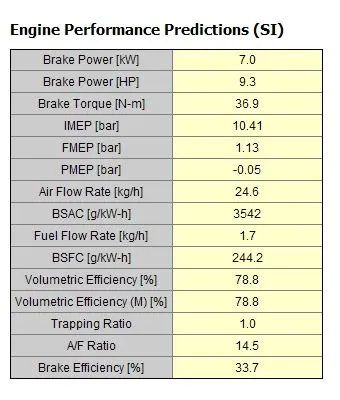
1.Run the case at 1800 rpm and list down important parameters (20 Marks)
- air flow rate
- BMEP
- BSFC
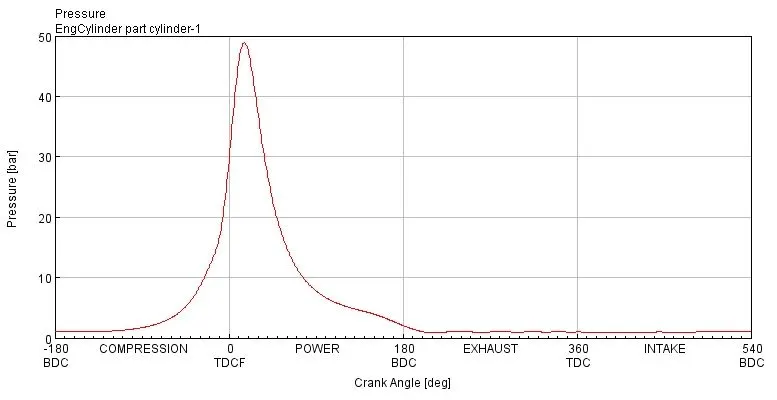
- In-cylinder pressure
2. Increase the power output at 3600 rpm by 10%
Introduction
Brake mean effective pressure (BMEP)
Brake mean effective pressure (BMEP) is an average value of the pressure inside the cylinder and if it is applied uniformly from TDC to BDC instead of the power stroke then the engine will produce the same amount of brake power as an actual engine.
Brake-specific fuel consumption (BSFC)
Is a measure of the fuel efficiency of any prime mover that burns fuel and produces rotational, or shaft power. It is typically used for comparing the efficiency of IC engines with a shaft output.
Spark Ignition 4 stroke engine
SI engine is an internal combustion engine, where the fuel is burned with the help of spark plug. SI engine working the principle of the Otto cycle. As the name suggests, in a four-stroke engine, the one cycle of combustion operation is completed in four strokes. Each stroke consists of 180° rotation of the crankshaft and hence four stroke completed in 720° rotation of the crankshaft. The engine takes two revolutions of crankshaft to complete this four stroke. The four-stroke for a spark ignition engines are
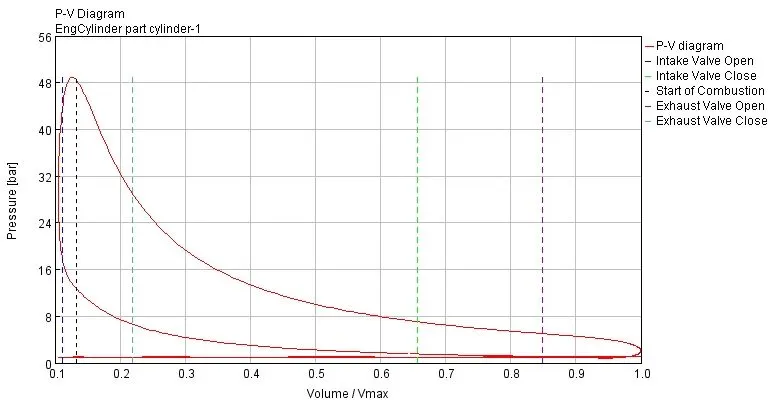
Various stroke and the corresponding position of piston and valves for a vertical IC engine, PV diagram are described below.
This stroke starts when the piston is at top dead centre (TDC) and about to move downward. While the piston moves downward the intake valve is open and the exhaust valve is closed. The movement of piston produces a vacuum inside the cylinder and charge consisting of air-fuel mixture drawn into the cylinder from the carburator . When the piston reaches the bottom dead centre (BDC), the inlet valves close. During this process, the volume increases but the pressure inside the cylinder remains constant (atmospheric pressure).
The piston moves from BDC to TDC. During this process, both the inlet and outlet valve is closed and the charge previously drawn into cylinder get compressed. At the end of this stroke, ie piston at TDC, the whole charge is compressed into clearance volume. The pressure increases with a decrease in volume. The compression ratio of SI engine is between 6 and 10.
At the end of compression stroke, the charge is burned using spark plug at the cylinder head. In ideal SI engine, it is considered as the instantaneous process. The temperature and pressure inside the cylinder increase dramatically at constant volume due to the burning of fuel (process 2→3). This is the only stroke in which actual power is produced. The high pressure burnt gases push the piston from TDC to BDC. During this process, both intake and exhaust valves remain closed. In this process, temperature and pressure decrease while the volume of gas increases. At the end of the power stroke, the exhaust valve is open, the pressure drops to atmospheric pressure (process 4→5).
The piston moves from BDC to TDC while the inlet valve is closed and the exhaust valve is open. The piston pushes out the burnt gas from the cylinder to the atmosphere. At the end of exhaust stroke, some residual gases get trapped in clearance volume. This residual gas gets mixed with fresh charge drawn into the cylinder during the following cycle.
- Suction/ intake stroke
- Compression stroke
- Combustion/ Expansion/ power stroke
- Exhaust stroke
Various stroke and the corresponding position of piston and valves for a vertical IC engine, PV diagram are described below.
| PV diagram for four-stroke spark ignition engine |
Suction or Intake stroke
Process 0→1.This stroke starts when the piston is at top dead centre (TDC) and about to move downward. While the piston moves downward the intake valve is open and the exhaust valve is closed. The movement of piston produces a vacuum inside the cylinder and charge consisting of air-fuel mixture drawn into the cylinder from the carburator . When the piston reaches the bottom dead centre (BDC), the inlet valves close. During this process, the volume increases but the pressure inside the cylinder remains constant (atmospheric pressure).
Compression stroke
Process 1→2.The piston moves from BDC to TDC. During this process, both the inlet and outlet valve is closed and the charge previously drawn into cylinder get compressed. At the end of this stroke, ie piston at TDC, the whole charge is compressed into clearance volume. The pressure increases with a decrease in volume. The compression ratio of SI engine is between 6 and 10.
Combustion/ Expansion or Power stroke
Process 2→3 and Process 3→4.At the end of compression stroke, the charge is burned using spark plug at the cylinder head. In ideal SI engine, it is considered as the instantaneous process. The temperature and pressure inside the cylinder increase dramatically at constant volume due to the burning of fuel (process 2→3). This is the only stroke in which actual power is produced. The high pressure burnt gases push the piston from TDC to BDC. During this process, both intake and exhaust valves remain closed. In this process, temperature and pressure decrease while the volume of gas increases. At the end of the power stroke, the exhaust valve is open, the pressure drops to atmospheric pressure (process 4→5).
Exhaust stroke
Process 5→0.The piston moves from BDC to TDC while the inlet valve is closed and the exhaust valve is open. The piston pushes out the burnt gas from the cylinder to the atmosphere. At the end of exhaust stroke, some residual gases get trapped in clearance volume. This residual gas gets mixed with fresh charge drawn into the cylinder during the following cycle.
Setup
- Case 1 is run with an rpm of 1800 and obtained the results
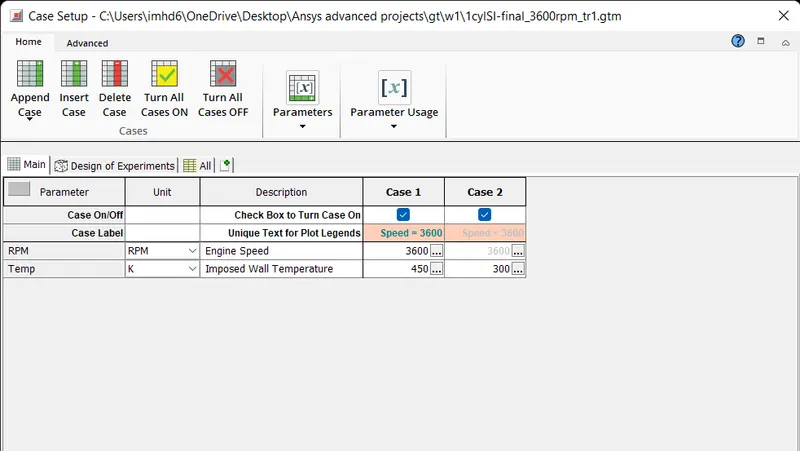
- Case 2 was run with a case setup of different intake wall temperatures so as to obtain more power
- Default values were used as input parametres
Outputs
Case 1

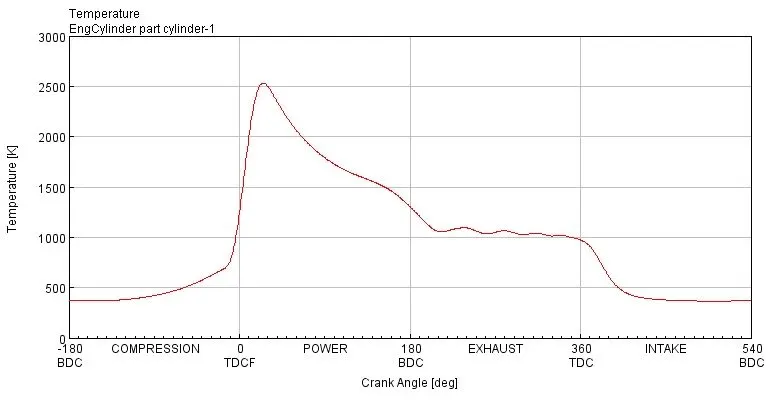
Case 2

Conclusions
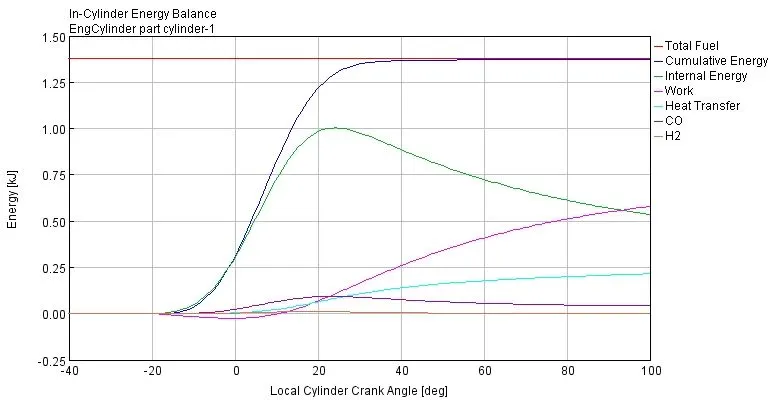
- The first case was run with default inputs and with an engine speed of 1800 and obtained some plots and results
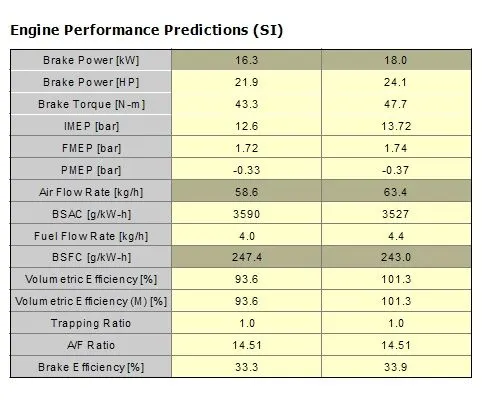
- Since the SI engine works on otto cycle the inlet temeperature is expected to have a relationship with the output shaft power. This relation is captured in the case 2 where lowering the intake temperature had an increase is in the brake power by around 10%
- It was understood that the colder the air more denser it is enabling more oxygen to enter the cylinder and produce a better combustion