Week 2 Air standard Cycle
The four processes of this cycle is as follows:
1.Isentropic ( reversible adiabatic) compression
2. Constant volume (Isochoric) heat addition
3. Isentropic (reversible adiabatic) Expansion
4. Constant volume heat rejection.
1. Process 1-2: Isentropic Compression
This process involves the motion of piston from TDC to BDC. The air that is sucked into cylinder during suction stroke undergoes reversible adiabatic (isentropic) compression. Since the air is compressed, the pressure increases from P1 to P2, the volume decreases from V1 to V2, temperature rises from T1 to T2, and entropy remains constant.
2. Process 2-3: Constant Volume Heat Addition
This process is an isochoric process i.e. the heat is added to the air at constant volume. The piston in this process rest for a moment at TDC and during this time heat is added to the air through external source. Due to the heat addition, the pressure increases from P2 to P3, pressure, volume remains constant(i.e. V2=V3), temperature increases from T2 to T3 and entropy increases from S2 to S3.
The amount of heat added is given by
3. Process 3-4: Isentropic Expansion
In this process, the isentropic (reversible adiabatic) expansion of air takes place. The piston moves from TDC to BDC. Power is obtained in this process which is used to do some work. Since this process involves expansion of air, so the pressure decreases from P3 to P4, volume increases from V3 to V4, temperature falls from T3 to T4 and entropy remains unchanged (i.e. S3=S4).
4. Constant Volume Heat Rejection
In this process, the piston rest for a moment at BDC and rejection of heat takes place at constant volume. The pressure decreases from P4 to P1, Volume remains constant (i.e. V4=V1), temperature falls from T4 to T1.
The amount of heat rejected in this process is given by
When this cycle is used in four stroke petrol engine than two process increases. one is suction of air fuel mixture inside the cylinder which takes place at constant atmospheric pressure and other one is exhaust of gases out of the engine cylinder at constant atmospheric pressure. These two process are not shown in ideal otto cycle that we have discussed above.
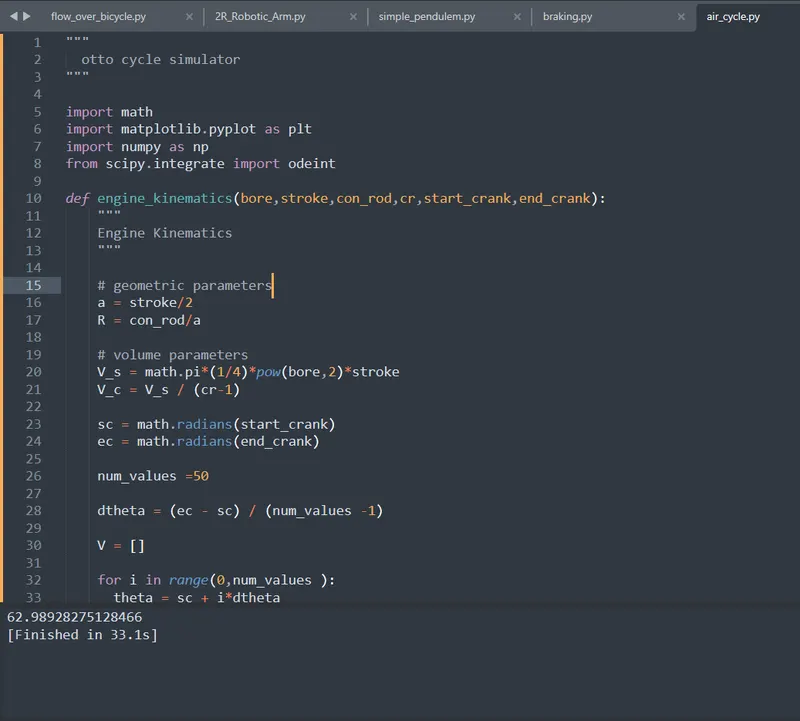
THE CODING IS:
"""
  otto cycle simulator
"""

import math
import matplotlib.pyplot as plt
import numpy as np
from scipy.integrate import odeint

def engine_kinematics(bore,stroke,con_rod,cr,start_crank,end_crank):
    """
    Engine Kinematics
    """

    # geometric parameters
    a = stroke/2
    R = con_rod/a

    # volume parameters
    V_s = math.pi*(1/4)*pow(bore,2)*stroke
    V_c = V_s / (cr-1)

    sc = math.radians(start_crank)
    ec = math.radians(end_crank)

    num_values =50

    dtheta = (ec - sc) / (num_values -1)

    V = []

    for i in range(0,num_values ):
      theta = sc + i*dtheta
      term1 = 0.5*(cr-1)
      term2 = R + 1 - math.cos(theta)
      term3 = pow(R,2) - pow(math.sin(theta),2)
      term3 = pow(term3, 0.5)
      V.append((1 + term1*(term2 - term3))*V_c)

    return V


# inputs
p1 = 101325
t1 = 500
gamma = 1.4
t3 = 2300

# geometric parameters
bore = 0.1
stroke = 0.1
con_rod = 0.15
cr = 12

# volume computation
v_s = (math.pi/4)*pow(bore,2)*stroke
v_c = v_s/(cr-1)
v1 = v_c + v_s


# state point 2
v2 = v_c

# p2v2^gamma = p1v1^gamma
p2 = p1*pow(v1,gamma)/pow(v2,gamma)

# p2v2/t2 = p1v1/t1 | rhs = p1v1/t1 | p2v2/t2 = rhs | t2 = p2v2/rhs
rhs = p1*v1/t1
t2 = p2*v2/rhs

V_compression = engine_kinematics(bore,stroke,con_rod,cr,180,0)

constant = p1*pow(v1,gamma)

P_compression = []

for v in V_compression:
   P_compression.append(constant/pow(v,gamma))


#nstate point 3
v3 = v2

# p3v3/t3 = p3v3/t2 | rhs = p2v2/t2 | p3 = rhs*t3/v3
rhs = p2*v2/t2
p3 = rhs*t3/v3

V_expansion = engine_kinematics(bore,stroke,con_rod,cr,0,180)

constant = p3*pow(v3,gamma)

P_expansion = []

for v in V_expansion :
   P_expansion.append(constant/pow(v,gamma))


# state point 4
v4 = v1

# p4v4^gamma = p3v3^gamma
p4 = p3*pow(v3,gamma)/pow(v4,gamma)

# p4v4/t4 = rhs
t4 = p4*v4/rhs

# calculating thermal efficiency
efficiency = (1 - pow((v2/v1),(gamma-1))) *100
print(efficiency)

#plotting rsults
plt.plot([v2,v3],[p2,p3])
plt.plot(V_compression,P_compression)
plt.plot(V_expansion,P_expansion)
plt.plot([v4,v1],[p4,p1])
plt.xlabel('Volume')
plt.ylabel('Pressure')
plt.show()
THE OUTPUT GRAPH IS :
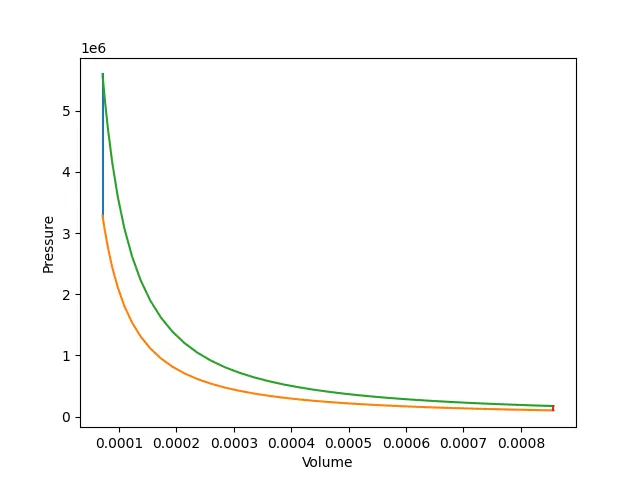
THE EFFECIENCY WE GET IN OUTPUT IS 62.9%