Week -2
Simulink model of Doorbell using solenoid block :
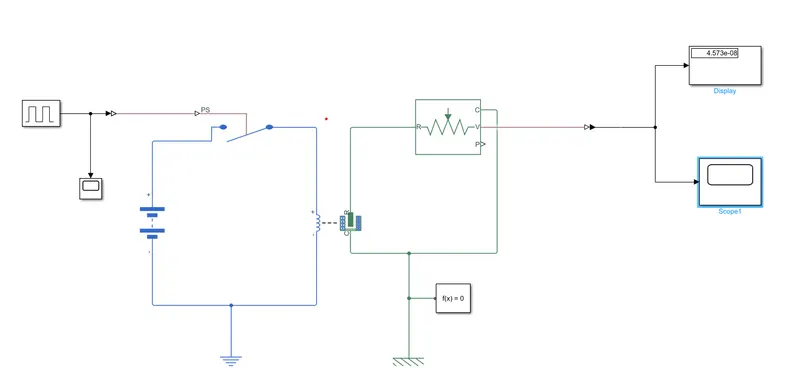
Blocks used are discribed below :
1.Pulse generator - it basically output the pulse
Output pulses
if (t >= PhaseDelay) && Pulse is on
Y(t) = Amplitude
else
Y(t) = 0
end
2. Scope - displays its input with respect to simulation time.
3. Simulink to Ps converter - converts the input Simulink signal into a physical signal
4.Switch block is also used
5. Battery source is used
6. Electrical reference is used
7.Solenoid block is used -The solenoid is a type of electromagnet, the purpose of which is to generate a controlled magnetic field through a coil wound into a tightly packed helix. The solenoid is as shown in the figure below. The solenoid is a coil of wire, and the plunger is made of soft iron. The magnetic field is formed around the coil when an electric current passes through it and draws the plunger in. We can say that the solenoid is responsible for converting electrical energy into mechanical work. Solenoids were the results of the development of an efficient and greater strength offering magnets. In the year 1823, a French Physicist and a mathematician, Andre-Marie Ampere coined the term solenoid to designate a helical coil.
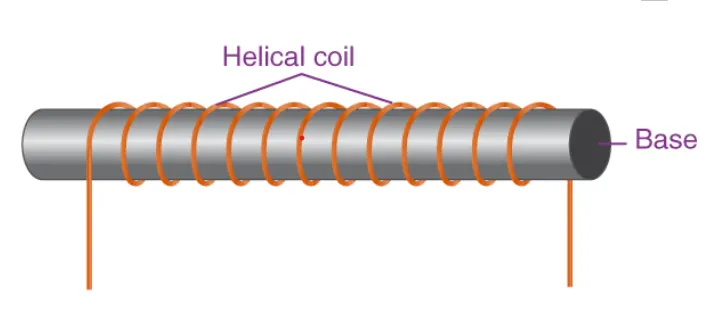
Working of Solenoids
After understanding the definition of solenoid and its parts, let us learn how solenoids work. Solenoid works on the principle of electromagnetism. When the electric current passes through the coil, the magnetic field is generated. When a metal core is placed inside the coil, the magnetic lines of flux are concentrated on the core. This increases the induction of the coil as compared to the air core. This concept is known as electromagnetic induction.
As we know, coils are made of numerous turns of copper wire wound tightly around it. A strong magnetic flux is developed when the current passes through the wire. The concentration of flux is high on the core, while some of the flux appears at the ends of the coil and outside the coil too. By increasing the flow of electric current or by increasing the density of the turns, the magnetic strength of the solenoid can be increased.
The housing is made of iron or steel. Housing is surrounded by the magnetic field created due to the coil. The plunger lets the mechanical force do work. Solenoids too feature positive and negative poles, through which an object can be attracted or repelled.
Consider a solenoid whose length is more than the radius. Enameled and insulated wire is wrapped with a wire in the form of a helix with a small gap between the turns. The amount of vector force provided by each turn, and the total magnetic field created by the solenoid are equal to that formed by a circular loop. This gives the total magnetic field of the solenoid. The lines of magnetic fields produced within a finite solenoid are as shown below
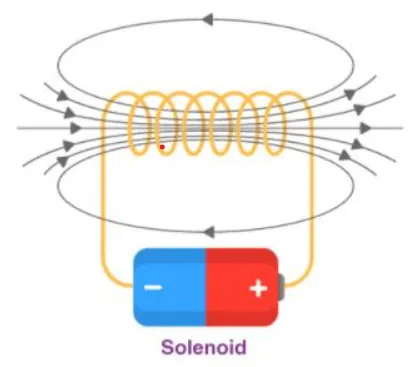
The field at any point beyond the solenoid is very thin. The field inside the solenoid is parallel to its axis at all times. The magnetic force produced by a solenoid can be defined using the Law of the Ampere:
Where n is the number of turns of the wire per unit length, I is the current flowing through the wire, and the direction is given using the right-hand thumb rule.
8. Ideal motion translation sensor is used and connected with the solenoid block R to view the movement of the plunger
9.Slover configuration - each physical network represented by a connected simscape blocks requires solver setting information for simulation
10. Display block is used to view the output signal
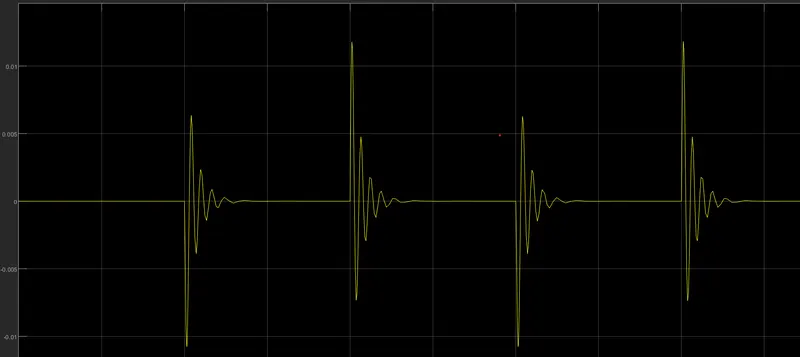
Output graphs :
The input signal of the pulse generator
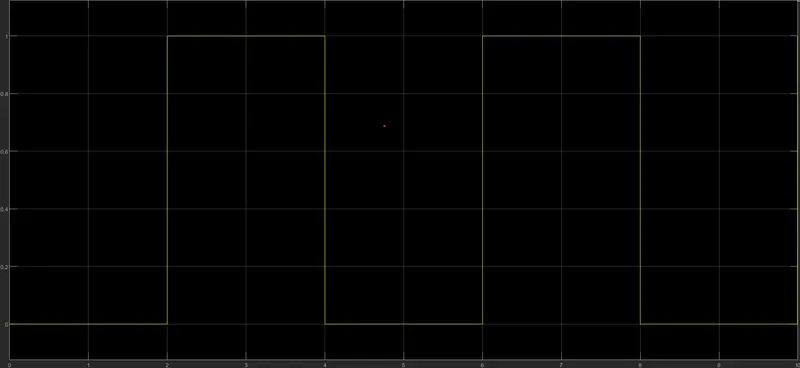
Output signal