Week -2
Aim : To make a simulink model of a doorbell using sollenoid
Principle :
The electric doorbell which we all have observed in our day-to-day life is said to be a simple circuit that triggers a sound on the completion of a circuit by pressing the button. It is said to be this simplicity that makes the doorbell such a marvel. Simple devices like the doorbell in the house put the scientific principle of electromagnetism into action in a useful way. In order to understand the operations of an electric bell, we should first understand what an electromagnet is. Well, to put it in simple words an electromagnet is said to be a type of magnet in which the magnetic field is produced with the help of an electric current. Under any electrical influences electromagnet generally works as a standard magnet that is generating magnetic fields. When the power generated by an electromagnet stops, we can see the production of the magnetic field also stops. So we can say that in an electric bell an electromagnet generally forms a very important part along with the armature and the spring, armature rod, hammer, and a gong.
Once the setup is completed when the switch is pressed then the circuit loop is complete which causes the flow of current through the circuit. The arm which generally strikes the gong is connected to spring at one end and a ball of iron at the other end. This is known as a hammer or a striker. For the working of an electric bell, the magnetic field that is created by the electromagnet attracts the iron strip which is towards it when the circuit is complete. This is the moment when we hear the ringing sound since the hammer keeps hitting the gong.
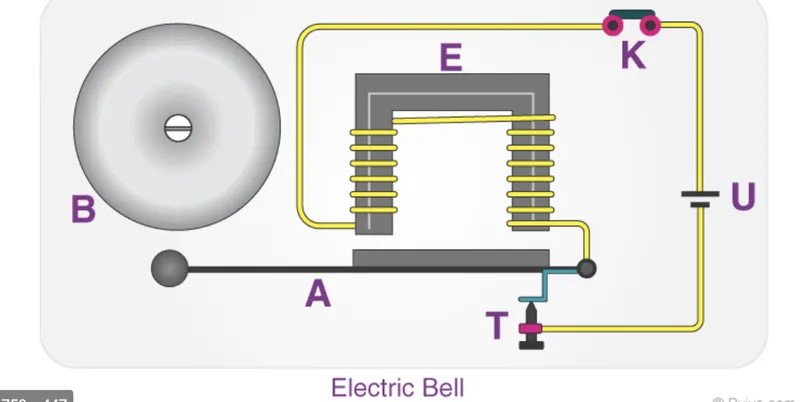
MAin Block
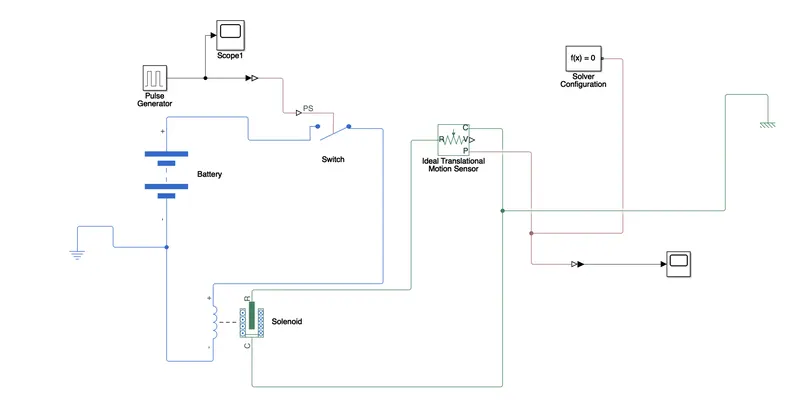
Explanation of the blocK
PUlse generator is connected to a switch which gives a pulse width of 50 with a period of 4 sec with a delay of 2sec.
When the switch is colsed the circuit is completed and current flows from a 12V battery to a solenoidwhich has a rated voltage of 50V
The sollenoid is connected to a transaltional motion sensor whose intial position is zero
Scope block is used to determine the movement of the bell.
Electrical reference is used to make sure electrical system are grounded
Output
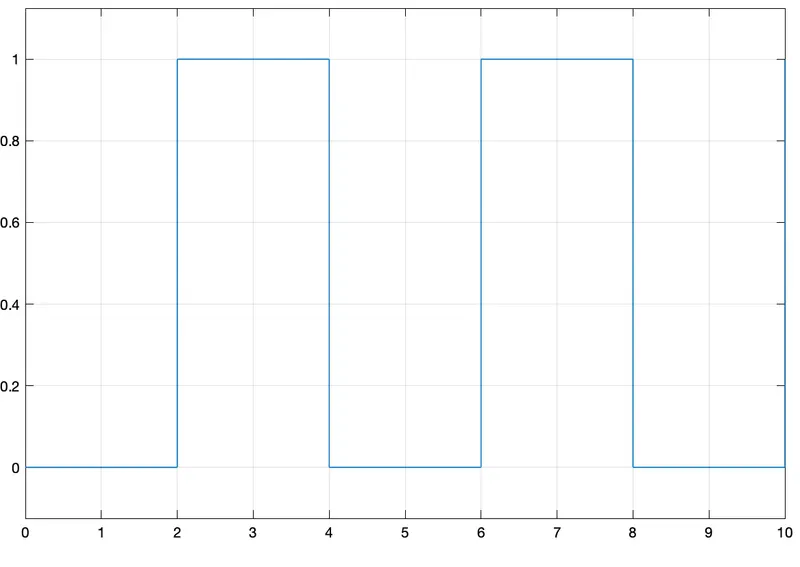
Pulse generator with a delay of 2 sec
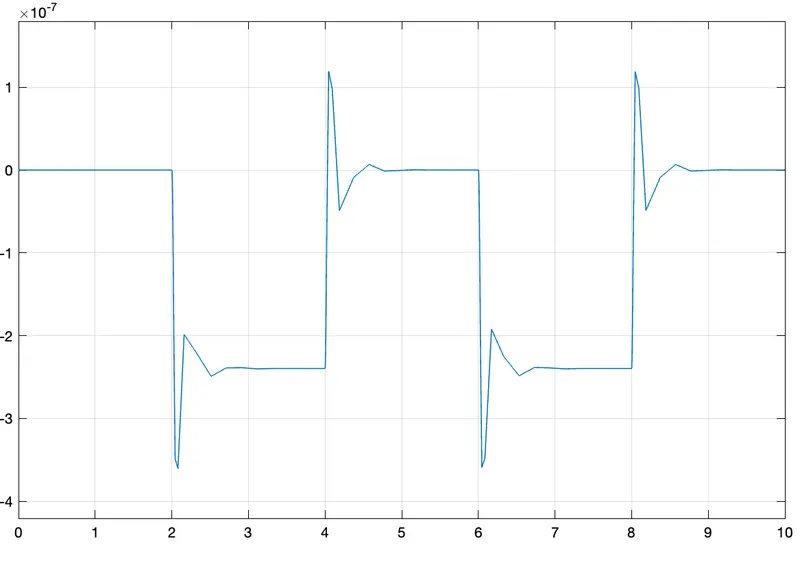
Movement of the bell
Model 2
Aim :Use a thermistor to sense the temperature of a heater & turn on or turn off the fan
Principle :
The term thermistor comes from “thermal” and “resistor”. A thermistor is a type of resistor whose resistance is reliant on temperature; it’s a resistance thermometer. They’re made from metallic oxide which is moulded into a bead, disk, or cylindrical shape and then enclosed with epoxy or glass.
Thermistors don’t work well with extreme temperatures, but they are perfectly suited for measuring the temperature at a certain point; they’re precise when they’re used within a limited temperature range i.e. within 50 °C of the target temperature; this range is dependent on the base resistance.
Thermistors are easy to use, relatively cheap, and durable. They’re commonly used in digital thermometers, in vehicles to measure oil and coolant temperatures, and in household appliances such as ovens and refrigerators and are preferred for applications that require heating or cooling protection circuits for safe operation.
Depending on materials used, thermistors are classified into two types:
- With NTC thermistors, resistance decreases as temperature rises; usually due to an increase in conduction electrons bumped up by thermal agitation from the valence band. An NTC is commonly used as a temperature sensor, or in series with a circuit as an inrush current limiter.
- With PTC thermistors, resistance increases as temperature rises; usually due to increased thermal lattice agitations particularly those of impurities and imperfections. PTC thermistors are commonly installed in series with a circuit, and used to protect against overcurrent conditions, as resettable fuses.
Model :
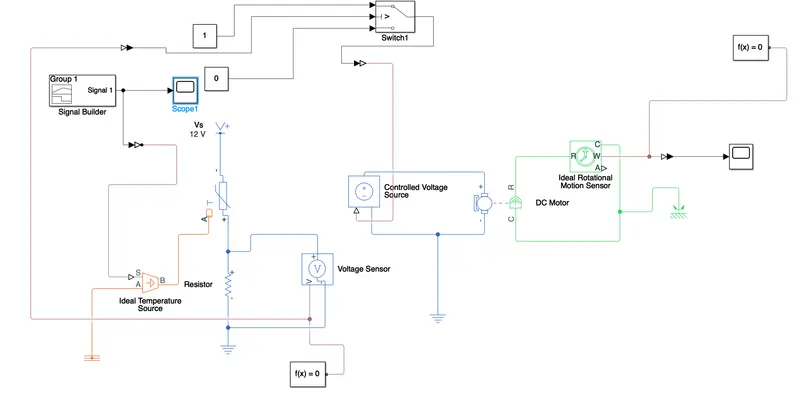
Explanation of the Code:
The heat generating device or signal bulider produces a signal and over a period of time when the frequency increases.The thermistor therefore heats up and its resistance decreases. Therefore increases the current in circuit.
The increase in current is detected by the Voltage sensor.When the current recahes a certain point the switch is closed .
Controlled Voltage Source then supplies the current to a DC motor which in turns on the fan
Electrical reference is given to elctrical systems to make sure its grounded.
Once the termistor cools down its resistance increases. As a result its current in the circuit goes down.