Doorbell model using Simulink and Simscape
Objectives:-
To make a Simulink model of Doorbell using Solenoid block.
To use a thermistor to sense the temperature of a heater & turn on or turn off the fan as per given conditions.
Theory:-
In door bell arrangement, when the switch is closed the electromagnet receives electrical power from the battery and pulls the metal arm to hit the bell producing sound. In this arrangement we are using a Solenoid block.
Solenoid - A solenoid is a device comprised of a coil of wire, the housing and a moveable plunger (armature). When an electrical current is introduced, a magnetic field forms around the coil which draws the plunger in. More simply, a solenoid converts electrical energy into mechanical work.
- The coil is made of many turns of tightly wound copper wire. When an electrical current flows through this wire, a strong magnetic field/flux is created.
- The housing, usually made of iron or steel, surrounds the coil concentrating the magnetic field generated by the coil.
- The plunger is attracted to the stop through the concentration of the magnetic field providing the mechanical force to do work.
Model:-
https://drive.google.com/file/d/1NwVWp17JZRQ8GBQcxBCobSdqAcyVkjNR/view?usp=sharing
Explaination:-
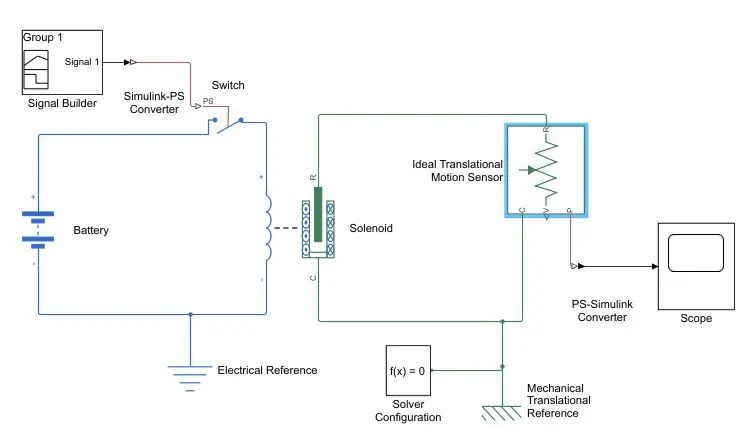
The given above is the simulink model of doorbell using a solenoid.
A solenoid converts electrical energy into mechanical energy, a 12v dc supply is provided to the the solenoid at the input terminals. A switch is introduced in between, which when closed the doorbell must ring. The system requires a 2 sec delay as we press the switch, this provided by using a signal builder block. Hence for the first 2 second of the simulation i.e. when the switch is closed signal is provided.
When the switch is closed the mechanical part of the solenoid, R port (Plunger) moves towards the C port for 2 seconds. In doorbell this is the motion which generates the sound.
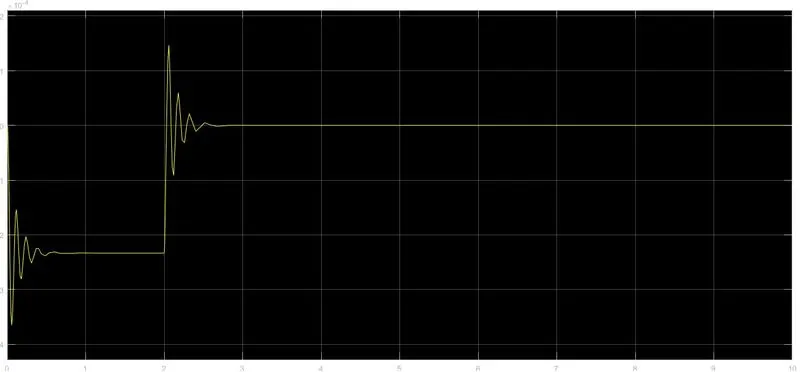
Here we want to observe the movement of the plunger. Since the plunger is moving we connect an Ideal Translational Motion sensor to the plunger and the output of the motion sensor is viewed in a scope. The scope here shows the movement of the plunger.
Electrical and Mechanical Refrences are connected where an electrical or a mechanical system are formed. Converters (PS -Simulink converter and Simulink -PS Converter) are used where ever there is a need to convert a signal. Since our model contains simscape as well as simulink blocks Solver Configuration block is used for smooth running of the system.
Output:-
Theory:-
A thermistor is a type of resistor whose resistance is strongly dependent on temperature, more so than in standard resistors. The word is a combination of thermal and resistor. Thermistors are widely used as inrush current limiters or thermal sensors (negative temperature coefficient or NTC type typically), self resetting overcurrent protectors and self-regulating heating elements (positive temperature coefficient or PTC type typically). An operational temperature range of a thermistor is dependent on the probe type and is typically in between −100 C (173 K) and 300 C (573 K).
Model:-
https://drive.google.com/file/d/1h4wKxbw4oYnZ3hXa2XhLMin-CkKTguh2/view?usp=sharing
Explaination:-
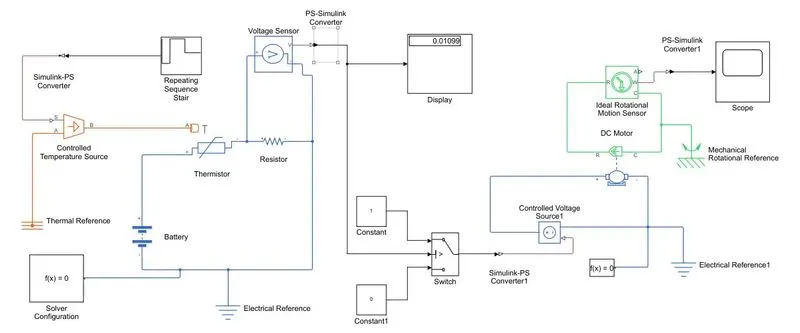
The required condition says that we need temperature of 20 C for 1st 10 seconds then 27 C for next 20 seconds and 23 C for next 20 seconds. This done using a Repeating Sequence stair block where we provide the 3 different inputs accoring to the mentioned time.
This input is then given to the controlled temperature source which gives output accordingly to the input provided. The temperature source is the connected to the thermistor. For a thermistor to operate it aslo requires a voltage source hence a battery is connected. A resistor is connected in series with the thermistor. When a constant supply is given to the thermistor we will get a constant voltage drop across the resistor as soon the temperature given to the thermistor is varried the voltage drop will also varry accordingly.
We need to turn on the fan when the temperature is above 25 C else the fan should be off. So here we calculate the voltage drop around the resistor using a Voltage Sensor when the temperature given to thermistor is 25 C. Further to satisfy the mentioned if else statement we use a switch where if the voltage drop is above the voltage drop at 25 C the switch will be on else the switch will be off.
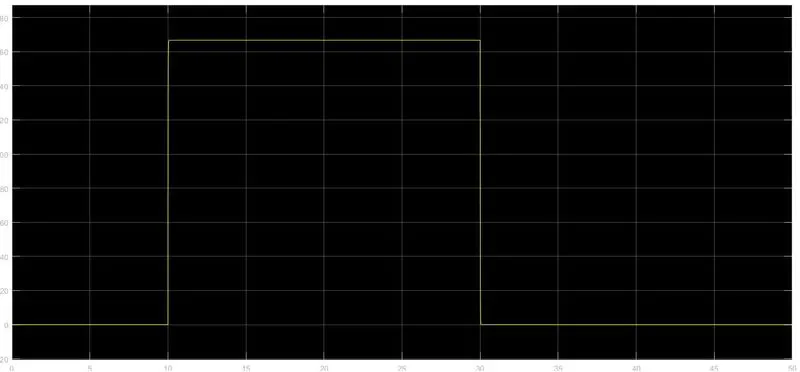
The output of the switch is connected to a Controlled Voltage Source. This Controlled Voltage Source gives supply to the DC Motor (in our case a fan). To check when the dc motor is on or off can be observe by rotation of the rotor. In simulink to observe the rotational motion, a Ideal Rotational Motion Sensor is used and the presence of angular velocity describes the motor is on or off. This angular velocity is observed in the scope.
Electrical and Mechanical Refrences are connected where an electrical or a mechanical system are formed. Converters (PS -Simulink converter and Simulink -PS Converter) are used where ever there is a need to convert a signal. Since our model contains simscape as well as simulink blocks Solver Configuration block is used for smooth running of the system.
Output:-
Conclusion:
From the doorbell model by observing the output we can conclude that the plunger moves for the total delay of 2 seconds. The small fluctuations in the graph are of the metal vibrations which creates the doorbell sound.
From the Fan model by observing the output we can conclude that the fan turns on from 10 to 30 seconds as this is the time period when our temperature is above 25 C esle our fan is off.