Week 12 - Validation studies of Symmetry BC vs Wedge BC in OpenFOAM vs Analytical H.P equation
Objective : To Simulate the incomressible laminar flow through a pipe using OpenFoam
- Validate Hydro-dynamic length with the numerical result
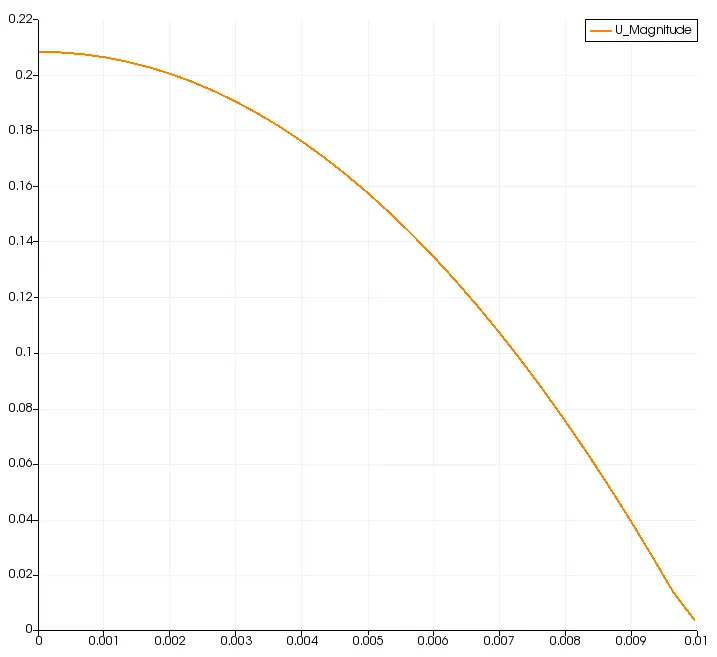
- Validate the fully developed flow velocity profile with its analytical profile
- Validate maximum velocity and pressured drop for fully developed flow
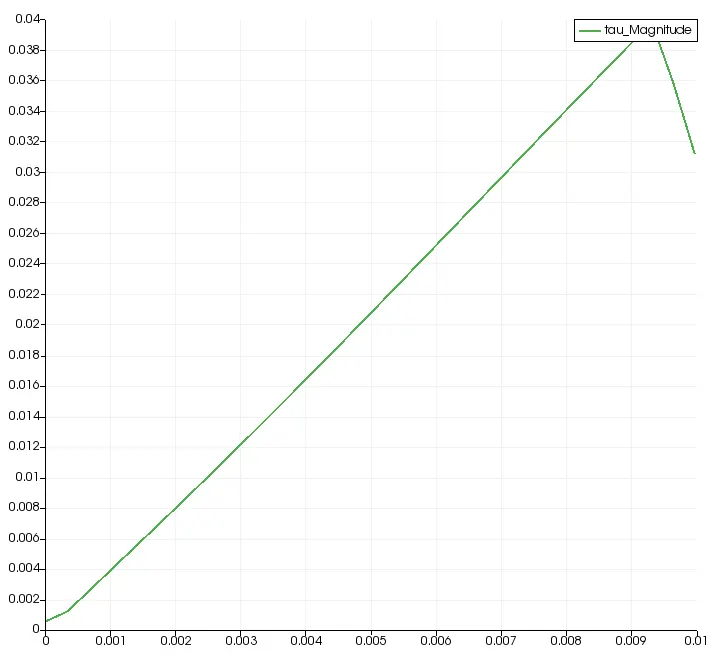
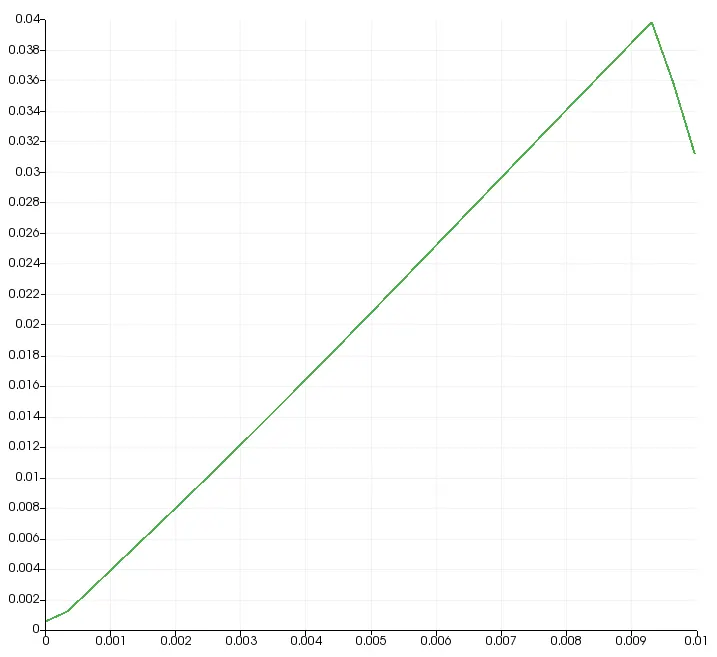
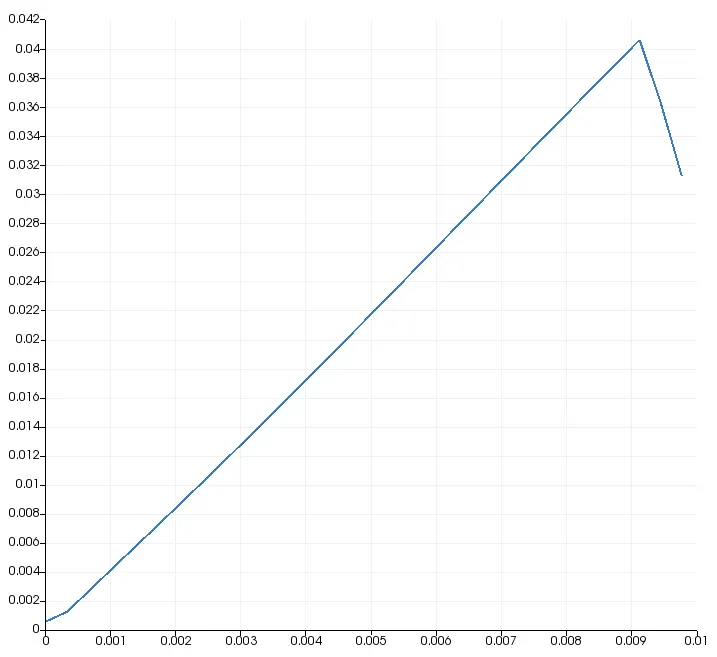
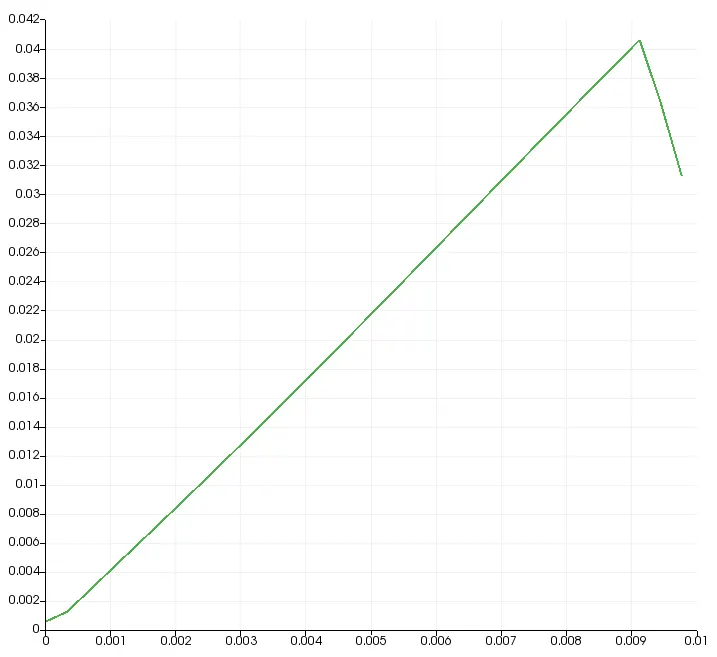
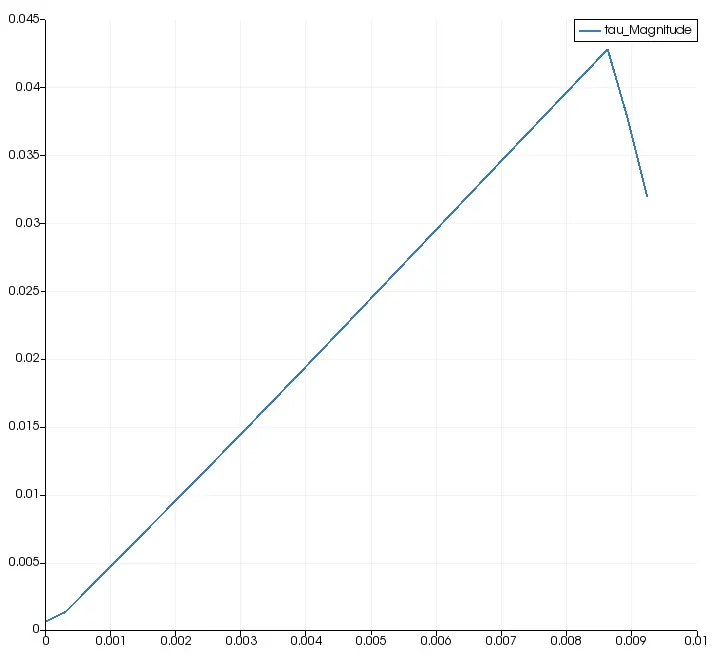
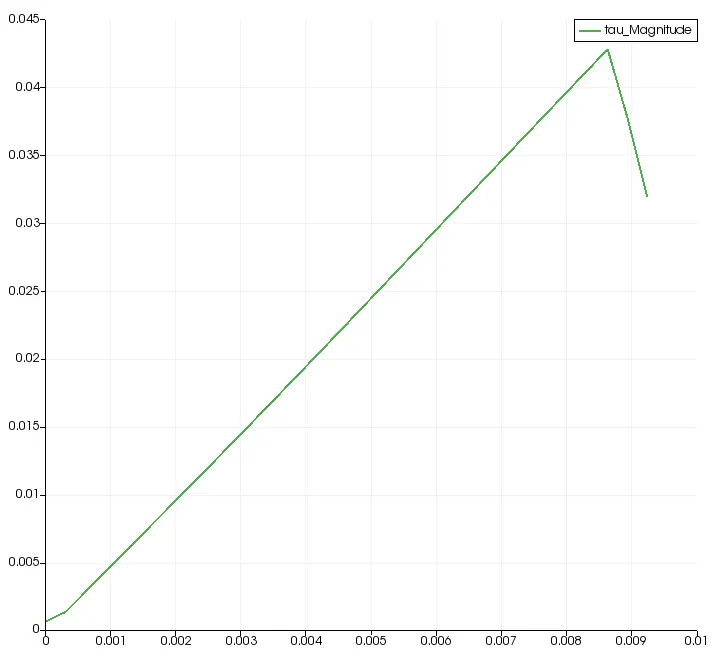
- Post-process Shear stress and validate wall shear stress for fully developed flow
- To validate the results with the Hagen- Poiseuille's equations for the fully developed flow.
- Use both symmetry and wedge boundary conditions and validate the results
Angles to test:
- `10degree`
- `25degree`
- `45degree`
Procedure :
- Edit the matlab code and input the above mentioned angle and change the BC
- After generating the blockmesh dict file we make the appropriate BC changes in the OpenFoam
- Run the simulation and plot then neccesary graphs at Wedge angles . .
Matlab Code : using Symmetry Bc ( `10degree` wedge angle )
clear all
close all
clc

%Inputs
Re = input('Renolds Number = ');
D = input('Diameter of the pipe =');
L = 0.05*Re*D;%entry length of the pipe
L_p  = L+0.3;%total length of the pipe
r = D/2; %radius of the pipe
theta = input('Angle of the wedge =');
mu = input('Dynamic viscosity =');
rho = input('Density =');

%Hagen Poiseuille flow equations

v_avg = (Re*mu)/(rho*D);
v_max = 2*(v_avg);
del_p = (8*mu*L_p*v_avg)/(r^2);
P = del_p/rho;
kv = mu/rho;


f1 = fopen('blockMeshDict','w');


header1='/*--------------------------------*- C++ -*----------------------------------*\';
header2=' =========                 |                                                   ';
header3=' \\      /  F ield         | OpenFOAM: The Open Source CFD Toolbox             ';
header4='  \\    /   O peration     | Website:  https://openfoam.org                    ';
header5='   \\  /    A nd           | Version:  8                                       ';
header6='    \\/     M anipulation  |                                                   ';
header7='\*---------------------------------------------------------------------------*/';

fprintf(f1, '%s\n', header1);
fprintf(f1, '%s\n', header2);
fprintf(f1, '%s\n', header3);
fprintf(f1, '%s\n', header4);
fprintf(f1, '%s\n', header5);
fprintf(f1, '%s\n', header6);
fprintf(f1, '%s\n', header7);

fprintf(f1, 'FoamFile\n{\n');
fprintf(f1, '%12s \t 2.0;\n','version');
fprintf(f1, '%12s \t ascii;\n','format');
fprintf(f1, '%12s \t dictionary;\n','class');
fprintf(f1, '%12s \t blockMeshDict;\n','object');
fprintf(f1, '}\n');
header8='// * * * * * * * * * * * * * * * * * * * * * * * * * * * * * * * * * * * * * //';
fprintf(f1, '%s\n\n',header8);

fprintf(f1, 'convertToMeters 1;\n\n');

fprintf(f1, 'vertices\n');
fprintf(f1, '(\n');
fprintf(f1, '\t (%d %d %d)\n',0,0,0);
fprintf(f1, '\t (%d %d %d)\n',0,r*cosd(theta/2),r*sind(theta/2));
fprintf(f1, '\t (%d %d %d)\n',0,r*cosd(theta/2),-r*sind(theta/2));
fprintf(f1, '\t (%d %d %d)\n',L_p,0,0);
fprintf(f1, '\t (%d %d %d)\n',L_p,r*cosd(theta/2),r*sind(theta/2));
fprintf(f1, '\t (%d %d %d)\n',L_p,r*cosd(theta/2),-r*sind(theta/2));
fprintf(f1, ');\n\n');


fprintf(f1, 'blocks\n');
fprintf(f1, '(\n');
fprintf(f1, '\t hex (0 1 4 3 0 2 5 3) (%d %d %d)', 30,300,1);
fprintf(f1, 'SimpleGrading (1 1 1)\n\n');
fprintf(f1, ');\n\n');

fprintf(f1, 'edges\n');
fprintf(f1, '(\n');
fprintf(f1, '\t arc %d %d (%d %d %d)\n', 1,2,0,r,0);
fprintf(f1, '\t arc %d %d (%d %d %d)\n',4,5,L_p,r,0);
fprintf(f1, ');\n\n');

fprintf(f1, 'boundary\n');
fprintf(f1, '(\n');
fprintf(f1, '\t inlet \n');
fprintf(f1, '\t {\n');
fprintf(f1, '\t\t type patch;\n');
fprintf(f1, '\t\t faces\n');
fprintf(f1, '\t\t (\n');
fprintf(f1, '\t\t\t (0 1 2 0)\n');
fprintf(f1, '\t\t );\n');
fprintf(f1, '\t }\n');


fprintf(f1, '\t outlet \n');
fprintf(f1, '\t {\n');
fprintf(f1, '\t\t type patch;\n');
fprintf(f1, '\t\t faces\n');
fprintf(f1, '\t\t (\n');
fprintf(f1, '\t\t\t (3 5 4 3)\n');
fprintf(f1, '\t\t );\n');
fprintf(f1, '\t }\n');

fprintf(f1, '\t top \n');
fprintf(f1, '\t {\n');
fprintf(f1, '\t\t type wall;\n');
fprintf(f1, '\t\t faces\n');
fprintf(f1, '\t\t (\n');
fprintf(f1, '\t\t\t (1 4 5 2)\n');
fprintf(f1, '\t\t );\n');
fprintf(f1, '\t }\n');

fprintf(f1, '\t front \n');
fprintf(f1, '\t {\n');
fprintf(f1, '\t\t type symmetry;\n');
fprintf(f1, '\t\t faces\n');
fprintf(f1, '\t\t (\n');
fprintf(f1, '\t\t\t (0 3 4 1)\n');
fprintf(f1, '\t\t );\n');
fprintf(f1, '\t }\n');

fprintf(f1, '\t back \n');
fprintf(f1, '\t {\n');
fprintf(f1, '\t\t type symmetry;\n');
fprintf(f1, '\t\t faces\n');
fprintf(f1, '\t\t (\n');
fprintf(f1, '\t\t\t (0 2 5 3)\n');
fprintf(f1, '\t\t );\n');
fprintf(f1, '\t }\n');

fprintf(f1, '\t axis \n');
fprintf(f1, '\t {\n');
fprintf(f1, '\t\t type empty;\n');
fprintf(f1, '\t\t faces\n');
fprintf(f1, '\t\t (\n');
fprintf(f1, '\t\t\t (0 3 3 0)\n');
fprintf(f1, '\t\t );\n');
fprintf(f1, '\t }\n');
fprintf(f1, '); \n\n');

fprintf(f1, 'mergePatchPairs\n');
fprintf(f1, '(\n');
fprintf(f1, ');\n');

header9='// * * * * * * * * * * * * * * * * * * * * * * * * * * * * * * * * * * * * * //';
fprintf(f1, '%s\n',header9);

fclose(f1);
BlockMeshDict
/*--------------------------------*- C++ -*----------------------------------*\
 =========                 |
 \\      /  F ield         | OpenFOAM: The Open Source CFD Toolbox
  \\    /   O peration     | Website:  https://openfoam.org
   \\  /    A nd           | Version:  8
    \\/     M anipulation  |
\*---------------------------------------------------------------------------*/
FoamFile
{
     version 	 2.0;
      format 	 ascii;
       class 	 dictionary;
      object 	 blockMeshDict;
}
// * * * * * * * * * * * * * * * * * * * * * * * * * * * * * * * * * * * * * //

convertToMeters 1;

vertices
(
	 (0 0 0)
	 (0 9.961947e-03 8.715574e-04)
	 (0 9.961947e-03 -8.715574e-04)
	 (2.400000e+00 0 0)
	 (2.400000e+00 9.961947e-03 8.715574e-04)
	 (2.400000e+00 9.961947e-03 -8.715574e-04)
);

blocks
(
	 hex (0 1 4 3 0 2 5 3) (30 300 1)SimpleGrading (1 1 1)

);

edges
(
	 arc 1 2 (0 1.000000e-02 0)
	 arc 4 5 (2.400000e+00 1.000000e-02 0)
);

boundary
(
	 inlet
	 {
		 type patch;
		 faces
		 (
			 (0 1 2 0)
		 );
	 }
	 outlet
	 {
		 type patch;
		 faces
		 (
			 (3 5 4 3)
		 );
	 }
	 top
	 {
		 type wall;
		 faces
		 (
			 (1 4 5 2)
		 );
	 }
	 front
	 {
		 type symmetry;
		 faces
		 (
			 (0 3 4 1)
		 );
	 }
	 back
	 {
		 type symmetry;
		 faces
		 (
			 (0 2 5 3)
		 );
	 }
	 axis
	 {
		 type empty;
		 faces
		 (
			 (0 3 3 0)
		 );
	 }
);

mergePatchPairs
(
);
// * * * * * * * * * * * * * * * * * * * * * * * * * * * * * * * * * * * * * //
Pressure BC
/*--------------------------------*- C++ -*----------------------------------*\
  =========                 |
  \\      /  F ield         | OpenFOAM: The Open Source CFD Toolbox
   \\    /   O peration     | Website:  https://openfoam.org
    \\  /    A nd           | Version:  8
     \\/     M anipulation  |
\*---------------------------------------------------------------------------*/
FoamFile
{
    version     2.0;
    format      ascii;
    class       volScalarField;
    object      p;
}
// * * * * * * * * * * * * * * * * * * * * * * * * * * * * * * * * * * * * * //

dimensions      [0 2 -2 0 0 0 0];

internalField   uniform 0;

boundaryField
{
    inlet
    {
        type            zeroGradient;
    }

    outlet
    {
        type            fixedValue;
        value           uniform 0.02;
    }


    axis
    {
        type            empty;
    }

    top
     {
        type            zeroGradient;
    }

    front
     {
        type            symmetry;
    }

    back
     {
        type            symmetry;
    }
}

// ************************************************************************* //
Velocity BC
/*--------------------------------*- C++ -*----------------------------------*\
  =========                 |
  \\      /  F ield         | OpenFOAM: The Open Source CFD Toolbox
   \\    /   O peration     | Website:  https://openfoam.org
    \\  /    A nd           | Version:  8
     \\/     M anipulation  |
\*---------------------------------------------------------------------------*/
FoamFile
{
    version     2.0;
    format      ascii;
    class       volVectorField;
    object      U;
}
// * * * * * * * * * * * * * * * * * * * * * * * * * * * * * * * * * * * * * //

dimensions      [0 1 -1 0 0 0 0];

internalField   uniform (0 0 0);

boundaryField
{
    inlet
    {
        type            fixedValue;
        value           uniform (0.1054 0 0) ;
    }

    outlet
    {
        type            zeroGradient;
    }


    axis
    {
        type            empty;
    }

    top
     {
        type            noSlip;
    }

    front
     {
        type            symmetry;
    }

    back
     {
        type            symmetry;
    }
}

// ************************************************************************* //
Results
- Shear Stress Variation
| Wedge BC (`10degree`) | Symmetry BC (`10degree`) |
| Wedge BC (`25degree`) | Symmetry BC (`25degree`) |
| Wedge BC (`45degree`) | Symmetry BC (`45degree`) |
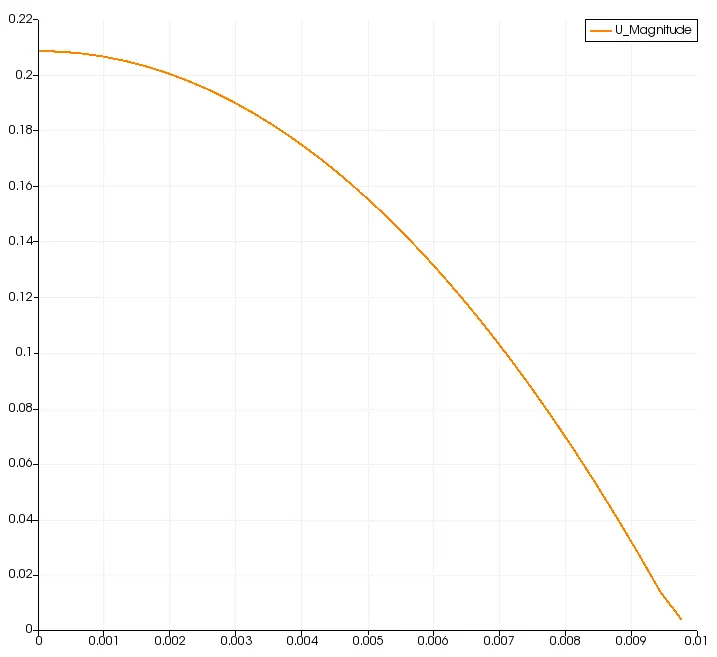
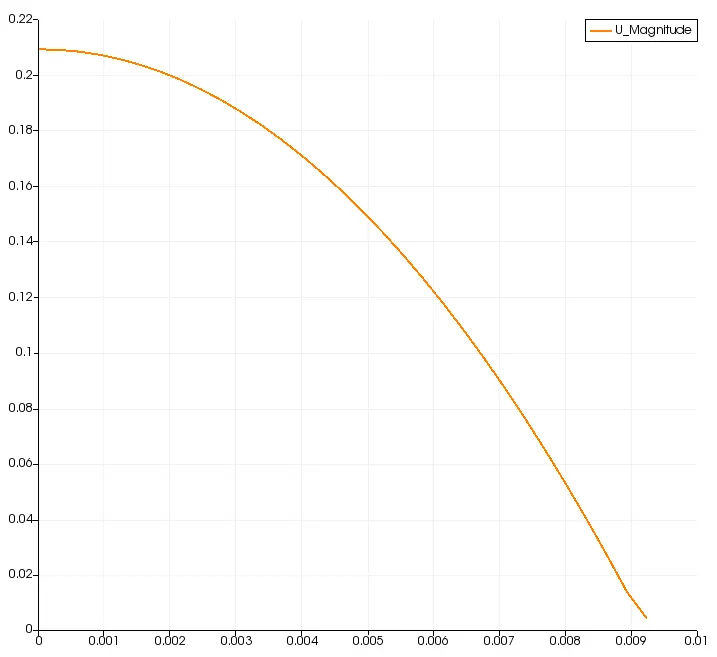
2. Velocity variation
| Wedge BC (`10degree`) | Symmetry BC (`10degree`) |
| Wedge BC (`25degree`) | Symmetry BC (`25degree`) |
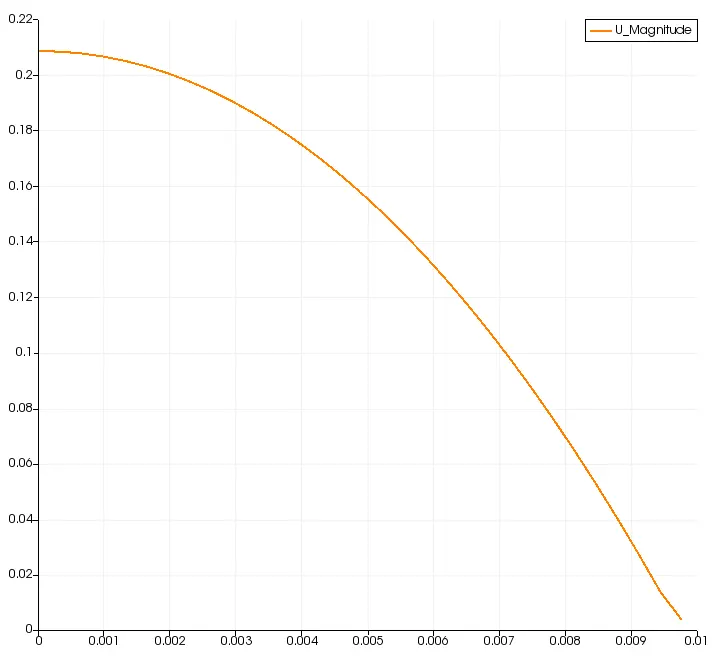
| Wedge BC (`45degree`) | Symmetry BC (`45degree`) |
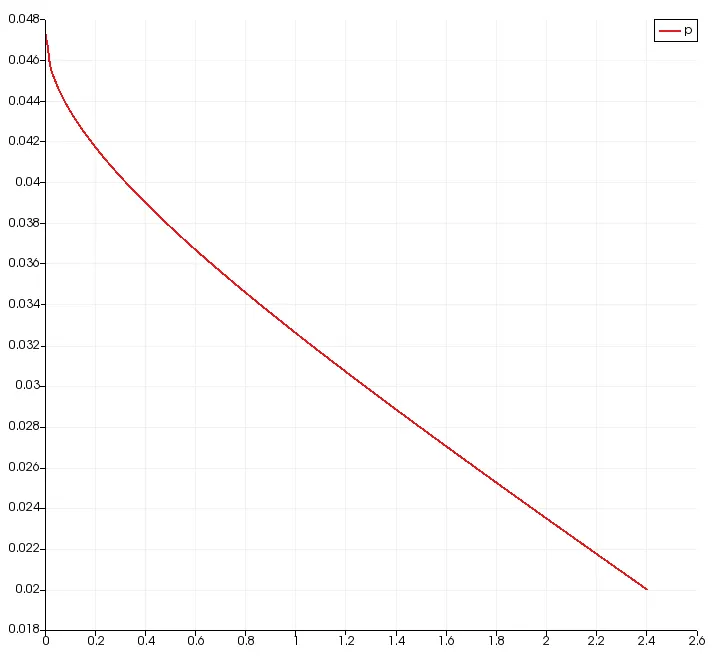
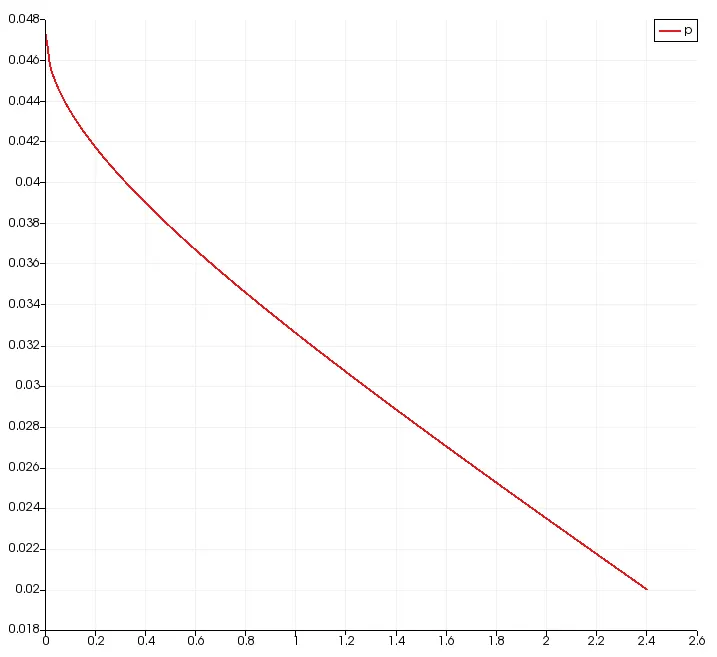
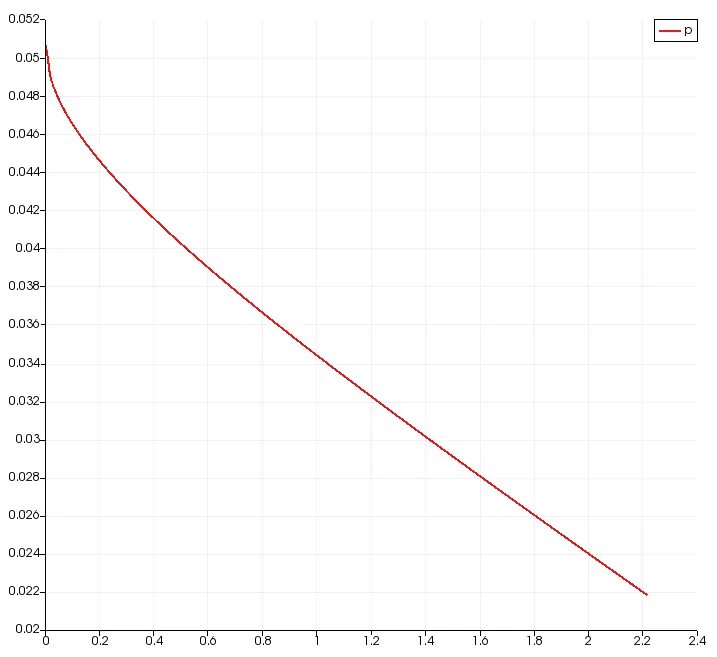
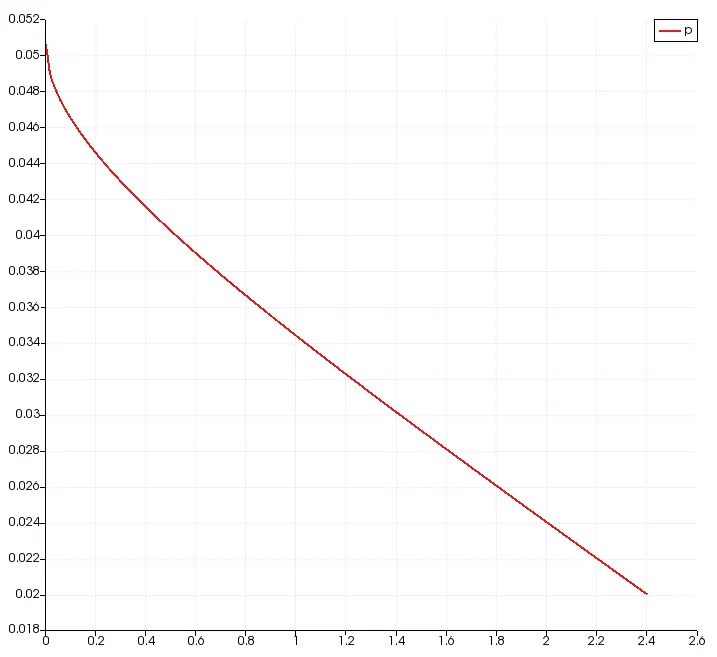
3. Pressrue drop variation
| Wedge BC (`10degree`) | Symmetry BC (`10degree`) |
| Wedge BC (`25degree`) | Symmetry BC (`25degree`) |
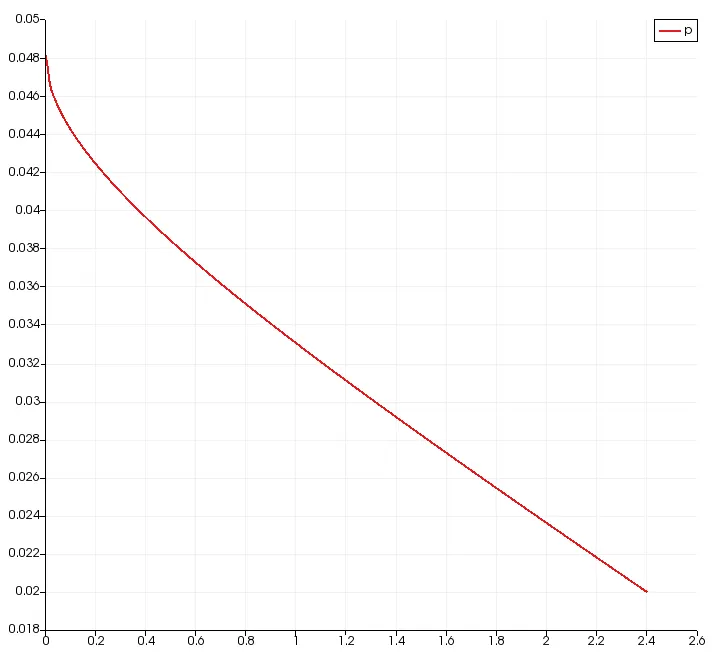
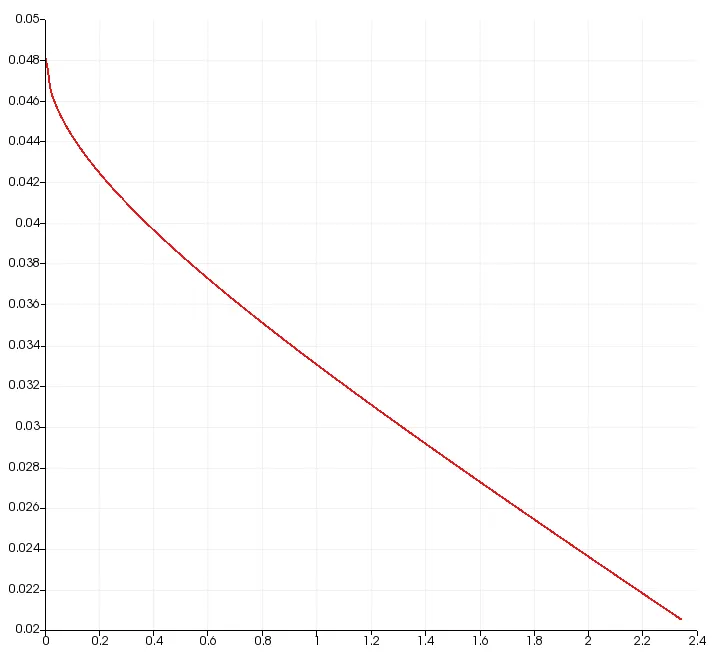
| Wedge BC (`45degree`) | Symmetry BC (`45degree`) |
Validation
Maximum velocity
The maximum velocity obtained from the graph is 2.1m/s
| Numerical | Analytical |
| 2.1m/s | 2.108m/s |
Hydro Dynamic Length
| At x = 0.5 | At x = 2.3 |
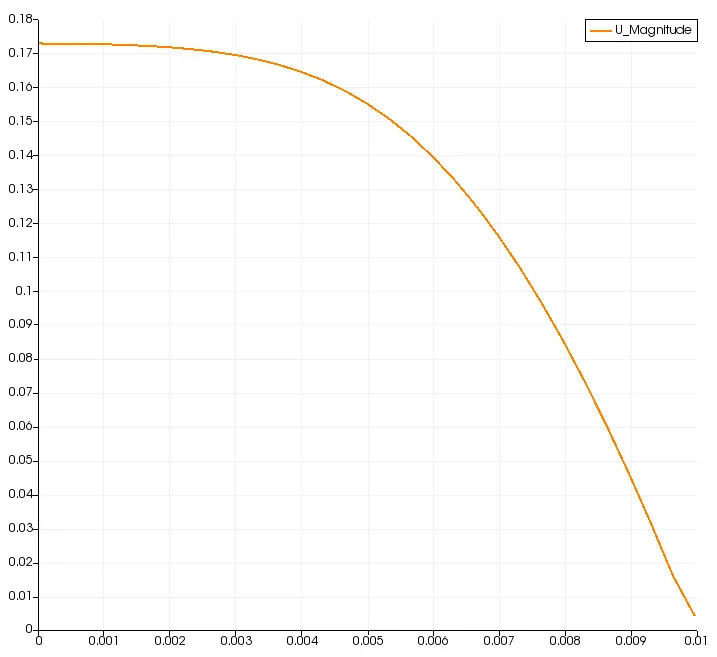
We can observe from the velocity profiles at different locations along x -axis within the Hydrodynamic entrance length the velocity profile is not fully developed and at x = 2.3 (Hydrodynamicaly fully developed region) the velocity attains it maximum as calculated by Hagen- Poiseuille's equations.Analytical the fully developed velocity profile is attained only after x = 2.1 m
Wall shear stress
Shear Stress is maximum near the wall because of the friction , and reduces as we move away from the wall
Differences between Boundary conditons
The symmetry BC considers the mesh as 3D and the calculation is done along all 3 axes. This also increases the compitational time . The results are not changing as we change the BC's