Week 12 - Validation studies of Symmetry BC vs Wedge BC in OpenFOAM vs Analytical H.P equation
Validation studies of Symmetry BC vs Wedge BC in OpenFOAM vs Analytical H.P equation
Aim: To simulate the flow in a pipe through openfoam.
Objective:
- Validate Hydro-dynamic length with the numerical result
- Validate the fully developed flow velocity profile with its analytical profile
- Validate maximum velocity and pressured drop for fully developed flow
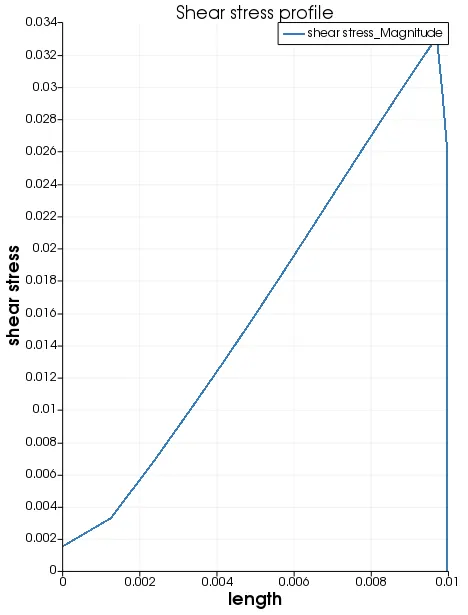
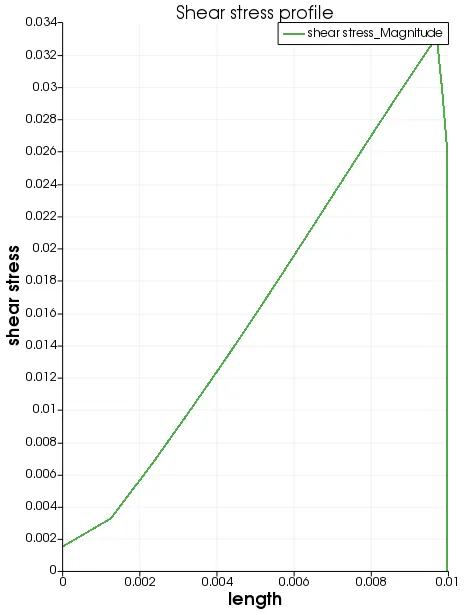
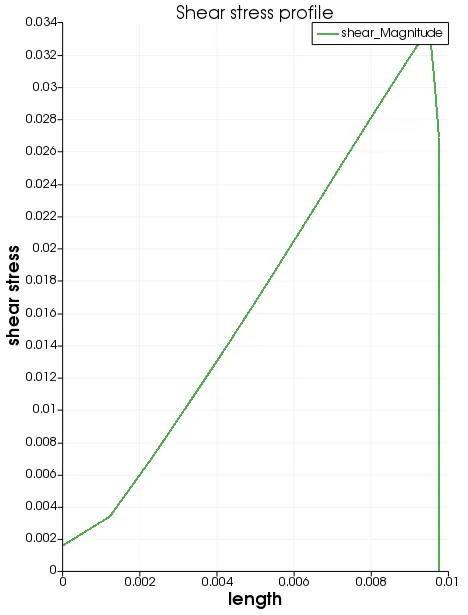
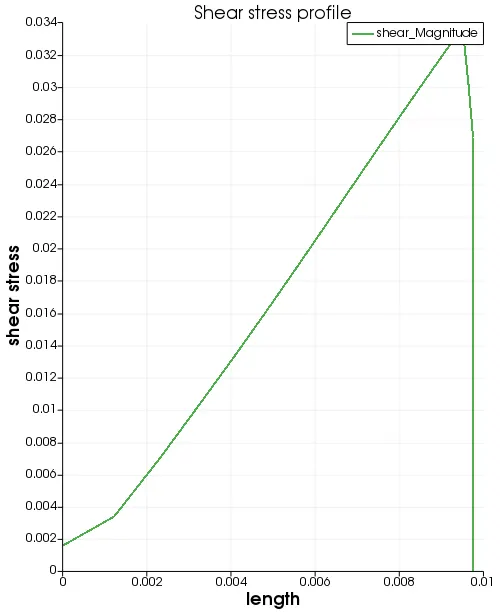
- Post-process Shear stress and validate wall shear stress for fully developed flow
- Highligh the differences in both boundary conditions in terms of their usage and aplication
To simulate flow at angles `10^0, 25^0, 45^0`
Solution:
Consider the water flow through the pipe of 20 mm diameter at velocity of 0.0935m/s of Reynold's number less than 2100, hence laminar flow. Due to No-slip condition, fluid particles in contact with the pipe stops completely.
Boundary layer theory:
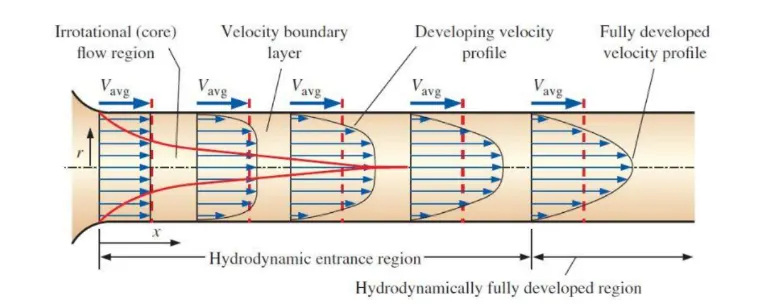
Consider a fluid entering a circular pipe at uniform velocity, with no-slip condition.
The velocity of fluid at mid-section has to increase to keep mass flow rate through the pipe constant, resulting in velocity gradient.
Hydrodynamic entrance region is region from inlet to the point at which velocity profile becomes fully developed, and its length is hydrodynamic entrance length.
Reynolds number is the ratio of inertial force to viscous force.
`Re=ρ⋅v⋅L`
Hagen- Poiseuille's flow: It is the pressure drop in incompressible fluid in laminar flow through the long cylindrical pipe of constant cross section. Flow is caused to flow by pressure difference between the points, from higher pressure to lower pressure.
It is assumed to have no acceleration of flow. Flow resistance offered is shear stress.
Shear stress is
`τ=μ⋅dudy`
pressure difference is represented as
`gradp=(32⋅μ⋅V⋅L)/D^2`
Enterance length
L_ent=0.06*Re*D
MATLAB Code:
Code for wedge blockmeshdict file and to calculate analytical result.
clear all
close all
clc

D=0.02;
Re=2100;
rho=1000; %density
theta=10;
nu=8.91e-7;  %kinematic viscocity

%dynamic vis
mu=rho*nu;
v_avg= mu*Re/(rho*D);
v_max=2*v_avg;

L_w=0.3;
L_entrance= 0.06* Re*D;
L=L_entrance+L_w;


%pressure drop in flow
delta_p= 32*mu*v_avg*L_w/D^2;


r=D/2;
R=linspace(0,r,500);

for i=1:length(R)

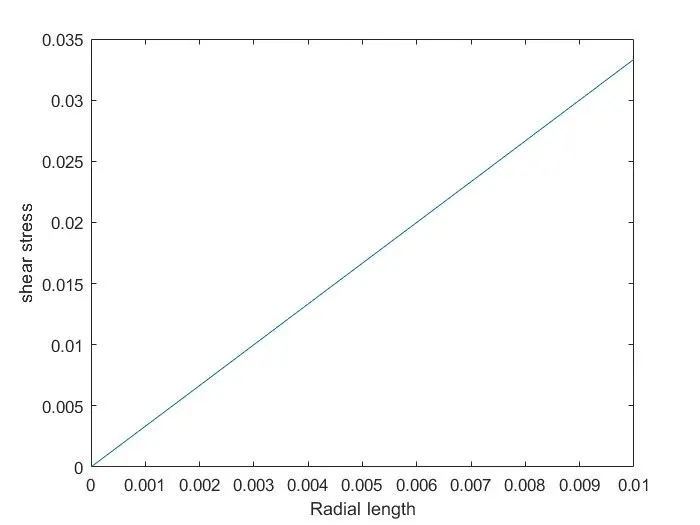
    tau(i)=2*mu*v_max*(abs(R(i)))/r^2;

end

for j=1: length(R)

    vel_p(j)=2*v_avg*(1-(abs(R(j))^2/r^2));
end
figure(1)
plot(R,tau)
ylabel('shear stress')
xlabel('Radial length')

figure (2)
plot(R,vel_p)
ylabel('velocity')
xlabel('Radial length')
%blockmeshdict file

v0=[0 0 0];
v1=[0 r*cosd(theta/2) -r*sind(theta/2)];
v2=[0 r*cosd(theta/2) r*sind(theta/2)];
v3=[L 0 0];
v4=[L r*cosd(theta/2) -r*sind(theta/2)];
v5=[L r*cosd(theta/2) r*sind(theta/2)];

f1=fopen('blockMeshDict','w');

fprintf(f1,'\t FoamFile \n')
fprintf(f1,'\t { \n')
fprintf(f1,'\t \t format      ascii;\n')
fprintf(f1,'\t\t class       dictionary;\n')
fprintf(f1,'\t\t object      blockMeshDict;\n')
fprintf(f1,'\t } \n')
%vertices
fprintf(f1,'%s \n','convertToMeters 1 ;')
fprintf(f1,'\n %s \n','vertices')
fprintf(f1,'%s \n','(')
fprintf(f1,'\t(%d %d %d)\n',v0(1), v0(2), v0(3))
fprintf(f1,'\t(%d %d %d)\n',v1(1), v1(2), v1(3))
fprintf(f1,'\t(%d %d %d)\n',v2(1), v2(2), v2(3))
fprintf(f1,'\t(%d %d %d)\n',v3(1), v3(2), v3(3))
fprintf(f1,'\t(%d %d %d)\n',v4(1), v4(2), v4(3))
fprintf(f1,'\t(%d %d %d)\n',v5(1), v5(2), v5(3))
fprintf(f1,'%s \n',');')

%blocks
fprintf(f1,'%s \n','blocks')
fprintf(f1,'%s \n','(')
fprintf(f1,'\t hex(0 3 4 1 0 3 5 2) (%d %d %d) simpleGrading (%d %d %d)\n', 200,20,1,1,0.1,1)
fprintf(f1,'%s \n',');')

%edges
fprintf(f1,'\n %s \n','edges')
fprintf(f1,'%s \n','(')
fprintf(f1,'\t arc 1 2 (%d %d %d) \n',0,r,0)
fprintf(f1,'\t arc 1 2 (%d %d %d) \n',L,r,0)
fprintf(f1,'\n %s',');')

%boundary
fprintf(f1,'\n %s \n','boundary')
fprintf(f1,'%s \n','(')
fprintf(f1,'\n %s \n','axis')
fprintf(f1,'{ \n \t type empty; \n')
fprintf(f1,'\t faces \n( \n')
fprintf(f1,'\t (%d %d %d %d) \n',0,3,3,0)
fprintf(f1,'\t ) ; \n }\n')

%wall
fprintf(f1,'\n %s \n','wall')
fprintf(f1,'%s \n','{')
fprintf(f1,'\t type wall; \n')
fprintf(f1,'\t faces \n ( \n')
fprintf(f1,'\t (%d %d %d %d) \n',1,4,5,2)
fprintf(f1,'\t ) ; \n }\n')

%inlet
fprintf(f1,'\n %s \n','inlet')
fprintf(f1,'%s \n','{')

fprintf(f1,'\t type patch; \n')
fprintf(f1,'\t faces \n ( \n')
fprintf(f1,'\t (%d %d %d %d) \n',0,1,2,0)
fprintf(f1,'\t ) ; \n }\n')

%outlet
fprintf(f1,'\n %s \n','outlet')
fprintf(f1,'%s \n','{')
fprintf(f1,'\t type patch; \n')
fprintf(f1,'\t faces \n ( \n')
fprintf(f1,'\t (%d %d %d %d) \n',3,5,4,3)
fprintf(f1,'\t ); \n }\n')

%front
fprintf(f1,'\n\t front \n { \n')
fprintf(f1,'\t type wedge ; \n')
fprintf(f1,'\t faces \n ( \n')
fprintf(f1,'\t (%d %d %d %d) \n',0,3,4,1)
fprintf(f1,'\t ) ; \n \t }\n')

%back
fprintf(f1,'\n\t back \n { \n')
fprintf(f1,'\t type wedge ; \n')
fprintf(f1,'\t faces \n ( \n')
fprintf(f1,'\t (%d %d %d %d) \n',0,2,5,3)
fprintf(f1,'\t ) ; \n \t }\n')

fprintf(f1,');')
Explaination:
1. Assign the initial values of the Hagen-Pousville flow.
2. Calculating the properties like dynamic viscocity, average velocity, maximum velocity, entrance length.
3. Also calculate drop in pressure
4. Calculate the shear stress and velocity profile by for loop.
5. Plotting the values to obtain analytical solution.
Create BlockMeshDict file by using write function:
1. Assign vertices at all points on the wedge. (v1, v2 ,v3 , v4, v5) for angle theta =`10^0`
2. Drafting the blockMeshDict file using write function in MATLAB.
3. Drafting should be made with similar pattern as per the blockMeshDict file used in openFoam.
4. Writing the vertices of the wedge.
5. Creating the hexagonal block with grading factor of 0.1 along Y-axis (finer mesh near walls).
6. Assigning edges, wall, boundary, inlet, outlet, front and back of blocks.
Follow the similar method to other angles also `25^0 and 45 ^0`, for different values of theta.
Procedure to simulate the flow:
a. To select solver and copy folder
1. Open terminal command in ubuntu.
2. open tutorials, code: tut
3. And open incompressible folder and select icofoam, then cavity. (code: icoFoam)
4. Copy cavity folder to run folder. using code: 'cp -r pipr/$FOAM_RUN'
5. Type run command to open run folder.
6. Open pipe. (code: cd pipe)
(6a. Also copy and paste the blockMeshDict file created by MATLAB in system folder)
7. Open system file.
8. Run blockMeshDict code file. (code: blockMesh)
BlockMeshDict file:
For angle `10^0` wedge:
FoamFile
{
    format      ascii;
    class       dictionary;
    object      blockMeshDict;
}
convertToMeters 1 ;

 vertices
(
      (0 0 0)
      (0 9.961947e-03 -8.715574e-04)
      (0 9.961947e-03 8.715574e-04)
      (2.820000e+00 0 0)
      (2.820000e+00 9.961947e-03 -8.715574e-04)
      (2.820000e+00 9.961947e-03 8.715574e-04)
);
blocks
(
	 hex (0 3 4 1 0 3 5 2) (200 20 1) simpleGrading (1 0.1 1)
);

 edges
(
	 arc 1 2 (0 1.000000e-02 0)
	 arc 4 5 (2.820000e+00 1.000000e-02 0)

 );
 boundary
(

 axis
{
 	 type empty;
	 faces
(
	 (0 3 3 0)
	 ) ;
 }

 wall
{
	 type wall;
	 faces
 (
	 (1 4 5 2)
	 ) ;
 }

 inlet
{
	 type patch;
	 faces
 (
	 (0 1 2 0)
	 ) ;
 }

 outlet
{
	 type patch;
	 faces
 (
	 (3 5 4 3)
	 );
 }

	 front
 {
	 type symmetry ;
	 faces
 (
	 (0 3 4 1)
	 ) ;
 	 }

	 back
 {
	 type symmetry	 ;
	 faces
 (
	 (0 2 5 3)
	 ) ;
 	 }
);
for theta= 25 :
FoamFile
{
    format      ascii;
    class       dictionary;
    object      blockMeshDict;
}
convertToMeters 1 ;

 vertices
(
     (0 0 0)
      (0 9.762960e-03 -2.164396e-03)
      (0 9.762960e-03 2.164396e-03)
      (2.820000e+00 0 0)
      (2.820000e+00 9.762960e-03 -2.164396e-03)
     (2.820000e+00 9.762960e-03 2.164396e-03)
);
blocks
(
	 hex (0 3 4 1 0 3 5 2) (200 20 1) simpleGrading (1 0.1 1)
);

 edges
(
	 arc 1 2 (0 1.000000e-02 0)
	 arc 4 5 (2.820000e+00 1.000000e-02 0)

 );
 boundary
(

 axis
{
 	 type empty;
	 faces
(
	 (0 3 3 0)
	 ) ;
 }

 wall
{
	 type wall;
	 faces
 (
	 (1 4 5 2)
	 ) ;
 }

 inlet
{
	 type patch;
	 faces
 (
	 (0 1 2 0)
	 ) ;
 }

 outlet
{
	 type patch;
	 faces
 (
	 (3 5 4 3)
	 );
 }

	 front
 {
	 type wedge ;
	 faces
 (
	 (0 3 4 1)
	 ) ;
 	 }

	 back
 {
	 type wedge ;
	 faces
 (
	 (0 2 5 3)
	 ) ;
 	 }
);
For theta = 45
FoamFile
{
    format      ascii;
    class       dictionary;
    object      blockMeshDict;
}
convertToMeters 1 ;

 vertices
(
  (0 0 0)
      (0 9.238795e-03 -3.826834e-03)
      (0 9.238795e-03 3.826834e-03)
      (2.820000e+00 0 0)
      (2.820000e+00 9.238795e-03 -3.826834e-03)
     (2.820000e+00 9.238795e-03 3.826834e-03)
);
blocks
(
	 hex (0 3 4 1 0 3 5 2) (200 20 1) simpleGrading (1 0.1 1)
);

 edges
(
	 arc 1 2 (0 1.000000e-02 0)
	 arc 4 5 (2.820000e+00 1.000000e-02 0)

 );
 boundary
(

 axis
{
 	 type empty;
	 faces
(
	 (0 3 3 0)
	 ) ;
 }

 wall
{
	 type wall;
	 faces
 (
	 (1 4 5 2)
	 ) ;
 }

 inlet
{
	 type patch;
	 faces
 (
	 (0 1 2 0)
	 ) ;
 }

 outlet
{
	 type patch;
	 faces
 (
	 (3 5 4 3)
	 );
 }

	 front
 {
	 type wedge ;
	 faces
 (
	 (0 3 4 1)
	 ) ;
 	 }

	 back
 {
	 type wedge ;
	 faces
 (
	 (0 2 5 3)
	 ) ;
 	 }
);
p and U files:
These values remain same for values of theta.
p file:
1. Open 0 folder in block_test
(code: cd..
code :cd 0)
2. Open files p file( code: gedit p)
code for p:
/*--------------------------------*- C++ -*----------------------------------*\
  =========                 |
  \\      /  F ield         | OpenFOAM: The Open Source CFD Toolbox
   \\    /   O peration     | Website:  https://openfoam.org
    \\  /    A nd           | Version:  9
     \\/     M anipulation  |
\*---------------------------------------------------------------------------*/
FoamFile
{
    format      ascii;
    class       volScalarField;
    object      p;
}
// * * * * * * * * * * * * * * * * * * * * * * * * * * * * * * * * * * * * * //

dimensions      [0 2 -2 0 0 0 0];

internalField   uniform 0;

boundaryField
{
    outlet
    {
        type            fixedValue;
        value           uniform 0;
    }
    inlet
    {
        type            zeroGradient;
    }
    axis
    {
        type            empty;
    }

    wall
    {
        type            zeroGradient;
    }

    front
    {
        type            wedge;
    }
    back
    {
        type            wedge;
    }
}

// ************************************************************************* //
1. Assign outlet as uinform 0.
2. Inlet and oulet as zerogradient, front and back as wedge.
Open file U file( code: gedit U)
/*--------------------------------*- C++ -*----------------------------------*\
  =========                 |
  \\      /  F ield         | OpenFOAM: The Open Source CFD Toolbox
   \\    /   O peration     | Website:  https://openfoam.org
    \\  /    A nd           | Version:  9
     \\/     M anipulation  |
\*---------------------------------------------------------------------------*/
FoamFile
{
    format      ascii;
    class       volVectorField;
    object      U;
}
// * * * * * * * * * * * * * * * * * * * * * * * * * * * * * * * * * * * * * //

dimensions      [0 1 -1 0 0 0 0];

internalField   uniform (0.0936 0 0);

boundaryField
{
    inlet
    {
        type            fixedValue;
        value           uniform (0.0936 0 0);
    }
    outlet
    {
        type            zeroGradient;
    }
    axis
    {
        type            empty;
    }

    wall
    {
        type            noSlip;
    }

    front
    {
        type            wedge;
    }
    back
    {
        type            wedge;
    }
}

// ************************************************************************* //
Explaination:
1. Assign outlet and fixedwalls as zero gradient.
2. Front and back as empty.
3. Inlet as uniform (0.0936 0 0) fixed value, obtained from MATLAB value.
Matlab code for symmetry BlockMeshDict file:
Follow the same process as wedge file.
1. Change the type as symmetry for back and front faces.
clear all
close all
clc


D=0.02;
Re=2100;
rho=1000; %density
theta=10;
nu=8.91e-7;  %kinematic viscocity

%dynamic vis
mu=rho*nu;
v_avg= mu*Re/(rho*D);
v_max=2*v_avg;

r=D/2;

L_w=0.3;
L_entrance= 0.06* Re*D;
L=L_entrance+L_w;

v0=[0 0 0];
v1=[0 r*cosd(theta/2) -r*sind(theta/2)];
v2=[0 r*cosd(theta/2) r*sind(theta/2)];
v3=[L 0 0];
v4=[L r*cosd(theta/2) -r*sind(theta/2)];
v5=[L r*cosd(theta/2) r*sind(theta/2)];

f1=fopen('blockMeshDict','w');

fprintf(f1,'\t FoamFile \n')
fprintf(f1,'\t { \n')
fprintf(f1,'\t \t format      ascii;\n')
fprintf(f1,'\t\t class       dictionary;\n')
fprintf(f1,'\t\t object      blockMeshDict;\n')
fprintf(f1,'\t } \n')
%vertices
fprintf(f1,'%s \n','convertToMeters 1 ;')
fprintf(f1,'\n %s \n','vertices')
fprintf(f1,'%s \n','(')
fprintf(f1,'\t(%d %d %d)\n',v0(1), v0(2), v0(3))
fprintf(f1,'\t(%d %d %d)\n',v1(1), v1(2), v1(3))
fprintf(f1,'\t(%d %d %d)\n',v2(1), v2(2), v2(3))
fprintf(f1,'\t(%d %d %d)\n',v3(1), v3(2), v3(3))
fprintf(f1,'\t(%d %d %d)\n',v4(1), v4(2), v4(3))
fprintf(f1,'\t(%d %d %d)\n',v5(1), v5(2), v5(3))
fprintf(f1,'%s \n',');')

%blocks
fprintf(f1,'%s \n','blocks')
fprintf(f1,'%s \n','(')
fprintf(f1,'\t hex(0 3 4 1 0 3 5 2) (%d %d %d) simpleGrading (%d %d %d)\n', 200,20,1,1,0.1,1)
fprintf(f1,'%s \n',');')

%edges
fprintf(f1,'\n %s \n','edges')
fprintf(f1,'%s \n','(')
fprintf(f1,'\t arc 1 2 (%d %d %d) \n',0,r,0)
fprintf(f1,'\t arc 1 2 (%d %d %d) \n',L,r,0)
fprintf(f1,'\n %s',');')

%boundary
fprintf(f1,'\n %s \n','boundary')
fprintf(f1,'%s \n','(')
fprintf(f1,'\n %s \n','axis')
fprintf(f1,'{ \n \t type empty; \n')
fprintf(f1,'\t faces \n( \n')
fprintf(f1,'\t (%d %d %d %d) \n',0,3,3,0)
fprintf(f1,'\t ) ; \n }\n')

%wall
fprintf(f1,'\n %s \n','wall')
fprintf(f1,'%s \n','{')
fprintf(f1,'\t type wall; \n')
fprintf(f1,'\t faces \n ( \n')
fprintf(f1,'\t (%d %d %d %d) \n',1,4,5,2)
fprintf(f1,'\t ) ; \n }\n')

%inlet
fprintf(f1,'\n %s \n','inlet')
fprintf(f1,'%s \n','{')

fprintf(f1,'\t type patch; \n')
fprintf(f1,'\t faces \n ( \n')
fprintf(f1,'\t (%d %d %d %d) \n',0,1,2,0)
fprintf(f1,'\t ) ; \n }\n')

%outlet
fprintf(f1,'\n %s \n','outlet')
fprintf(f1,'%s \n','{')
fprintf(f1,'\t type patch; \n')
fprintf(f1,'\t faces \n ( \n')
fprintf(f1,'\t (%d %d %d %d) \n',3,5,4,3)
fprintf(f1,'\t ); \n }\n')

%front
fprintf(f1,'\n\t front \n { \n')
fprintf(f1,'\t type symmetry ; \n')
fprintf(f1,'\t faces \n ( \n')
fprintf(f1,'\t (%d %d %d %d) \n',0,3,4,1)
fprintf(f1,'\t ) ; \n \t }\n')

%back
fprintf(f1,'\n\t back \n { \n')
fprintf(f1,'\t type symmetry ; \n')
fprintf(f1,'\t faces \n ( \n')
fprintf(f1,'\t (%d %d %d %d) \n',0,2,5,3)
fprintf(f1,'\t ) ; \n \t }\n')

fprintf(f1,');')
BlockMeshDict file:
For theta = 10
FoamFile
{
    format      ascii;
    class       dictionary;
    object      blockMeshDict;
}
convertToMeters 1 ;

 vertices
(
      (0 0 0)
      (0 9.961947e-03 -8.715574e-04)
      (0 9.961947e-03 8.715574e-04)
      (2.820000e+00 0 0)
      (2.820000e+00 9.961947e-03 -8.715574e-04)
      (2.820000e+00 9.961947e-03 8.715574e-04)
);
blocks
(
	 hex (0 3 4 1 0 3 5 2) (200 20 1) simpleGrading (1 0.1 1)
);

 edges
(
	 arc 1 2 (0 1.000000e-02 0)
	 arc 4 5 (2.820000e+00 1.000000e-02 0)

 );
 boundary
(

 axis
{
 	 type empty;
	 faces
(
	 (0 3 3 0)
	 ) ;
 }

 wall
{
	 type wall;
	 faces
 (
	 (1 4 5 2)
	 ) ;
 }

 inlet
{
	 type patch;
	 faces
 (
	 (0 1 2 0)
	 ) ;
 }

 outlet
{
	 type patch;
	 faces
 (
	 (3 5 4 3)
	 );
 }

	 front
 {
	 type symmetry ;
	 faces
 (
	 (0 3 4 1)
	 ) ;
 	 }

	 back
 {
	 type symmetry	 ;
	 faces
 (
	 (0 2 5 3)
	 ) ;
 	 }
);
Fo theta= 25
FoamFile
{
    format      ascii;
    class       dictionary;
    object      blockMeshDict;
}
convertToMeters 1 ;

 vertices
(
  (0 0 0)
      (0 9.762960e-03 -2.164396e-03)
      (0 9.762960e-03 2.164396e-03)
      (2.820000e+00 0 0)
      (2.820000e+00 9.762960e-03 -2.164396e-03)
     (2.820000e+00 9.762960e-03 2.164396e-03)
);
blocks
(
	 hex (0 3 4 1 0 3 5 2) (200 20 1) simpleGrading (1 0.1 1)
);

 edges
(
	 arc 1 2 (0 1.000000e-02 0)
	 arc 4 5 (2.820000e+00 1.000000e-02 0)

 );
 boundary
(

 axis
{
 	 type empty;
	 faces
(
	 (0 3 3 0)
	 ) ;
 }

 wall
{
	 type wall;
	 faces
 (
	 (1 4 5 2)
	 ) ;
 }

 inlet
{
	 type patch;
	 faces
 (
	 (0 1 2 0)
	 ) ;
 }

 outlet
{
	 type patch;
	 faces
 (
	 (3 5 4 3)
	 );
 }

	 front
 {
	 type symmetry ;
	 faces
 (
	 (0 3 4 1)
	 ) ;
 	 }

	 back
 {
	 type symmetry	 ;
	 faces
 (
	 (0 2 5 3)
	 ) ;
 	 }
);
For theta =45
FoamFile
{
    format      ascii;
    class       dictionary;
    object      blockMeshDict;
}
convertToMeters 1 ;

 vertices
(
      (0 0 0)
      (0 9.238795e-03 -3.826834e-03)
      (0 9.238795e-03 3.826834e-03)
      (2.820000e+00 0 0)
      (2.820000e+00 9.238795e-03 -3.826834e-03)
     (2.820000e+00 9.238795e-03 3.826834e-03)
);
blocks
(
	 hex (0 3 4 1 0 3 5 2) (200 20 1) simpleGrading (1 0.1 1)
);

 edges
(
	 arc 1 2 (0 1.000000e-02 0)
	 arc 4 5 (2.820000e+00 1.000000e-02 0)

 );
 boundary
(

 axis
{
 	 type empty;
	 faces
(
	 (0 3 3 0)
	 ) ;
 }

 wall
{
	 type wall;
	 faces
 (
	 (1 4 5 2)
	 ) ;
 }

 inlet
{
	 type patch;
	 faces
 (
	 (0 1 2 0)
	 ) ;
 }

 outlet
{
	 type patch;
	 faces
 (
	 (3 5 4 3)
	 );
 }

	 front
 {
	 type symmetry ;
	 faces
 (
	 (0 3 4 1)
	 ) ;
 	 }

	 back
 {
	 type symmetry	 ;
	 faces
 (
	 (0 2 5 3)
	 ) ;
 	 }
);
p and U files:
p file:
/*--------------------------------*- C++ -*----------------------------------*\
  =========                 |
  \\      /  F ield         | OpenFOAM: The Open Source CFD Toolbox
   \\    /   O peration     | Website:  https://openfoam.org
    \\  /    A nd           | Version:  9
     \\/     M anipulation  |
\*---------------------------------------------------------------------------*/
FoamFile
{
    format      ascii;
    class       volScalarField;
    object      p;
}
// * * * * * * * * * * * * * * * * * * * * * * * * * * * * * * * * * * * * * //

dimensions      [0 2 -2 0 0 0 0];

internalField   uniform 0;

boundaryField
{
    outlet
    {
        type            fixedValue;
        value           uniform 0;
    }
    inlet
    {
        type            zeroGradient;
    }
    axis
    {
        type            empty;
    }

    wall
    {
        type            zeroGradient;
    }

    front
    {
        type            symmetry;
    }
    back
    {
        type            symmetry;
    }
}

// ************************************************************************* //
U file:
/*--------------------------------*- C++ -*----------------------------------*\
  =========                 |
  \\      /  F ield         | OpenFOAM: The Open Source CFD Toolbox
   \\    /   O peration     | Website:  https://openfoam.org
    \\  /    A nd           | Version:  9
     \\/     M anipulation  |
\*---------------------------------------------------------------------------*/
FoamFile
{
    format      ascii;
    class       volVectorField;
    object      U;
}
// * * * * * * * * * * * * * * * * * * * * * * * * * * * * * * * * * * * * * //

dimensions      [0 1 -1 0 0 0 0];

internalField   uniform (0.0936 0 0);

boundaryField
{
    inlet
    {
        type            fixedValue;
        value           uniform (0.0936 0 0);
    }
    outlet
    {
        type            zeroGradient;
    }
    axis
    {
        type            empty;
    }

    wall
    {
        type            noSlip;
    }

    front
    {
        type            symmetry;
    }
    back
    {
        type            symmetry;
    }
}

// ************************************************************************* //
controlDict file:
This file is same for all theta values, including wedge and symmetry.
/*--------------------------------*- C++ -*----------------------------------*\
  =========                 |
  \\      /  F ield         | OpenFOAM: The Open Source CFD Toolbox
   \\    /   O peration     | Website:  https://openfoam.org
    \\  /    A nd           | Version:  9
     \\/     M anipulation  |
\*---------------------------------------------------------------------------*/
FoamFile
{
    format      ascii;
    class       dictionary;
    location    "system";
    object      controlDict;
}
// * * * * * * * * * * * * * * * * * * * * * * * * * * * * * * * * * * * * * //

application     icoFoam;

startFrom       startTime;

startTime       0;

stopAt          endTime;

endTime         15;

deltaT          0.05;

writeControl    timeStep;

writeInterval   10;

purgeWrite      10;

writeFormat     ascii;

writePrecision  6;

writeCompression off;

timeFormat      general;

timePrecision   6;

runTimeModifiable true;


// ************************************************************************* //
Eplaination:
1. open control dict file in system folder (code: gedit controlDict).
2. Assign start time as 5 and end time 15, delta t 0.05.
Transient properties:
It is constant for value of water.
1. Open constant foler
2. Open transientProperties file. (code: gedit transientProperties)
3. Give value nu = 8.91e-7 (Kinematic viscosity of water)
/*--------------------------------*- C++ -*----------------------------------*\
  =========                 |
  \\      /  F ield         | OpenFOAM: The Open Source CFD Toolbox
   \\    /   O peration     | Website:  https://openfoam.org
    \\  /    A nd           | Version:  9
     \\/     M anipulation  |
\*---------------------------------------------------------------------------*/
FoamFile
{
    format      ascii;
    class       dictionary;
    location    "constant";
    object      transportProperties;
}
// * * * * * * * * * * * * * * * * * * * * * * * * * * * * * * * * * * * * * //

nu              [0 2 -1 0 0 0 0] 8.91e-7;


// ************************************************************************* //
Results and discussion:
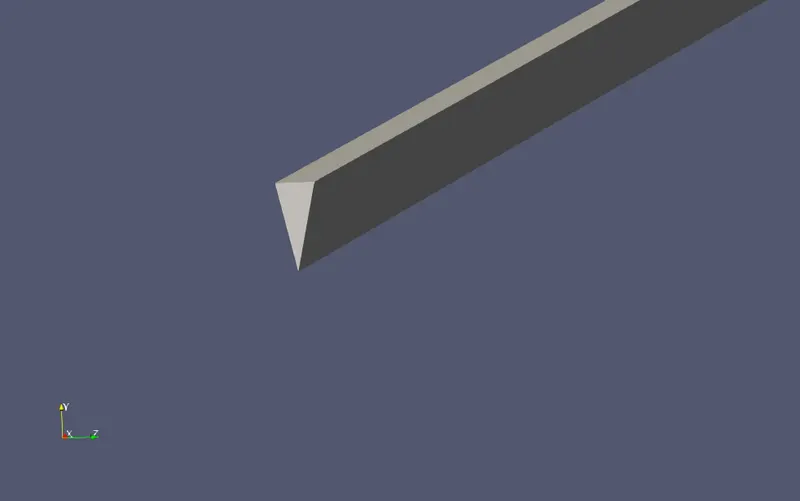
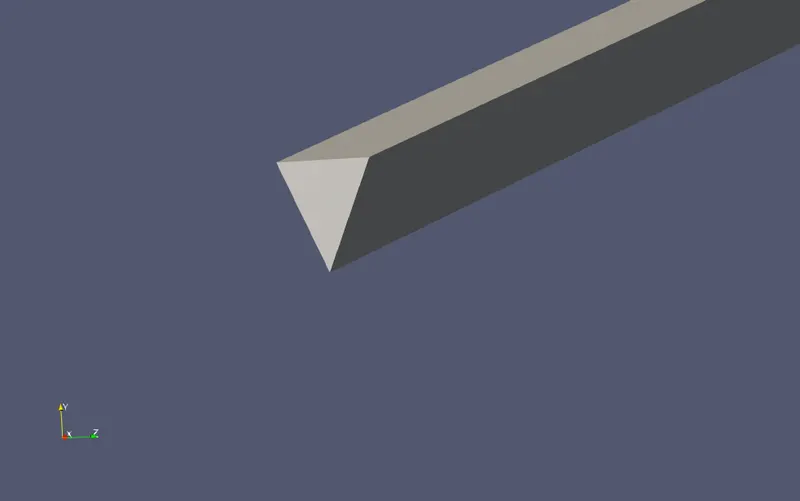
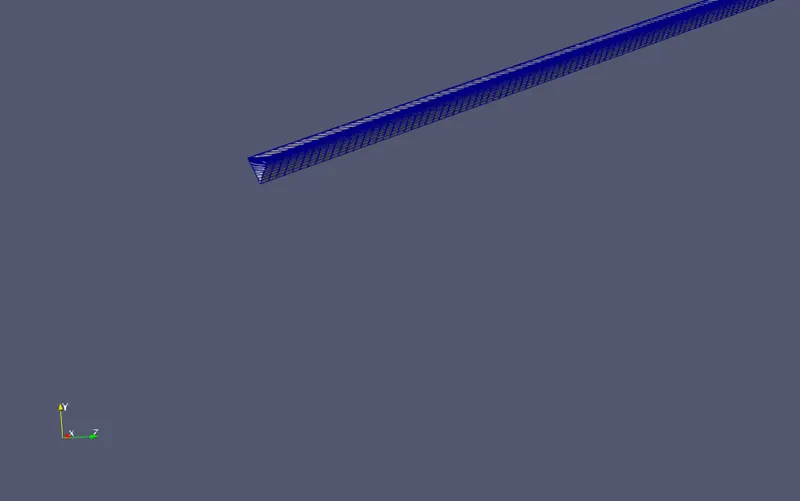
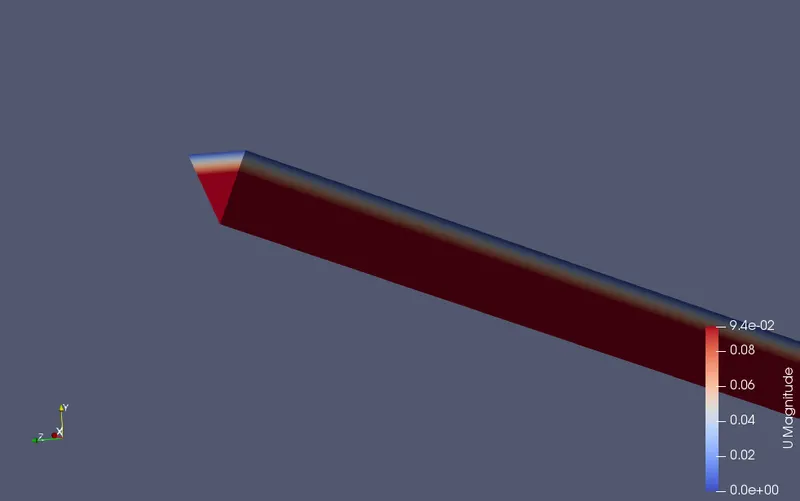
Paraview:
Geometry:
Symmetry( with colors)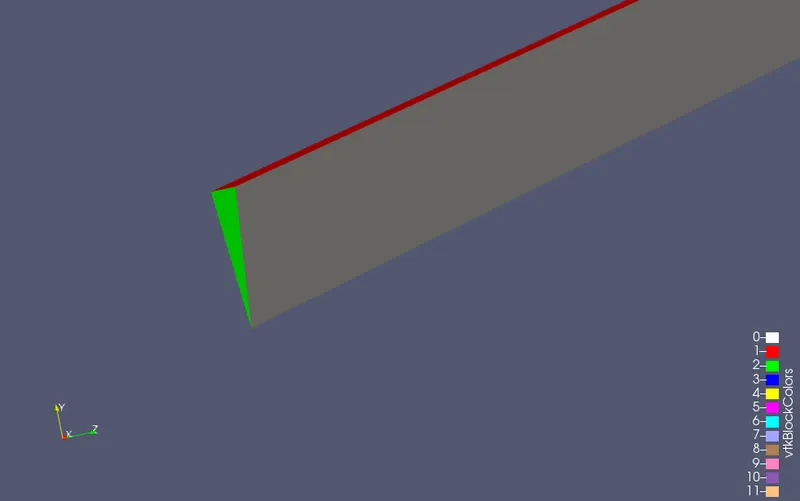 |
Wedge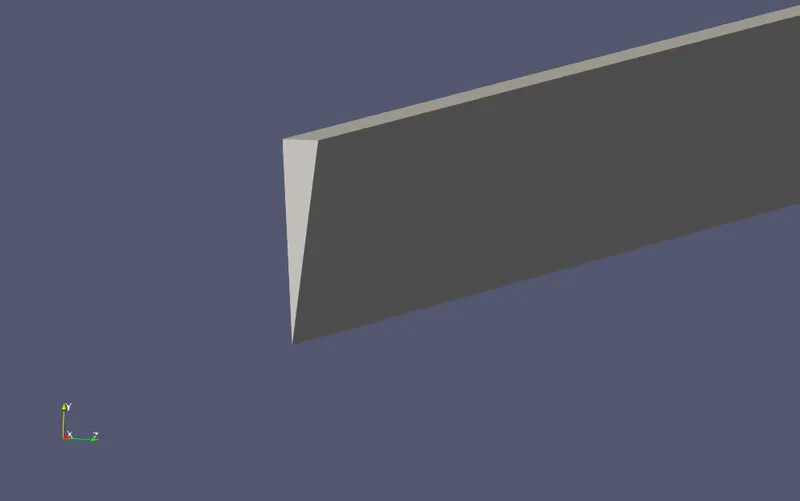 |
For theta= 25
|
Symmetry
|
Wedge
|
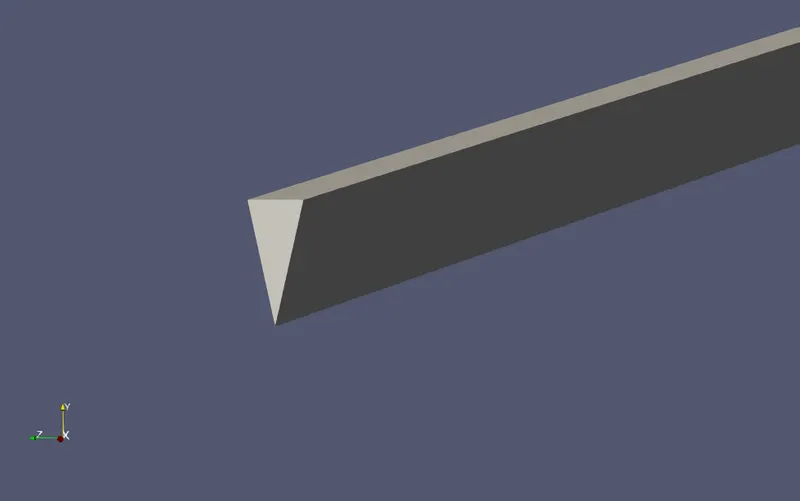
For theta= 45
|
Symmetry
|
Wedge (with mesh)
|
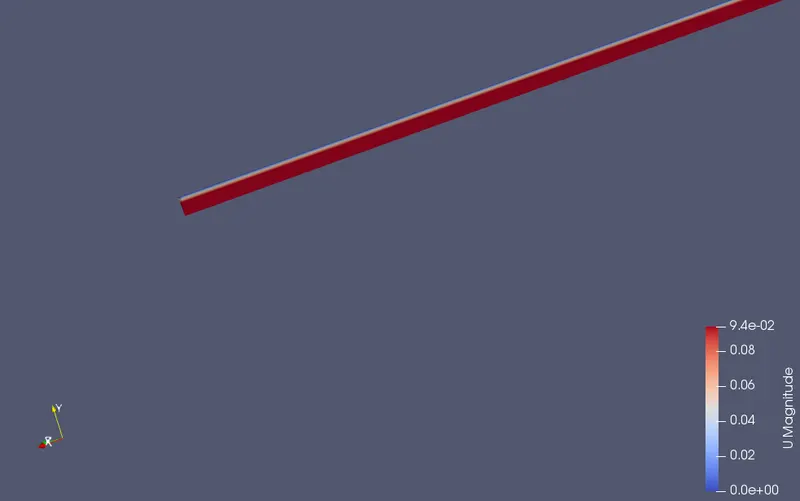
Velocity profile:
For theta=10
|
Symmetry
|
Wedge
|
For theta= 25
|
Symmetry
|
Wedge
|
For theta=45
|
Symmetry
|
Wedge
|
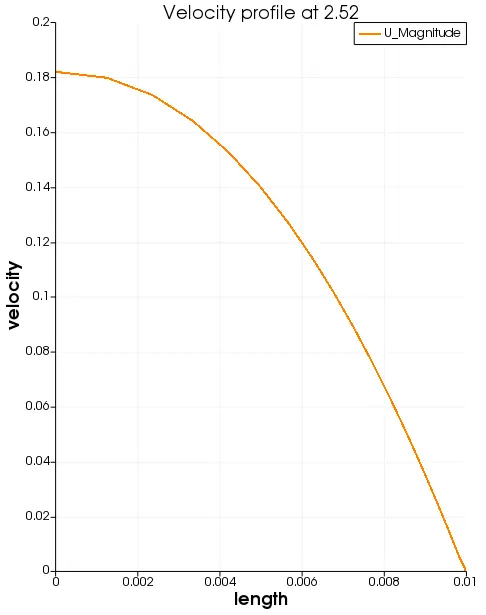
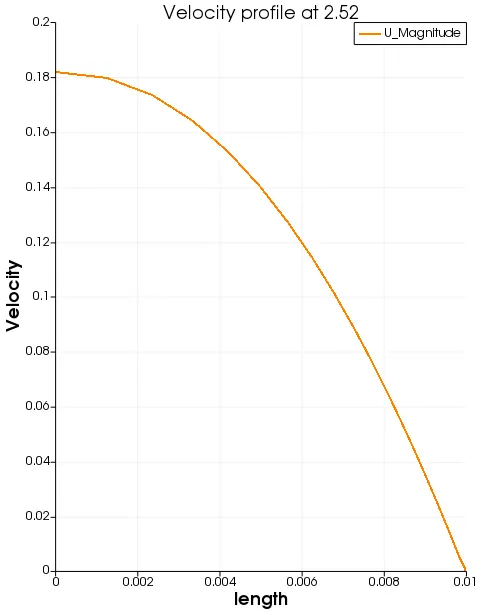
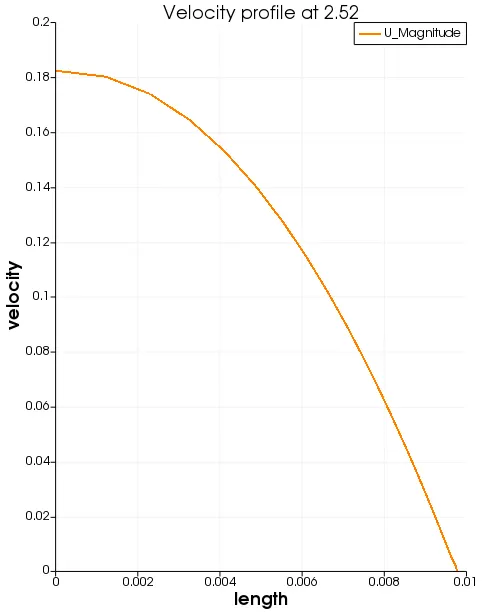
Velocity profile obained at point 2.52 where the flow is fully developed.
For theta =10
|
Symmetry
|
Wedge
|
For theta= 25
|
Symmetry
|
Wedge
|
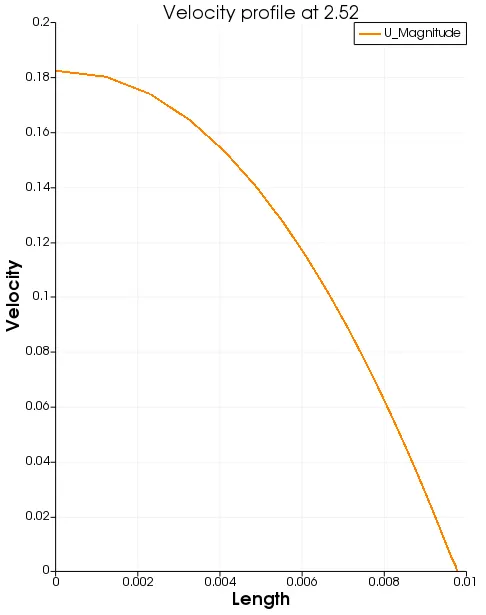
For theta= 45
|
Symmetry
|
Wedge
|
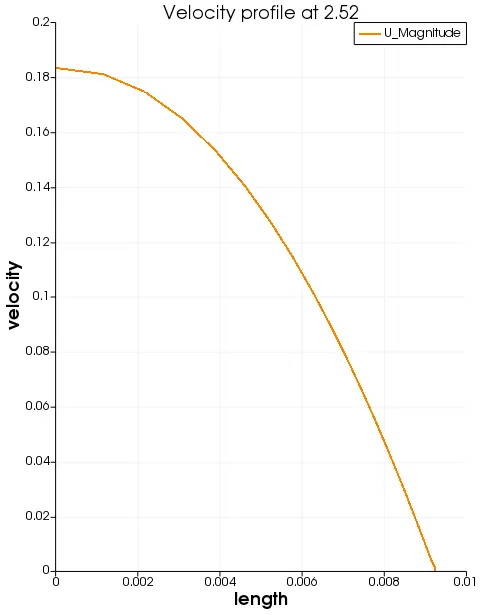
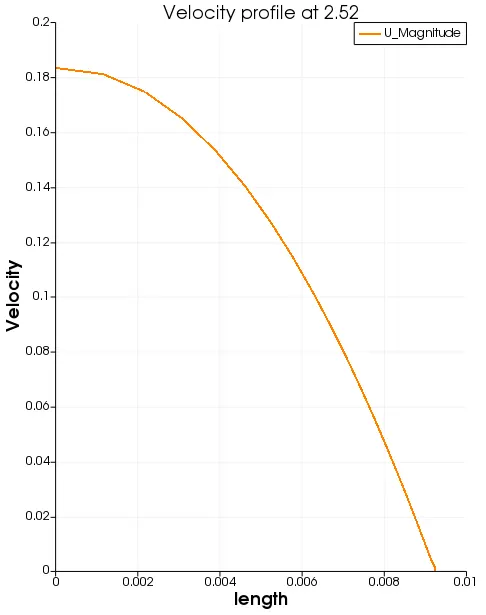
Analytical velocity profile from MATLAB: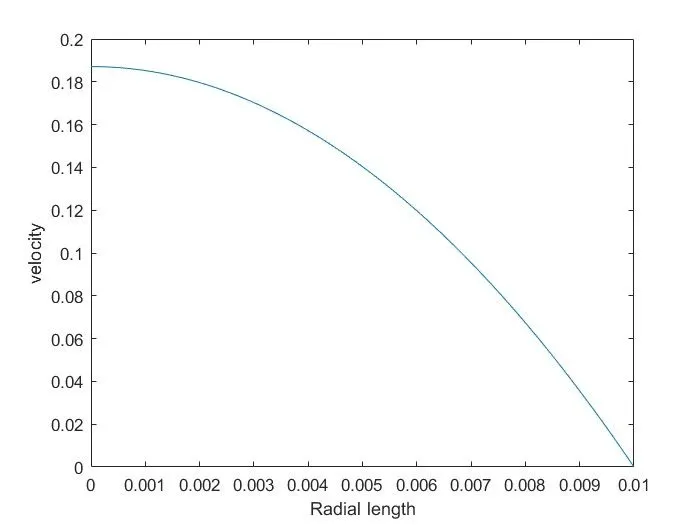
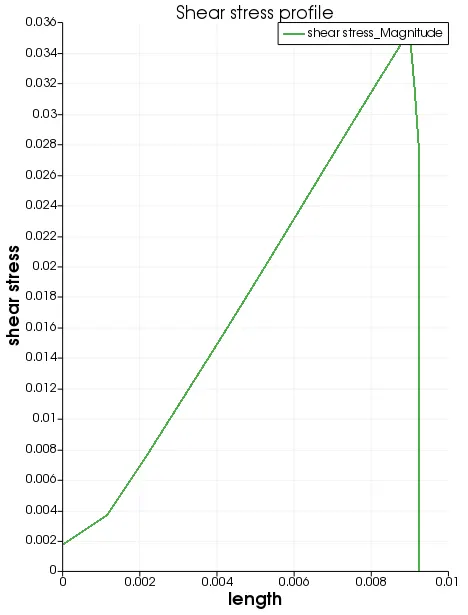
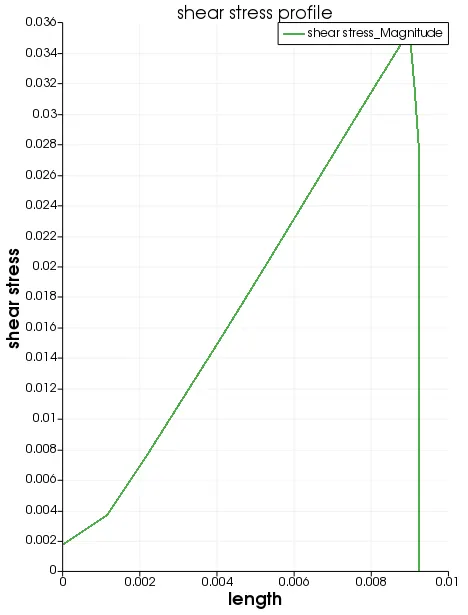
Shear stress profile :
For theta =10
|
Symmetry
|
Wedge
|
For theta= 25
|
Symmetry
|
Wedge
|
For theta =45
|
Symmetry
|
Wedge
|
Analytical shear stress profile from MATALB:
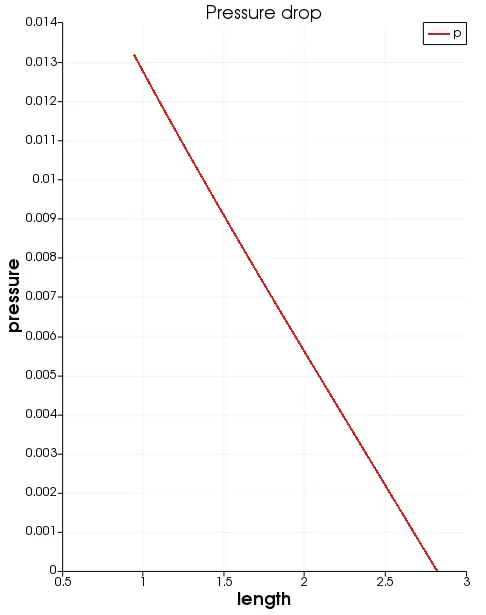
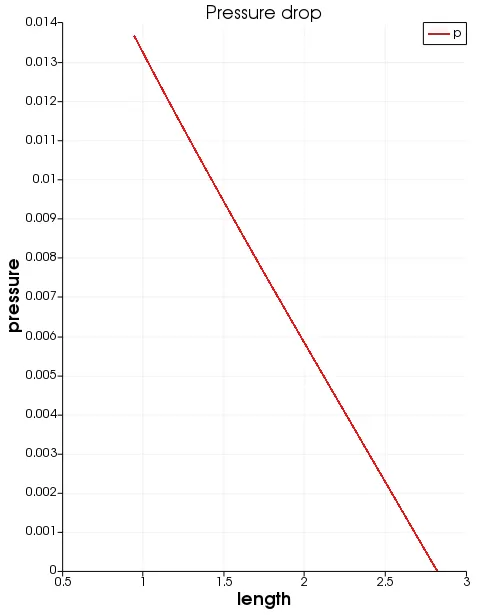
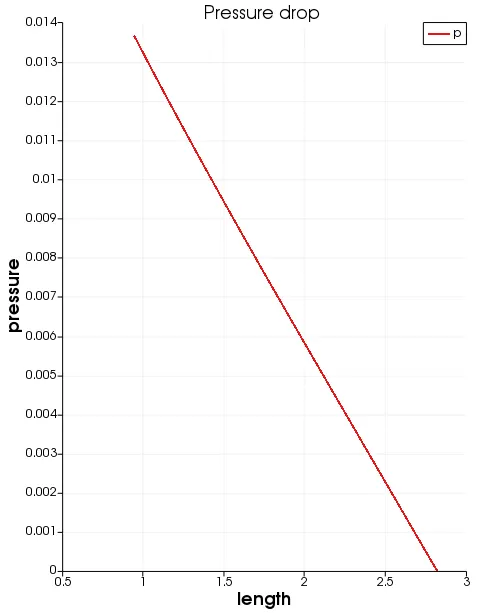
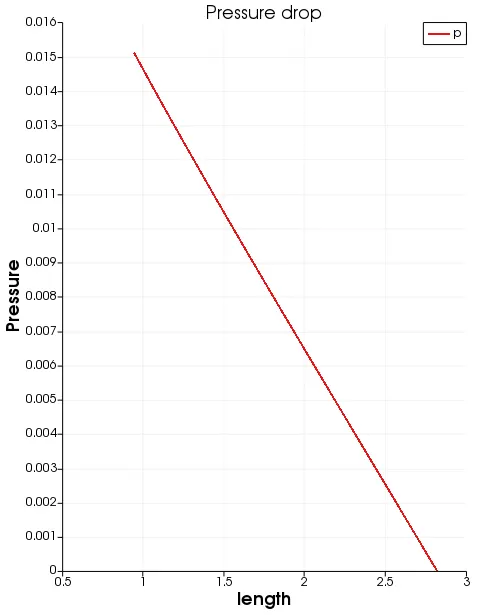
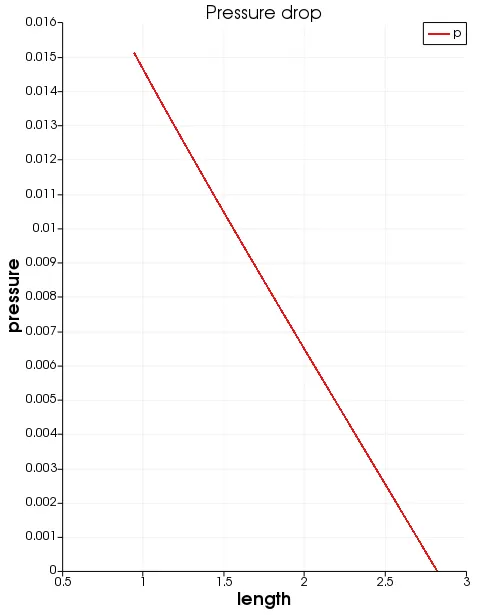
Pressure loss:
For theta= 10
|
Symmetry
|
Wedge
|
For theta= 25
|
Symmetry
|
Wedge
|
For theta=45
|
Symmetry
|
Wedge
|
Conclusion:
Hydro dynamic length is obtained to be 2.52 units, where velocity profile is fully developed.
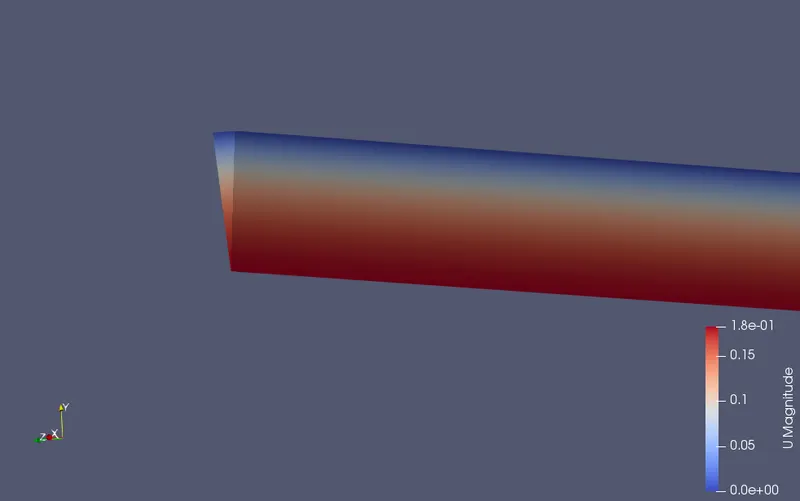
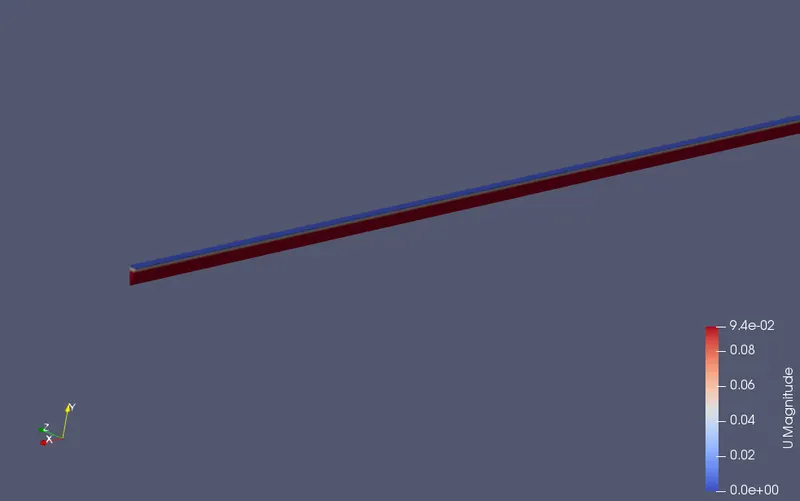
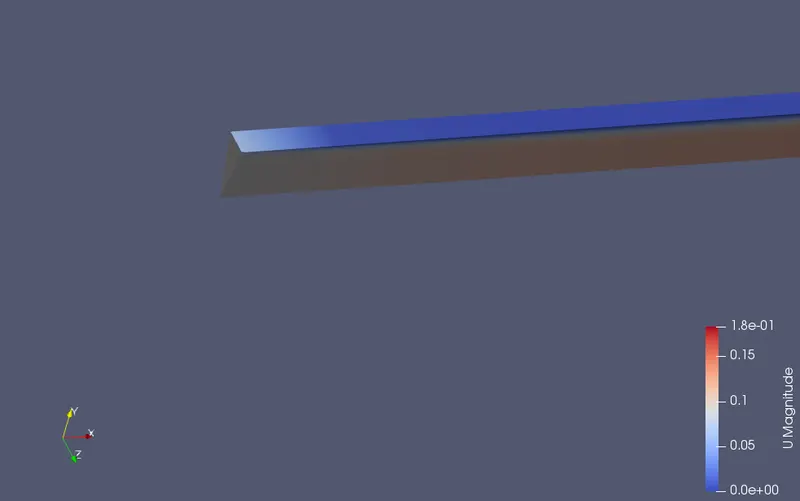
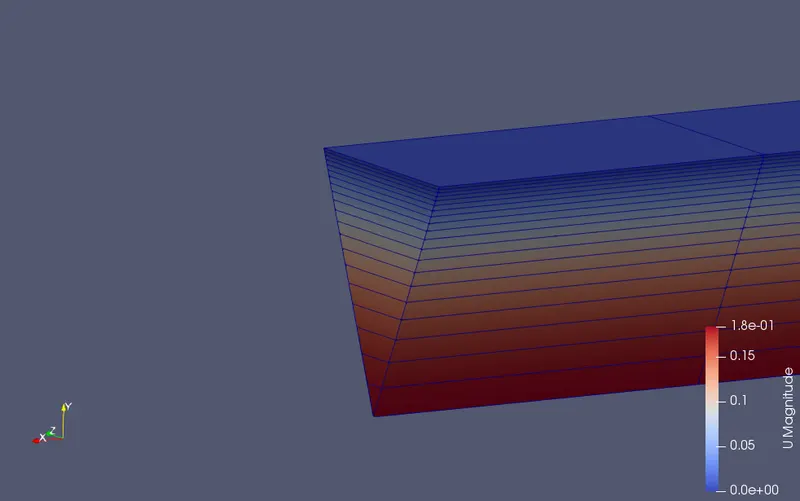
The velocity profile gradually increase from inlet to outlet. It remains constant after the flow is fully developed.
Analytical velocity profile and velocity obtained in openfoam matches very well, where velocity is maximum at centre and parabolically decrease toward wall.
The velocity profile for different values of theta, shifts to left for higher angles in openfoam.
Shear stress is zero at centre of pipe and increases linearly toward the wall, graph obtained from openfoam is close to analytical result.
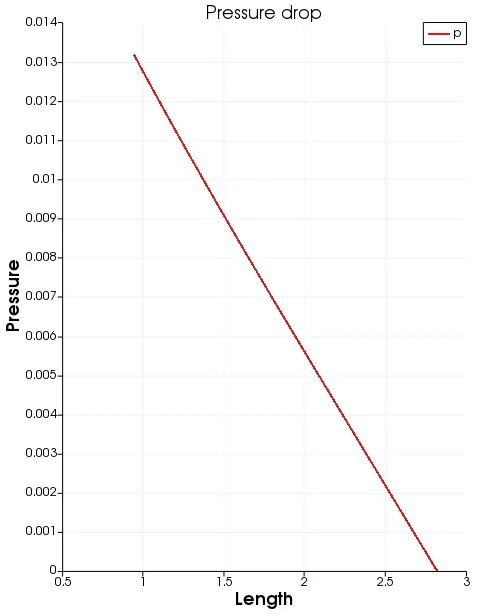
Maximum velocity and pressure drop value is obtained for fully develpoed flow.
Pressure drop is linear for all anlges.