Week 12 - Validation studies of Symmetry BC vs Wedge BC in OpenFOAM vs Analytical H.P equation
The laminar flow through a pipe has viscous effects which affect the velocity and pressure distribution through the pipe.
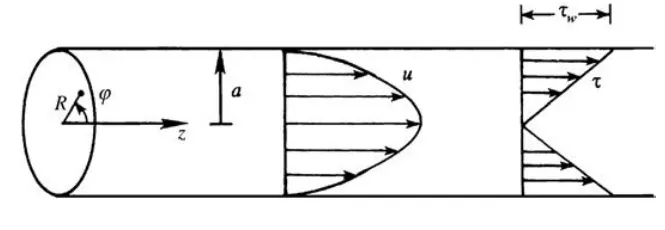
The flow is said to be fully developed when the axial velocity no longer varies along the length and is just a function of the radius of pipe. The flow is assumed to be purely axial, `u_z != 0` and `u_r & u_varphi` are equal to zero.
u = u(r).
For laminar flow the entrance length correlation with Reynolds number is
`L_e/d=0.06⋅R_e`
The value of Reynolds number for transition from laminar to turbulent is,
`R_(ed,crit=2300`
For laminar fully developed Poiseuille flow in a round pipe of diameter d, the pressure drop is given by the Hagen-Poiseuille equation.
`Δp=32⋅μ⋅V⋅L/d^2`
where V is the average velocity which is one-half of the maximum velocity. The velocity follows a paraboloid profile.
`u=u_max(1−r^2/R^2)`
`V=u_max/2`
`tau_(wall) = 4*mu*V/R`
`R_(ed)=ρ⋅V⋅d/μ`
The analytical flow properties from the HP equations are,
d = 0.01m
Red=2100
The values of dynamic and kinematic viscosities, density are taken for water at 1 atm, 20 degrees Celsius.
`rho = 998 (kg)/m^3`
`μ=1*10^-3 N*s/m^2`
`nu = 1*10^-6 m^s/s^2`
| Average velocity `V_(avg)` m/s |
Max velocity `V_max` m/s |
Entrance length `L_e` m | Pressure drop `DeltaP` Pa | Kinematic pressure drop `(DeltaP)/rho` m^2/s^2 | Wall shear stress `tau` Pa |
| 0.21 | 0.42 | 1.26 | 134.4 | 0.1347 | 0.168 |
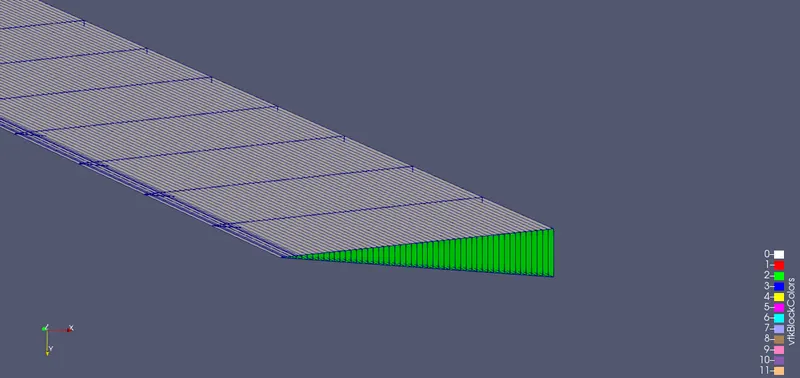
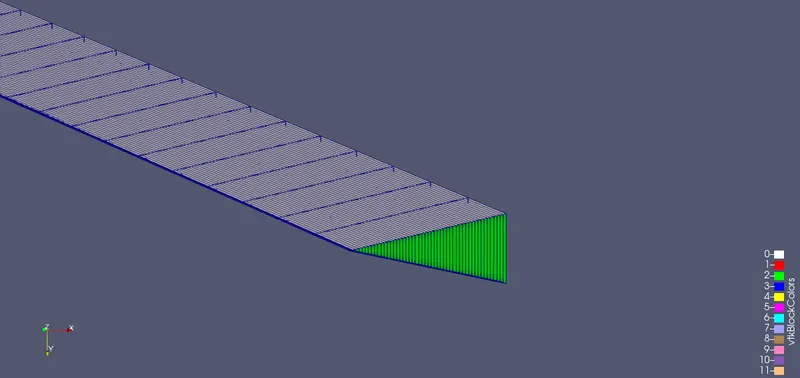
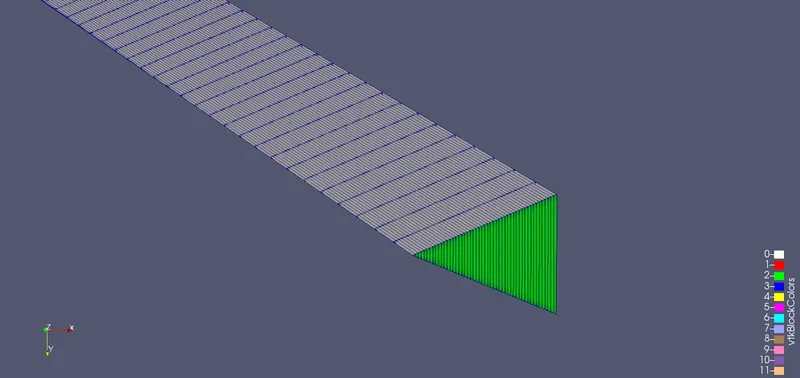
The flow is simulated for wedge angles of 10, 25, 45 degrees. The boundary conditions used are symmetry and wedge. The results for both these are then compared with the analytical Hagen-Poiseuille equations.
For each boundary condition, the mesh remains the same for every angle.
10 degrees
25 degrees
45 degrees
Angle 10
A] The hydrodynamic entry length for wedge and symmetry v/s analytical HP equations.
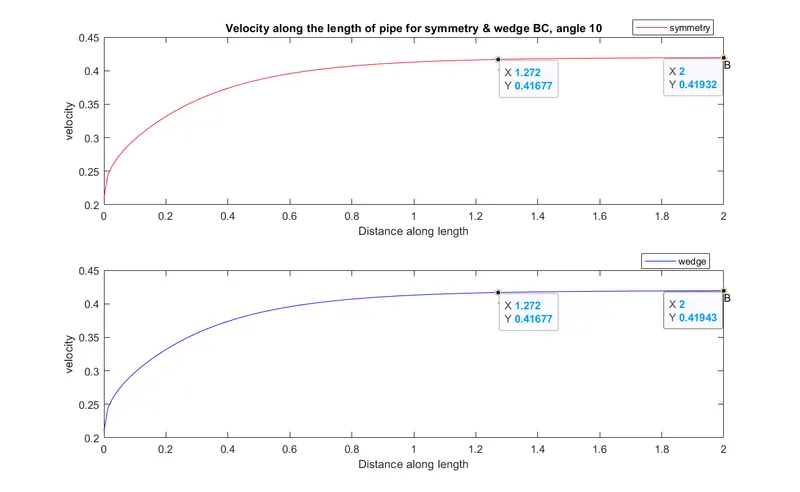
There is not much difference between the two velocity profiles. From 1.272 to 2 m, the change in velocity is very small for both the boundary conditions.
| Boundary conditions | Maximum velocity (m/s) | Entrance length from numerical results (in meters) | Analytical/Theoretical entry length (in meters) | Difference |
| Symmetry | 0.4193 | 1.272 | 1.26 | 0.012 |
| Wedge | 0.4194 | 1.272 | 1.26 | 0.012 |
B]Fully developed velocity profile
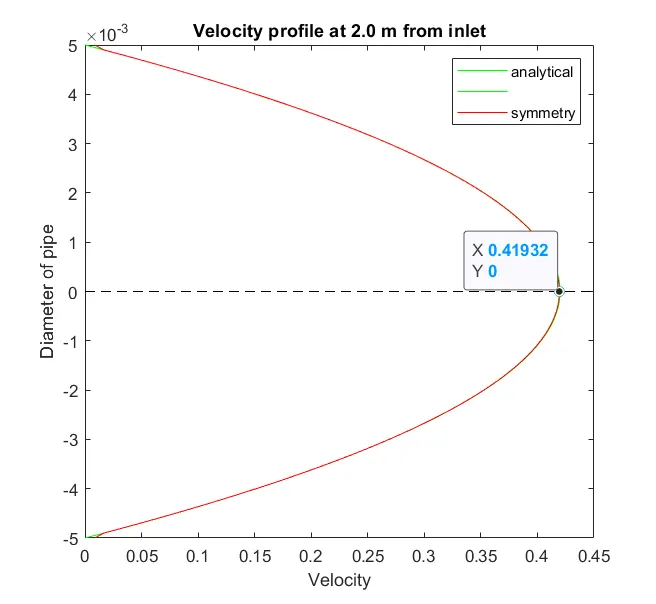
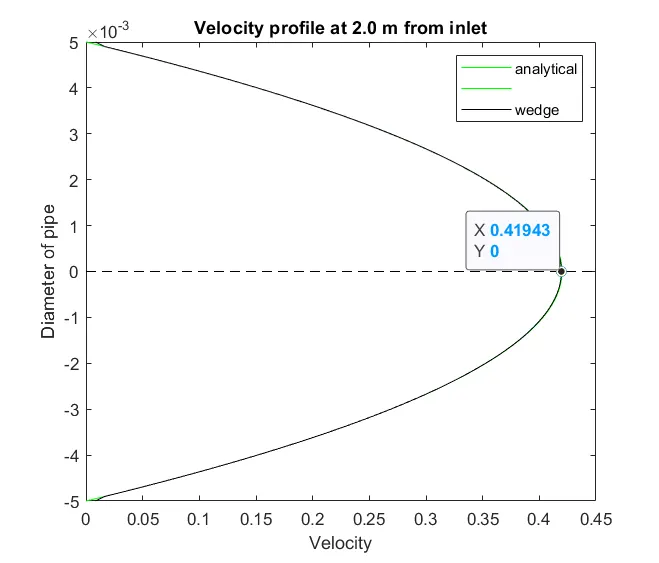
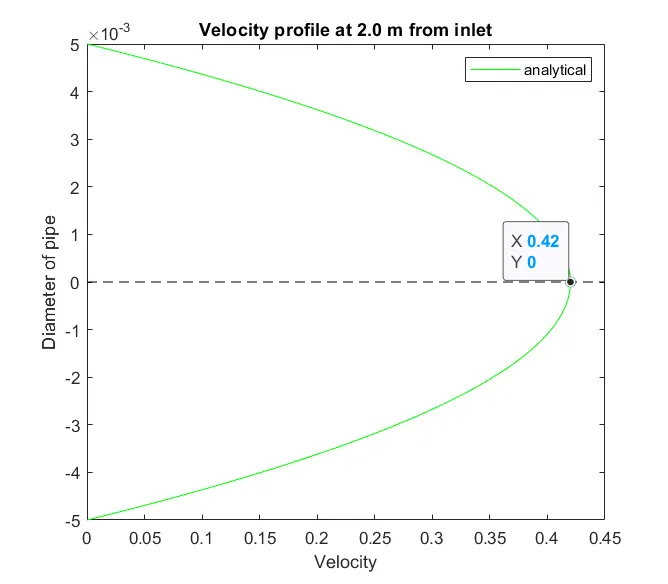
| Boundary conditions | Maximum velocity (m/s) | Theoretical maximum velocity m/s |
| Symmetry | 0.4193 | 0.42 |
| Wedge | 0.4194 | 0.42 |
C] Pressure drop
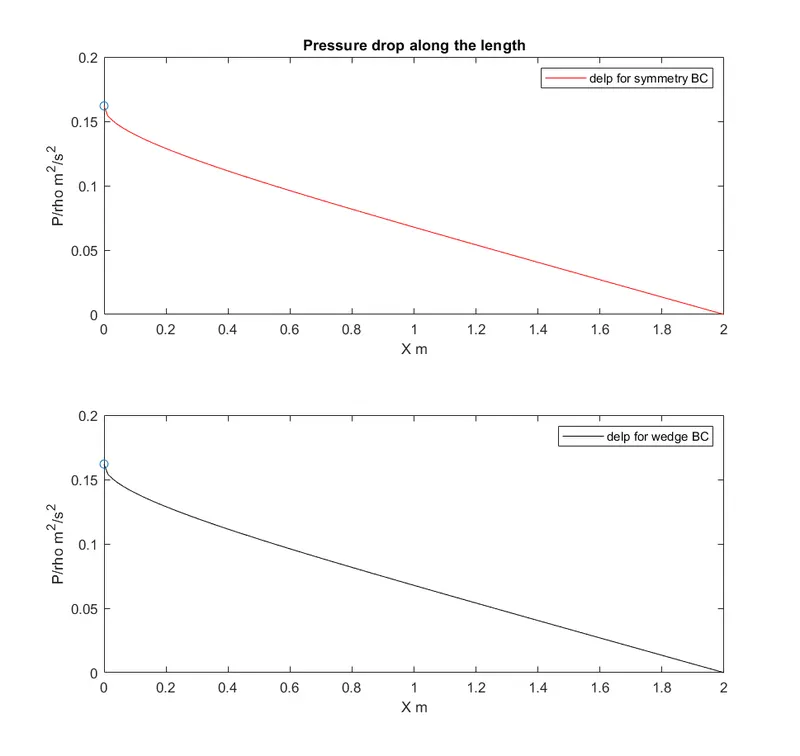
The pressure drop is linear as the flow develops which validates with the Hagen Poiseuille flow equation.
| Boundary | Kinematic Pressure drop (m^2/s^2) | Theoretical `32*mu*V*L/d^2` |
| Symmetry | 0.162 | 0.134 |
| Wedge | 0.162 | 0.134 |
D] Wall shear stress
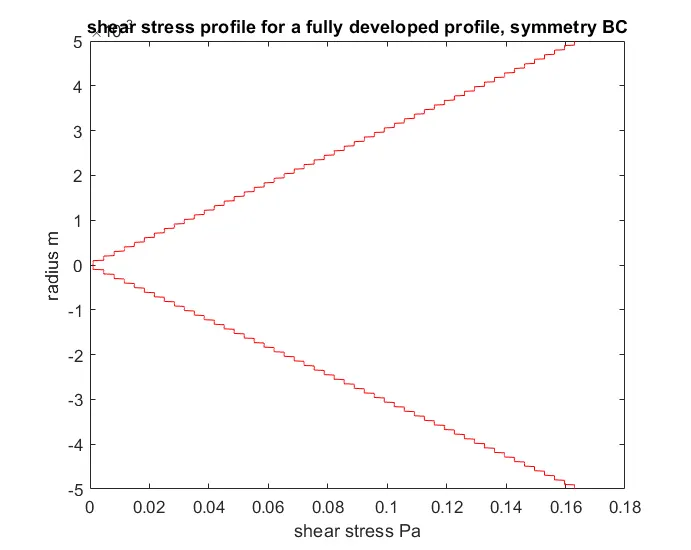
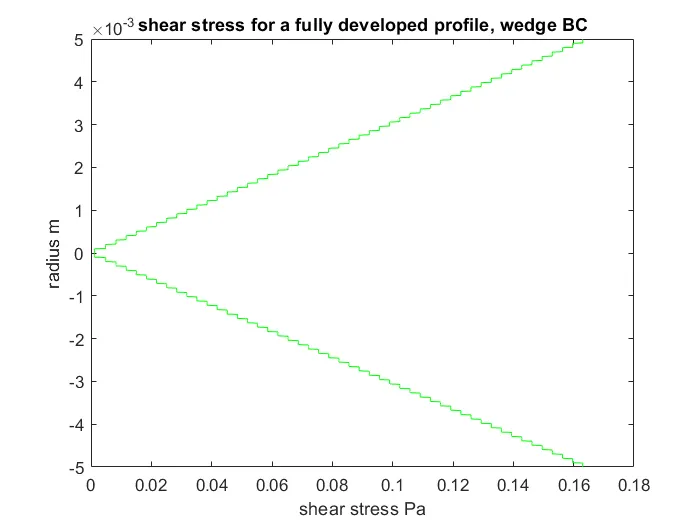
| Boundary | wall shear stress Pa | Theoretical`4*mu*V/R` |
| Symmetry | 0.163 | 0.168 |
| Wedge | 0.163 | 0.168 |
Angle 25
A] The hydrodynamic entry length for wedge and symmetry v/s analytical HP equations.
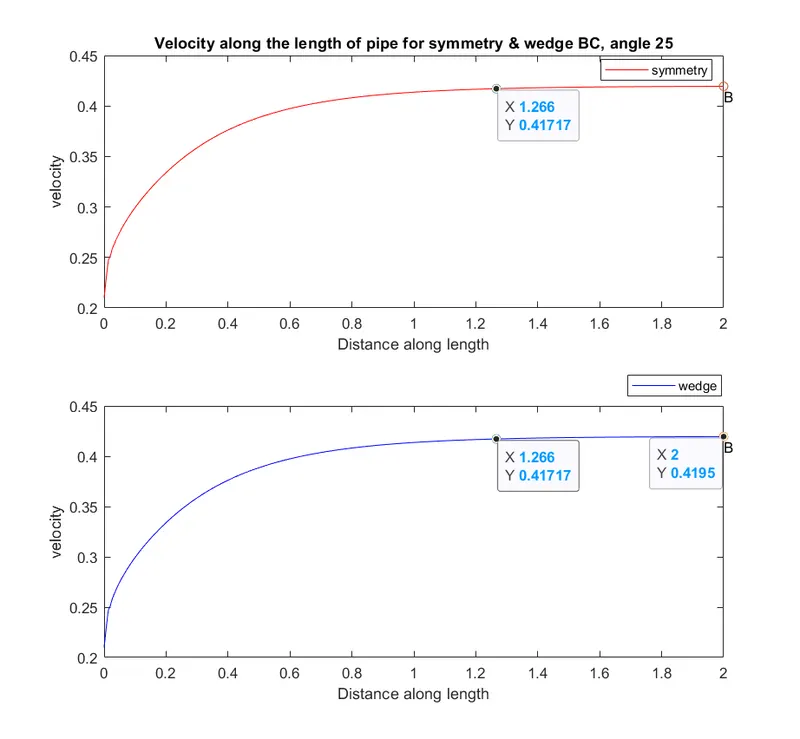
| Boundary conditions | Maximum velocity (m/s) | Entrance length from numerical results (in meters) | Analytical/Theoretical entry length (in meters) | Difference |
| Symmetry | 0.4195 | 1.266 | 1.26 | 0.006 |
| Wedge | 0.4195 | 1.266 | 1.26 | 0.006 |
B] Fully developed velocity profile
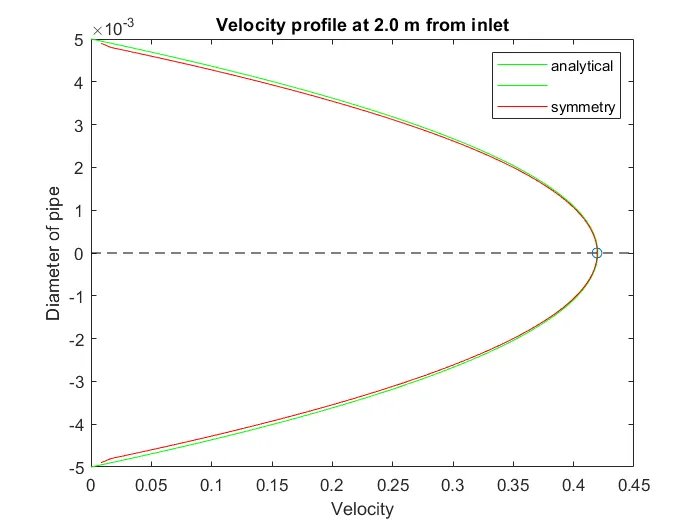
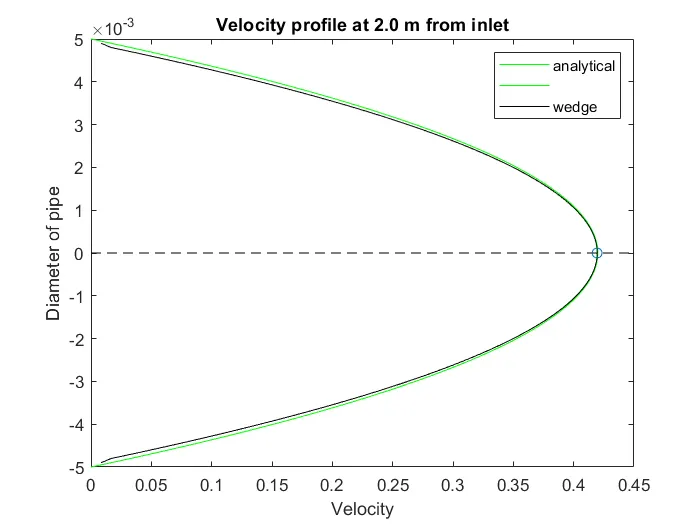
| Boundary conditions | Maximum velocity (m/s) | Theoretical maximum velocity m/s |
| Symmetry | 0.4195 | 0.42 |
| Wedge | 0.4195 | 0.42 |
C] Pressure drop
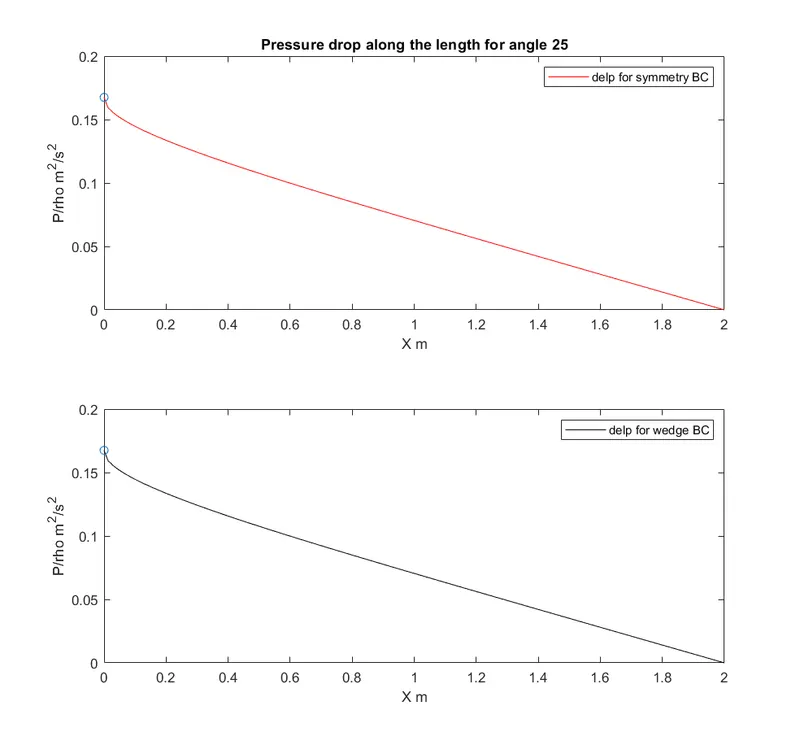
| Boundary | Kinematic Pressure drop (m^2/s^2) | Theoretical `32*mu*V*L/d^2` |
| Symmetry | 0.167 | 0.134 |
| Wedge | 0.167 | 0.134 |
D] Wall shear stress
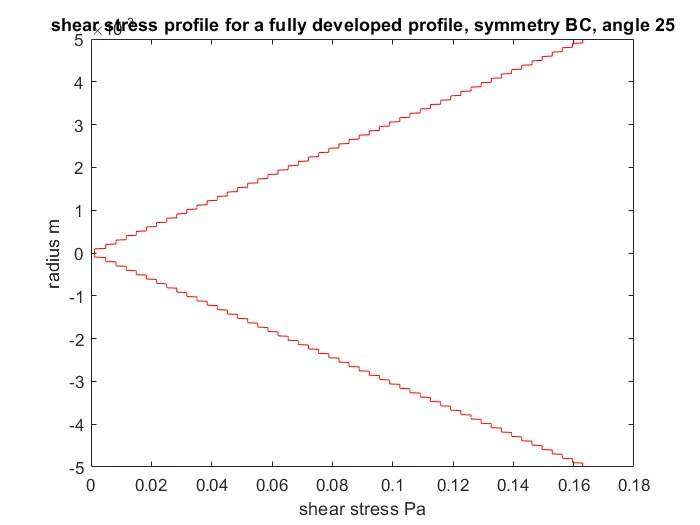
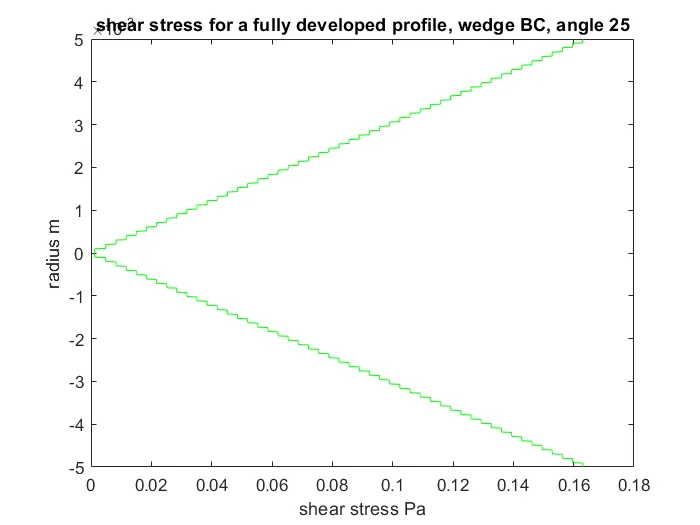
| Boundary | wall shear stress Pa | Theoretical`4*mu*V/R` |
| Symmetry | 0.163 | 0.168 |
| Wedge | 0.163 | 0.168 |
Angle 45
A] The hydrodynamic entry length for wedge and symmetry v/s analytical HP equations.
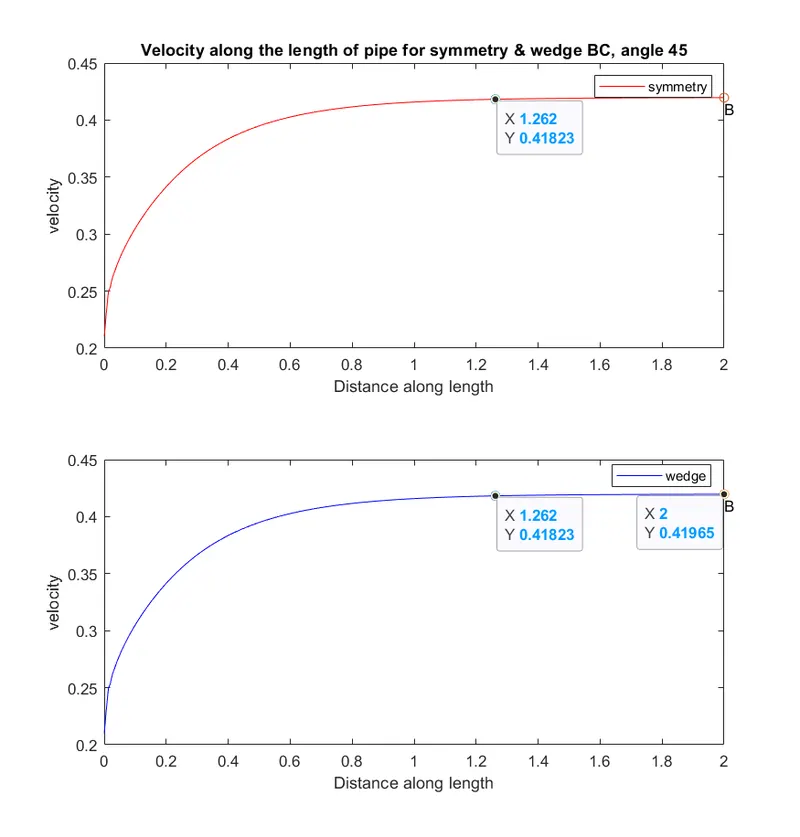
| Boundary conditions | Maximum velocity (m/s) | Entrance length from numerical results (in meters) | Analytical/Theoretical entry length (in meters) | Difference |
| Symmetry | 0.41965 | 1.262 | 1.26 | 0.002 |
| Wedge | 0.41965 | 1.262 | 1.26 | 0.002 |
B] Fully developed velocity profile
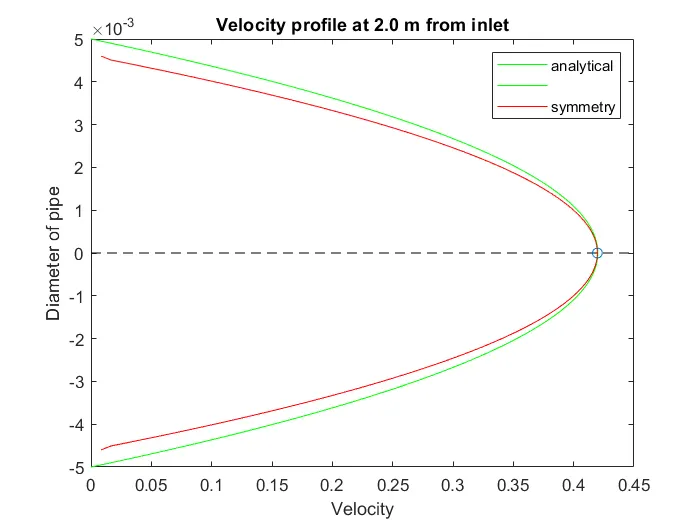
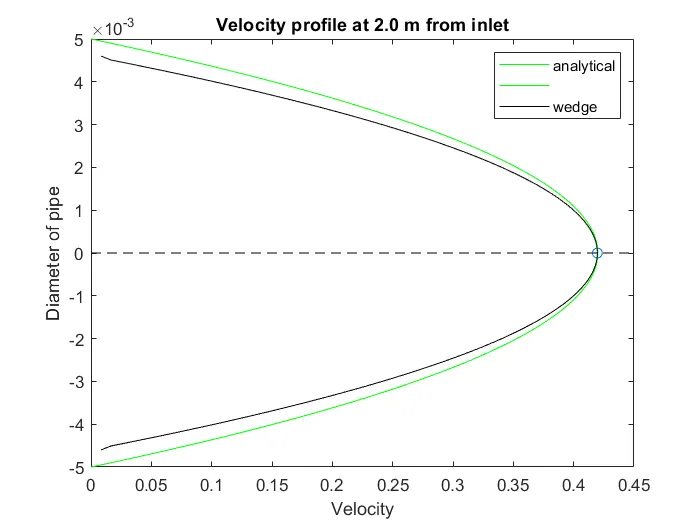
| Boundary conditions | Maximum velocity (m/s) | Theoretical maximum velocity m/s |
| Symmetry | 0.41965 | 0.42 |
| Wedge | 0.41965 | 0.42 |
C] Pressure drop
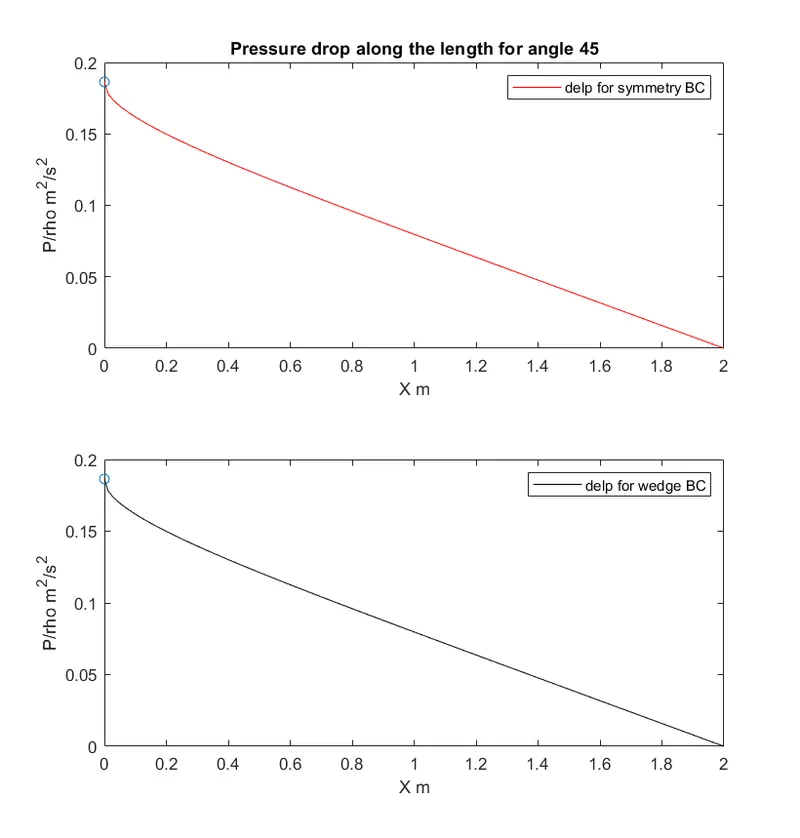
| Boundary | Kinematic Pressure drop (m^2/s^2) | Theoretical `32*mu*V*L/d^2` |
| Symmetry | 0.186 | 0.134 |
| Wedge | 0.186 | 0.134 |
D]Wall shear stress
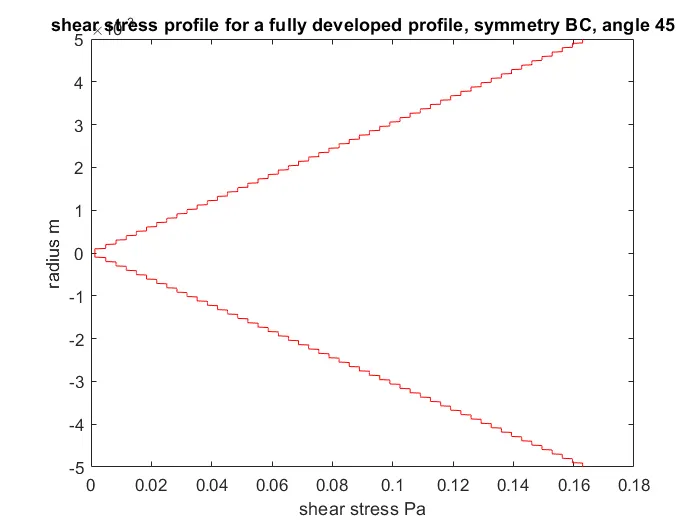
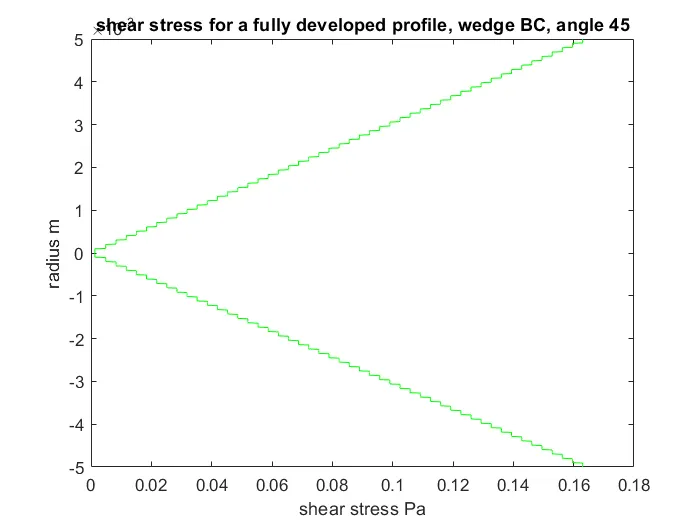
| Boundary | wall shear stress Pa | Theoretical`4*mu*V/R` |
| Symmetry | 0.163 | 0.168 |
| Wedge | 0.163 | 0.168 |
BOUNDARY CONDITIONS
Wedge
The wedge boundary condition is used to define an axisymmetric flow, for e.g flow through a pipe. Both the model and flow must be axisymmetric along a centre line. The flow properties have the same value at a given radius for all angles.
The fluxes and normal components are not assumed to be zero. Hence, this allows for rotational flow around the axis.
Symmetry
The symmetry boundary condition defines a mirror face or surface. Should only be used if the geometry and flow pattern of the solution are mirrored along that surface. It does not allow rotational flow.
Wedge boundary conditions are applied in cylindrical coordinate system, whereas the symmetry boundary condition is applied in Cartesian coordinate system.
Conclusion
From the results it is seen that for the same angle there is not much difference in flow properties for wedge and symmetry boundary conditions. However, as the angle increases, the results are much close to the theoretical values.
| Wedge BC/ Angle ° | Maximum velocity (m/s) | Entrance length (m) |
| 10 | 0.4194 | 1.272 |
| 25 | 0.4195 | 1.266 |
| 45 | 0.41965 | 1.262 |