Validation studies of Symmetry BC vs Wedge BC in OpenFOAM vs Analytical H.P equation
OBJECTIVE
To simulate an axi-symmetric flow by applying the symmetry boundary condition by conducting a transient or steady state simulation for multiple wedge angles and validate theresults with the Hagen- Poiseuille's equations for the fully developed flow. The flow is laminar and flows through a constant cross-section pipe at an inlet Reynold's number of 2100.
THEORY
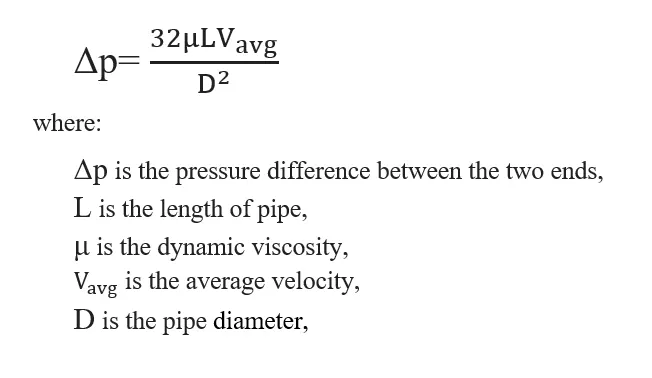
Hagen–Poiseuille equation, also known as the Hagen–Poiseuille law, Poiseuille law or Poiseuille equation, is a physical law that gives the pressure drop in an incompressible and Newtonian fluid in laminar flow flowing through a long cylindrical pipe of constant cross section.
Assumptions:
- The fluid is incompressible and Newtonian
- Laminar flow occurs through a pipe of constant circular cross-section that is substantially longer than its diameter
- There is no acceleration of fluid in the pipe.
Entrance region and Fully Developed region for a Laminar Flow.
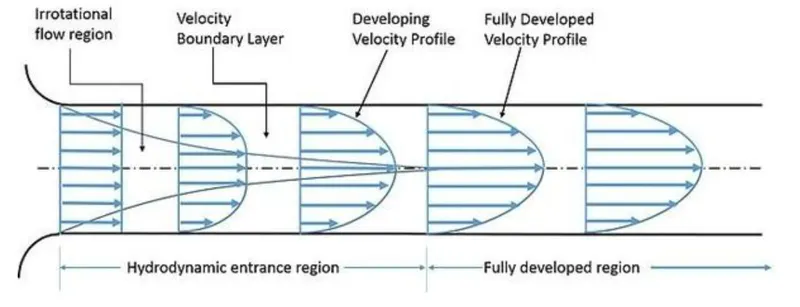
figure 1: Hydrodynamic Entrance region and Fully Developed region
Hydrodynamic entrance region is defined as the area of the pipe, where the fluid entering the pipe developes a velocity profile due to viscous forces propagating from the interior walls.
The region of flow where the viscous and velocity effects changes suddenly is called boundary layer and it separates the flow into two regions-irrotational flow layer and boundary layer region.
When the flow reaches the mid section, velocity profile will be fully developed, and this particular length from the inlet is called as Hydrodynamic entrance length.
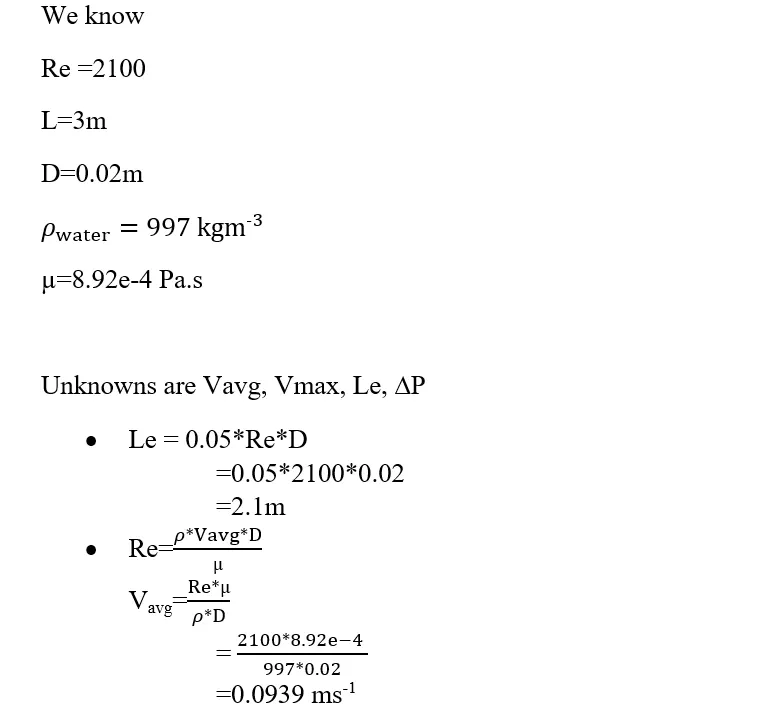
It is calculated as Le=0.05*Re*D
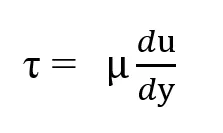
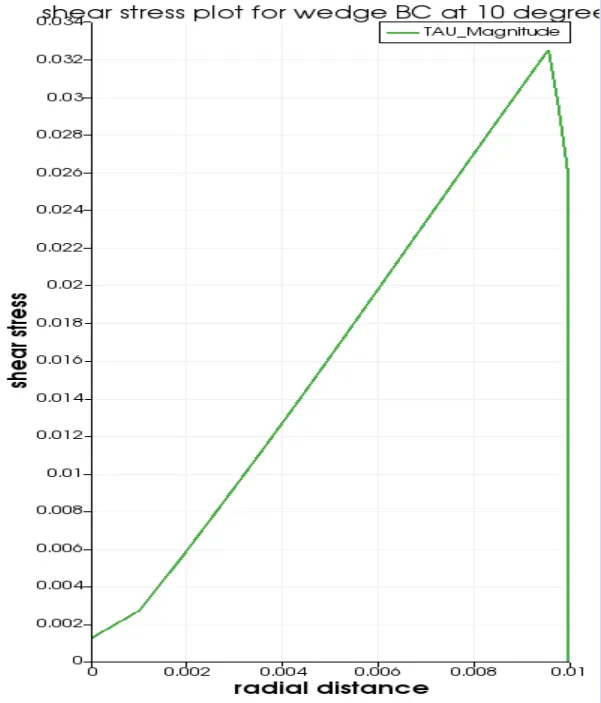
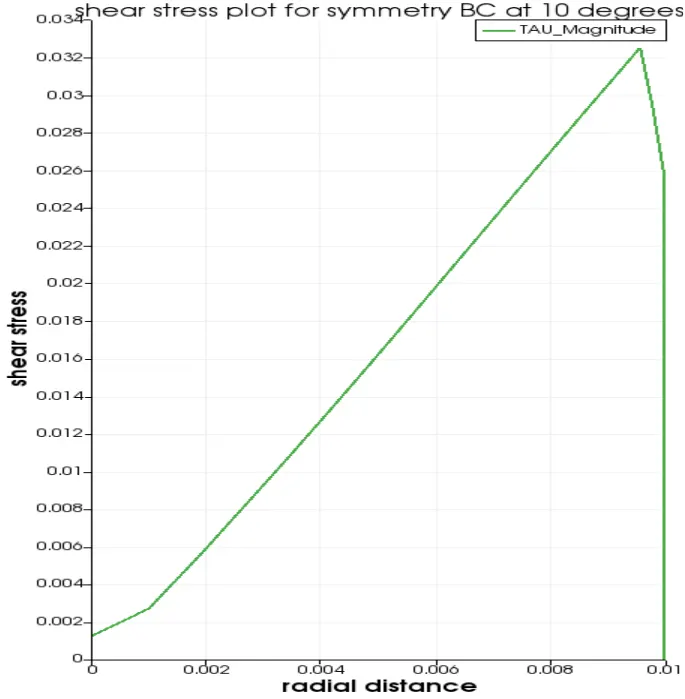
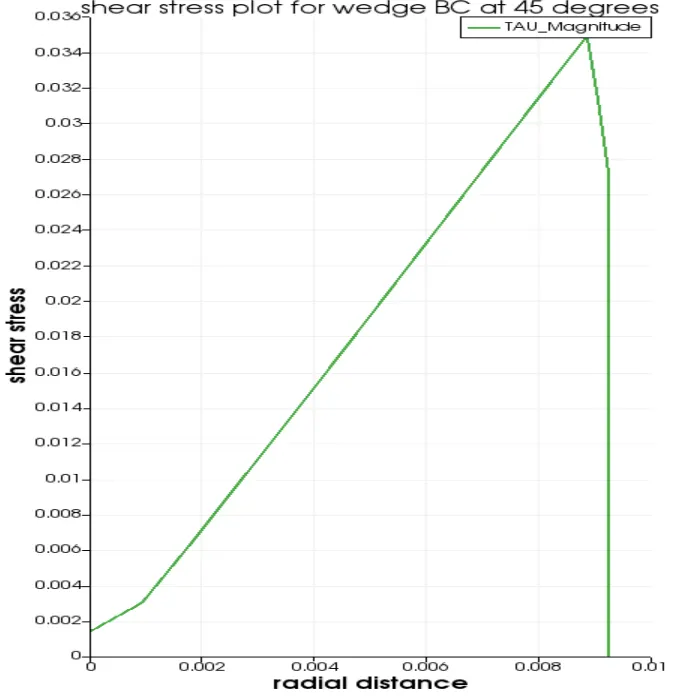
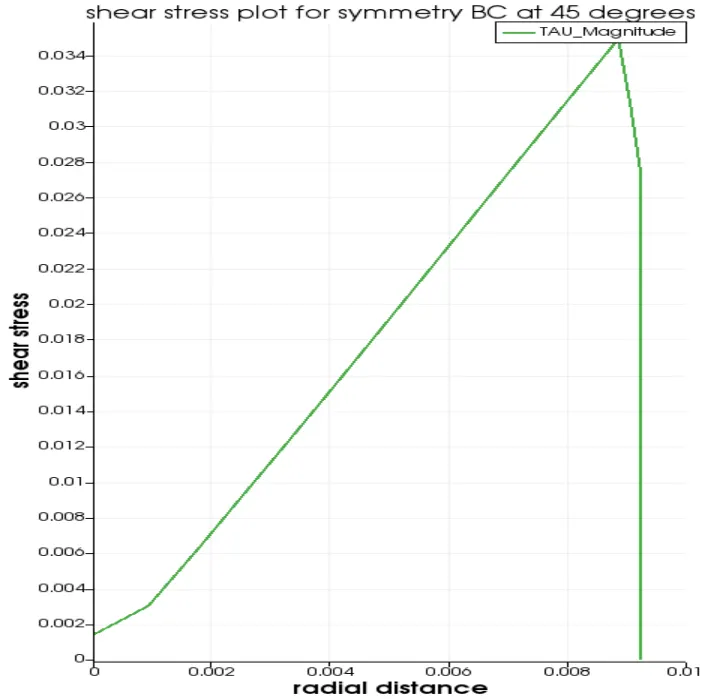
Shear stress is directly proportinal to the velocity gradient and is calculated as
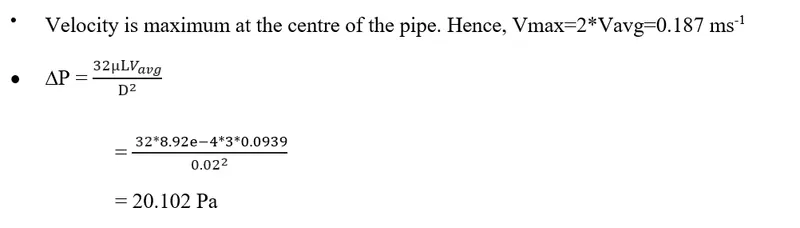
CALCULATIONS
CODE
Writing code in matlab with an objective to create the blockMesh.
Code for Wedge Boundary Condition is the same that was programmed in the previous case.
Code for Symmetry Boundary Condition
clear all
close all
clc

%inputs
Re=2100; %reynolds number
D=0.02; %pipe diameter
R=D/2;
L=3; %length
rho=997; %density of water
mu=8.92e-4;%dynamic viscosity of water

theta=input('enter a value for theta: '); %wedge angle

%finding the unknowns
Le=0.05*Re*D; %hydrodynamic entrance length
Vavg=(Re*mu)/(rho*D); %average velocity
Vmax=2*Vavg;
dP= 32*mu*L*Vavg/D^2;%pressure drop-dynamic
dP_k=dP/rho; %pressure drop-kinematic

%number of mesh cells
nx=200;
ny=20;
nz=1;
%mesh grading
gx=1;
gy=0.2;
gz=1;
%vertices of the wedge
v0=[0 0 0];
v1=[0 R*cosd(theta/2) R*sind(theta/2) ];
v2=[0 R*cosd(theta/2) -R*sind(theta/2)];
v3=[L 0 0];
v4=[L R*cosd(theta/2) R*sind(theta/2)];
v5=[L R*cosd(theta/2) -R*sind(theta/2)];

%writing the blockmesh
f1=fopen('blockMeshDict.txt','w');
fprintf(f1,'%s n','/*--------------------------------*- C++ -*----------------------------------*');
fprintf(f1,'%sn','========= |');
fprintf(f1,'%sn','\ / F ield | OpenFOAM: The Open Source CFD Toolbox');
fprintf(f1,'%sn','\ / O peration | Website: https://openfoam.org');
fprintf(f1,'%sn','\ / A nd | Version: 9');
fprintf(f1,'%sn','\/ M anipulation |');
fprintf(f1,'%sn','*---------------------------------------------------------------------------*/');
fprintf(f1,'%sn','FoamFile');
fprintf(f1,'%sn','{');
fprintf(f1,'%sn','version 2.0;');
fprintf(f1,'%sn','format ascii;');
fprintf(f1,'%sn','class dictionary;');
fprintf(f1,'%sn','object blockMeshDict;');
fprintf(f1,'%sn','}');
fprintf(f1,'%snn','// * * * * * * * * * * * * * * * * * * * * * * * * * * * * * * * * * * * * * //');

fprintf(f1,'nnconvertToMeters 1 ;');
fprintf(f1,'nvertices');
fprintf(f1,'n(');
fprintf(f1,'n(%f %f %f)//v0',v0(1),v0(2),v0(3)); %v0
fprintf(f1,'n(%f %f %f)//v1',v1(1),v1(2),v1(3)); %v1
fprintf(f1,'n(%f %f %f)//v2',v2(1),v2(2),v2(3)); %v2
fprintf(f1,'n(%f %f %f)//v3',v3(1),v3(2),v3(3)); %v3
fprintf(f1,'n(%f %f %f)//v4',v4(1),v4(2),v4(3)); %v4
fprintf(f1,'n(%f %f %f)//v5',v5(1),v5(2),v5(3)); %v5
fprintf(f1,'nn);');
fprintf(f1,'nblocks');
fprintf(f1,'%sn','(');
fprintf(f1,'n  hex (0 3 5 2 0 3 4 1) (%d %d %d) simpleGrading (%f %f %f)',nx,ny,nz,gx,gy,gz);
fprintf(f1,'nn);');

fprintf(f1,'nedges');
fprintf(f1,'n(');
fprintf(f1,'narc 1 2 (%f %f %f)',0,R,0);
fprintf(f1,'narc 4 5 (%f %f %f)',L,R,0);
fprintf(f1,'nn);');

fprintf(f1,'nboundary');
fprintf(f1,'n(');
fprintf(f1,'n  inlet');
fprintf(f1,'n  {');
fprintf(f1,'n      type patch;');
fprintf(f1,'n      faces');
fprintf(f1,'n      (');
fprintf(f1,'n         (2 0 0 1)');
fprintf(f1,'n      );');
fprintf(f1,'n  }');

fprintf(f1,'n  outlet');
fprintf(f1,'n  {');
fprintf(f1,'n      type patch;');
fprintf(f1,'n      faces');
fprintf(f1,'n      (');
fprintf(f1,'n         (3 5 4 3)');
fprintf(f1,'n      );');
fprintf(f1,'n  }');

fprintf(f1,'n  topwall');
fprintf(f1,'n  {');
fprintf(f1,'n      type wall;');
fprintf(f1,'n      faces');
fprintf(f1,'n      (');
fprintf(f1,'n         (4 5 2 1)');
fprintf(f1,'n      );');
fprintf(f1,'n  }');

fprintf(f1,'n  front');
fprintf(f1,'n  {');
fprintf(f1,'n      type symmetry;');
fprintf(f1,'n      faces');
fprintf(f1,'n      (');
fprintf(f1,'n        (4 1 0 3)');
fprintf(f1,'n      );');
fprintf(f1,'n  }');

fprintf(f1,'n  back');
fprintf(f1,'n  {');
fprintf(f1,'n      type symmetry;');
fprintf(f1,'n      faces');
fprintf(f1,'n      (');
fprintf(f1,'n        (0 2 5 3)');
fprintf(f1,'n      );');
fprintf(f1,'n  }');

fprintf(f1,'n  axis');
fprintf(f1,'n  {');
fprintf(f1,'n      type empty;');
fprintf(f1,'n      faces');
fprintf(f1,'n      (');
fprintf(f1,'n        (0 3 3 0)');
fprintf(f1,'n      );');
fprintf(f1,'n  }');
fprintf(f1,'nn);');


fprintf(f1,'nmergePatchPairs');
fprintf(f1,'n(');
fprintf(f1,'nn);');
fprintf(f1,'n// ************************************************************************* //');
When we execute this, we are being asked to provide the wedge angle, and once provided, we get the following blockMeshdict output.
- blockMeshdict for 10 degrees
/*--------------------------------*- C++ -*----------------------------------*
========= |
\ / F ield | OpenFOAM: The Open Source CFD Toolbox
\ / O peration | Website: https://openfoam.org
\ / A nd | Version: 9
\/ M anipulation |
*---------------------------------------------------------------------------*/
FoamFile
{
version 2.0;
format ascii;
class dictionary;
object blockMeshDict;
}
// * * * * * * * * * * * * * * * * * * * * * * * * * * * * * * * * * * * * * //
convertToMeters 1 ;
vertices
(
(0.000000 0.000000 0.000000)//v0
(0.000000 0.009962 0.000872)//v1
(0.000000 0.009962 -0.000872)//v2
(3.000000 0.000000 0.000000)//v3
(3.000000 0.009962 0.000872)//v4
(3.000000 0.009962 -0.000872)//v5
);
blocks(
hex (0 3 5 2 0 3 4 1) (200 20 1) simpleGrading (1.000000 0.200000 1.000000)
);
edges
(
arc 1 2 (0.000000 0.010000 0.000000)
arc 4 5 (3.000000 0.010000 0.000000)
);
boundary
(
inlet
{
type patch;
faces
(
(2 0 0 1)
);
}
outlet
{
type patch;
faces
(
(3 5 4 3)
);
}
topwall
{
type wall;
faces
(
(4 5 2 1)
);
}
front
{
type symmetry;
faces
(
(4 1 0 3)
);
}
back
{
type symmetry;
faces
(
(0 2 5 3)
);
}
axis
{
type empty;
faces
(
(0 3 3 0)
);
}
);
mergePatchPairs
(
);
// ************************************************************************* //
- controlDict
/*--------------------------------*- C++ -*----------------------------------*
========= |
\ / F ield | OpenFOAM: The Open Source CFD Toolbox
\ / O peration | Website: https://openfoam.org
\ / A nd | Version: 9
\/ M anipulation |
*---------------------------------------------------------------------------*/
FoamFile
{
format ascii;
class dictionary;
location "system";
object controlDict;
}
// * * * * * * * * * * * * * * * * * * * * * * * * * * * * * * * * * * * * * //
application icoFoam;
startFrom startTime;
startTime 0;
stopAt endTime;
endTime 10;
deltaT 0.01;
writeControl timeStep;
writeInterval 20;
purgeWrite 0;
writeFormat ascii;
writePrecision 6;
writeCompression off;
timeFormat general;
timePrecision 6;
runTimeModifiable true;
// ************************************************************************* //
- transportProperties
/*--------------------------------*- C++ -*----------------------------------*
========= |
\ / F ield | OpenFOAM: The Open Source CFD Toolbox
\ / O peration | Website: https://openfoam.org
\ / A nd | Version: 9
\/ M anipulation |
*---------------------------------------------------------------------------*/
FoamFile
{
format ascii;
class dictionary;
location "constant";
object transportProperties;
}
// * * * * * * * * * * * * * * * * * * * * * * * * * * * * * * * * * * * * * //
nu [0 2 -1 0 0 0 0] 0.894e-6;
// ************************************************************************* //
- velocity
/*--------------------------------*- C++ -*----------------------------------*
========= |
\ / F ield | OpenFOAM: The Open Source CFD Toolbox
\ / O peration | Website: https://openfoam.org
\ / A nd | Version: 9
\/ M anipulation |
*---------------------------------------------------------------------------*/
FoamFile
{
format ascii;
class volVectorField;
object U;
}
// * * * * * * * * * * * * * * * * * * * * * * * * * * * * * * * * * * * * * //
dimensions [0 1 -1 0 0 0 0];
internalField uniform (0 0 0);
boundaryField
{
inlet
{
type fixedValue;
value uniform (.0939 0 0);
}
outlet
{
type zeroGradient;
}
topwall
{
type noSlip;
}
front
{
type symmetry;
}
back
{
type symmetry;
}
axis
{
type empty;
}
}
// ************************************************************************* //
- pressure
/*--------------------------------*- C++ -*----------------------------------*
========= |
\ / F ield | OpenFOAM: The Open Source CFD Toolbox
\ / O peration | Website: https://openfoam.org
\ / A nd | Version: 9
\/ M anipulation |
*---------------------------------------------------------------------------*/
FoamFile
{
format ascii;
class volScalarField;
object p;
}
// * * * * * * * * * * * * * * * * * * * * * * * * * * * * * * * * * * * * * //
dimensions [0 2 -2 0 0 0 0];
internalField uniform 0;
boundaryField
{
inlet
{
type zeroGradient;
}
outlet
{
type fixedValue;
value uniform 0.0201624;
}
topwall
{
type zeroGradient;
}
front
{
type symmetry;
}
back
{
type symmetry;
}
axis
{
type empty;
}
}
// ************************************************************************* //
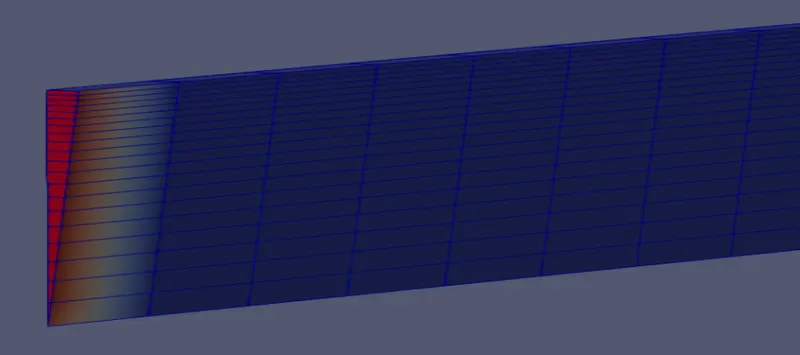
figure 2: Mesh diagram with finer cells towards the boundary(top wall)
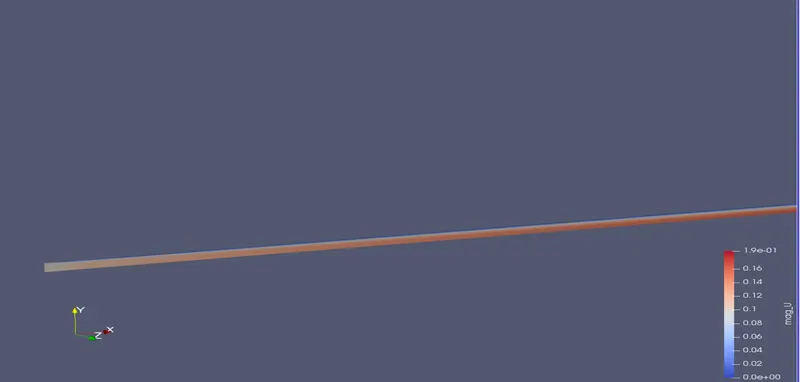
figure 3: Velocity contour plot at the end of final time step
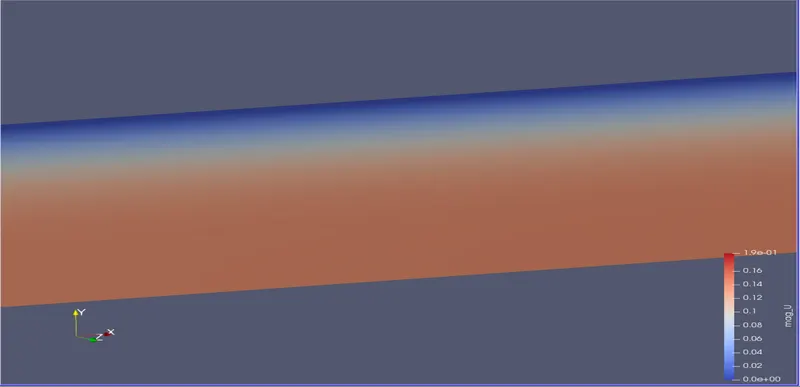
figure 4:Velocity contour plot of a region at the end of final time step
RESULTS
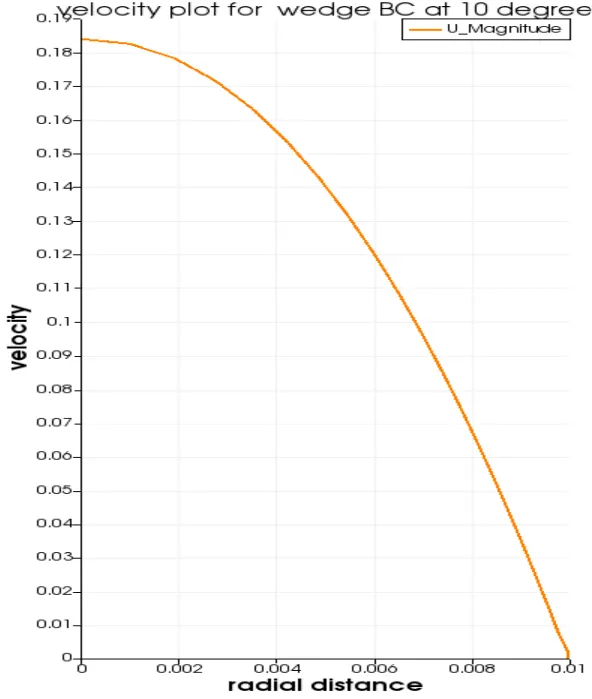
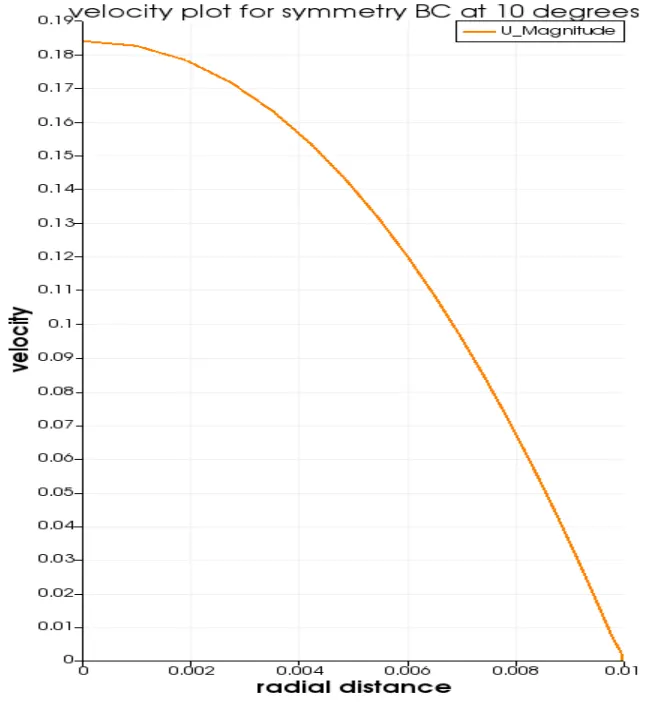
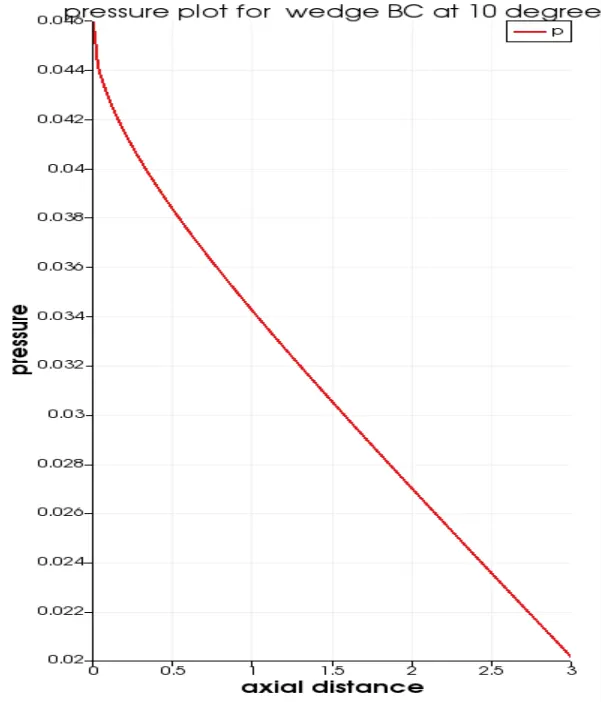
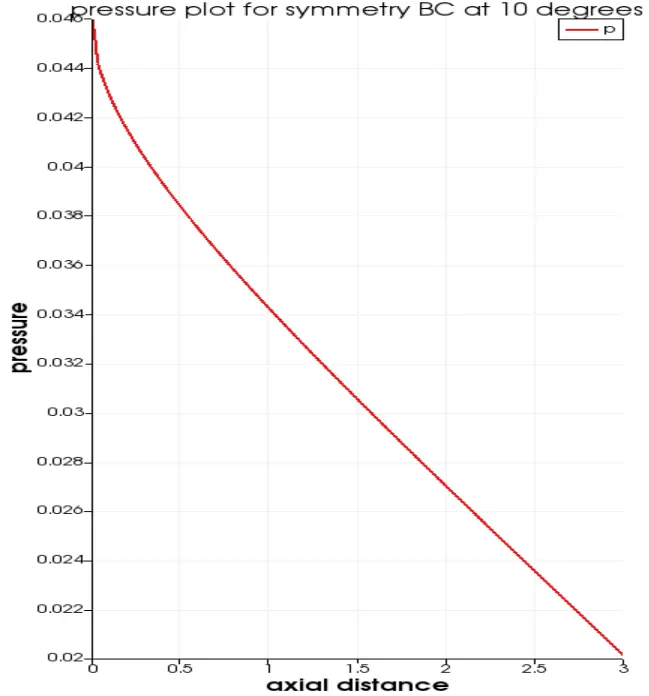
- Comparison of various plots for wedge and symmetry boundary conditions at 10 degrees
 |
 |
 |
 |
 |
 |
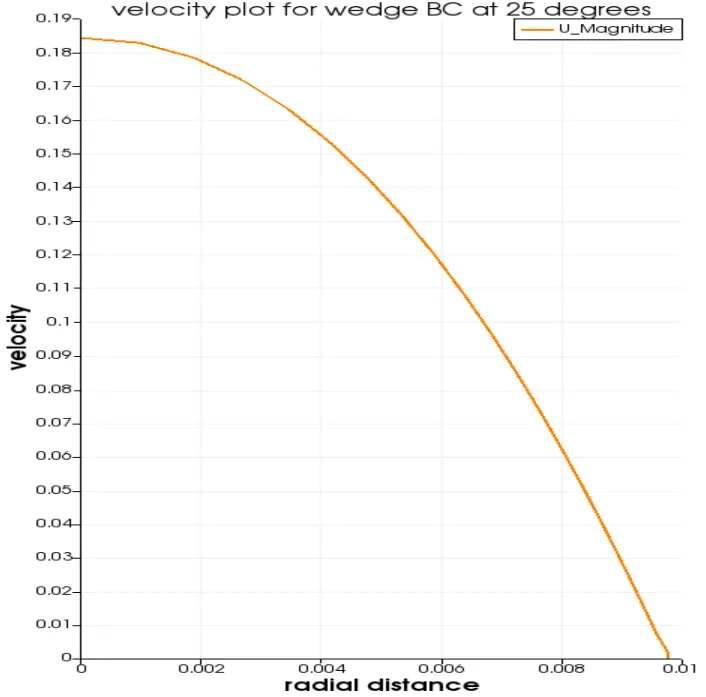
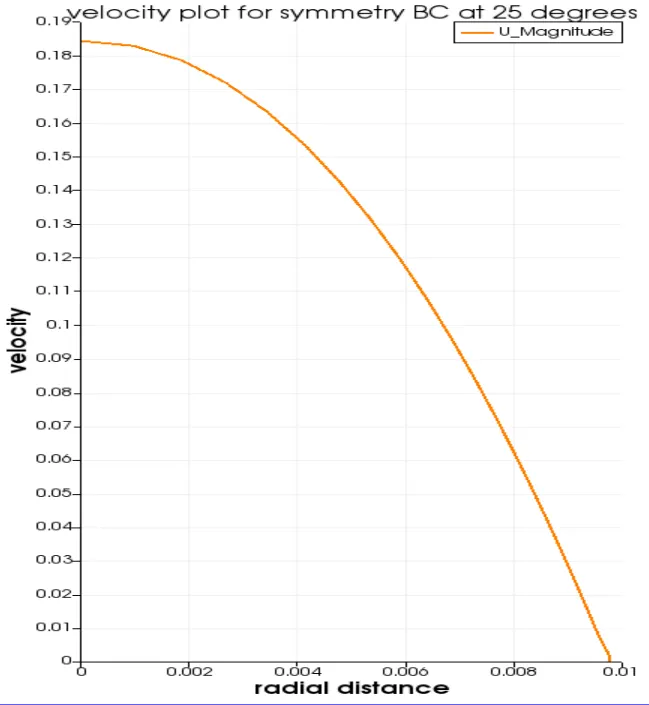
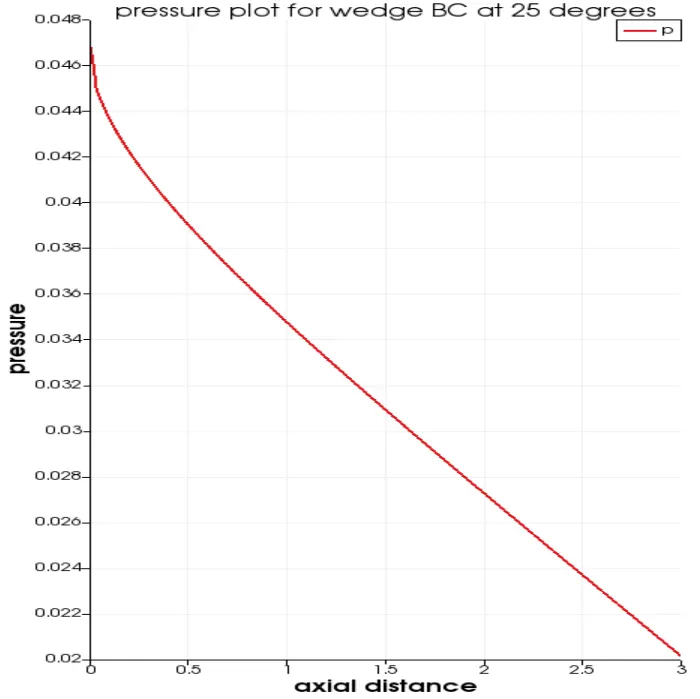
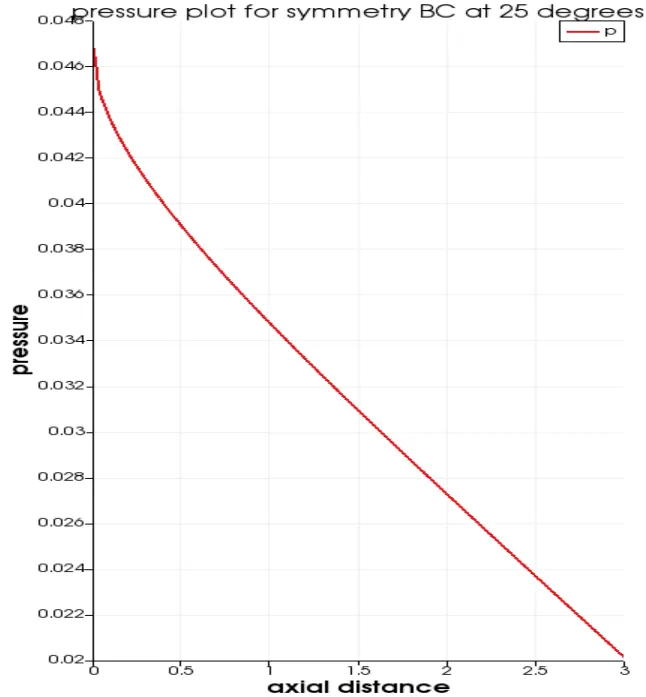
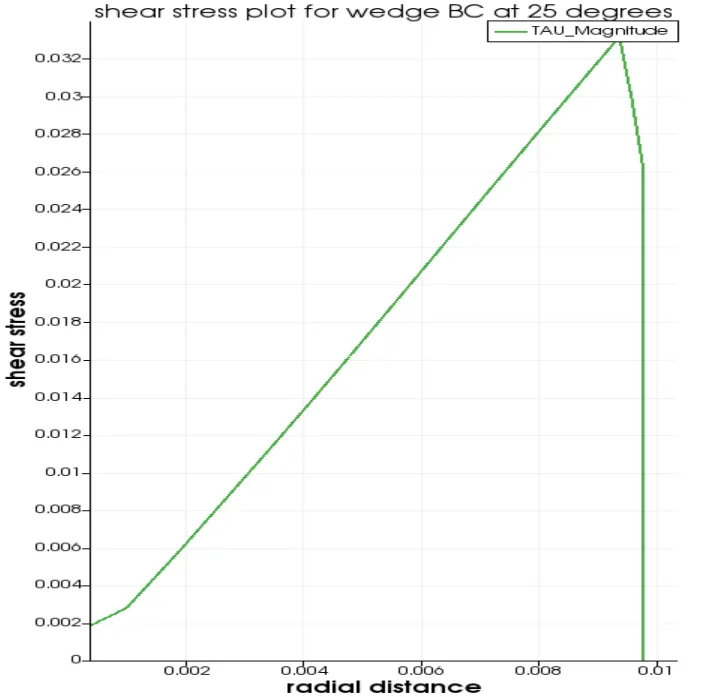
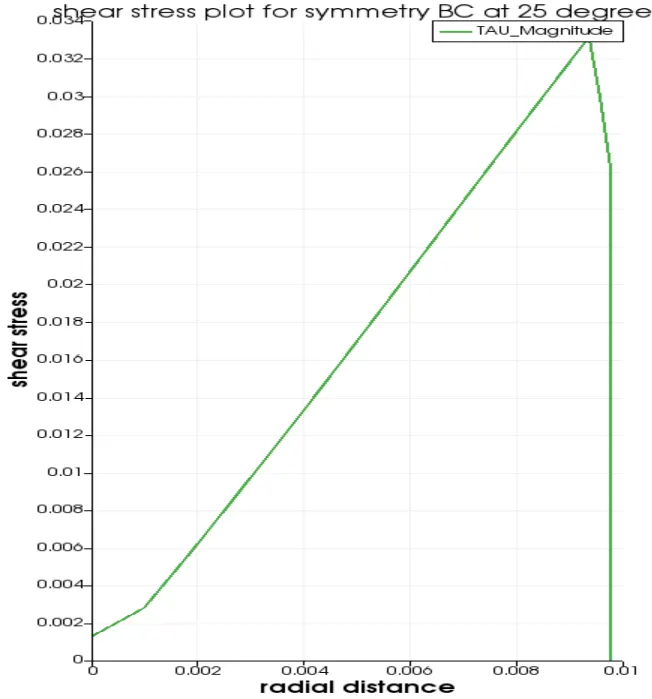
- Comparison of various plots for wedge and symmetry boundary conditions at 25 degrees
 |
 |
 |
 |
 |
 |
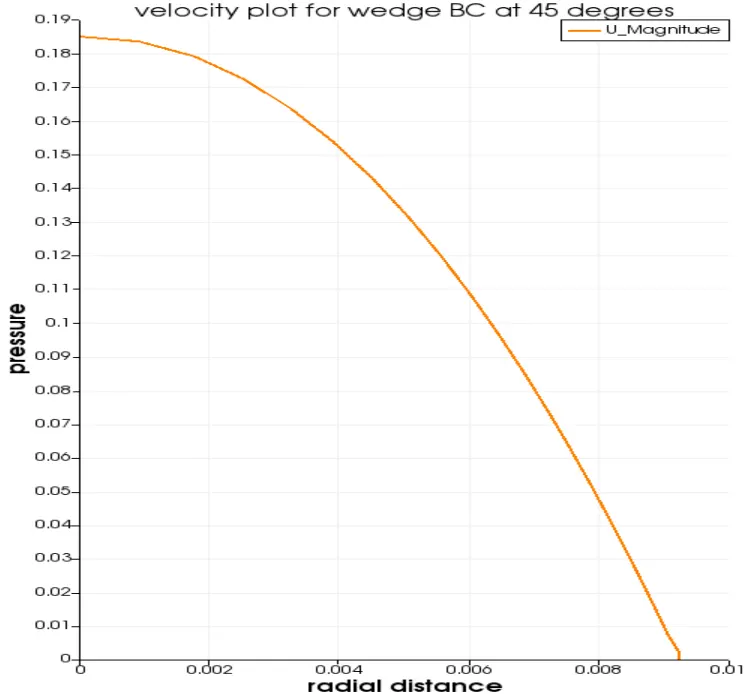
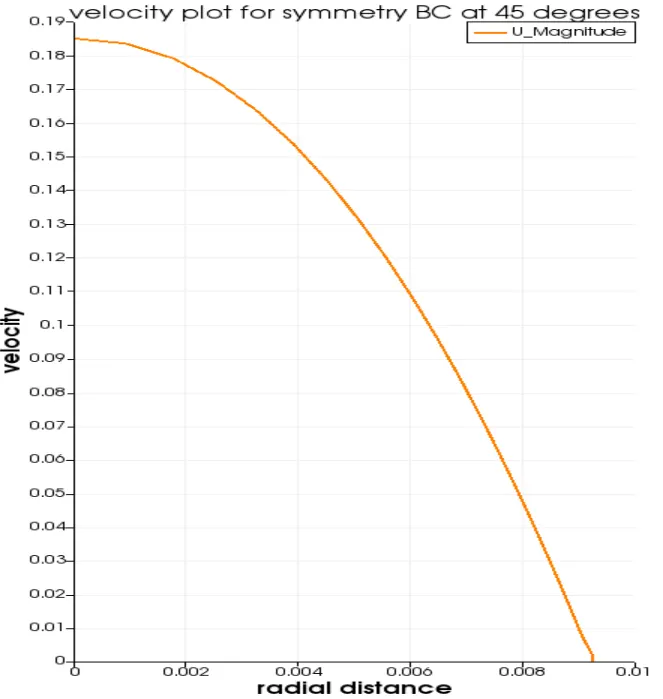
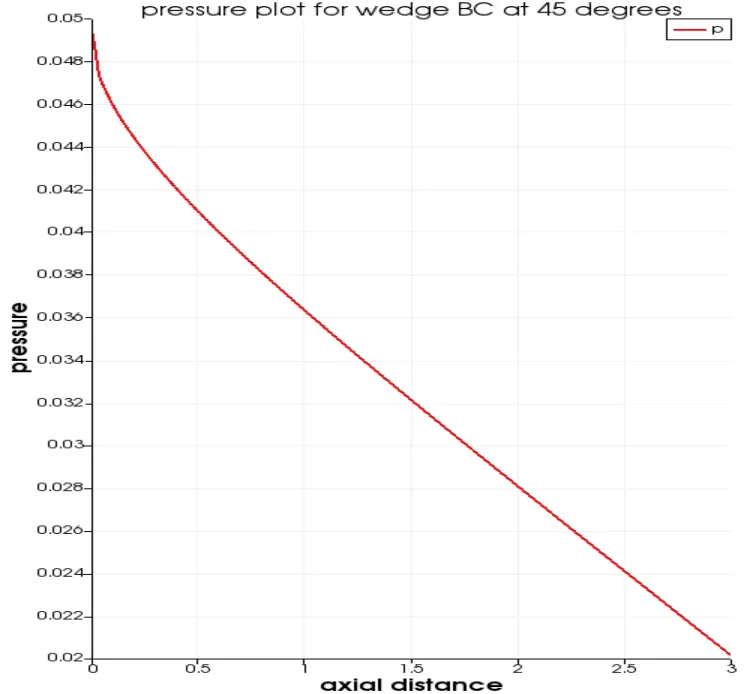
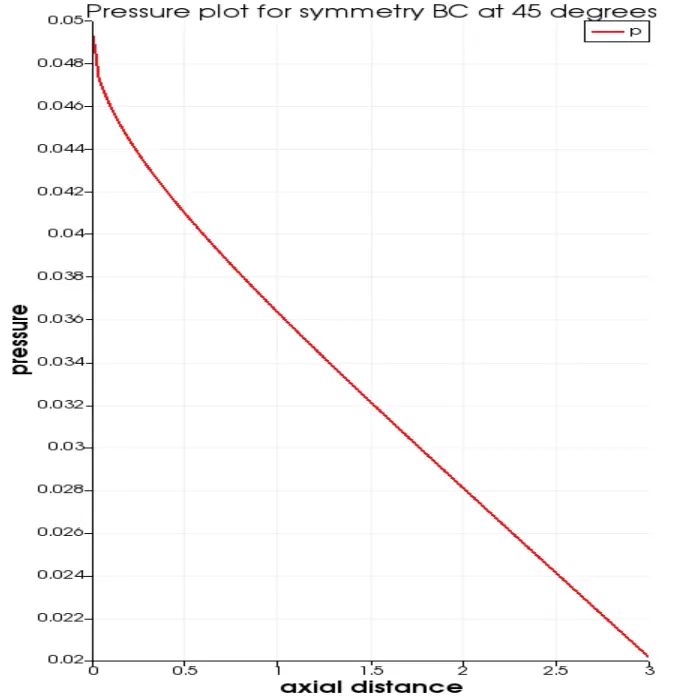
- Comparison of various plots for wedge and symmetry boundary conditions at 45 degrees
 |
 |
 |
 |
 |
 |
CONCLUSION
- It can be seen that the results of both the boundary conditions are the same, which means, the results should not change because of boundary conditions, since the physics behind the problem is unchanged.
- The Symmetry Boundary Condition considers the mesh as 3D, and hence the calculation is done along all the three global axes and the simulation time is a bit higher as well.
- The Courant number is slightly increasing in the case of wedge BC, and hence we can say that symmetry BC is a bit more accurate.