Week 11 - Final project
- Development of a Door Trim panel
Aim
Creation of CAD model considering following inputs as like in OEM and tier1 companies
- Class A surface
- Nominal thickness : Refer master sections
- Attachment strategy
Introduction
We know in automobile industries plastic places a major role in reducing the weight and by that able to increase the efficiency of the vehicle. So designing of the plastics parts are also plays a key profile in automation research and development. There are different grades of plastics are used according to the application. The design is possible by using certain software such as NX cad , Catia V5 etc. Among this Catia V5 is more reliable and simpler to use.
Using catia V5 we create a 3D model of the part from the master section and the class A surface given
Objectives
In order to increase the workability and able to create the effective product life cycle. Designing the part from the master section and the class A surface given.
Methodology
In the door trim provided for the project consist of four sub parts
- Lower substrate
- Arm rest panel
- Map pocket
- Water bottle holder
Class A surface for all the sub parts are given.
From class A surface we first create the tooling axis at appropriate place, with respect to the tooling axis all the other parts are drawn.
After creating the tooling axis the Class B surface is created by offsetting the class A surface at a distance of 2.5mm.
After creating the class b surface the class C surface is created with respect to the class A surface then join and create a close body.
Then after creating the closed body just do a draft analysis to know the draft angle and the feasibility check.
After that create the B side features like the 4 way locator, heat stake with rib and the dog house, flanges for these
Then in assembly workbench fix the lower substrate and then assemble each part with respect to the slots.
Output required:
- Create thickened part using master section for reference
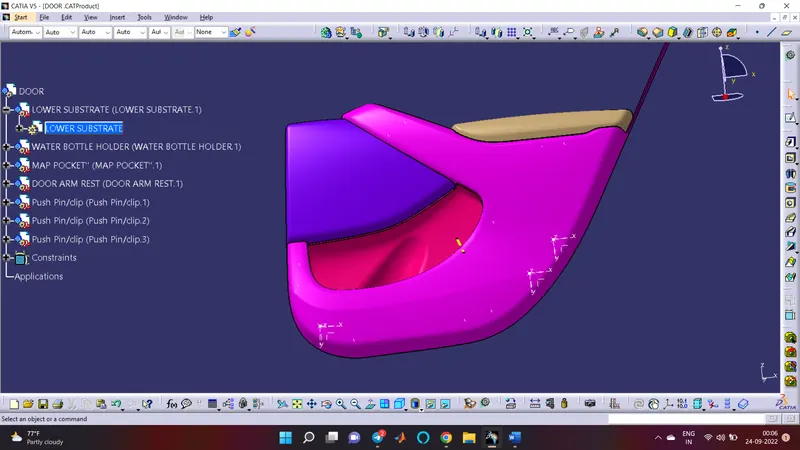
- Create the mounting features as per design guidelines in the industry and with master sections
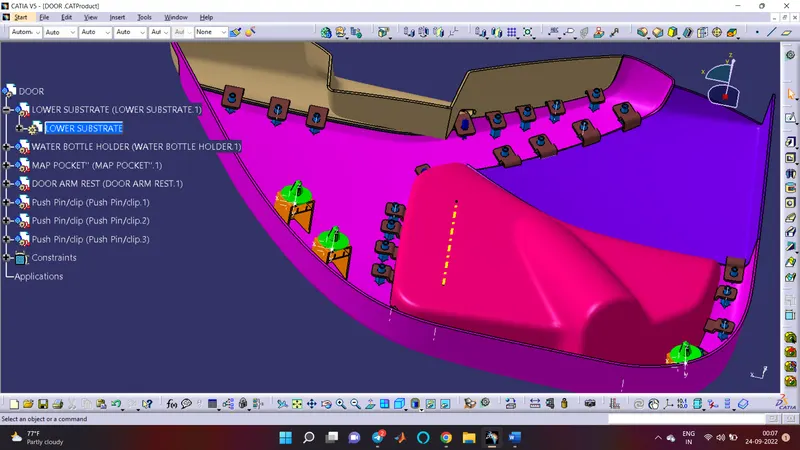
- Apply material details : plastic
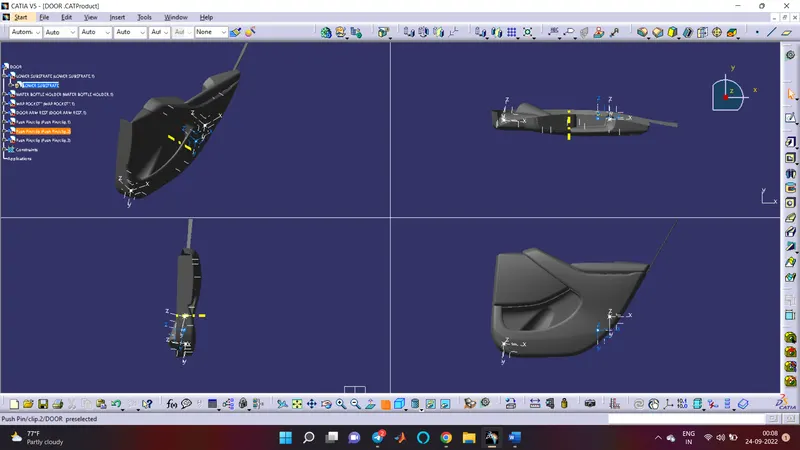
- Draft analysis & Tooling analysis
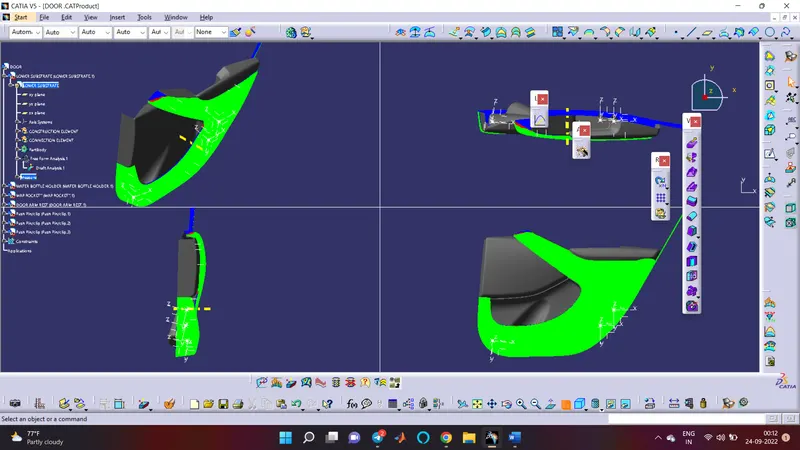
- Creation of parting lines and check tooling feasibility
Conclusion
Thus using Catia v5, the Door Trim panel is develoeped.