Week 11 - Final project
DOOR PANEL
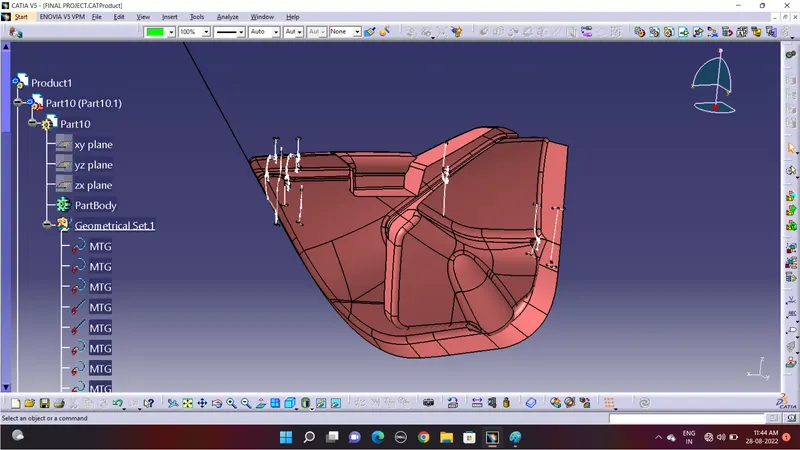
INPUT SURFACE:
INTRODUCTION:
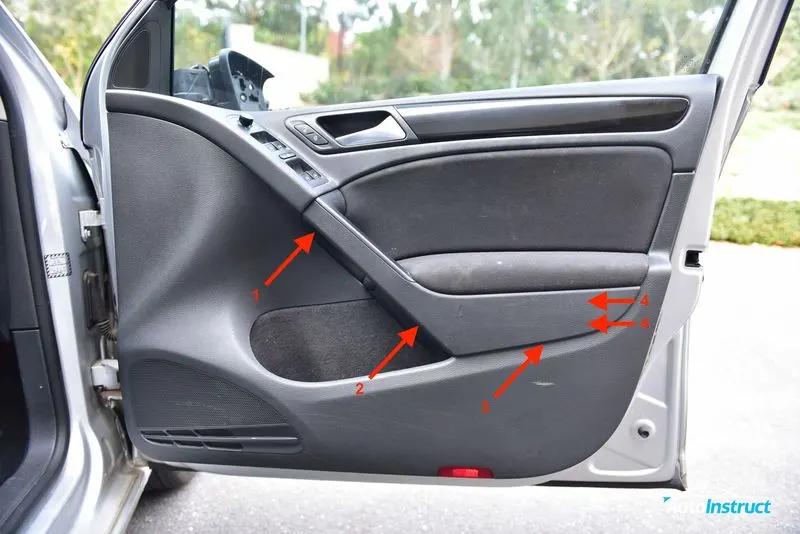
Door panels serve as an interface between the interior of the car and the inner workings of the door, and between vehicle occupants and the door. They are expected to meet a variety of design specifications regarding safety, aesthetics, and functionality. In addition, they are expected to continue the material theme of the dashboard and pillars while concealing intricate electrical and mechanical components for operating locks, windows, and other features. The door panel has evolved from a simple two-part system of latch and simple winding mechanism to a more sophisticated enclosure. Doors currently have an inner full-width panel consisting of electronic windows, central locking system, and speakers. These panels typically consist of a foamed core covered with either textiles or plastics.
A CLASS SURFACE:
A-class surfaces are those aesthetic/ free form surfaces, which are visible to us (interior/exterior), having an optimal aesthetic shape and high surface quality. Mathematically class-A surfaces are those surfaces which are curvature continuous while providing the simplest mathematical representation needed for the desired shape/form and does not have any undesirable waviness. Products are not only designed considering the functionality but special consideration is given to its form/aesthetics which can bring a desire in one’s mind to own that product. This is only possible with high-class finish and good forms. This is the reason why in design industries Class-A surfaces are given more importance. In automotive design, a class-A surface is any of a set of freeform surfaces of high efficiency and quality. Although, strictly, it is nothing more than saying the surfaces have curvature and tangency alignment – to ideal aesthetical reflection quality, many people interpret class A surfaces to have G2 (or even G3) curvature continuity to one another (see free form surface modelling). Class A surfacing is done using computer-aided industrial design applications. Class-A surface modellers are also called "digital sculptors" in the industry. Industrial designers develop their design styling through the A-Surface, the physical surface the end user can feel, touch, see etc.
B CLASS SURFACE:
Class-B surfaces are the secondary surfaces that can be seen sometimes, but are less important, such as the inside of your glovebox, ash tray, etc. These must be smooth and "error-free" as well, but are not held to the standards that class-A surfaces are.
C CLASS SURFACE:
Class C surfaces are the backside surfaces that can have tool marks, flash and other imperfections without hurting appearance, function, etc.
5 Common Plastics Used In Automotive Industry
1)AUTOMOTIVE PLASTIC-POLYPROPYLENE(PP)
PP can be used as a variety of automotive parts, and now in typical passenger cars, PP plastic parts account for more than 60. The main varieties of PP auto parts are: bumper, instrument panel, door trim panel, air conditioner parts, battery shell, cooling fan, steering wheel, among which the first five kinds account for more than half of the total PP consumption of the whole car.
Application: automotive bumpers, chemical tanks, cable insulation, gas cans, carpet fibres.
2)AUTOMOTIVE PLASTIC-POLYETHYLENE(PE)
A series of modified PE alloy materials with good flexibility, weather resistance and coating properties were obtained by grafting and filling toughening modification of high density PE and low density PE resin. PE mainly uses blow molding method to produce fuel tank, vent pipe, deflector and various storage tanks.
In recent years, the amount of PE in the automobile has not increased. It is worth noting that the development trend of automobile lightweight has promoted the plasticization of fuel tank. Plastic fuel tank is officially used in European cars, and its main material is high molecular weight high density polyethylene (HMWHDPE).
Application: car bodies (glass reinforced), electrical insulation.
3)AUTOMOTIVE PLASTIC-POLYOXYMETHYLENE(POM)
It has excellent friction and wear resistance, long-term sliding characteristics, forming fluidity, beautiful surface and luster, and is also suitable for insert molding. Polyoxymethylene type three-layer composite material is widely used in automobile chassis lining, such as steering knuckle bushing, various bracket bushing, front and rear leaf spring bushing, brake bushing, etc. it is a three-layer composite material with cold-rolled steel plate as matrix, sintered porous bronze powder as intermediate layer and modified Polyoxymethylene as friction reducing layer on the surface. The special properties of the oil storage pit are determined by its structure: the mechanical strength and rigidity of steel, and the excellent friction and wear resistance characteristics under boundary lubrication conditions. Other applications include door handles, seat belt mechanical components, combination switches and mirrors.
Application: interior and exterior trims, fuel systems, small gears.
4)AUTOMOTIVE PLASTIC-ACRYLONITRILE BUTADIENE STYRENE(ABS)
Acrylonitrile Butadiene Styrene is a copolymer made by polymerizing styrene and acrylonitrile in the presence of polybutadiene. The styrene provides the copolymer with a shiny, tough exterior. The rubbery butadiene supplies a resilience down to very low temperatures. A wide variety of adjustments can be made to enhance impact resistance, durability and heat resistance. In recent years, the amount of ABS resin used in automobiles has not increased greatly, which is mainly due to the fierce competition between ABS resin and PP resin, and the defects of poor weatherability, discoloration and flammability of ABS itself, so it is used in the main parts of automobile, such as dashboards and wheel covers.
Application: automotive body parts, dashboards, wheel covers.
5)AUTOMOTIVE PLASTIC-POLYAMIDE
Polyamide, commonly known as nylon, has high impact strength, friction and wear resistance, heat resistance, chemical resistance, lubricity and dyeability. As a structural part of automobile, the amount of PA is increasing and can be used in harsh environment around the engine.
Application: gears, bushes, cams, bearings, weather proof coatings.
WORKING OF CAD SURFACE:
DOOR ARM REST INPUT SURFACE:
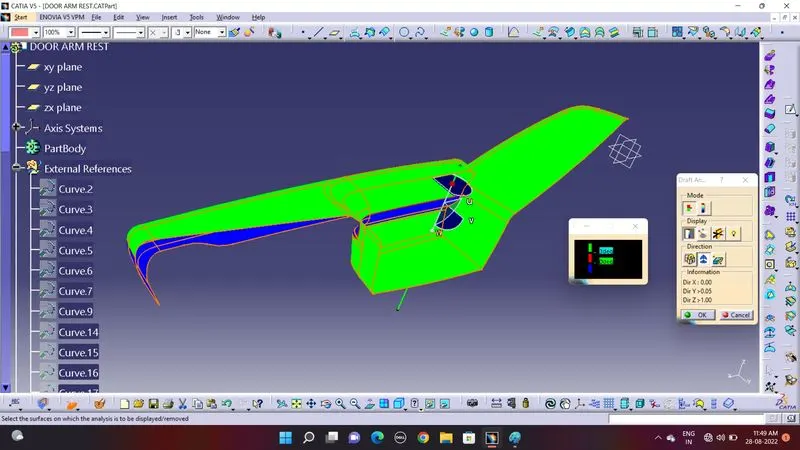
DOOR ARM REST TOOLING AXIS AND DRAFT ANALYSIS:
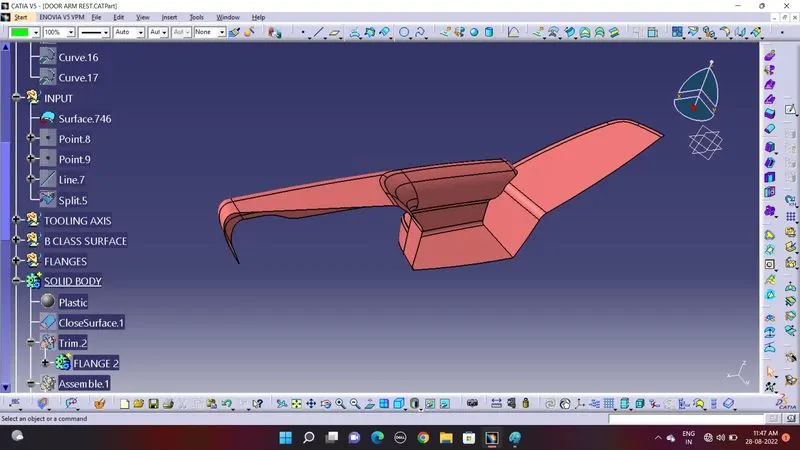
SOLID PART FOR DOOR ARM REST:
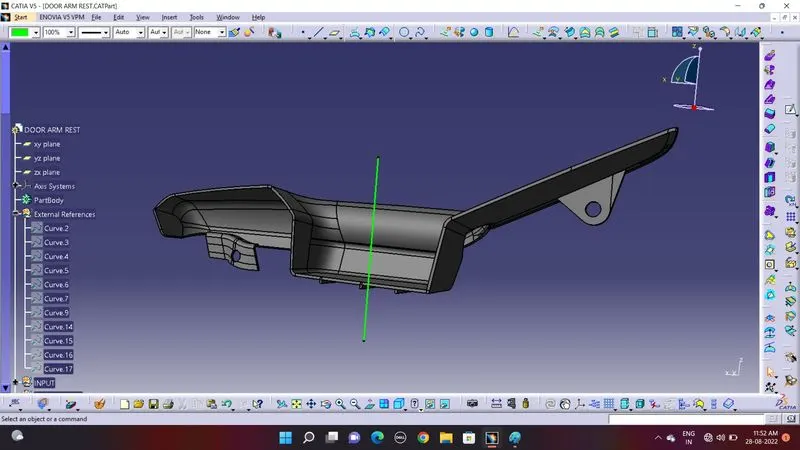
LOWER SUBSTRATE INPUT SURFACE:
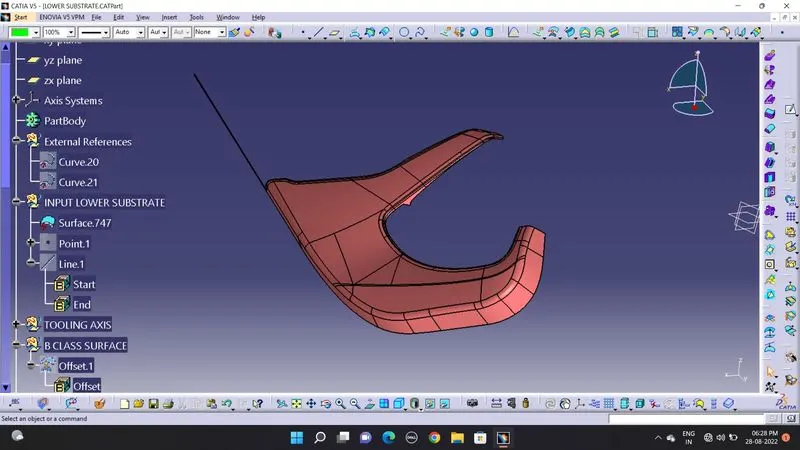
LOWER SUBSTRATE TOOLING AXIS AND DRAFT ANALYSIS:
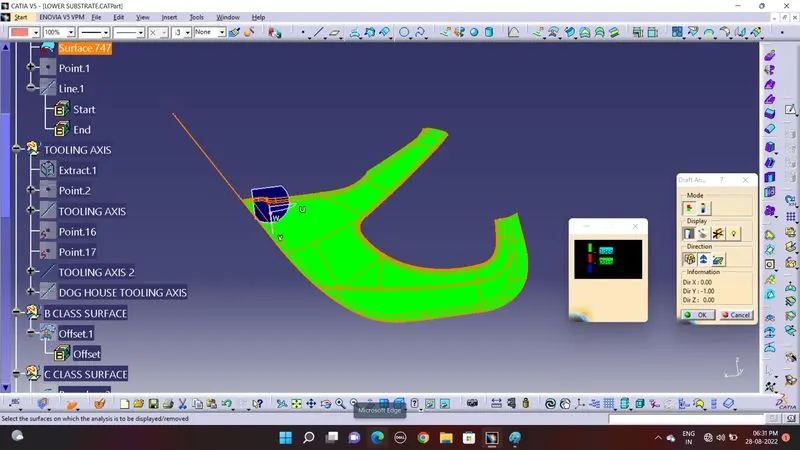
LOWER SUBSTRATE SOLID BODY:
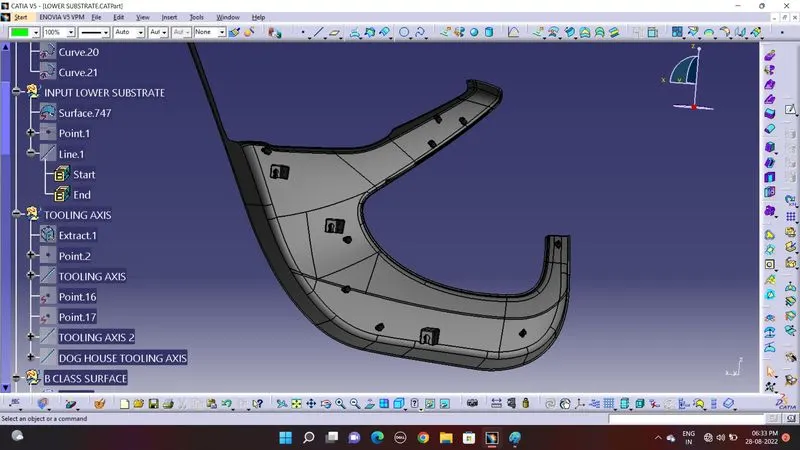
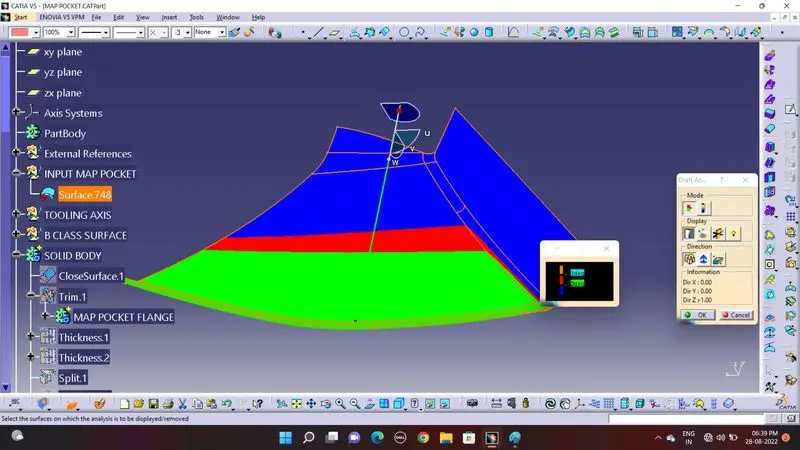
MAP POCKET INPUT SURFACE WITH DRAFT ANALYSIS:
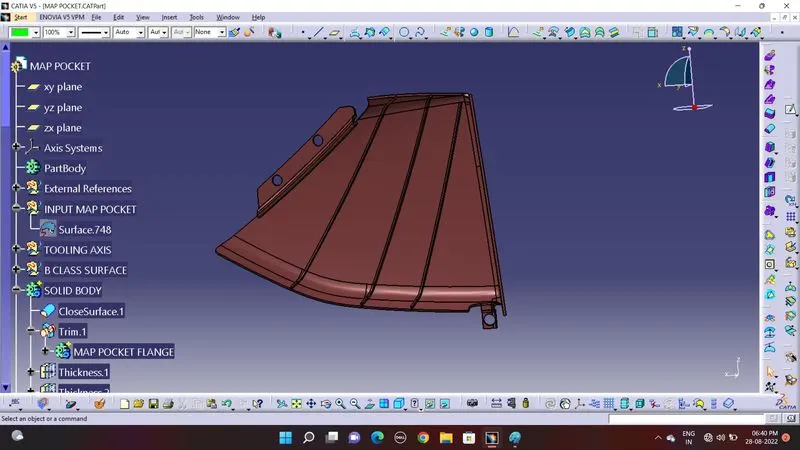
MAP POCKET SOLID BODY:
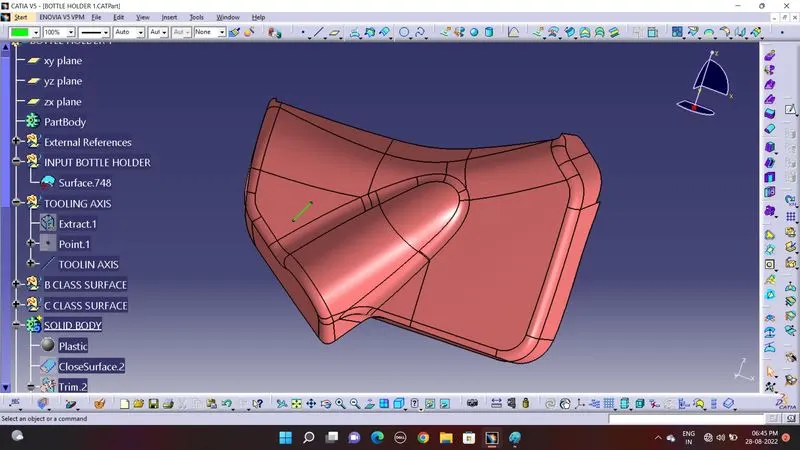
BOTTLE HOLDER WITH TOOLING AXIS:
BOTTLE HOLDER SOLID BODY:
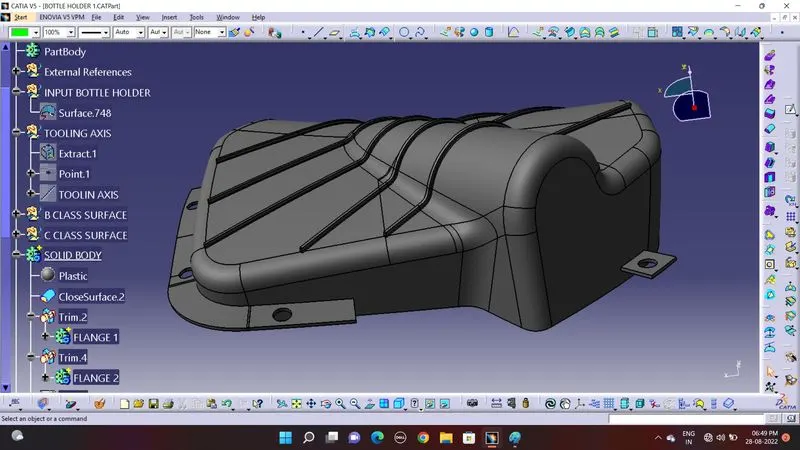
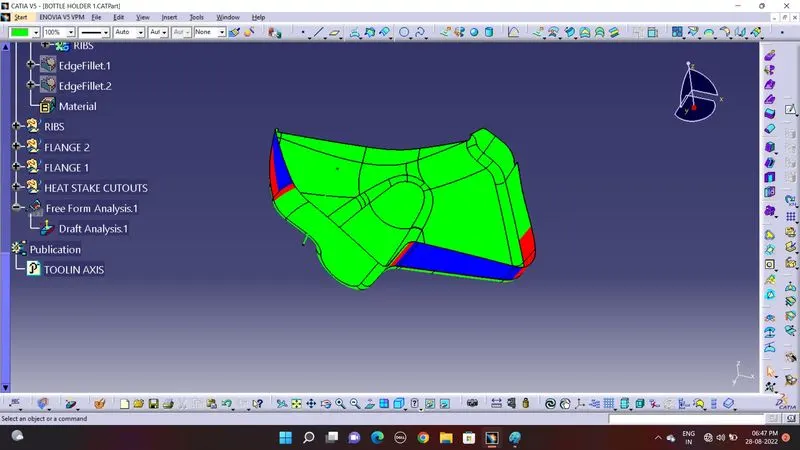
BOTTOLE HOLDER DRAFT ANALYSIS:
ENGINEERING FEATURES:
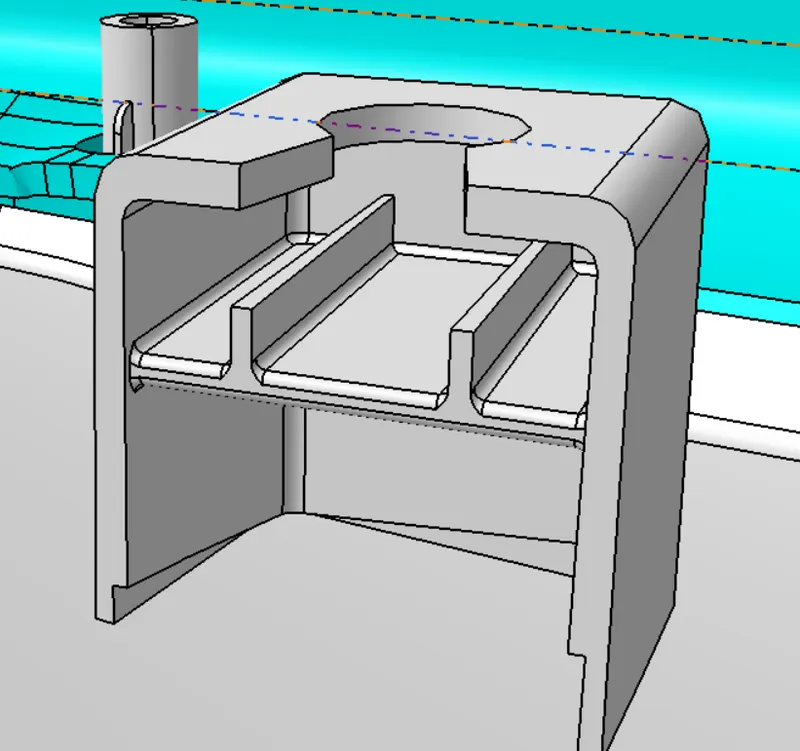
DOG HOUSE DESIGN:
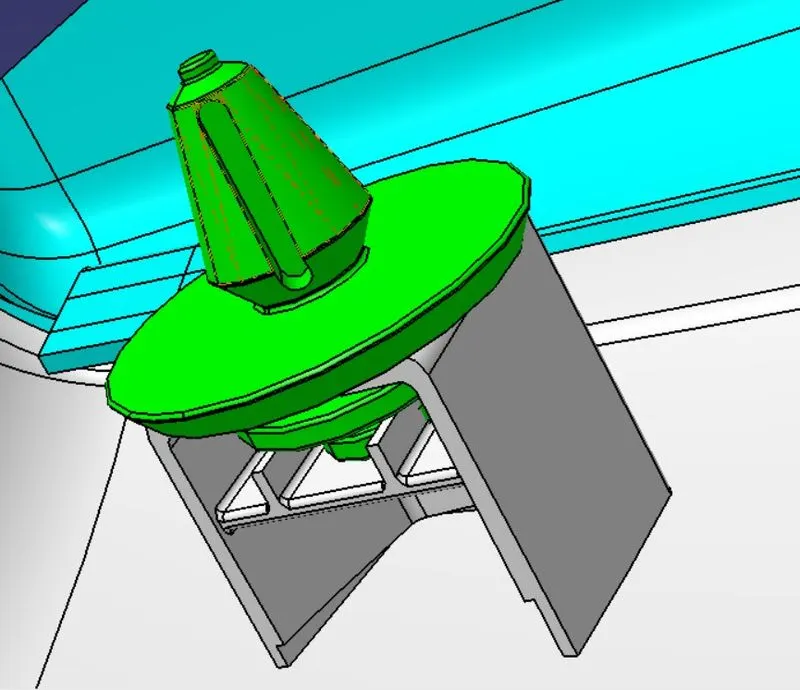
Dog house is an engineering feature used in plastic trim design. Dog houses are used as supporting features. Sometimes other engineering features like snaps; locators etc. are mounted on them to increase their strength. Dog houses are subjected to draft analysis to prevent breakage of the component during ejection from mould cavity. Dog house and other engineering components are built on a B-surface.
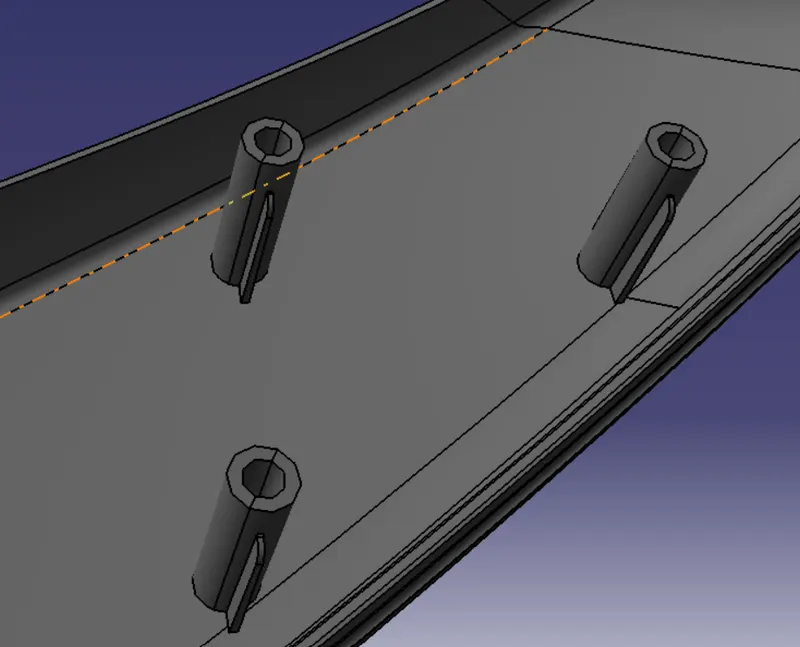
HEAT STAKES:
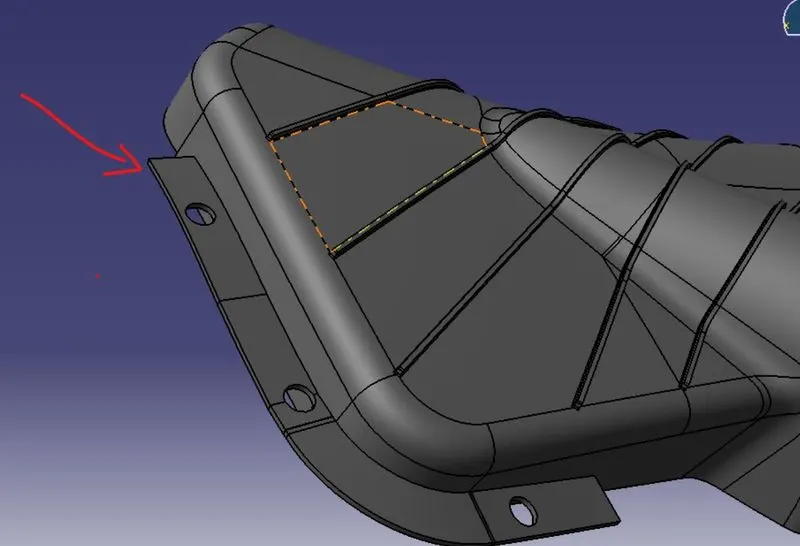
FLANGES:
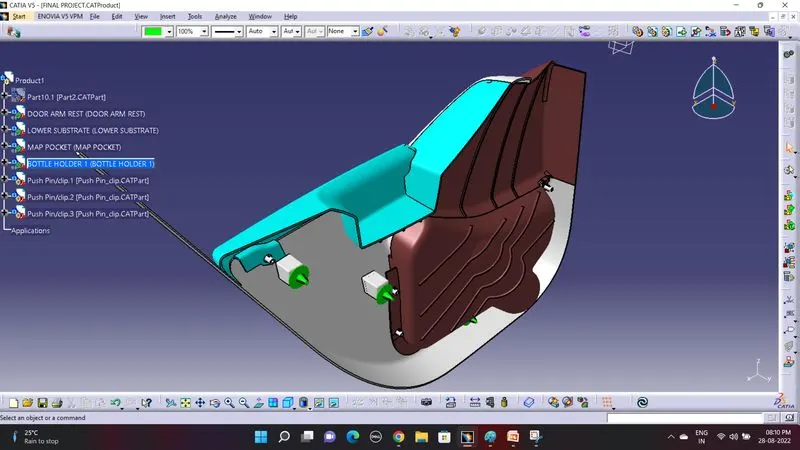
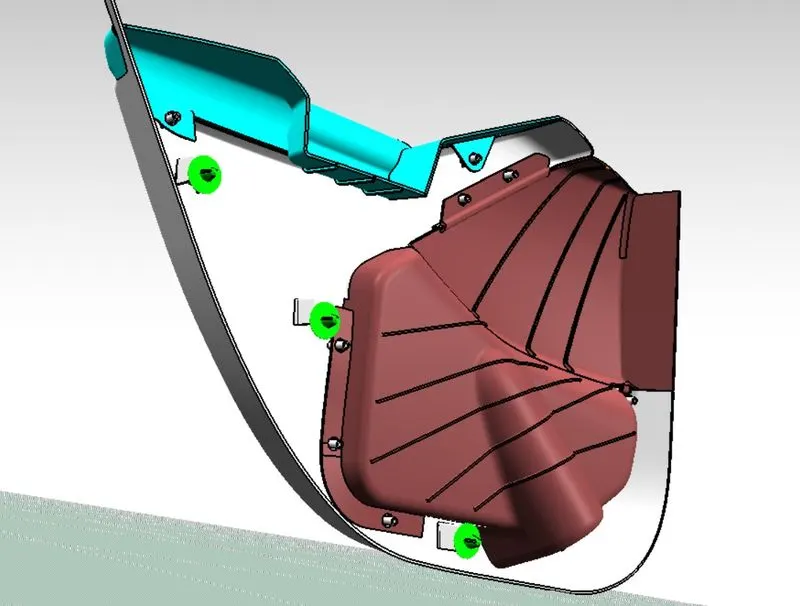
DOG HOUSE WITH PUSH PIN:
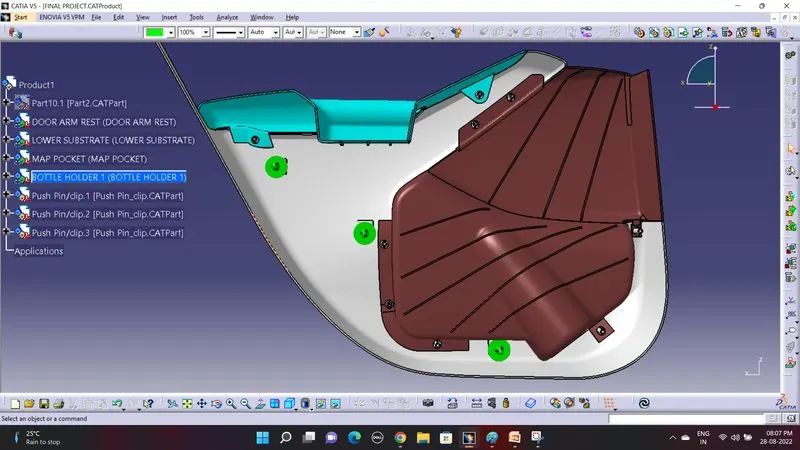
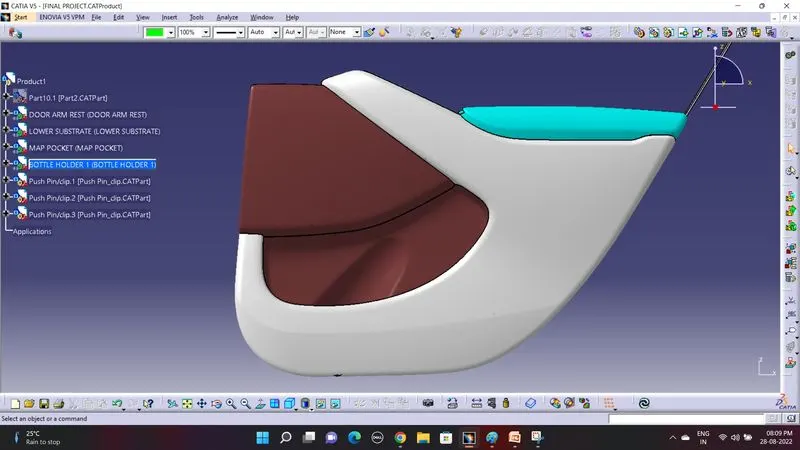
FINAL DOOR TRIM: