Section Modulus calculation and optimization
SECTION MODULUS FOR HOOD DESING
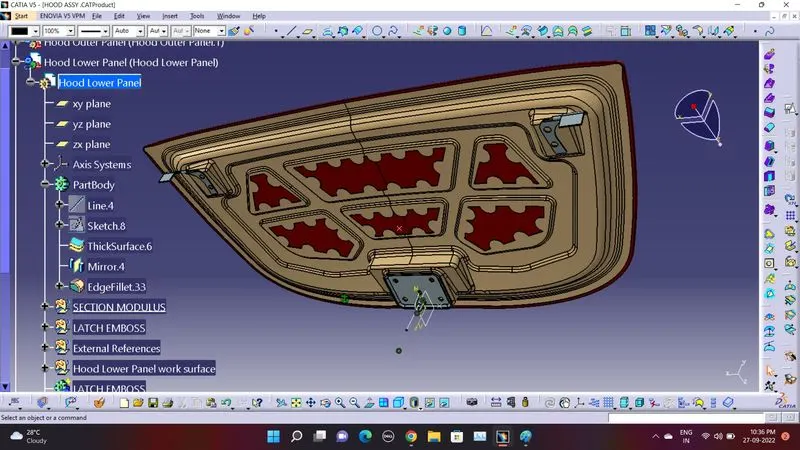
SECTION MODULUS:
It is a way of quantifying a cross-section of a given geometry. It is directly proportional to the area moment of inertia of the cross-section. Higher the section modulus, the more the moment of inertia, more stiffness and thus more resistance to deformation and bending. Section modulus can also be improved by varying the geometry of the cross-section. Isn other words, stiffness can be improved by just improving the geometry without the need for adding extra material.
S=I/Y
I=Moment of Inertia
Y=End of Extremum Point Distance
Moment of Inertia:
The moment of inertia of an object is a calculated measure for a rigid body that is undergoing rotational motion around a fixed axis: that is to say, it measures how difficult it would be to change an object's current rotational speed. That measurement is calculated based upon the distribution of mass within the object and the position of the axis, meaning that the same object can have very different moment of inertia values depending upon the location and orientation of the axis of rotation.
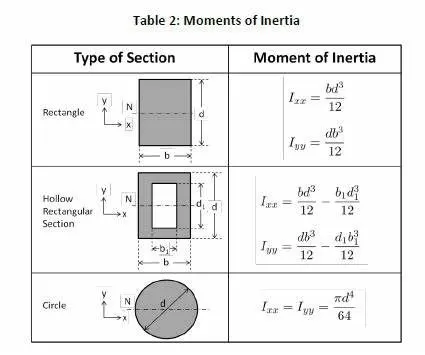
SOME SHAPE MOMENT OF INERTIA FORMULAS;
SECTION MODULUS CALCULATION IN CAD MODEL:
SEGMENT 1:
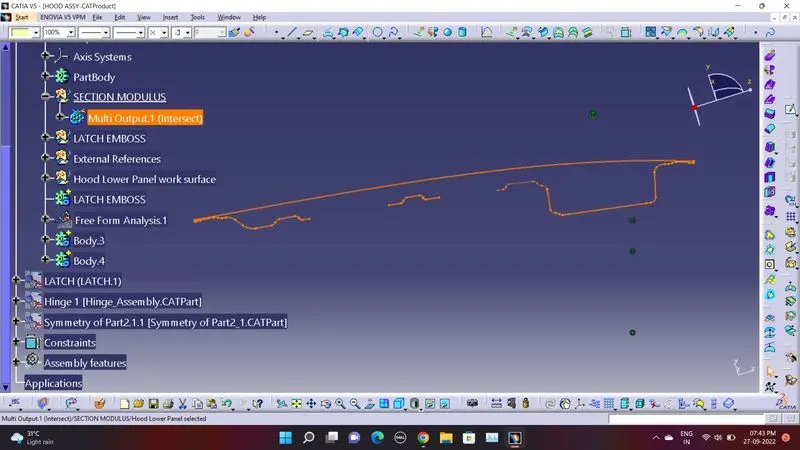
- Above Image shows Intersection of Hood assembly
EXTREMUM POINT LENGTH-(Y)
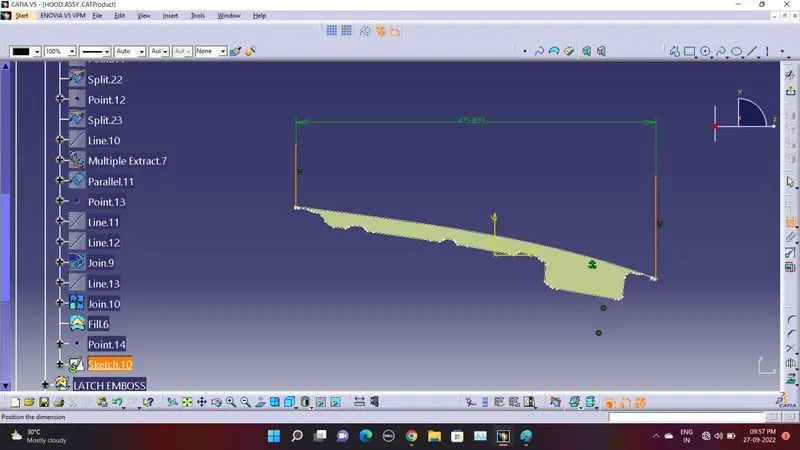
Y=475.833/2
Y=237.91mm
S=I/Y
I=1.65 X 10^6 mm^4
i.e) S=1.65 X 10^6 mm^4/237.91
For Segment 1 Section Modulus Value S=6935.4mm^3
SEGMENT 2:
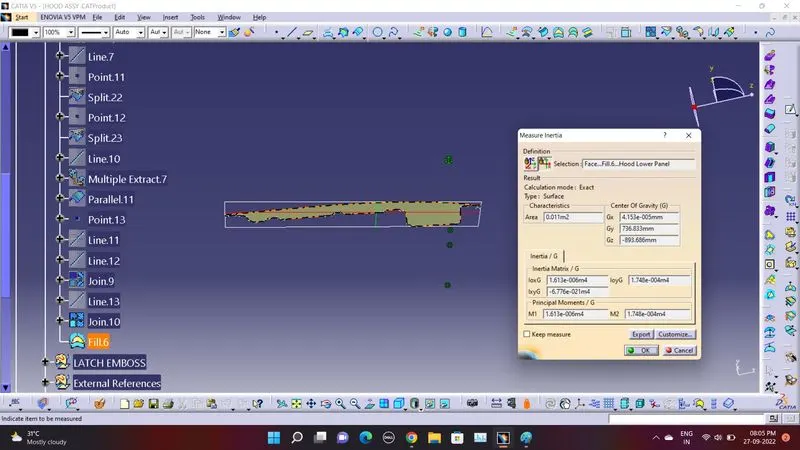
Y=475.833/2
Y=237.91mm
S=I/Y
I=1.613 X 10^6 mm^4
i.e) S=1.613 X 10^6 mm^4/237.91
For Segment 2 Section Modulus Value S=6779.87mm^3
CONCLUSION:
- After Taking 1st Segment, to Offset a Curve Outside +0.6mm added in 2nd Segment
- Segment 1> Segment 2 Value
- i.e) Segment 1 value of section modulus is greater than Segment 2, So before offsetting Curves are good section modulus.
- We can go with segment 1