Hood design-Week 2
HOOD ASSY
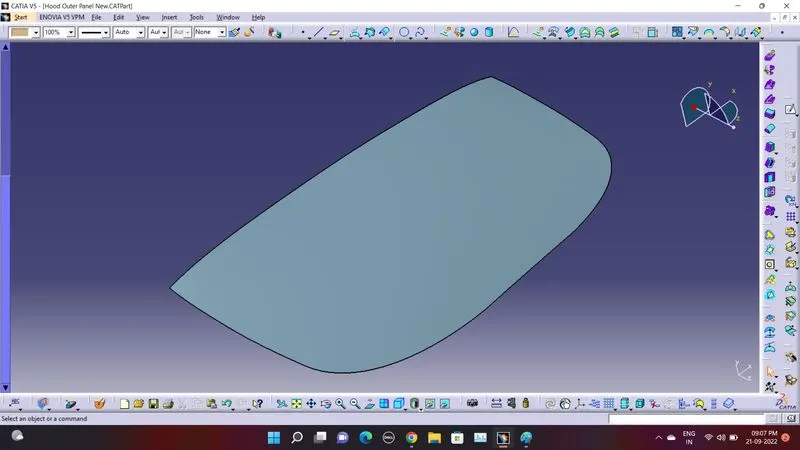
Input Surface For Hood Assy:
Introduction Of Hood Assy:
Hood Or Car Bonnet Design is Very Important for Pedestrian safety considerations. Most of the Designer should work for safety purpose.
Pedestrian safety:
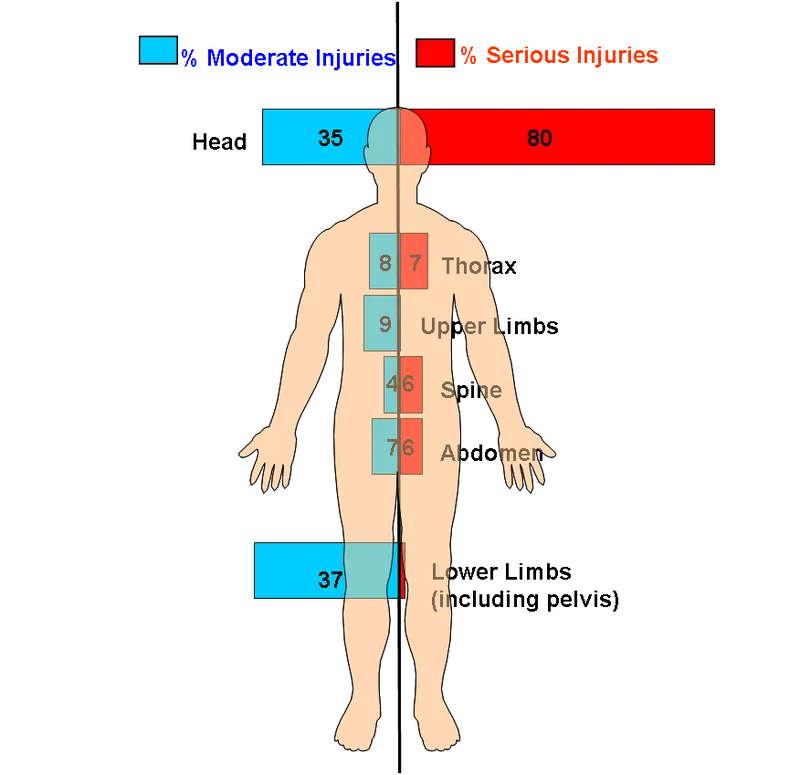
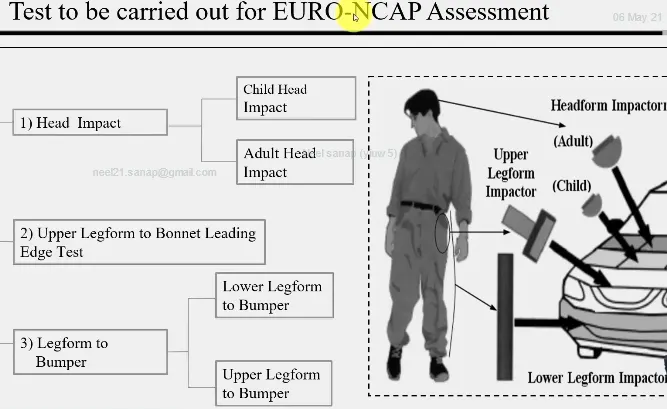
Many pedestrian crashes involve a forward moving car (as opposed to buses and other vehicles with a vertical hood/bonnet). In such a crash, a standing or walking pedestrian is struck and accelerated to the speed of the car and then continues forward as the car brakes to a halt. The pedestrian is impacted twice, first by the car and then by the ground, but most of the fatal injuries occur due to interaction with the car. Vehicle designers usually focus on understanding the car-pedestrian interaction, which is characterized by the following sequence of events: the vehicle bumper first contacts the lower limbs of the pedestrian, the leading edge of the hood hits the upper thigh or pelvis, and the head are struck by the top surface of the hood and/or windshield.
Deep Drawing Process:
Deep drawing is a manufacturing process that is used extensively in the forming of sheet metal into cup or box like structures. Pots and pans for cooking, containers, sinks, automobile parts, such as panels and gas tanks, are among a few of the items manufactured by sheet metal deep drawing. This process is sometimes called drawing and is not to be confused with the bulk deformation process of drawing discussed earlier. A basic deep drawing operation could be the forming of a flat sheet into a three dimensional cup, or a box. The shape of a deep drawn part is not limited to a circle or square, more complex contours are possible. However, as the complexity goes up, the manufacturing difficulties increase rapidly. It is best to design the shape of a deep drawing to be as simple as possible. For the primary sheet metal deep drawing process the part will have a flat base and straight sides.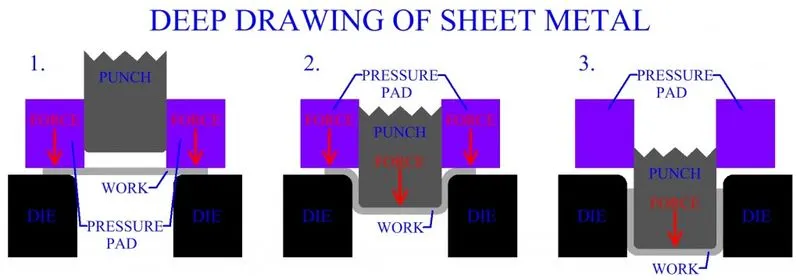
Hemming Process:
Hemming is a forming operation in which the edges of the sheet are folded or folded over another part in order to achieve a tight fit. Normally hemming operations are used to connect parts together, to improve the appearance of a part and to reinforce part edges.
In car part production, hemming is used in assembly as a secondary operation after deep drawing, trimming and flanging operations to join two sheet metal parts (outer and inner) together. Typical parts for this type of assembly are hoods, doors, trunk lids and fenders.
The accuracy of the hemming operation is very important since it affects the appearance of the surface and surface quality. Material deformations, which occur during the hemming process, can lead to dimensional variations and other defects in parts. Typical hemming defects are splits or wrinkles in the flange, material overlaps in the corner areas or material roll-in. This is why it is important to use simulation tools in order to, on the one hand, better understand the hemming process and, on the other hand, significantly reduce the number of “trial and error” loops during tryout und production.
There are various types of hemming operations:
- Conventional die hemming
- Roll hemming
Conventional die hemming
Conventional die hemming is suitable for mass production. In die hemming, the flange is folded over the entire length with a hemming tool. Normally the actual hemming is a result of a forming operation in which the flange is formed with a hemming tool after the drawing and trimming operations have been completed. The formed flange is then hemmed in several process steps. These steps include, for example, the pre-hemming and final hemming depending on the respective opening angle of the flange. Production plants for conventional die hemming are very expensive, but the cycle times are very low.
Roll hemming
Roll hemming is carried out incrementally with a hemming roller. An industrial robot guides the hemming roller and forms the flange. Roll hemming operation can also be divided into several pre-hemming and final hemming process steps. Roll hemming is very flexible to use and tool costs are significantly lower as compared to those of conventional die hemming. However, the cycle times are much higher since the hemming is realized using a hemming roller which follows a defined path.
Sheetmetal Embossing:
Sheet metal embossing is generally used to create logos, lettering, small depressions, etc. It is also used to create desired non-slip surfaces as well as other geometric features on the sheet metal.
In sheet metal embossing, the deformation of the metal takes place because of stretching of the metal (or tensile force acting on the metal), due to which the sheet metal is subjected to excessive thinning and fracturing.
Thus the depth to which the material is depressed depends upon the thickness of the sheet as well as stretchability of the material.
Embossing is generally used to make dimples on sheet metal to increase their rigidity as well as it is also used for decorative purposes on panels in houses or other places.
Characteristics of Embossing:
- Embossing has an ability to form (change the shape) of ductile metals.
- Embossing operations can be used for high production purposes too.
- The embossing operation has the ability to maintain the same metal thickness before and after the embossing operation.
- It has the capability to produce longer lengths of embossed sheets.
Working Of Hood Assy In CAD:
Maste Section for Hood Assy:
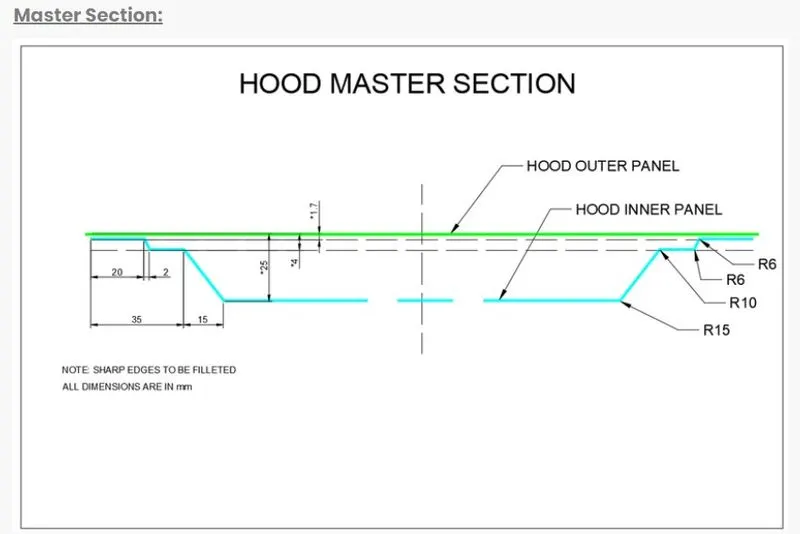
Above Master Sections are Working of hood desings
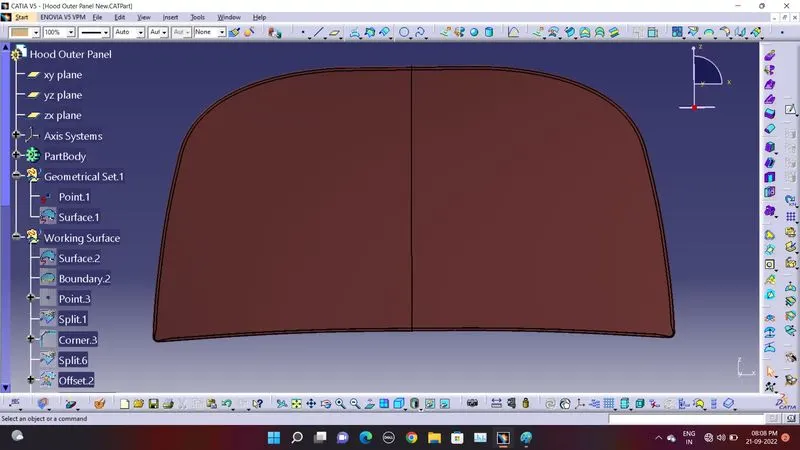
HOOD OUTER PANEL:
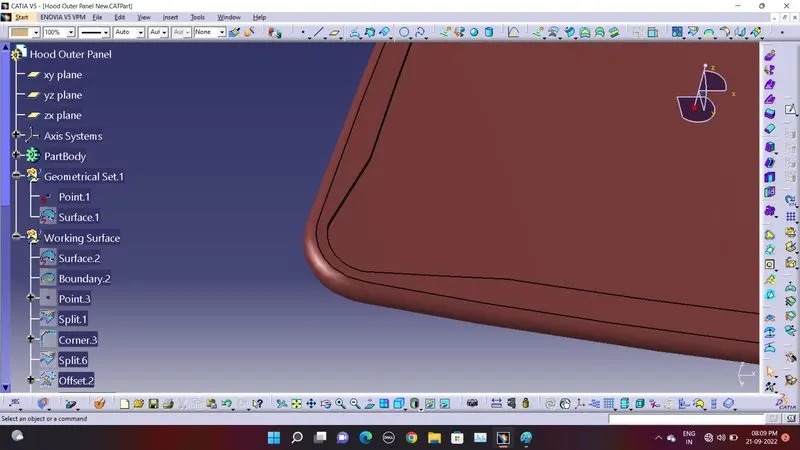
HOOD OUTER PANEL RELIEF CORNER FOR HEMMING:
HOOD LOWER PANEL WITH MASTIC POINTS AND EMBOSSING'S:
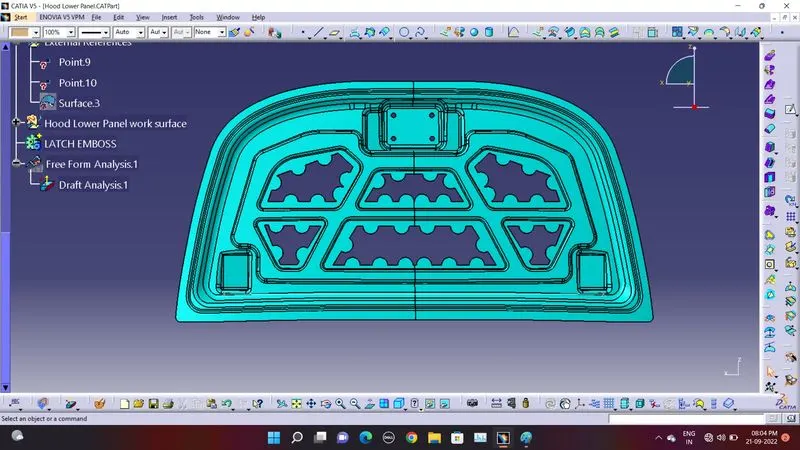
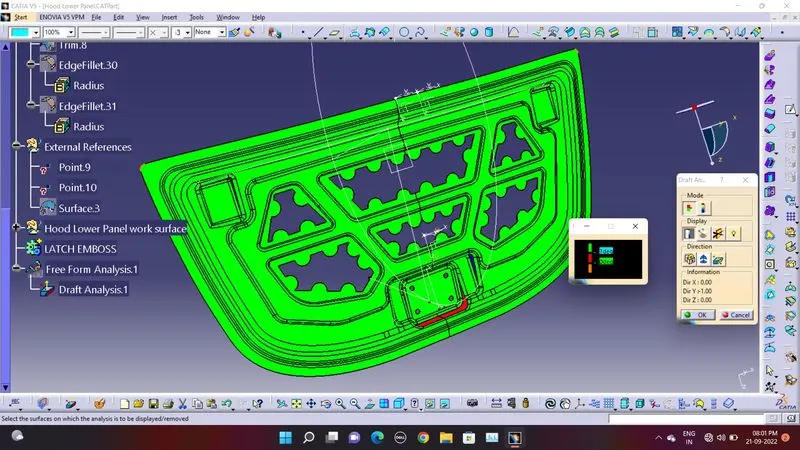
DRAFT ANALYSIS OF LOWER PANEL:
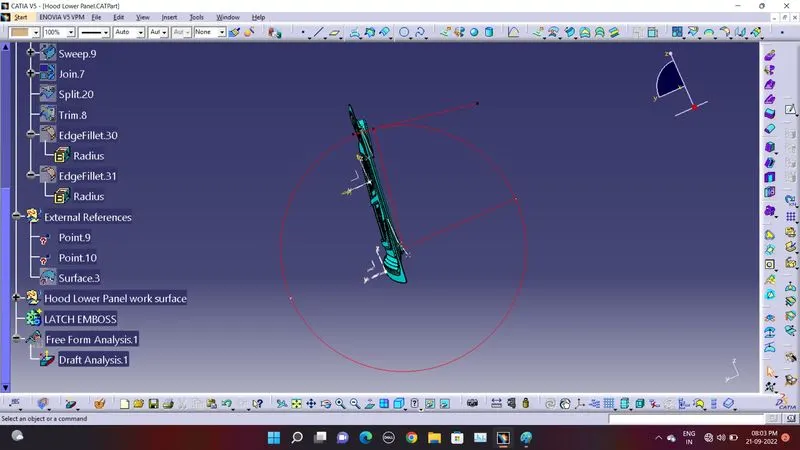
LOWER PANEL WITH TRAJECTORY CIRCLE:
HOOD ASSY WITH STRIKER AND HINGES:
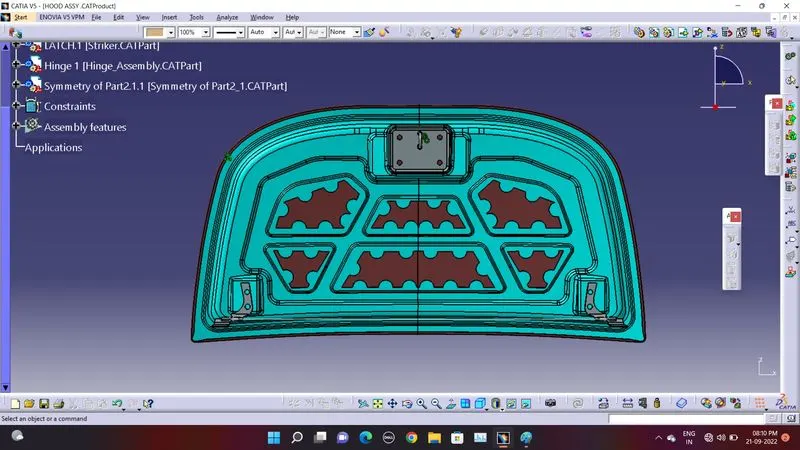
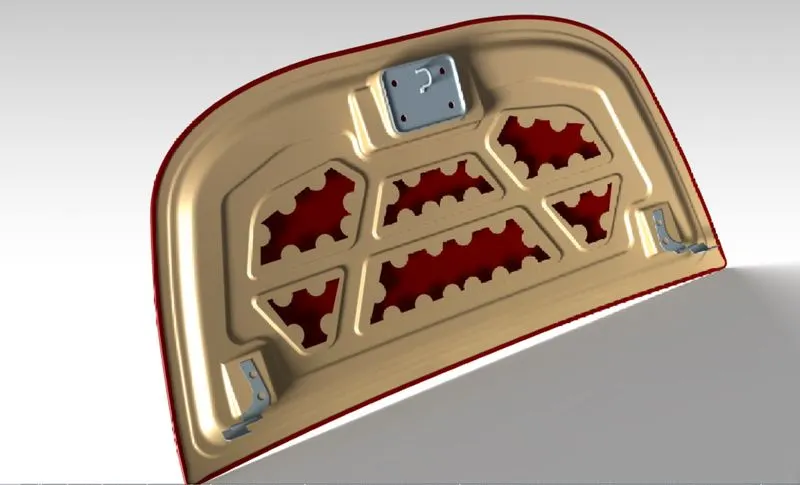
RENDERED IMAGE FOR HOOD DESIGN: