Week-11 Challenge: Braking
AIM:
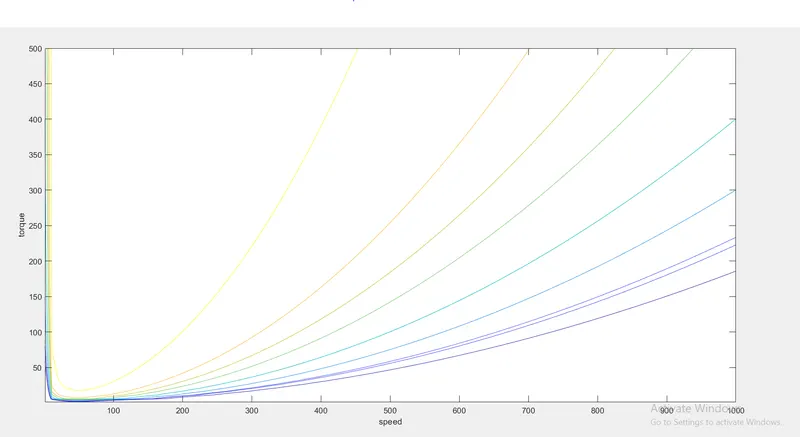
To Make a MATLAB program that plots the contour of given motor speed, torque, and efficiency values
Objective:
# To calculate the energy required for braking for the defined driving cycle.
# At high speed Why electric motor can’t develop braking torque similar to starting and to determine How electric and mechanical brakes are coordinated.
# To make a MATLAB program that plots the contour of given motor speed, torque, and efficiency values.
Case(i): To calculate the energy required for braking for the defined driving cycle.
The driving cycle is generated in an excel sheet
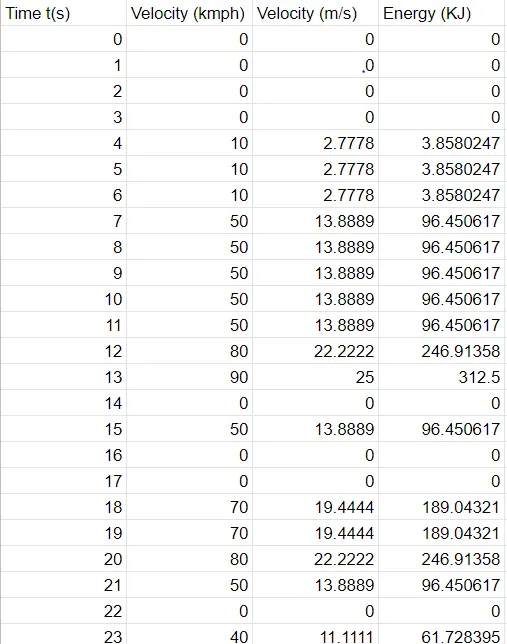
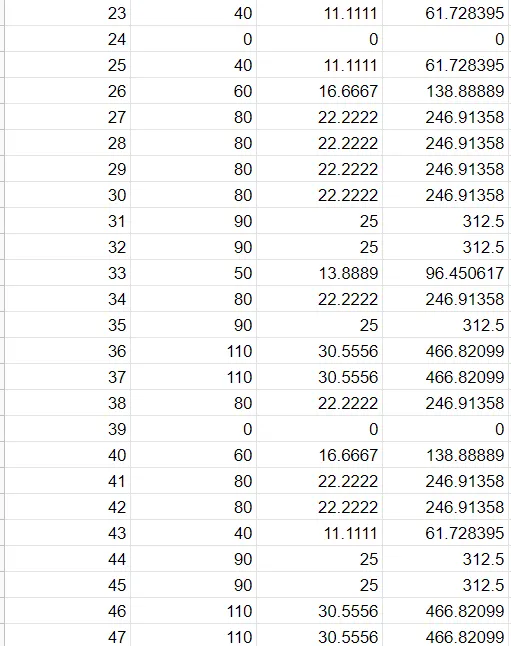
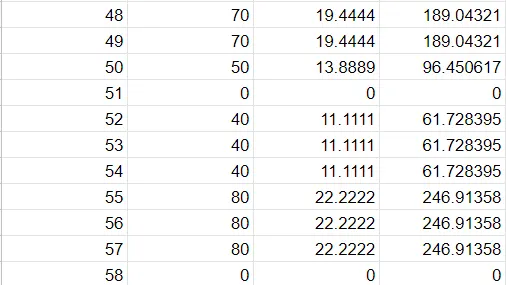
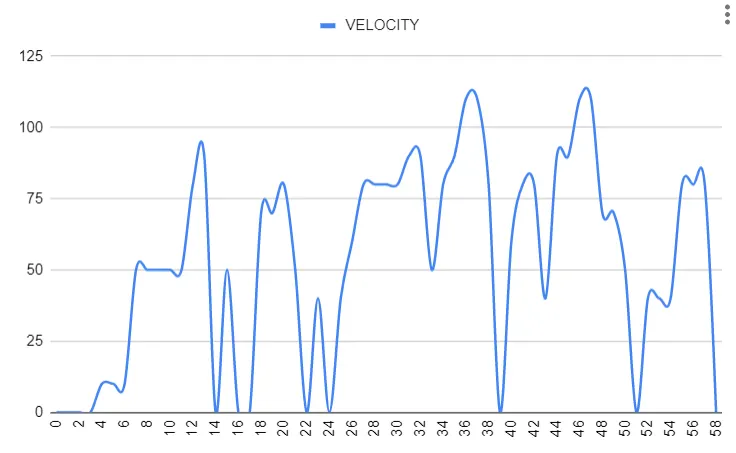
# At each point, the kinetic energy`1/2(mv^2)` where m is the mass(kg) and v is the velocity in(m/s) is calculated.
# During deceleration only, the brakes will be applied, so consider only those points and the kinetic energy is calculated.
# The total braking energy is calculated by the summation of all the braking energy spent on each deceleration point.
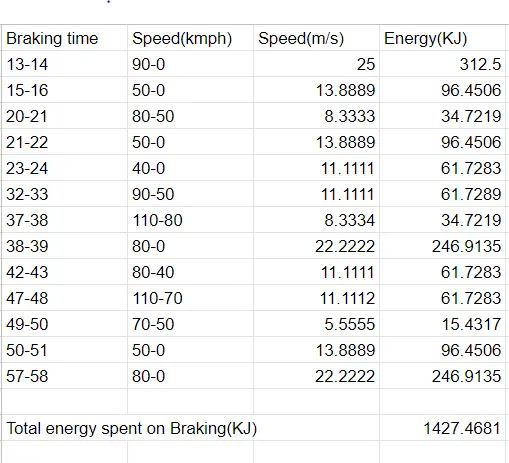
From the above calculation, we found that the Total energy spent on braking is 1427.4681KJ
Case(ii): At high speed Why electric motor can’t develop braking torque similar to starting and determine How electric and mechanical brakes are coordinated.
BRAKING:
The term braking comes from the term brake. We know that brake is equipment to reduce the speed of any moving or rotating equipment, like vehicles, locomotives. The process of applying brakes can be termed braking. We can classify the term braking into two parts:
# Mechanical Braking
# Electrical Braking
Mechanical braking :
Mechanical brakes all act by generating frictional forces as two surfaces rub against each other. The stopping power or capacity of a brake depends largely on the surface area of frictional surfaces as well as on the actuation force applied. The friction and wear encountered by the working surfaces are severe. Thus, the durability of a brake or service life between maintenance depends heavily on the type of material used to line the shoe or pad.
Mechanical brakes are assemblies consisting of mechanical elements for the slowing or stopping of shafts in equipment drives. They use levers or linkages to transmit force from one point to another. Braking slows or stops the movement of the coupled shafts. There are several types of mechanical brakes. Band brakes, the simplest brake configuration, have a metal band lined with heat and wear-resistant friction material. Drum brakes, which are commonly used on automobile rear wheels, work when shoes press against a spinning surface called a drum. Disc brakes are constructed of brake pads, a caliper, and a rotor. During operation, the brake pads are squeezed against the rotor. Cone brakes are made with a cup and a cone, which is lined with heat and wear-resistant material. During actuation, the cone is pressed against the mating cup surface.
Electric braking :
Electric brakes are devices that use an electrical current or magnetic actuating force to slow or stop the motion of a rotating component. They are used in industrial and vehicular braking applications that require fast response times and precise tension control.
clear all
clc
s = linspace(1,1000);
T = linspace(1,500);
%copper loss
kc = 0.1;
%iron loss
 ki = 0.001;
%motor loss
cm = 20;
%windage loss
kw = 0.0001;
[x,y] = meshgrid(s,T);
Pout = x.*y;
a = (y.*2).*kc;
b = ki.*x;
c = (x.^3).*kw;
Pin = Pout + a + b + c + cm;
eff = Pout./Pin;
EFF = [0.65,0.69,0.70,0.75,0.80,0.85,0.88,0.91,0.96];
contour(x,y,eff,EFF);
xlabel('speed');
ylabel('torque');