Week-11 Challenge: Braking
Question 1:
For a defined driving cycle, calculate the energy required for braking.
Answer:
Let us consider the europe drive cycle and calculate the energy required for braking.
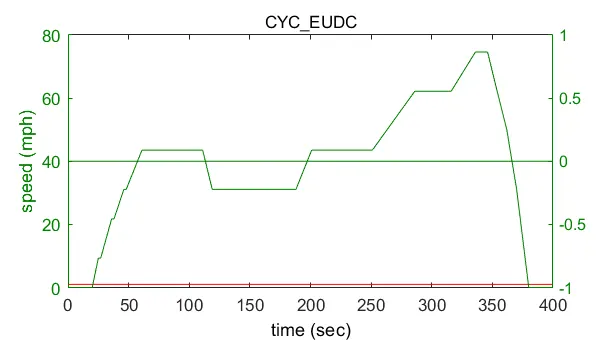
In an above drive cycle the vehicle started at time 20 sec, It gradually increase the speed with the time. At the 60 sec the vehicle reached speed of the 45mph and maintain the constant speed of the 45mph from 60 to 110 sec after that the speed get reduced to 30mph in 5 sec. Here an bracking force is applied on the vehicle to change the speed of the vehicle from 45 - 30mph and it maintain the constant speed of 35 mph from 110-190 sec.And the Accelaration is applied on the vehicle again to reach the 30- 45mph speed and maintaint the constant speed of 45mph again the accelaration speed is applied on the vehicle to increases the speed of the motor from 45-65 mph and again maintain the constant speed for particular time again accelaration speed is applied on the vehicle and speed increases from 65-75mph and maintaint constant speed for particular time. Atlast the vehicle start deaccelaration at 350 sec, now the vehicle required large amount of the deaccelation force to stop the vehicle from 75mph to 0mph in an time diffrence of 35 sec.
Sample Braking energy calculation:
Let as consider,
weight of the pure electric vehicle (M) = 1350 Kg.
Speed of the vehicle start deaccelaration (V_initial) = 75mph = 120kmph = 33.33m/s
Speed of the vehicle end deaccelaration (V_final) = 0mph = 0kmph
Time difference between V_initial and V_final (t) = 35sec.
Deaccelaration = (V_initial - V_final) / t.
Deaccelaration = (33.33 - 0) / 35.
Deaccelaration = 0.9522 m / s^2.
Deaccelaration Force = Deaccelaration * M.
Deaccelaration Force = 1285 N.
Deaccelaration Power = (1/2)*M*(V^2).
Deaccelaration Power = 0.5 * 1350 * (33.33)^2.
Deaccelaration Power = 750 KW.
Deaccelaration energy = Power * time.
Deaccelaration energy = 750 * 35 = 26250 KJ = 7.29 KWh.
******************************************************************************************
Question 2:
Why electric motor can’t develop braking torque at high speed similar to starting? How electric and mechanical brakes are coordinated?
Answer:
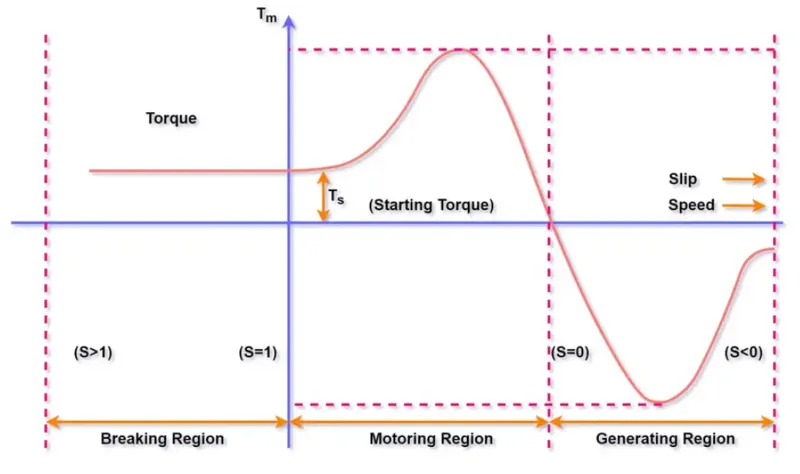
Electric motor can't develop bracking torque at high speed similar to starting. Because during braking the braking torque is opposite in direction it can be increases with the help of the Mechanical and Electrical braking.
Electrical braking torque:
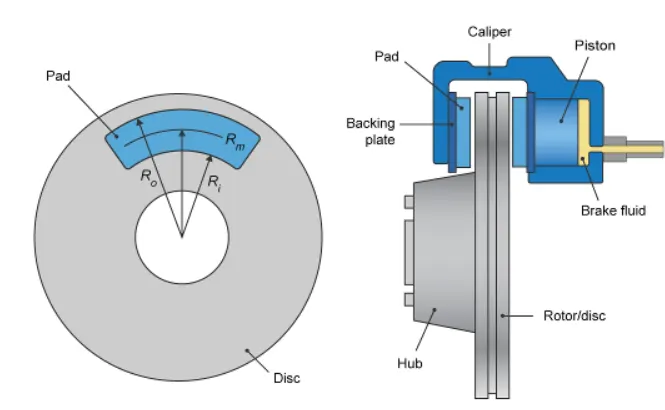
Mechanical Braking:
Electric and Mechanical brakes coordinated:
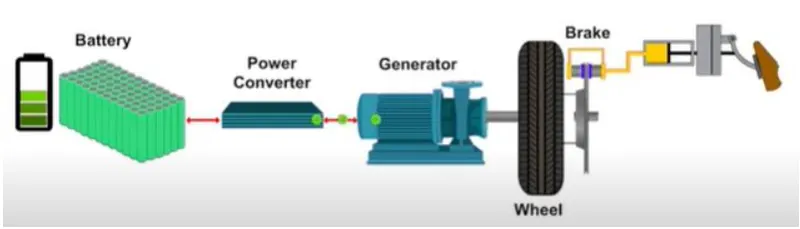
Electrical motor brake can be controlled by both electrical and mechanical braking system.Electrical bracking can be achived by regenerative bracking where mechanical braking can be achived by hydralic pressure method. A regenerative braking can be achived when an motor run above the syncronous speed of the motor it act as generator and deliver power to the batter or the regernerative braking capacity more than the battery capacity then the mechanical braking is applied to the vehicle to maintain the regeneretive capacity of the motor. So the above statement shows that the combination of both mechanical and electrical bracking is required for vehicle to stop.
It can be classified into two type
- Series Braking
- Parallel Braking
Series Braking:
In this series bracking system, the brake can be applied one after another to the mechanical and electrical braking in series method. If the speed of the vehicle is slow then the electrical bracking is sacrfied else the speed of the vehicle is high then the mechanical bracking take place.
This series braking is comfort for an driver and vehicle, but it produce less amount of energy efficiency.
Parallel Braking:
In this parallel braking system, the both mechanical and electrical brake can be applied simultanously.in parallel method both the brake can be applied at the same time.
This parallel braking is not comfortable for both driver and vehicle but it produce more amount of regenerative bracking energy.
******************************************************************************************
Question 3:
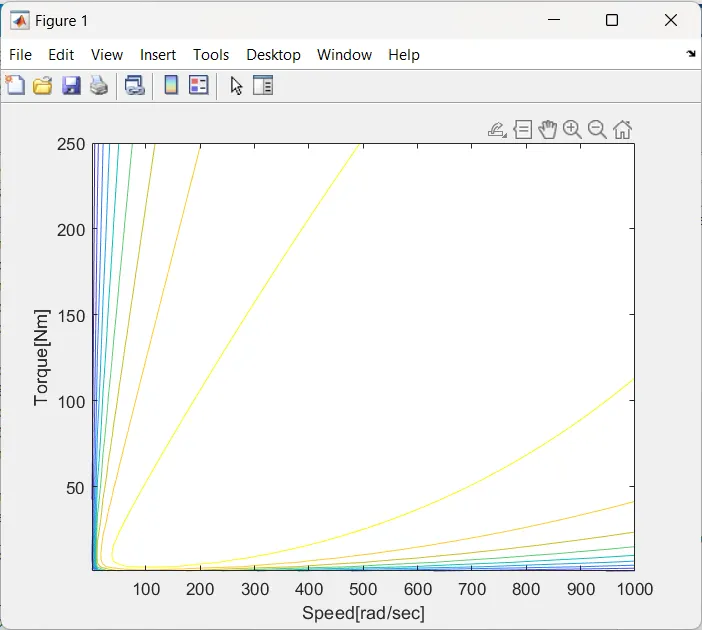
Make a MATLAB program which plots contour of given motor speed, torque and efficiency values. Attach the code as a .m file attach a screenshot of all the plots.
Answer:
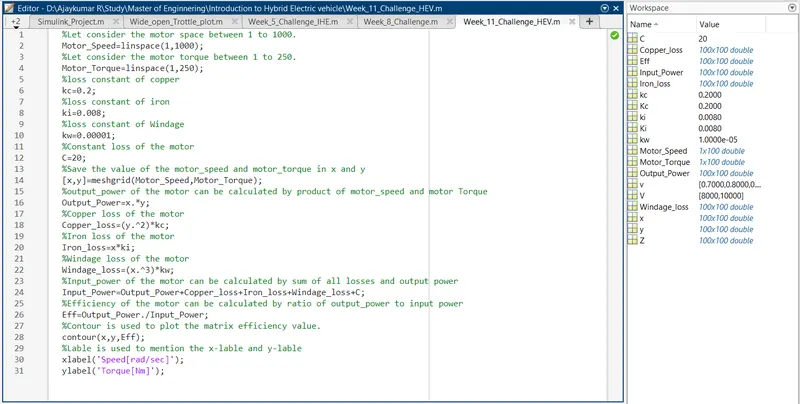
Efficiency of the electical vehicle can be calculated by ratio of the input power to the output power. Output power can be calculated by subtract the input power with all the loss.
The losses produced in electric vehicle are Copper loss, Iron loss, Windage loss and Constant loss.
Copper Loss:
Copper loss is due to the heat produced inside the motor in the form of I^2R loss
Copper_Loss = Kc * (Motor_Torque)^2.
where Kc - Copper loss constant.
Iron Loss:
Iron loss is due to induction loss in the motor the flux produced in the stator is not reached the rotor of the motor efficitively.
Iron_Loss = Ki * Motor_Speed.
Where Ki - Iron loss constant.
Windage Loss:
Windage loss is due to the frictional loss in the motor.
Windage_Loss = Kw * (Motor_Speed)^3.
Where Kw - Windage loss constant.
Constant loss:
Constant loss is actual loss of the motor due to ther efficiency of the motor quality.
It can be absorved in the name plate details where efficiency of the motor at rated speed and torque.
Matlab CODE: