Week-11 Challenge: Braking
Study#1:
Braking:
Braking is the one of the important requirement to retard the speed of the vehicle. Usually mechanical brakes are used to retard the vehicle speed by appling friction on the wheels. It absorbs either kinetic energy or potential energy or both while remaining in action and this absorbed energy appears in the form of heat.
Automobiles are fitted with two brakes; the service or foot brake and the emergency or hand brake. The foot brake is used to control the speed of the vehicle and to stop it, when and where desired, by the application of force on the brake pedal. The hand brake, applied by a lever, is used to keep the vehicle from moving when parked. Hand brakes are called emergency brakes because they are applied when the service brake fails. Virtually all vehicles are now equipment with 4-wheel brakes. The front brakes must operate without interfering with the steering action.
The brakes must be capable of decelerating a vehicle at a faster rate than the engine is able to accelerate it. Normally brakes have to absorb three times the amount of engine horsepower energy in its equivalent form.
Kinetic energy is the force that keeps the vehicle moving. This energy is provided by the engine in order to accelerate the vehicle from a standstill to desired speed. Kinetic energy is dissipated as heat by the brakes during application of brakes. The kinetic energy of a vehicle during braking is given by
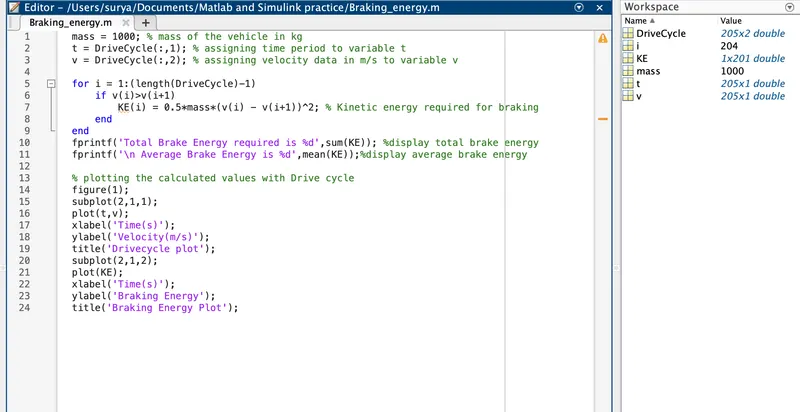
K.E required for braking =(1/2)*Mass*((initial velocity)^2 - (final velocity)^2)
Matlab Program to calculate Braking Energy:
Plot:
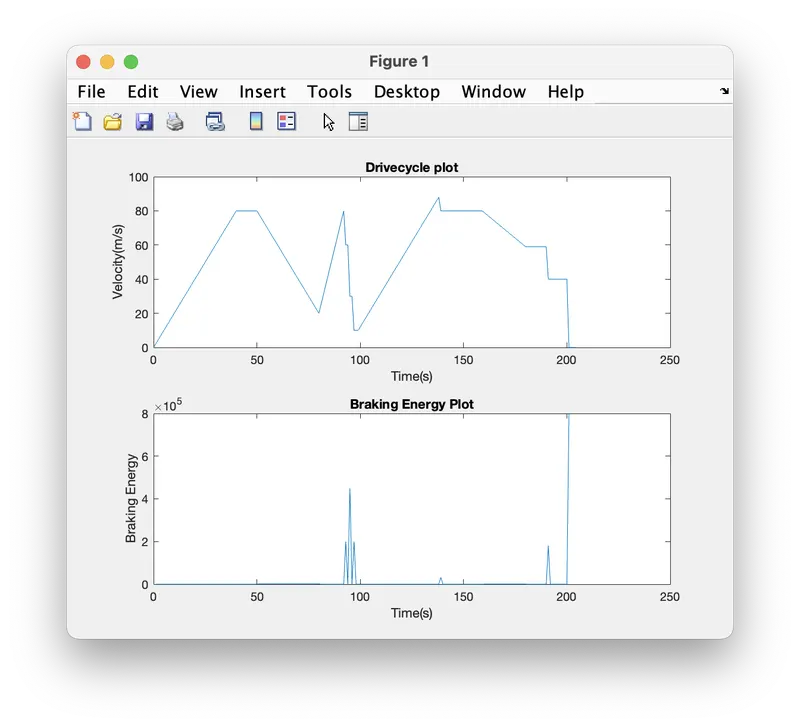
Conclusion:

Study#2:
Regenerative Braking:
Regenerative braking recovers some of the kinetic energy that would otherwise turn into heat and instead converts it into electricity. In this system, the motor drives the wheels during acceleration or cruising, but the wheels drive the motor while decelerating. This two-way energy flow allows the motor to act as a generator, resisting the rotation of the wheels and creating electricity to recharge the vehicle's battery.
There are two conditions when regeneration occurs:
1. When the driver applies the brake pedal
2. When the driver releases the accelerator pedal, and the vehicle is coasting
In both cases, the system creates electricity to recharge the battery. Drivers can view this regenerative effect on the vehicle's charging gauge, which shows it as energy flowing from the wheels to the battery.
The amount of electricity the system generates is proportional to the level of braking force. That means the stronger the braking force, the greater the electrical current. Ultimately, the amount of energy the system captures is dependent on the vehicle's speed and the duration of brake application.
When braking, the system automatically allocates some portion of the braking force to energy regeneration and some to the conventional brake system. This way, the system simultaneously achieves the dual purpose of slowing the vehicle down and recharging the battery for improved efficiency and greater electric driving range.
- Series Way
- Parallel
Series:
In case of Series, we apply Mechanical brake and Regenerative electric brake one after another. We can apply only one brake strategy at a time either apply Regeneratively or apply Mechanical brake. The Series Brake Control Strategy has a further classification, that is based on whether we want the comfort of driver or Brake behavior compared to energy efficiency.
Parallel:
Conclusion:
Electric motor can’t develop braking torque at high speed similar to starting because once the electric supply to the motor is cut-off,it acts as a generator and due to the flux weakening effect of the electric generator,the generator produces low torque as expected as the speed of the motor is high.
The speed of the vehicle should be reduced to critical speed with the help of mechanical brake and then the regenerative braking can be applied to recover the kinetic energy from the vehicle and store into battery in the form of electricity. At emergency the vehicle can be stoped using mechanical brake.
Question#3:
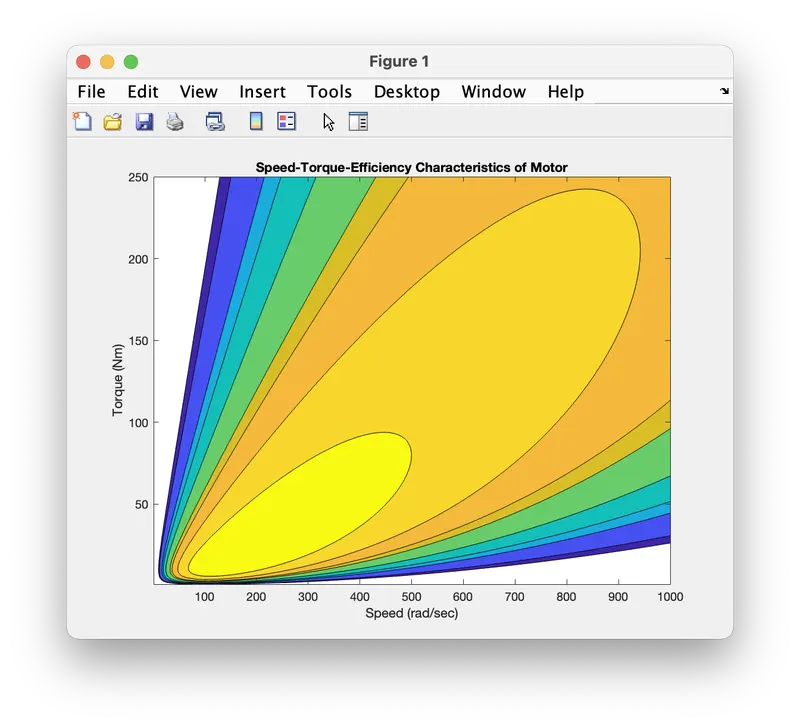
Matlab program:
w=linspace(1,1000,250); %Speed in rad/sec
t=linspace(1,250,250); %Torque in Nm
%Motor loss constants
Kc=0.2; %Copper loss constant
Ki=0.008; %Iron loss constant
Kw=0.00001; %Windage loss constant
Constant_Loss=20; %Constant motor loss
[W,T]=meshgrid(w,t); %Converting to 2D
Output_power=(W.*T); %Power = Torque x Speed
Copper_loss= (T.^2)*Kc; %Copper loss
Iron_loss= W.*Ki; %Iron loss
Windage_loss= (W.^3)*Kw; %Windage loss
Input_power = Output_power + Copper_loss + Iron_loss + Windage_loss + Constant_Loss;
Eff= Output_power./Input_power; %Eff of the motor
V=[0.72 , 0.75 , 0.81 , 0.83 , 0.86 , 0.89 , 0.90 , 0.92 , 0.94]; %Efficiencies to be plotted
box off
grid off
contourf(W,T,Eff,V); %contourf fills the regions between the contour lines with color.
title('Speed-Torque-Efficiency Characteristics of Motor');
xlabel('Speed (rad/sec)');
ylabel('Torque (Nm)');
Efficiency Plot: