Week-11 Challenge: Braking
STUDY 1:-
Energy Required For Braking:-
Drive Cycle:-
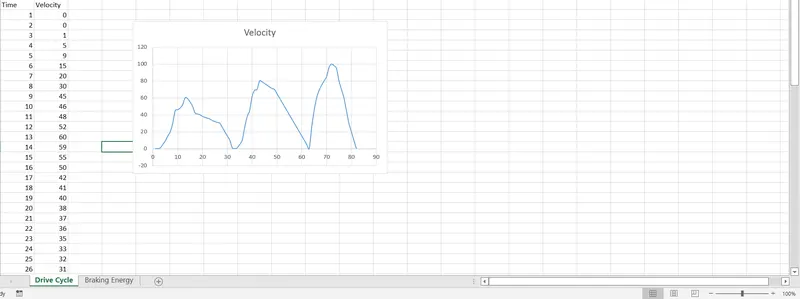
A new Drive cycle is created and the braking energy is calculated
The above mentioned Drive Cycle Time is in seconds and velocity is in KM.
The Calculation is made using Excel File and screen shot is as seen below
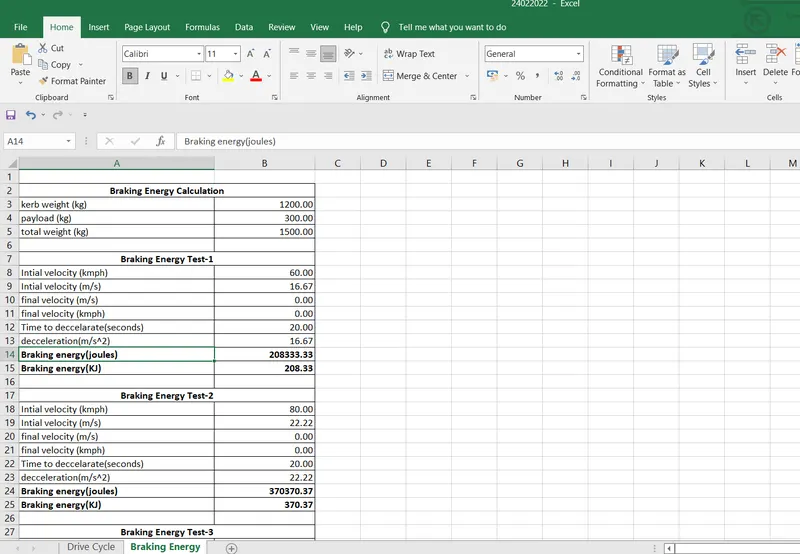
The Calculation Excel file is attached
The Braking energy is calculated by using the formula
Eb = `1/2 mv^2`
Velocity , v = intial velocity - final velocity
By using this formula the braking energy is calculated.
STUDY 2:-
Braking Torque in Electric Motor:
The Braking torque is in an electric motor is less than that of accelarating torque of the motor at high speed since the rate of discharge of the battery is higher than that of the charging rate.
At higher speed the motor will be running in a constant power region in which the torque of the motor is reduced and so the motor cannot develop the necessory braking torque as seen during low speed where the motor is in constant torque region.
Since the electric motor cannot develop necessary braking torque at high speed mechanical torque is also used.
Electric And Mechanical Brake Coordination:-
The method to control brakes in which the both electrical braking and mechanical braking are involved are
1) Series Control
2) Parallel Control
Series Control Strategies:-
In this case when brake is applied the front Mechanical brake , rear mechanical brake and the regenerative brakes are engaged one after the other . As per requirement i.e, at high speed increased mechanical brakeing is applied.
Where as at low speed regenrative braking is used which is limited based on the state of charge of the battery.
The coordination of series control braking can be done by the choice of braking and energy storage.
Parallel Control Strategies:-
In this case when the brake is applied both mechanical brake and regenerative brakes are employed simultaneously ,
The Braking energy distribution is from the rear wheel mechanical brake then the front wheel mechanical brake and then regenerative braking
The difference in braking energy among the braking systems are seen in this type of braking.
Electric Driven Intelligent Braking:
EDIB is also a braking strategy which is a type of parallel braking system
Here the mechanical and electrical brakes are used simultaneously during higher speed of the vehicle
At low speed since the torque is high regenerative braking is used since it offers higher braking than the mechanical brakes.
STUDY 3:-
MATLAB Program - Contour Plot:-
Matlab Code:-
clear all
close all
clc

speed= linspace(0,1000);
torque= linspace(0,500);

kc= 0.2;
ki=0.006;
kw=0.000010;
k=20;

[x,y] = meshgrid(speed,torque);
copper_loss= (y.^2)*kc;
iron_loss= x*ki;
windage_loss= (x.^3)*kw;

output_power= x.*y;
input_power= (copper_loss+iron_loss+windage_loss+output_power+k);
efficiency=(output_power./input_power);

n=linspace(0.7,0.95,10);
contourf(x,y,efficiency,n);
title('speed-torque efficiency')
xlabel('speed (rad/s)');
ylabel('torque (Nm)');
colorbar
Output Plot:-
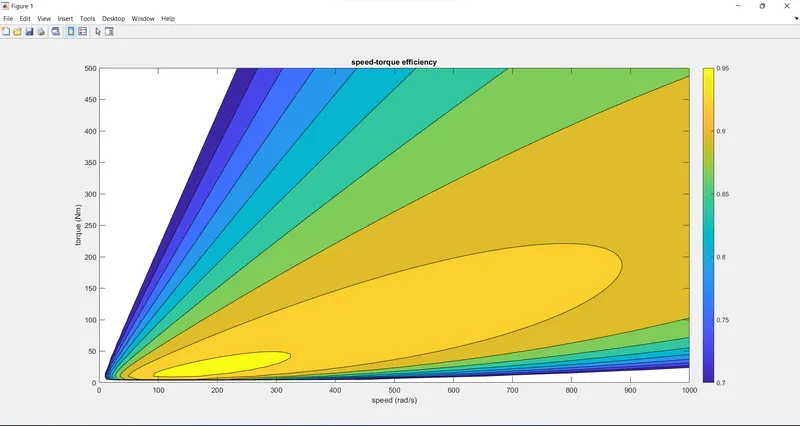
Contour plot is used in finding the operational efficiency of the machine by plotting a speed-torque characteristics of the machine.