Week-11 Challenge: Braking
Aim: For a defined driving cycle, calculate the energy required for braking.
Theory: A driving cycle is a series of data points representing the speed of a vehicle versus time. Driving cycles are produced by different countries and organizations to assess the performance of vehicles in various ways, as for instance fuel consumption, electric vehicle autonomy and polluting emissions.
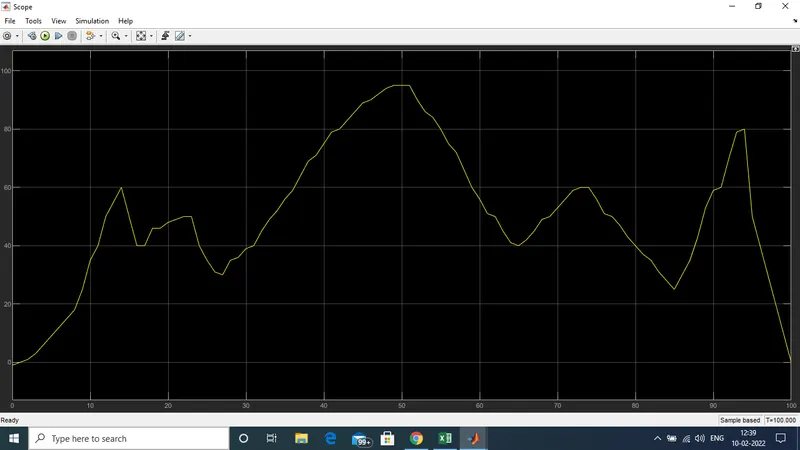
Here we have not taken any standard drive cycle values into consideration we have created our own set of driving values for 100 Second.
Drive Cycle:
| Time(Sec) | Speed(Kmph) |
| 1 | 0 |
| 2 | 1 |
| 3 | 3 |
| 4 | 6 |
| 5 | 9 |
| 6 | 12 |
| 7 | 15 |
| 8 | 18 |
| 9 | 25 |
| 10 | 35 |
| 11 | 40 |
| 12 | 50 |
| 13 | 55 |
| 14 | 60 |
| 15 | 50 |
| 16 | 40 |
| 17 | 40 |
| 18 | 46 |
| 19 | 46 |
| 20 | 48 |
| 21 | 49 |
| 22 | 50 |
| 23 | 50 |
| 24 | 40 |
| 25 | 35 |
| 26 | 31 |
| 27 | 30 |
| 28 | 35 |
| 29 | 36 |
| 30 | 39 |
| 31 | 40 |
| 32 | 45 |
| 33 | 49 |
| 34 | 52 |
| 35 | 56 |
| 36 | 59 |
| 37 | 64 |
| 38 | 69 |
| 39 | 71 |
| 40 | 75 |
| 41 | 79 |
| 42 | 80 |
| 43 | 83 |
| 44 | 86 |
| 45 | 89 |
| 46 | 90 |
| 47 | 92 |
| 48 | 94 |
| 49 | 95 |
| 50 | 95 |
| 51 | 95 |
| 52 | 90 |
| 53 | 86 |
| 54 | 84 |
| 55 | 80 |
| 56 | 75 |
| 57 | 72 |
| 58 | 66 |
| 59 | 60 |
| 60 | 56 |
| 61 | 51 |
| 62 | 50 |
| 63 | 45 |
| 64 | 41 |
| 65 | 40 |
| 66 | 42 |
| 67 | 45 |
| 68 | 49 |
| 69 | 50 |
| 70 | 53 |
| 71 | 56 |
| 72 | 59 |
| 73 | 60 |
| 74 | 60 |
| 75 | 56 |
| 76 | 51 |
| 77 | 50 |
| 78 | 47 |
| 79 | 43 |
| 80 | 40 |
| 81 | 37 |
| 82 | 35 |
| 83 | 31 |
| 84 | 28 |
| 85 | 25 |
| 86 | 30 |
| 87 | 35 |
| 88 | 43 |
| 89 | 53 |
| 90 | 59 |
| 91 | 60 |
| 92 | 70 |
| 93 | 79 |
| 94 | 80 |
| 95 | 50 |
| 96 | 40 |
| 97 | 30 |
| 98 | 20 |
| 99 | 10 |
| 100 | 0 |
Graph:
Calculation: Assume vehicle weight 1000 Kg
Braking is the condition to slow down or to stop the moving vehicle when required. The most common used technique is friction brake where the complete Kinetic energy is converted into heat energy.
Braking force: `(1/2)*m*v^2`
Where braking force is kinetic energy in unit of joule.
m is the total weight of the vehicle in Kg
v is the velocity difference of initial and final velocity in m/s
| No. of braking | Initial Speed (Kmph) | Final Speed (Kmph) | Time Required (sec) | Braking Energy (J) | Braking Power (W) |
| 1 | 60 | 40 | 2 | 15432.09877 | 7716.049383 |
| 2 | 50 | 39 | 6 | 4668.209877 | 778.0349794 |
| 3 | 95 | 40 | 14 | 116705.2469 | 8336.089065 |
| 4 | 60 | 25 | 11 | 47260.80247 | 4296.436588 |
| 5 | 80 | 0 | 6 | 246913.5802 | 41152.26337 |
| Total Braking Power ( W ) | 62278.87339 | ||||
| Total Braking Power ( KW ) | 62.27887339 |
Here the Total Braking Power for this driving cycle is 62.27 KW.
Aim: Why electric motor can’t develop braking torque at high speed similar to starting? How electric and mechanical brakes are coordinated?
Theory: Electric motor cant develop braking torque at a high speed similar to starting because at that high speed the motor will work in constant power region.And in this region the torque of the motor reduces and speed increases keeping the power constant. And the motor cannot produce a braking torque which is equal to the torque produced at starting of the motor at low speed.
Below figure shows the torque speed characteristic of an induction motor:
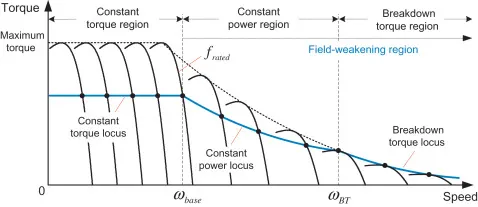
From the above graph also it is clear that at low speed the torque is constant and at high speed the torque reduces and power remain constant.
Electrical and Mechanical brake:
Electrical Braking: This can be done by many methods such as:
- Using transistor in H bridge arrangement to reverse the motor direction to reduce the speed of vehicle.
- Implementing a regenerative braking system by using bi-directional power converter.
- Regenerative braking convert much of the energy to electrical energy which can be stored in battries for later use.
Mechanical Braking: Mechanical brake uses friction between two surface plate pressed together to convert the kinetic energy of the vehicle into heat. The friction between the surfaces is performed using pressurized air and pressurized oil which are commonly known as an air brake and hydraulic brake respecitivelly.
Coordination of electric and mechanical brakes:
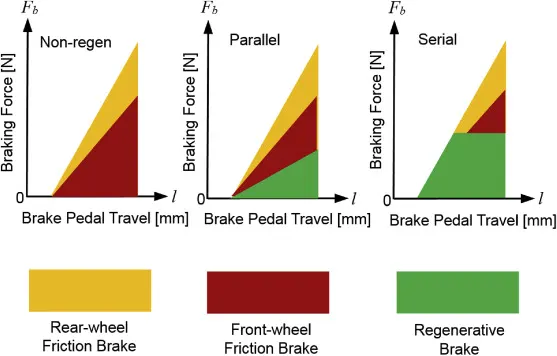
Two types of brake startegies are use to co-ordinate electrical and mechanical brake together.
- Series control startegy
- Parallel control startegy
1.Series Control Startegy: When the brake is applied using brake pedal the front axle brake , rear axle brake and the regenerative brake are employed one after another. As the braking action increases the friction brake are used subsequently.
For low speed of vehicle, regenerative brake can be used depending the power requirement and SOC of the battries.
As the speed of the vehicle increases, the rear brake is applied first and if the braking torque is not satisfied then front brakes are applied.
2.Parallel Control Startegy: When the brake is applied using brake pedal the front axle brake , rear axle brake and the regenerative brake are employed simultaneously. Higher the amount of brake pedal pressed more will be the braking action. The braking sequence is as, rear brake first and front brake second and regenerative at the last.
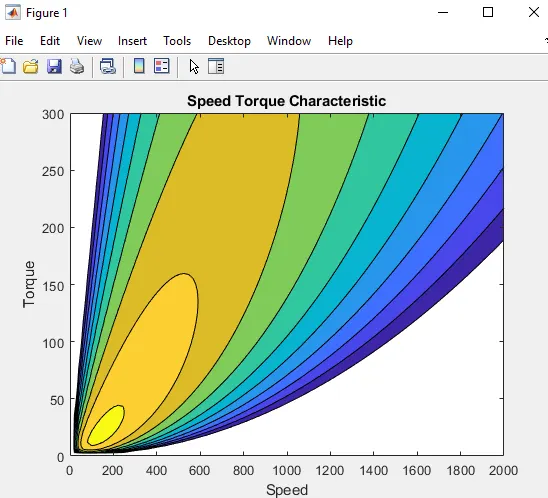
Aim: Make a MATLAB program which plots contour of given motor speed, torque and efficiency values. Attach the code as a .m file attach a screenshot of all the plots.
Theory: In MATLAB script,We have created two one dimensional array. first of 'omega' using 'linsapce' command whose length is 100 second of 'Torque' with the same command and same length. once this 1D array is created we will meshgrid both this array to create 100*100 matric using 'meshgrid' command.
After that some dummy values of the losses were considered and the power loss were calculated using the formula below:
1. Copper loss = `T^2*Kc`
2. iron loss = `omega*Ki`
3. Windage losses = `omega^3*Kw`
4.Conduction losses = 18
Then we find out the output power and input power using some standard formula and finally the efficiency which is give as ratio of output power to input power.Then using contour command we plot the graph.
MATLAB SCRIPT:
clear all
close all
clc
%speed array
omega=linspace(0,300,100);
%torque array
T=linspace(0,2000,100);
%meshgrid
[X,Y]=meshgrid(T,omega);
%loss coefficient
kc=0.17;
ki=0.006;
kw=0.000015;
%loss calculation
cu_loss=(Y.^2)*kc;
fe_loss=(X*ki);
win_loss=(X.^3)*kw;
const_loss=18;
%output power
P_out=(X.*Y);
%input power
P_in=P_out+cu_loss+fe_loss+win_loss+const_loss;
%efficiency
n=P_out./P_in;
%efficiency array
W=linspace(0.75,0.95,10);
%plotting the contour
contourf(X,Y,n,W)
title('Speed Torque Characteristic');
xlabel('Speed');
ylabel('Torque');
Output: