Week-11 Challenge: Braking
1. For a defined driving cycle, calculate the energy required for braking.
Answer:
Let consider total weight of vehicle be 1000kg including kerb weight and passenger.
- We know acceleration energy can be calculated as (1/2MV^2) where M is mass in Kg and V is speed of vehicle in m/sec.
- In the same way, deceleration energy calculated by as (1/2MV^2).
- So the energy used for acceleration and deceleration (breaking energy) is almost same.
- But the only difference is that the torque and speed values during starting and braking.
For driving cycle lets use a matlab code.
Matlab code:
clc
close all
t = [0 1 2 3 4 5 6 7 8 9 10];%time from 0 to 10 seconds
v = [0 5 5 10 40 30 30 30 20 10 0];%speed in m/sec
plot(t,v)
ylabel('Speed in m/sec')
xlabel('Time in seconds')
Output:
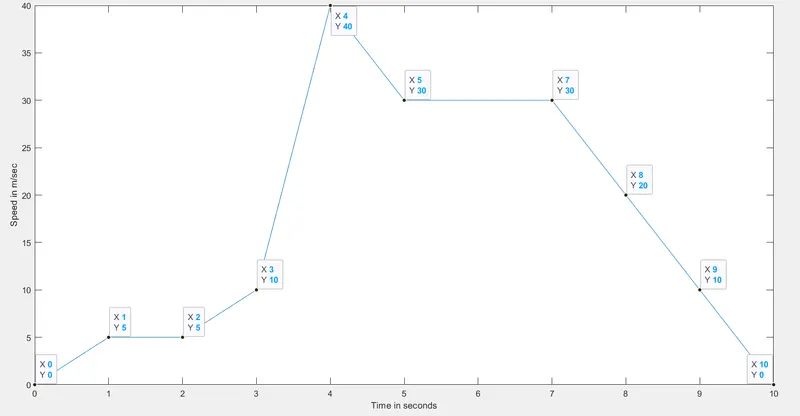
From driving cycle,
- From 4th sec to 5 th sec, speed is reduced from 40 m/sec to 30 m/sec which is deceleration.
- So breaking energy for this case (1/2mv^2). Breaking energy1 = 0.5*1000*(900 - 1600)= -350 Kilo Joules
- We know energy in Kwh = Joules/3600000 Kwh
- Breaking energy1 = 0.0973Kwh-----(1)
- Breaking energy2 = 0.5*1000*(400 - 900)= -250 Kilo Joules = 0.06945Kwh-----(2)
- Breaking energy3 = 0.5*1000*(100 - 400)= -150 Kilo Joules = 0.0417Kwh-------(3)
- Breaking energy4 = 0.5*1000*(0 - 100)= -50 Kilo Joules = 0.0139Kwh-------(4)
- Total breaking energy = 0.22235Kwh
- Average breaking energy = 0.22235Kwh/4 = 0.0555875Kwh
Conclusion:
- The breaking energy required for braking for a given driving cycle is calculated.
2.
a) Why electric motor can’t develop braking torque at high speed similar to starting?
Answer:
- Peak acceleration torque and peak deceleration torque are not equal for EV.
- Actually, acceleration torque is higher as, at low speeds we get high torque and at high speeds we get low torque.
- Because, we are operating the motor in the filed weakining region and we operating the motor above base speed torque value is comprimised or lower.
- If the motor is at rest, it has to operate in standstill condition to reach the speed required for that a high torque is required.
- But, if the motor is already in running condition, the torque limit is already reached by the motor so that we can't develop the torque beyond the limit.
- So, higher torque cannot be developed in braking.
Conclusion:
- The braking torque of EV motor is not high as acceleration torque.
- Therefore, the regenerative braking is not happen so efficiently that all the power cannot goto the battery
b) How electric and mechanical brakes are coordinated?
Answer:
We know there are two types of brake control strategies:
1) Series brake control strategy
2) Parallel brake control strategy
1) Series brake control strategy:
- In the case of series brake control strategy, the mechanical braking and regenerative braking (electrical braking) are applied one after another
- It can be catogerized as whether we want comfort of driver or brake energy efficient
2) Parallel brake control strategy:
- In the case of parallel brake control strategy, the mechanical braking and regenerative braking are applied both applied at a time
Practical brake control strategy:
- Developed by Nisson Leaf uisn Electric driven Intelligent Brake (EDIB) technology.
- It is a comibination of hydraulic/Mechanical braking and regenerative braking.
- It is a parallel brake control strategy
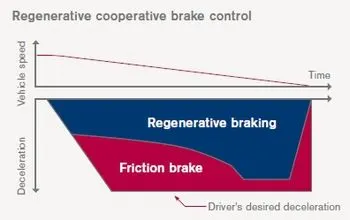
- The control criteria is that at low speeds, high regenerative braking is applied and at high speed, both regenerative braking and mechanical braking is applied.
So, How to apply control signals for the combination braking?
Lets say we need 30% mechanical braking and 70% regenerative braking is required.
- First, over all brake signal is detected by brake pedal and then those control signals has to be dtistributed/diverted accordingly requirement of the braking
Conclusion:
- The coordination of electrical and mechnaical brakes is discussed
3. Make a MATLAB program which plots contour of given motor speed, torque and efficiency values. Attach the code as a .m file attach a screenshot of all the plots.
Answer:
For understanding efficiency contour, we need to understand losses of the motor.
Armature copper loss:
- (I^2)*R where I is the armature current and R is the armature resistance.
- We know that Torque =KϕI. Therefore Torque, T is proportional to I.
- So the copper loss can be considered as (Kc*T^2)
- Where Kc is taken care of resistance of brushes, flux and its effect.
Copper loss = (Kc*T^2)
Iron loss:
- These are nothing but magnetic losses.
- This loss can be represented as (Ki*W) where Ki is based on magnetic field effect
- For permanent magnets, we have a constant magnetic field.
Iron loss = Ki*W
Friction and Windage loss:
- This is nothing but mechanical loss.
- This is based on size and shape of the motor
Friction loss and windage loss = (Kw*W^3)
Constant loss:
- This is denoted as C
Constant loss = C
Total loss:
- The total loss can be the sum of above four losses
Total loss = (Kc*T^2) + Ki*W + (Kw*W^3) + C
With the certain accuracy, almost all motors can be mathematically modelled as per above equation of losses
Matlab program to plot Motor speed-Torque contour characteristics:
% A progrm to plot efficiency contours
Speed = linspace(1,2000);%speed in rad/sec
Torque = linspace(1,500); %Torque in N-m
%Give the values for Kc,Ki and Kw
Kc = 0.2;%Copper loss constant
Ki = 0.008;%Iron loss constant
Kw = 0.00001;%friction and windage loss constant
C = 20;%Constant loss
[S,T] = meshgrid(Speed,Torque);
Outpower = (S.*T);%Torque*speed = power
C_L = (T.^2)*Kc;%Copper loss
I_L = (S.*Ki);%iron loss
W_L = (S.^3)*Kw;%Friction and windage loss
Inpower = (Outpower) + (C_L + I_L + W_L );%Output = input - losses
R = Outpower./Inpower;%efficiency
E = [0.65 0.7 0.75 0.8 0.85 0.9 0.925 0.95];
box off
grid off
contour(S,T,R,E);
xlabel('speed/(rad-sec^-1)');
ylabel('Torque/N-m');
hold on
E = [5000, 16000];%power in watt
contour(S,T,Outpower,E);
Output:
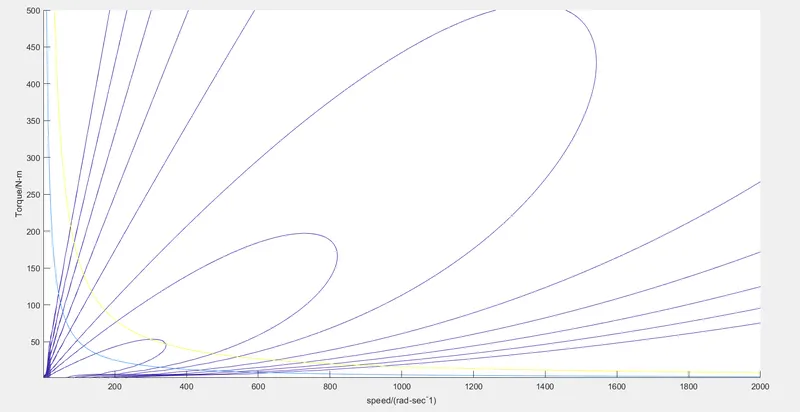
Conclusion:
- The MATLAB program which plots contour of a given motor speed torque characteristics and efficiency values were plotted