Week-11 Challenge: Braking
1 ) AIM - For a defined driving cycle, calculate the energy required for braking.
Braking energy is the energy required to stop the vehicle at any Instant of Time.
Drive Cycle with Graphical Representation
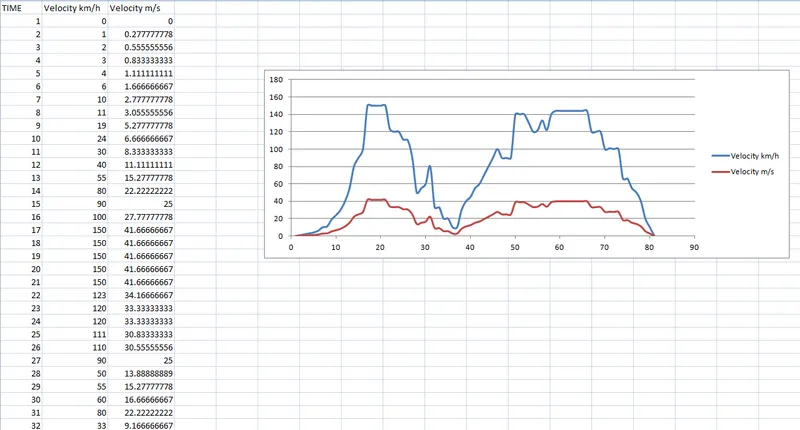
To calculate Braking energy we use following formula,
1 ) For 1st Braking -
41.67 m/s to 34.17 m/s for 1 sec
E = `1/2m.v^2=33750 W`
2 ) For 2nd Braking -
33.333 to 30.56 m/s for 1 sec
E = `1/2m.v^2=4603 W`
3 ) For 3rd Braking -
30.56 to 25 m/s for 1 sec
E = `1/2m.v^2=3336 W`
4 ) For 4th Braking -
38.88 to 33.33 m/s for 1 sec
E = `1/2m.v^2=18481 W`
Total Energy Required for braking is 60 kW Or 0.01673226 Wh.
2 ) Aim - Understanding Why electric motor can’t develop braking torque at high speed similar to starting? How electric and mechanical brakes are coordinated?
According to the speed torque characteristics of motor at starting the torque requirement is maximum.
As the speed increases torque requirement decreases and at maximum speed torque required is minimum.
For example, if the starting torque is 10 Newton metre and at the maximum speed it is 7 Newton metre then the motor will develop braking torque of -7 Nm only not -10 Nm.
Therefore peak acceleration Torque and peak deceleration torque is not equal for electric vehicle.
Braking torque of an electric vehicle motor is not high as acceleration torque therefore regenerative breaking cannot happen so effectively that we can get all POWER back to the battery.
Another limitation of regenerative braking is battery.
During acceleration battery discharges at double rate but during deceleration battery charges at half rate compared to acceleration.
So the battery charging rate is low compared to pick discharge rate.
And there are also limitations of power converters as in reverse direction of power flow.
How electric and mechanical brakes are coordinated?
There are two types of control strategies of breaking,
1 ) Series
2 ) Parallel
1 ) Series
In case of series the mechanical brakes and regenerative electric brakes are applied one after another.
Means only one break is applied at a time either mechanical or electric brake.
The break behaviour is comfortable but energy recovery is not much.
2 ) Parallel
In case of parallel the mechanical brakes and regenerative electric brakes are applied at a time.
Energy recovery is more but break behaviour is not comfortable.
3 ) Aim - Making a MATLAB program which plots contour of given motor speed, torque and efficiency values.
To know the efficiency we need to check the losses in the motor.
Motors have various types of losses,
1) Copper loss which is I^2R loss can be considered as kcT^2 because torque is proportional to current.
2) Iron loss changes according to speed it is denoted by kiW
3) Windage Loss - which is equal to kwW^3
4) Constant Loss = C
MATLAB CODE -
clc;
w = linspace(0,1000);% speed array
T = linspace(0,250);%torque array
% Loss coffiecients
kc=0.18; % Coperloss Constant
ki=0.008; % Ironlosses Constant
kw=0.0001; % Windagelose Constant
% Mesh grid
[X,Y] = meshgrid(w,T);
A = (Y.^2)*kc; % Coper losses
B = X.*ki; % Iron losses
C = (X.^3)*kw; % Windage losses
D = 33; % Constant loss
Outputpower = X.*Y;
Inputpower = Outputpower + A + B + C + D;
E = Outputpower./Inputpower; % Efficiency
V = [0.70,0.75,0.80,0.85,0.90,0.91,0.92,0.93];
box on;
grid off;
contour(X,Y,E,n);
xlabel('Speed rad/s');
ylabel('Torque Nm');
title('Efficiency Contour')
In Matlab code we entered the values of loss coefficients.
Then we calculated copper loss, iron loss , windage loss, constant loss with output power to get input power which is the sum of all these.
Then efficiency is calculated by dividing output power to the input power.
RESULT -
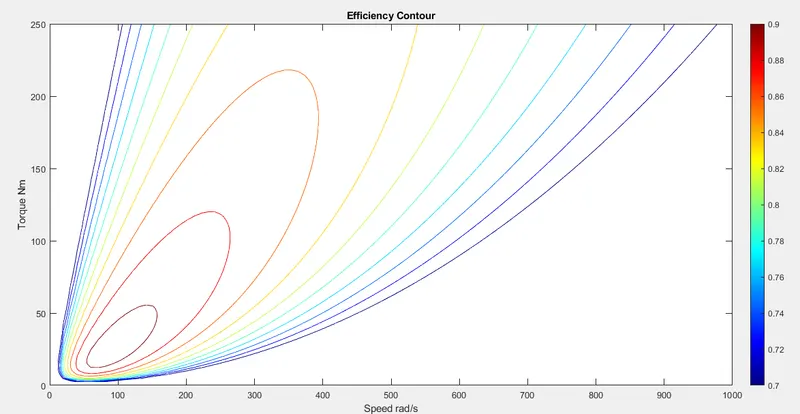
From The Graph of Efficiency contour, we can see that as the speed and torque increases the efficiency decreases.