Week-11 Challenge: Braking
Aim: For a defined drive cycle, calculate the energy required for braking
Circuit diagrams/Plots:
Drive cycle:
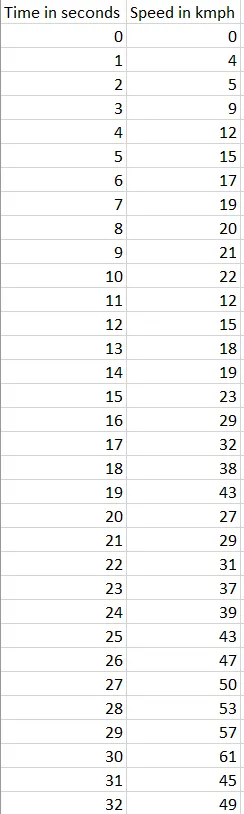
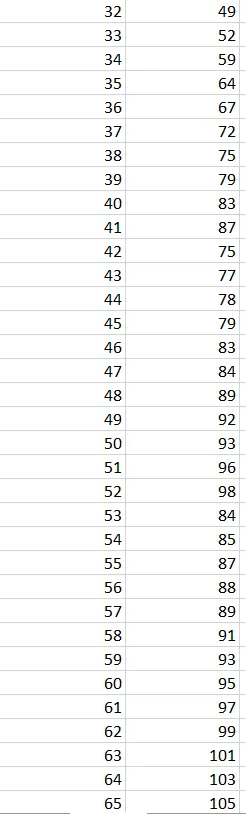
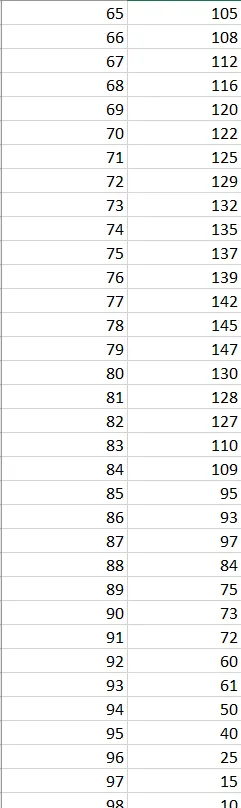
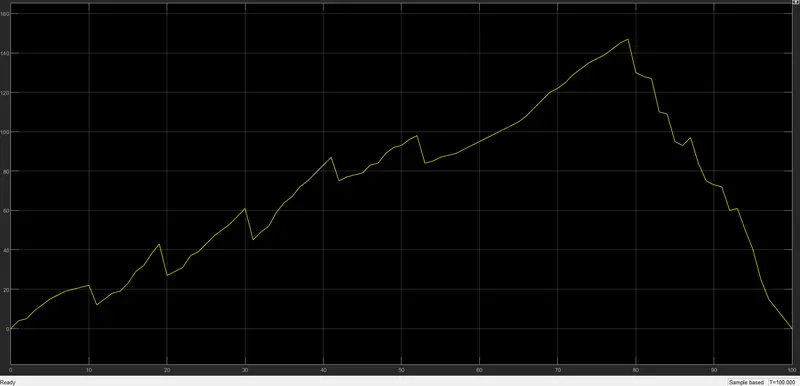
At any point of braking, the kinetic energy required for braking is calculated by the following formula:
Energy required for braking = 1/2*m*(v2-v1)^2
where,
m = mass of the vehicle
v2 = final velocity
v1 = initial velocity
So, depending on the areas you would like to calculate the energy required, we can alter the parameters and calculate the energy.
Let us assume a sample case where the mass of the vehicle is 3000kg
m = 3000kg
At time t = 19 and t = 20 seconds, the vehicle decelerates from 43 to 27.
The energy required for braking here is given by,
1/2* 3000*(43-27)^2
= 384000Joules
= 384KJ
2.
Why electric motor can't develop braking torque at a high speed similar to starting?
A: When the motor is at rest and it has to operate from a standstill position to reach the moderate speed, the higher torque is required to bring the motor into operation. When the vehicle is at a higher speed, it is operating at a higher torque and a higher torque is not achievable for braking. The braking operation happens in the motion which has been distributed as per proportion in the brake energy and the regenerative braking.
How electric and mechanical brakes are coordinated?
Along with mechanical braking, certain life-saving electrical technologies like ABS, EBD, and BA have been implemented in stopping the vehicle and coming back to rest at a high speed.
There are two types where electric and mechanical brakes can be combined.
1. Series- The electric and mechanical braking both are applied one after the other.
2. Parallel- Regenerative braking or mechanical braking is applied parallel.
When the brake pedal is pressed, the hydraulic fluid reaches the brake piston and created the braking pressure on the wheels, and the same kinetic energy is used by regenerative braking for generating more power using the bi-directional motor which acts as a generator.
3. Make a MATLAB program that plots the contour of given motor speed, torque, and efficiency values. Attach the code as a .m file attach a screenshot of all the plots.
% program for plotting efficiency contours for electric motors
clc
x=linspace(1,1000) %speed rad/sec
y=linspace(1,250) % torque N-m
Kc=0.2; %copper losses
Ki=0.008; %iron losses
Kw=0.00001; %winding losses
conL=20; %constant motor losses
% Now making mesh
[X,Y]=meshgrid(x,y);
outputpower=(X.*Y); %power= torque x speed
B=(Y.^2)*Kc; % copper losses
C=(x*Ki); % iron losses
D=((X.^3).*Kw); % windage losses
inputpower=outputpower+B+C+D+conL;
Z=outputpower./inputpower;
% efficiency for contour
V=[0.70,0.80,0.85,0.90,0.91,0.92,0.925,0.93];
box off
grid off
contour(X,Y,Z,V);
xlabel('Speed rad/sec')
ylabel('Torque N-m')
hold on
V=[8000,1000];
contour(X,Y,outputpower,V);
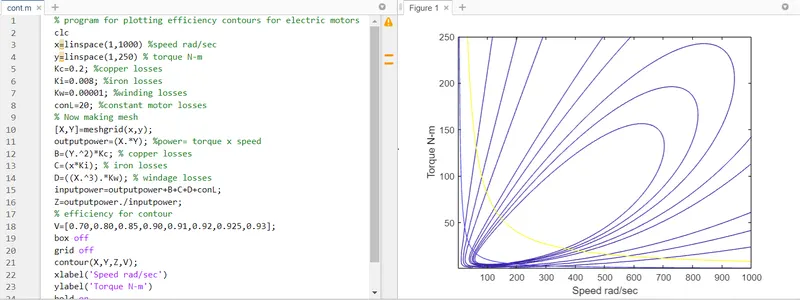
The maximum efficiency is at the center of the plot and it decreases when it goes outwards.