Week-11 Challenge: Braking
1. A driving cycle is a series of data points of a vehicle representing speed vs time.
Here consider the UDDS driving cycle which is for around 1300 seconds. But here I will consider upto 100 seconds for calculation of energy required for braking.
The energy required for braking is = [(1/2)(m)(V^2)]
Now we will calculate the braking energy using exel sheet:
The calculation would be-
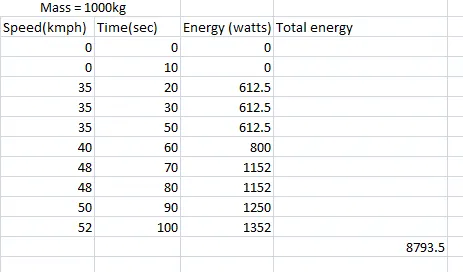
from calculations the brkaing power will be around 8793.5 W
https://drive.google.com/file/d/1LmU0Ss2fJonhygNbkJxOsaPfFtHaoaaL/view?usp=sharing
2. The elctric motor can not develop braking torque at high speed similar to starting because, When the motor is at rest and it has to operate from standstill position to reach the moderate speed the higher torque is required to bring the motor in operation. Whereas, when the vehicle is already at high speed the capping or the limit is reached by the motor operation and thus any further higher torque couldn't be oobtained while braking.
The braking operation happens in the motion which is been distributed as per proportion in the brake energy and regenerative braking. This situation does not occur at the beginning of an acceleration because most of the torque is used to increase the kinetic energy of the load (and motor). But when the speed is already high and no extra load is applied it is not possible to increase the torque.
Electrical Braking - Is usually employed by motors in an exact position or to have the speed of the driven unit suitably controlled during it's deceleration. Electrical braking is used in application where frequent, quick, accurate, or emergency stops are required. This braking allows smooth stops without any inconvenience to passangers.
- When a loaded hoist is lowered, electric braking keeps the speed within safe limits. Otherwise, the machine or drivr speed will reach dangerous values.
- When a train goes down a steep gradient, electric braking is employed to hold the train speed within the prescribed safe limits.
- It is more commonly used where active loads are applicable. In spite of electric braking, the braking force can also be obtained by using mechanical brakes.
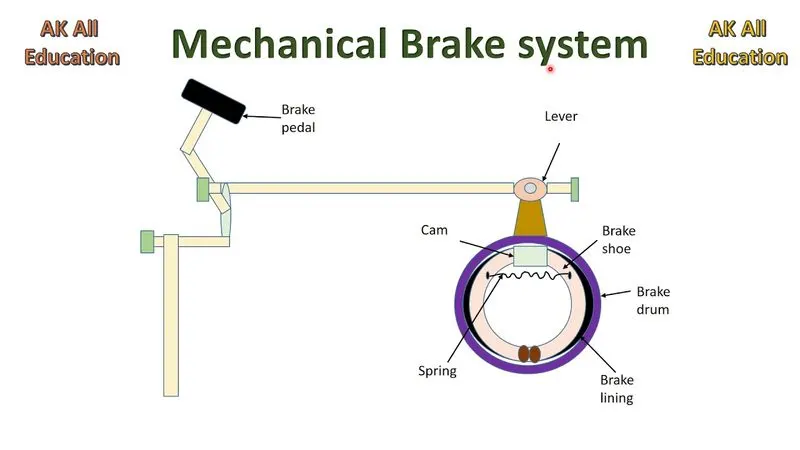
Mechanical Braking - Mechanical brakes all act by generating frictional forces as two surfaces rub against each other. The stopping power or capacity of a brake depends largely on the surface area of the frictional surfaces as well as the on the actuation forces applied. The friction and wear encountered by the working surfaces are severe. Thus, the durability of a brake or service lifebetween maintenance depends heavily on te type of material used to line the shoe or pad.
- Frequent maintenance and replacement of brake shoes is the major disadvantage. Despite of more braking power is wasted in the form of heat, it is also used along with the electric braking to ensure reliable operation of the drive.
- It is also used to hold the drive at the standstill because many braking methods do not produce torque at standstill condition.
- The prime concerns are, generating a force capable of retarding a rotating shaft and dissipating and absorbing the heat generated in the process.
Co-ordination of electric and mechanical brake -
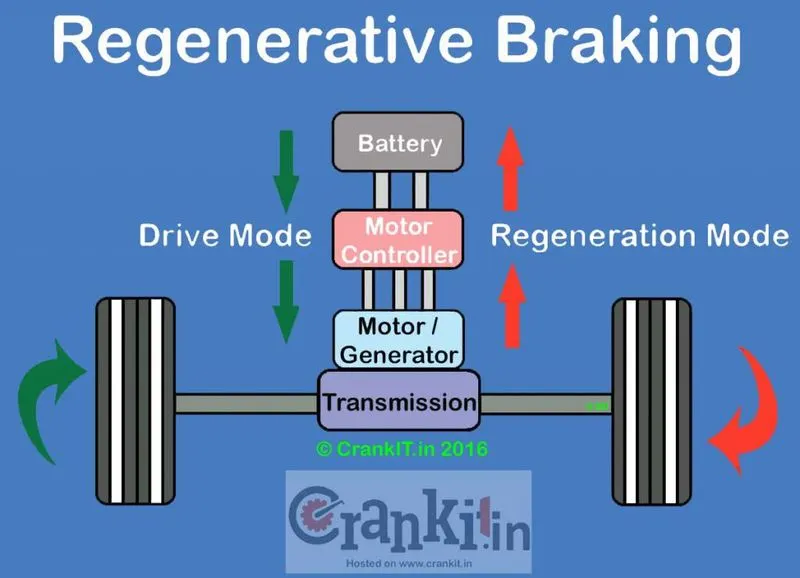
- In a electric motor the total brake didtribution is in two aspects which are electrical brake (regenerative brake) and mechanical brake (classical brake) with hydraulic cylindrical system.
- Brake force distribution must be uniform, if the regenerative braking power requirement is more than the charging limit of the battery or more than regenerative capacity of the machine we must apply mechanical brakes as well.
- In practical case the combination of these two is applied. So usually it is combined response of mechanical brake and regenerative brake. The reason for how these brake forces are combined that particular phenomenon is called Brake control strategies. There are two brake control stratagies -
Series - In case if series we apply mechanical brake and regenerative electric brake one after another. We can apply one brake strategy at a time either apply regenerative or apply mechanical brake. The series brake control strategy has further classification, that is based on whether we want comfort of driver or brake behaviour compared to energy efficiency.
Parallel - In case of parallel we apply both brakes simultaneously. This particular parallel braking is going to happen both at a time.
Electric Driven Intelligent Brake -
EVs and hybrid vehicles use regenerative braking, which utilizes the motor to convert the kinetic energy during deceleration into electrical energy. With energy regeneration, an EV is able to run on less electricity and a hybrid vehicle on less fuel.The EDIB (Electric Driven Intelligent Brake) allows and controls optimization of the regenerative brake and regular friction brake (hydraulic brake).
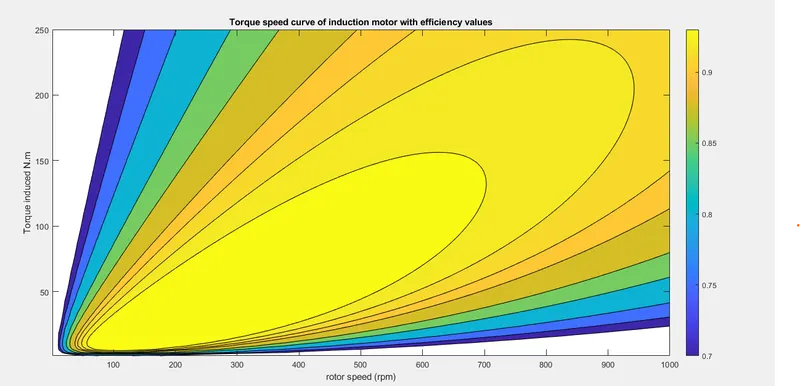
3. A contour line (also isoline, isopleth, or isarithm) of a function of two variables is a curve along which the function has a constant value, so that the curve joins points of equal value.
The matlab code would be -
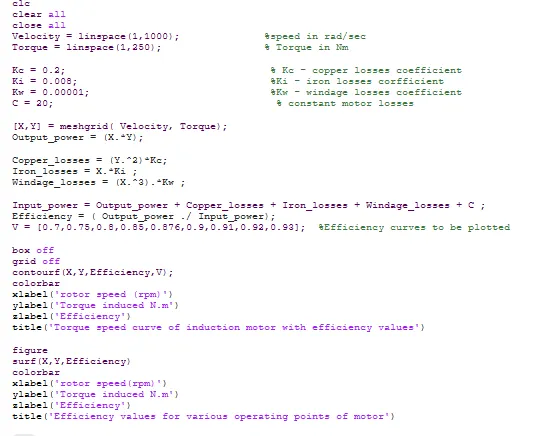
https://drive.google.com/file/d/1A6QrGakHGJBe12KijoYidYC86YoZNWZ_/view?usp=sharing
The output plot is -