Week 1 Understanding Different Battery Chemistry
1. A battery is a device consisting of one or more electrochemical cells with external connections for powering electrical devices. When a battery is supplying electric power, its positive terminal is the cathode, and its negative terminal is the anode. The terminal marked negative is the source of electrons that will flow through an external electric circuit to the positive terminal.
When a battery is connected to an external electric load, a redox (reduction-oxidation) reaction converts high-energy reactants to lower-energy products, and the free-energy difference is delivered to the external circuit as electrical energy. Historically the term "battery" specifically referred to a device composed of multiple cells; however, the usage has evolved to include devices composed of a single cell.
Lithium-ion cells are widely used for cellular phones and note - type personal computers (PCs) because of their high voltage and high energy density. More than 1000 million such cells were sold in the year 2007. Many of the commercial lithium-ion cells have lithium cobalt oxide (LiCoO2) positive electrodes, carbon negative electrodes, and non aqueous electrolyte solutions.
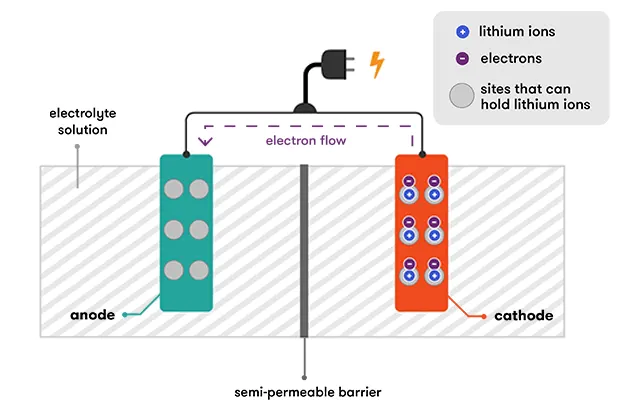
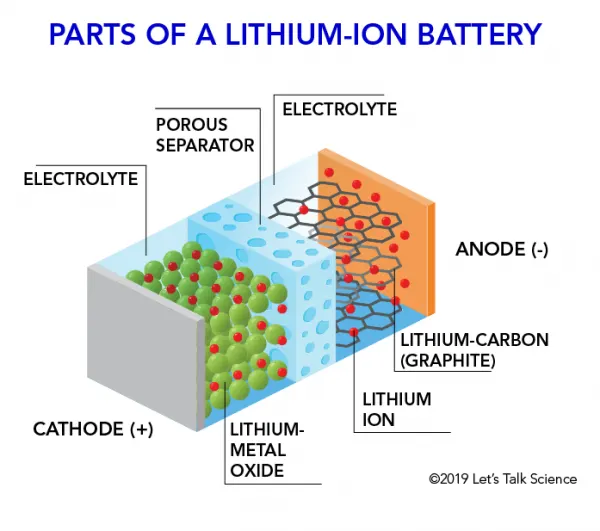
These cells should be safe because various types of electronic protection devices such as overcharge protection circuit and fuse are installed in the commercial battery pack even if the battery pack employs only one cell.However, the safety margin of these cells is still small for practical use because of thermal runaway of lithium ion cells.
How does a lithium - ion battery work?
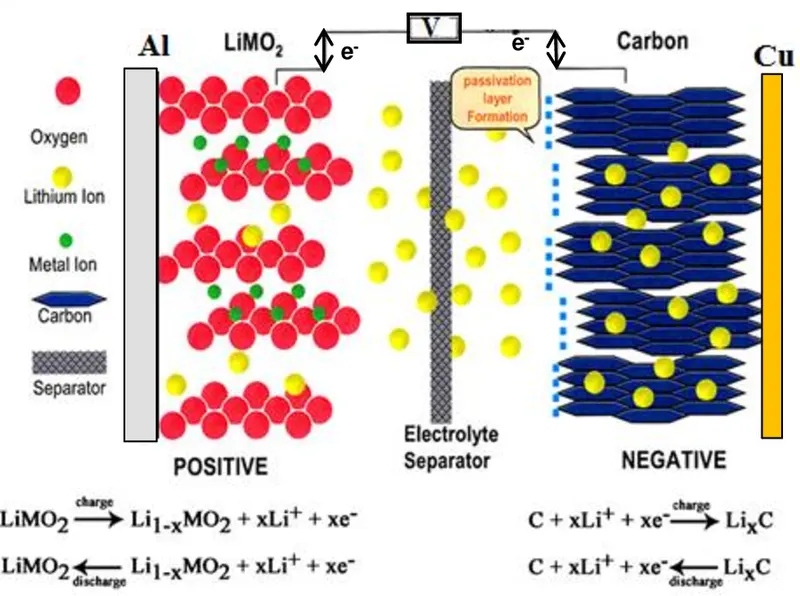
- Most Li-ion batteries share a similar design consisting of a metal oxide positive electrod(cathode) coated on to an aluminum current collector, negative electrode (anode) made from carbon/graphite coated on a copper current collector, a seperator and electrolyte made of lithium salt in an organic solvent.
- While the battery is discharging and providing an electric current, the electrolyte carries positively charged lithium ions from the anode to the cathode and vice versa through the seperator.
- The movement of the lithium ions creates free electrons in the anode which creates a charge at the positive current collector. The electrical current then flows from the current collector through a device being powered to the negative current collector. The seperator blocks the flow of electrons inside the battery.
- During the charging,an external electrical power source (the charging circuit) applies an over-voltage (a higher voltage than the battery produces, of the same polarity), forcing a charging current to flow within the battery from the positive to the negative electrode, i.e. in the reverse direction of a discharge current under normal conditions.
- The lithium ions then migrate from the positive to the negative electrode, where they become embedded in the porous electrode material in a process known as intercalation.
(i) LCO - (Lithium Cobalt Oxide) -
- Lithium cobalt oxide is one of the most common Lithium-ions, it has a chemical symbol which is LiCoO2 and is abbreviated as LCO. For simplification, Li-cobalt –which is the short term- can also be used for this type battery. Cobalt is the core active material which defines the character of the battery.
- The most popular technology of the battery sector currently is the lithium ion battery. Relative to other types of batteries, lithium ion batteries have better energy, power density and higher cycling ability.
- These qualities are extremely important in the use in modern applications like electrical and hybrid vehicles and most importantly energy storage systems which are used in the renewable energy applications. The lithium ion batteries chemistry is the same across the different lithium ion battery types types.
- During discharge, Lithium-ions are moved to the positive cathode from the negative anode through the organic electrolyte.
- The anodes in all various technologies of lithium ion are all made from graphite.
- The differences are the cathode which contains changing cobalt, nickel or manganese concentrations. All various cathode types allow high lithium insertion and intercalation levels which result in large energy storage quantities.
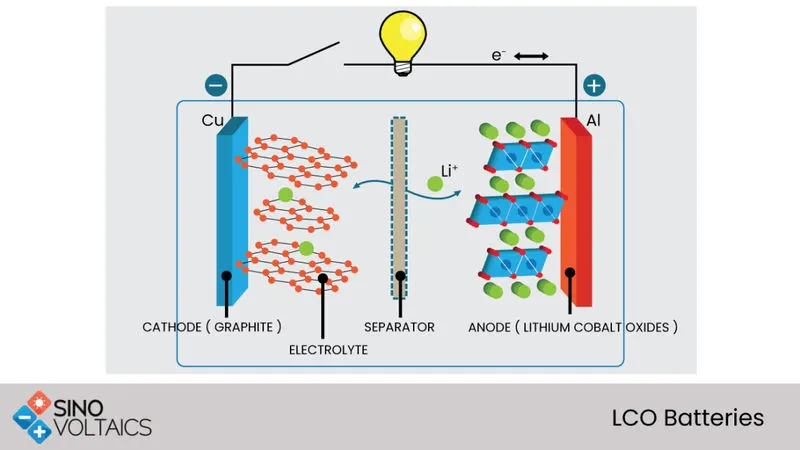
LCO batteries and technology -
- LCO (Lithium cobalt oxide) was invented in the year 1991.
- Its anode material is LiaC6, the cathode material is LibCoO2 and the carrier is Li+.
- It is used in various applications ranging from electronic devices to all laptops and phone batteries. The majority of lithium-ion batteries for the portable devices are cobalt based. The system contains a cobalt oxide cathode (positive electrode) and graphite carbon anode (negative electrode).
Advantages -
- High energy density.
- Long runtime making it optimum for new technologies
Disadvantages -
- It has a relatively low discharge current so high load can lead to pack overheat
- The safety circuit of the LCO battery is typically limited to a 1C for charging and discharging.
- The internal resistance increases with cycling and aging. This high internal resistance can cause the battery to become unserviceable due to a large voltage drop under the load after a couple of years of use.
(ii) LMO (Lithium manganese oxide)
LMO stands for Lithium manganese oxide batteries, which are commonly referred to as lithium-ion manganese batteries or manganese spinel. This battery was discovered in the 1980s, yet the first commercial lithium-ion battery made with a cathode material made from lithium manganese was produced in 1996.
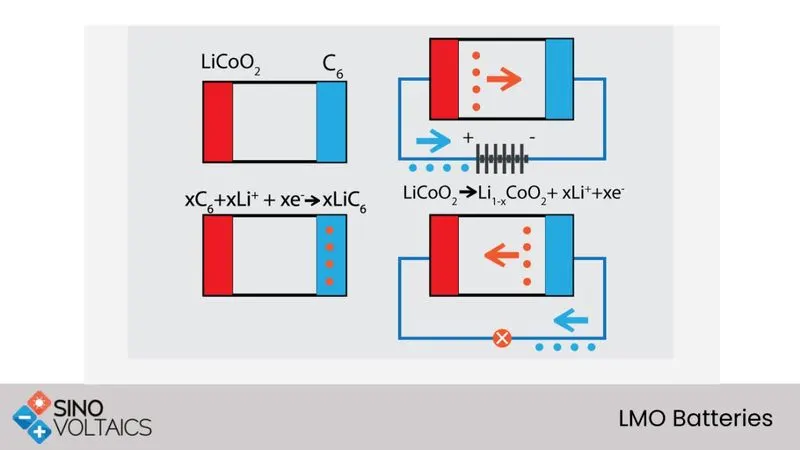
LMO batteries and technology -
- LMO (Lithium magnesium oxide) was invented in the year 1996.
- Its anode material is LiaC6, the cathode material is LibMn2O4 and the carrier is Li+.
- It is used in different applications like power tools and electric cars. LMO batteries have the ability to deliver a lot of energy in a short period of time, which makes them extremely useful for use in power tools like drills.
- In 1996, lithium manganese oxide was first used as a cathode material.
- A three dimensional spinel structure was formed by this structure, this improves the flow of ions between the electrodes.
- The high flow decreases the internal resistance and increases loading capability. LMO batteries are usually used in medical devices and equipment, power tools, electric bikes and more. Because of their thermal resistance and higher safety. LMO batteries can also be used for laptops and electrical cars.
Advantages -
- High temperature stability and safety relative to other Li-ion types as it has integrally high thermal stability thus needs less safety circuitry than cobalt system.
- High rate capability due to low internal cell resistance which benefits fast charging and high current discharging.
Disadvantages -
- Lower capacity relative to cobalt-based system,yet it still has an energy density which is nearly 50% higher than the nickel based system.
(iii) NCA (Lithium nickel cobalt aluminium oxide) -
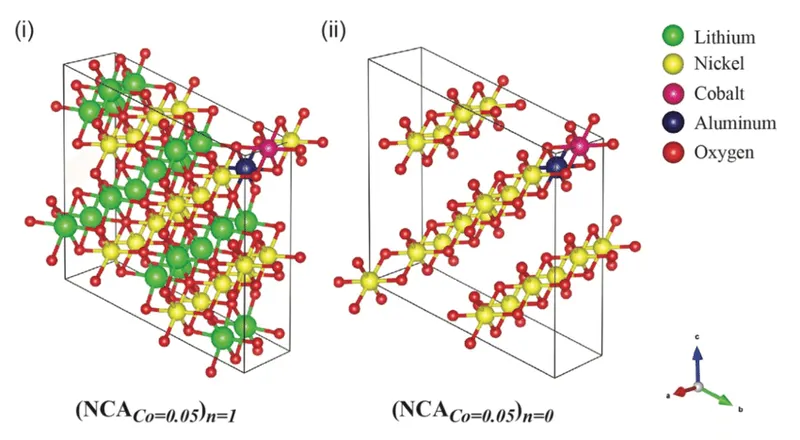
NCA battery stands for Lithium nickel cobalt aluminum oxide based battery (LiNiCoAlO2). Also, NCA batteries are becoming more and more important in in-grid storage and electrical power terrain applications.
NCA batteries and technologies -
- NCA (Lithium nickel cobalt aluminum oxide) battery was invented in the year 1999.
- Its anode material is LiaC6, the cathode material is LibNi0.8Co0.15Al0.05O2 and the carrier is Li+.
- It is used in different applications like power grid applications, medical devices and elecric cars.
- Most notably Tesla deploys NCA batteries in their electric vehicles system. NCA batteries can store the same amount of energy as NMC. NCA batteries are not widely common in the consumer industry, but are quite promising in the electric car industry.
Advantages -
- High specific energy.
- Reasonably good specific power.
- Long life span.
- NCA cathodes contain the most energy amount by weight and volume (as NMC).
Disadvantages -
- Less safety than other Li-ion battery types (they require extra safety features and circuits for use in electric cars for)
- Higher cost in comparison to other Li-ion battery types
(iv) NMC (lithium nickel managnese cobalt oxide) -
- One of the most successful Li-ion systems is a cathode combination of nickel-manganese-cobalt (NMC).
- Also known as lithium-manganese-cobalt-oxide batteries, or NMC, lithium nickel manganese cobalt oxide batteries are made of several materials common in other lithium iron batteries. These involve a cathode combination of nickel, manganese and cobalt.
- NMC in the same cell optimized for specific power has a capacity of only about 2,000mWh but delivers a continuous discharge current of 20A.
- A silicon-based anode will go to 4,000mAh and higher but at reduced loading capability and shorter cycle life. Silicon added to graphite has the drawback that the anode grows and shrinks with charge and discharge, making the cell mechanically unstable.
- Like other varieties of lithium-ion batteries, NMC batteries can have either a high specific energy or high specific power. They cannot, however, have both properties. This battery is most common in power tools and in powertrains for vehicles.
- The cathode combination ratio is usually one-third nickel, one-third manganese and one-third cobalt, meaning that the raw material cost is lower than for other options, as cobalt on its own can be quite expensive.
- According to Battery university, this battery is also commonly preferred for electric vehicles due to its very low self-heating rate.
(v) LFP (Lithium iron phosphate LiFePO4)
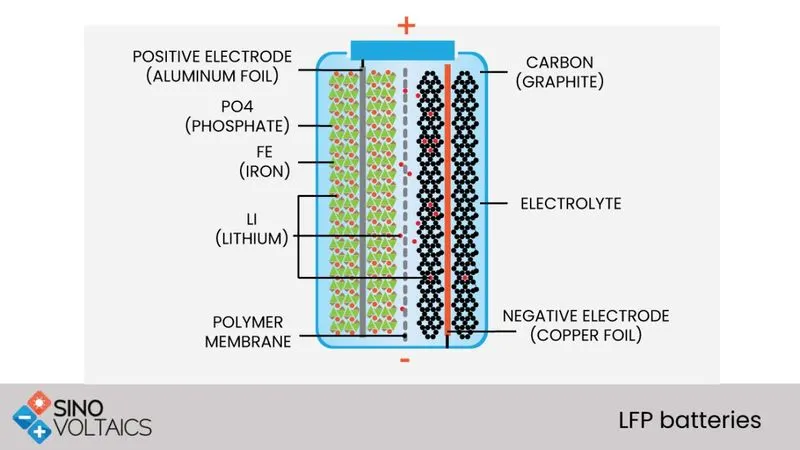
LFP batteries stands for Lithium iron phosphate(LiFePO4) batteries, which is known as li-phosphate batteries as well. They use phosphate as cathode material. In addition, they benefit from the low resistance properties that enhance their thermal stability and safety.
LFP batteries and technologies -
- LFP (Lithium iron phosphate) was invented in the year 1996.
- Its anode material is LiaC6, the cathode material is LibFePO4 and the carrier is Li+.
- They use LFP batteries in different applications like electric cars, electric buses and electric trucks.
- The LFP is ideal for use in electric trucks or buses – as volume or weight isn’t really a restriction as is in cars- because the battery is less energy dense yet cheaper to manufacture than other Li-ion batteries types.
- In addition, they use LFP batteries in other applications like electric motorcycles which need a longer life cycle and increased safety.
- LFP provides good electrochemical performance with lower resistance. This is enabled by the nano scale phosphate cathode material. The main benefits are long cycle life, higher current rating and thermal stability which means extra safety.
Advantages of LFP -
- Durability
- Long lifecycle
- Low cost
- Excellent safety
Disadvantages of LFP -
- More tolerant to conditions of full charge and is less stressed at higher voltage for a long time.
- lower nominal voltage which reduces the specific energy
- Higher self discharge than other types Li-ion batteries, which causes balancing issues with aging.
(vi) LTO (Lithium titanate oxide)
- The lithium-titanate-oxide (LTO) battery is a type of rechargable battery. which has the advantage of being faster to charge than other lithium ion batteries, but the disadvantage of having a much lower energy density.
- A lithium-titanate battery is a modified lithium-ion battery that uses lithium titnate nano crystals, instead of carbon, on the surface of its anode.
- This gives the anode a surface area of about 100 square meters per gram, compared with 3 square meters per gram for carbon, allowing electrons to enter and leave the anode quickly.
- This makes fast recharging possible and provides high currents when needed. Lithium-titanate cells also last for 3000 to 7000 charge cycles. one source claims a cycle life of ~1000 cycles before reaching 80% capacity when charged and discharged at 55 °C (131 °F), rather than the standard 25 °C (77 °F).
- A disadvantage of lithium-titanate batteries is that they have a lower inherent voltage (2.4 V), which leads to a lower specific energy (about 30–110 Wh/kg) than conventional lithium-ion battery technologies, which have an inherent voltage of 3.7 V,although some lithium-titanate batteries are reported to have an energy density of up to 177 Wh/L.
Applications -
- Because of the benefits of lithium titanate in terms of high security, high stability, long life and green features, lithium titanate batteries can be widely used in military, aerospace, electric vehicles and charging stations, tourist coaches, yachts, wind and solar energy storage power, traffic signals, solar hybrid street lighting, UPS power supply, home storage, coal, disaster relief emergency, weather radar, electricity, smart grid, communication base stations, hospitals, finance, telecommunications as well as system critical backup power systems.
| Name | Anode material used | Cathode material used | Seperator | Electrolyte | Anode Reaction | Cathode Reaction | Overall Reaction |
| LCO | Graphite | Lithium cobalt | Polyoefin | Ethylene carbonate | LiC6⟷ C6 + Li+ + e− | CoO2 + Li+ + e− ⟷ LiCoO2 | C6 + LiCoO2 ⟷ LiC6 + CoO2 |
| LMO | Graphite | Lithium managanese | Polyoefin | Lithium Halide | LiC6⟷ C6 + Li+ + e− | MnO2 + Li+ + e− ⟷ LiMnO2 | C6 + LiMnO2 ⟷ LiC6 + Mn2O4 |
| NCA | Graphite | Nickel cobalt aluminium | Polyoefin | Ethylene carbonate | LiC6⟷ C6 + Li+ + e− | NiCoAlO2 + Li+ + e− ⟷ LiNiCoAlO2 | C6 + LiNiMnCoO2 ⟷ LiC6 + NiCoAlO2 |
| NMC | Graphite | Nickel managanese | Polyoefin | Lithium salt | LiC6⟷ C6 + Li+ + e− | NiMnCoO2 + Li+ + e− ⟷ LiNiMnCoO2 | C6 + LiNiMnCoO2 ⟷ LiC6 + NiMnCoO2 |
| LFP | Graphite | Lithium iron phosphate | Polyoefin | Ethylene Carbonate | LiC6⟷ C6 + Li+ + e− | FePO4 + Li+ + e− ⟷ LiFePO4 | C6 + LiFePO4 ⟷ LiC6 + FePO4 |
| LTO | Graphite | Lithium titanate | Polyoefin | Lithium salt | Li4Ti5O12 ⟷ Ti5O12 + 4Li+ + 4e− | 4Mn2O4 + 4 Li+ +4e− ⟷ 4LiMn2O4 | 4Mn2O4 + Li4Ti5O12 ⟷ 4LiMn2O4 + Ti5O12 |
2. Based on their characteristics we can compare like this -
| Battery | Specific energy | Specific power | Safety | Performance | Lifespan | Cost | |
| LCO | Has a good energy capacity | Power distribution is not upto the mark | provides better saftey and protection | Performs good | Good Lifespan | Less cost | |
| LMO | Has a good energy capacity | Provides good power distribution | provides better saftey and protection | Does not perform well | Have short lifespan | Little pricy | |
| NCA | High specific energy | High Specific Power | Poor Safety | Performs well | Long lifespan | Less cost | |
| NMC | High specific energy |
|
Good safety | Average performance | Short span | Little pricy | |
| LTO | Very low specific energy | Average power distribution | High saftey | High performance | Long span | Very less | |
| LFP | Poor specific energy | Better power distribution | High saftey | Average performance | Long lifespan | Little pricy |