Week-6 Challenge: EV Drivetrain
1. The large number of automobiles in use around the worldhas caused and continue to cause the serious problems of environment and human life. Air pollution, global warming and the rapid depletion of earth's pertroleum resources are now serious problems. EVs,HEVs and fuel cell EVs have been typically proposed to replace conventional vehicles in the future. Most EVs and HEVs configurations use two energy storage devices, one with high energy storage capability called main energy systems(MES) and the other with high power capability and reversability called rechargeable energy storage system(RESS). MES provides extended driving range and RESS provides good acceleration and regenerative braking.
The types of power converter circuits used in EVs and HEVs are -
(i) DC - DC converters - These are the category of power converters and these convert a source of DC from one voltage level to another, by storing the input energy temporarily and then releasing that energy to the output at a different voltage.
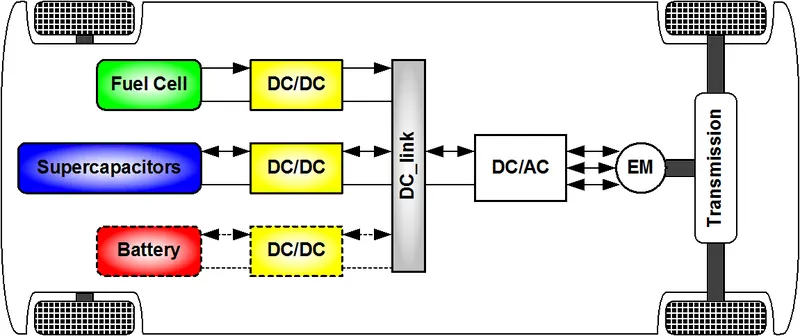
- These can be used to interface the elements in the electric power train by boosting or chopping the energy levels.
- Due to the automotive constraints, the power converter structure has to be reliable, light weight, small volume with high efficiency, low electromagnetic interference and low current/voltage ripple.
- The different configurations of EV power supply show that at least one DC/DC converter is necessary to interface the FC, the battery or the supercapacitors module to the DC link.
- DC/DC's storage maybe in either magnetic field storage components(inductors, transformers) or electric field storage components(capacitors).
- DC/DC converters canbe designed to transfer power in only one direction, from the input to output.
- A bi directional converter can move power in either direction, which is useful in applications requiring regenerative braking.
- The amount of powerflow between input and output canbe controlled by adjusting the duty cycle ratio. Usually, this is done to control the output current or to maintain a constant power.
- The main drawbacks are, complexity, electronic noise and high cost.
(ii) AC - DC converters - These converters convert the AC to DC levels. and are one of the most important in power electronics because there are lot of real applications are based on this conversions.
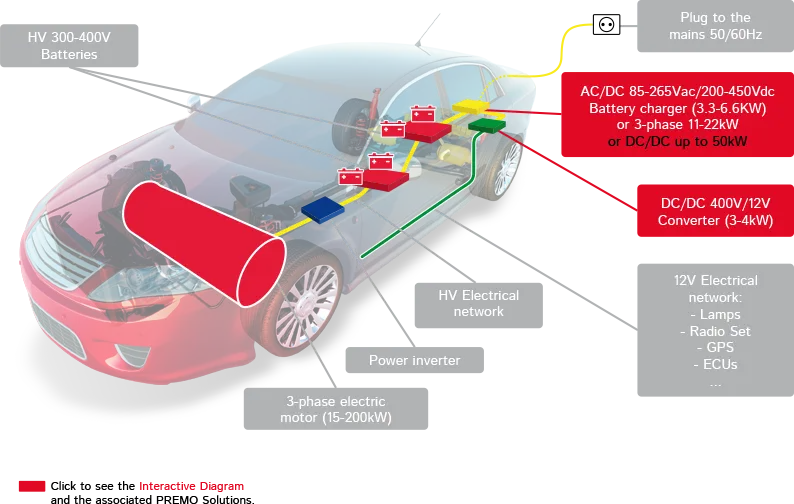
- The AC current to DC current conversion process is knoen as rectification.
- The rectifier converts AC to DC supply at load end connection.
- Normally transformers are used to adjust the AC source to get step down the transformer to reduce the voltage level to to have operation range for DC supply.
- It converts low voltage values.
- As the global warming countermeasure reduction of CO2 emitted from vehicles and the improvement of fuel efficiency have become increasingly important for the automobile industry.
- In such circumstances, many automakers have concentrated their efforts on the development of HEVs, PHEVs, EVS, from which greater CO2 reduction efforts are expected.
- The EVs and PHEVs are equipped not only with a DC/DC converter which generates electricity for the accessories but also with an AC/DC converter which supplies electric power from a commercial power system to an on - board high votage battery.
- The AC/DC converter is required to work more efficiently to shorten the charging time and also to be downsized so as to be fitted in the restricted space.
(iii) DC - AC converters - These are called as inverters. It is a power electronic device or circuitry that changes direct current(DC) to alternating current(AC).
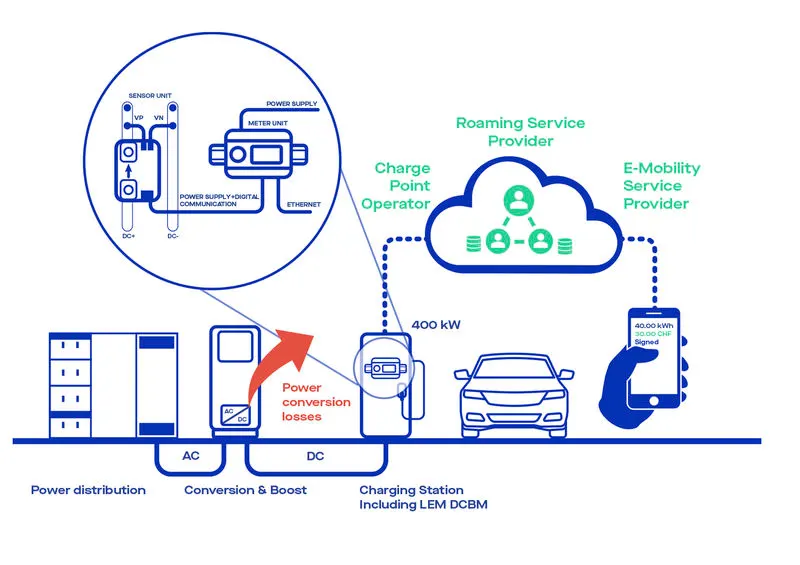
- In a hybrid and other EVs two key elements work together to manage power and recharge the circuits. Here is how these critical components the inverter and converter work in together.
- Broadly speaking, an inverter is an electrical device that converts electricity derived from a DC source to AC source of the type that can be used to drive a device or an appliance.
- In a solar power system, for example, the power stored by the batteries charged by solar panels is converted to standard AC power by the inverter which provides the power to plug-in outlets and other standard 120V devices.
- The inverter serves the same kind of function in a hybrid or EVs , the theory of operation is relatively simple. DC power, from a hybrid battery, for example, is fed to the primary winding in a transformer within the inverter housing.
- Through an electronic switch(generally a set of semicondutors transistors), the direction of the flow of the current is continuosly and regularly flip-flopped the electrical charge travels into the primary winding, then abruptly reverses and flow back out.
- The in/out flow of electricity produces AC current in the transformer's secondary winding circuit ultimately, this included AC electricity provides power for an AC load. For example, EVs and electric traction motor.
2. The parameters given for the motor and controller are,
Rated armature voltage= 72V, Rated armature current=400A, Ra = 0.5ohms, kϕ = 0.7 voltsec, chopping switching freq = 400Hz, duty cycle = 0.7
The vehicle speed - torque characterstic equation is given by, Tv = 24.7 + (0.0051)ω2
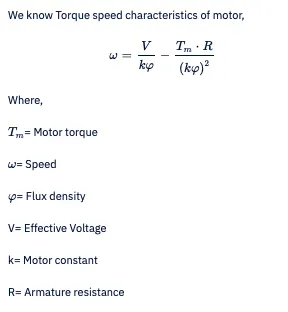
Now we will substitute all the values in the above eauation.
Here V = effective voltage is the product of rated armature voltage and duty cycle. i.e
V = 72 * 0.7 = 50.4 V
Now we substitute V in torque-speed euation of the motor,
ω = (50.4)/(0.7) - (Tm*0.5)/(0.7^2)
ω = 72 - 1.0204(Tm)
on solving we get,
Tm = 70.56 - 0.98ω
At steady state,
Tm = Tv
Tv = 24.7 + (0.0051)ω2
now the equating both Tm and Tv we get,
70.56 - 0.98ω = 24.7 + (0.0051)ω2
we will get a quadrartic equation as,
0.0051ω2 + 0.98ω - 45.86 = 0
on solving the equation we get two values for ω
ω1 = 38.91 and ω2 = -231.07
since the speed can't be negative the value for speed is,
ω = 38.91 rad/sec
3. The mathematical model for the DC motor equation is given below-
ω = v/kϕ - Ra*T/(kϕ)^2
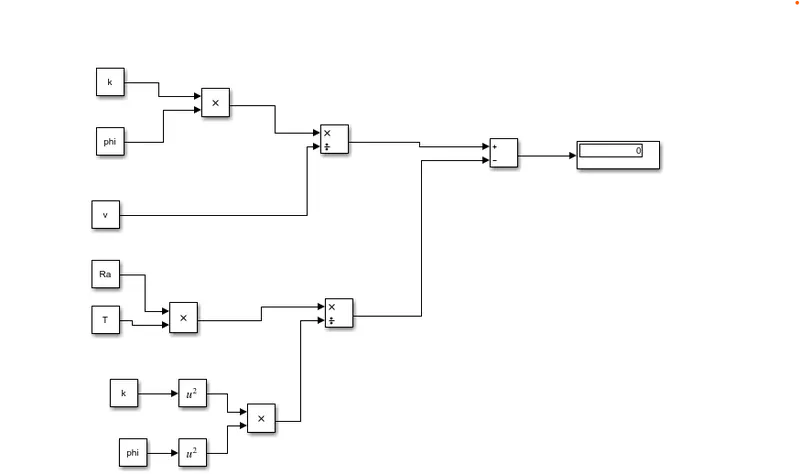
The link is,
https://drive.google.com/file/d/1Lqt2GFJmxFN1jG0SG717cCthBK9KTpFo/view?usp=sharing
4. Induction motors Versus DC brushless motors.
Here the author's explains about both motor's own advantage and disadvantages. And their particularities in the EVs.
Initially he explains about how they are similar in the structure except some of the internal arrangements and parts. Both these produce required magnetic fields to rotate the rotor but the depending on magnetic fields there is a huge complexity.
- Since Inverter is must for DC brushless motors, and these do not produce any starting torque when directly connected to fixed frequency utility power. Where as for Inducton motors no inverter is needed and IMs are connected to utility powe torque is produced at the outset.
- AC is must for Induction motors and they only require speed sensors. whereas, DC brushless require an absolute position sensor.
- Compared to Induction motors DC brushless motors operate at high utility power factor about 90%, which makes them more efficient.
Since Induction motors have high complex fields, they make any system more efficient but they are uncontrollable that's what the authour tries to say. The authour says that , EVs will be dominated by induction motor in future when we understand the level of complexity. But also he says the contradictory statement where even DC brushless motors also dominate future EVs and HEVs with greater extent by the performance.