Week-11 Challenge: Braking
1) For a defined driving cycle, calculate the energy required for braking.
Let's start with a definition of braking. Braking is the process of bringing a moving system to a halt by absorbing energy. Energy cannot be generated or destroyed; it can only be transformed from one state to another.In certain conventional braking systems, a brake pad or a shoe is used to create friction to the wheels, converting the kinetic energy of the moving system into heat energy, which is subsequently dispersed into the environment.We now have regenerative braking, a simple energy recovery technology that brings a moving device to a halt by transforming its kinetic energy into a form that can be saved for later use.
In today's EVs, we use regenerative braking, which does not use brake pads or shoes; instead, the electric motor acts as a generator, which is the reverse functioning of a motor. This prevents the vehicle from progressively converting kinetic energy to electric energy, which may then be transferred to any battery packs for charge.
Inorder to calculate the energy required for braking, we must first prepare a user defined drive cycle.
we taaken the mass as 500 kg
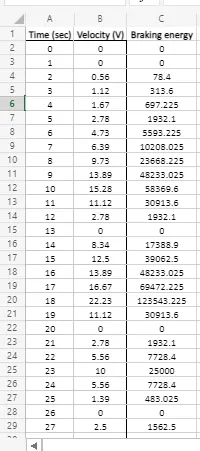
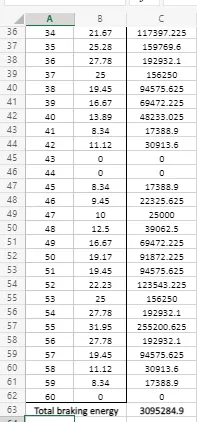
The graph will be
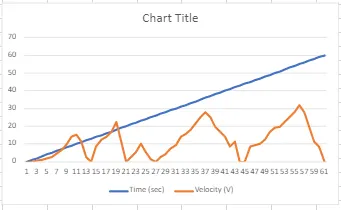
In general there is an equation for the energy required for braking. It is :
E = 1/2 * m * V^2.
we have to take the total braking energy
where,
m - inertia effect of the system or simply considered as the mass of the system. (in Kg)
V - Velocity of the system. (in m/s).
The total braking energy of the drive cycle is 309.52 KJ
2) Why electric motor can’t develop braking torque at high speed similar to starting? How electric and mechanical brakes are coordinated?
Why electric motor can’t develop braking torque at high speed similar to starting?
When the motor is at rest and must be started from a standstill position to attain a moderate speed, a higher torque is required to start the motor. When the vehicle is already at a high speed, the motor action reaches a capping or limit, and thus any additional greater torque cannot be achieved during braking.The braking process occurs in the motion that is proportionally distributed in the BRAKE ENERGY and the REGENERATIVE BRAKING.
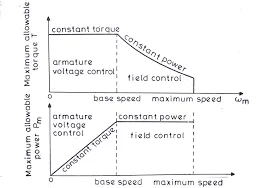
The first graph clearly shows that until the motor reaches the critical speed, it has constant torque, and once it hits the critical speed, the curve has a down slope, indicating a constant power region.And this graph represents the motor's accelerating functioning. This graph is mirrored down for the motor's deceleration or braking activity, which will have the speed (+ve) and torque (-ve).
How electric and mechanical brakes are coordinated?
In mechanical braking, which is common in all automobiles, the brake pedal in the vehicle cabin assists us in engaging or disengaging the brakes. At the moment, braking technology has done miracles by inventing life-saving braking systems like as ABS, EBD, BA, and a slew of others. All of these technologies are critical in slowing the vehicle and bringing it to a halt once it has reached a high speed.When the driver uses the brakes in any of these vehicles, the brake pedals move closer to the disc attached to the driving disc. Brake pads are typically used to aid with efficient braking.
In the ELECTRIC BRAKES, there are two basic methods for braking the vehicle.
- series
- parallel
Series
The Regenerative Braking and the Mechanical Braking are applied sequentially.
Parallel
Both regenerative and mechanical braking are used in parallel.
When the brake pedal is pushed, hydraulic fluid enters the brake piston and creates braking pressure on the wheels. The same kinetic energy is employed by Regenerative Braking to generate extra power via the Bi-directional motor, which acts as a generator when braking.
ELECTRIC DRIVEN INTELLIGENT BRAKE
In addition, Nissan has developed a realistic braking method known as the ELECTRIC DRIVEN INTELLIGENT BRAKE developed by Nissan leaf.
When the brake pedal is depressed, the system generates a natural and adequate braking force that corresponds to the operation. The amount of energy regeneration must also be boosted to the greatest extent possible. To meet both of these criteria, EDIB (Electric Driven Intelligent Brake) regulates the regenerative and friction brakes. It also regulates the response force of the pedal in order to integrate the sensation of stepping down on the pedal with the perception of deceleration.
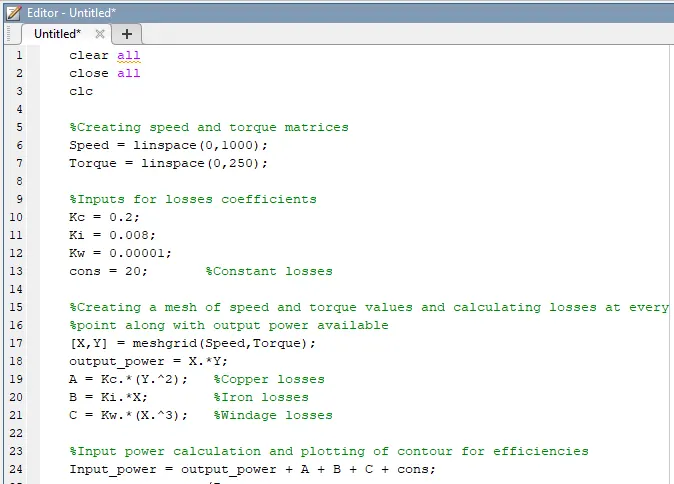
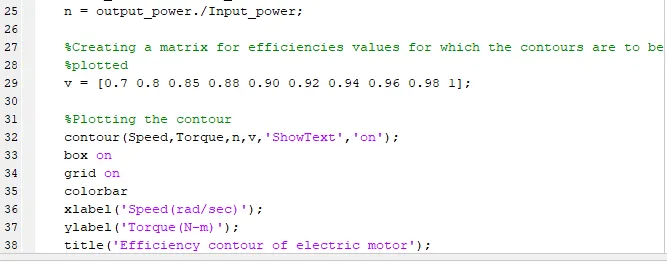
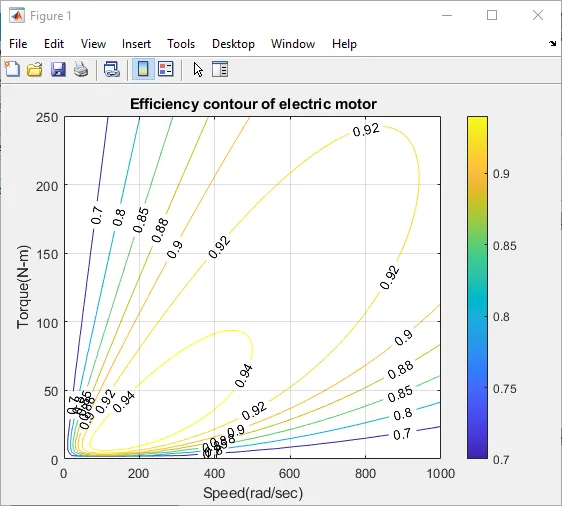
3) Make a MATLAB program which plots contour of given motor speed, torque and efficiency values. Attach the code as a .m file attach a screenshot of all the plots.
code:
Graph:
Conclusion:
- As a result, all of the questions are completed in according with the conditions specified and all the required files are attached