Week-11 Challenge: Braking
Aims:
- To calculate the energy required for braking for a defined driving cycle.
- To study why electric motor cannot develop braking torque at high speed similar to starting and how electric and mechanical brakes are coordinated.
- To write a MATLAB program that plots contour of given motor speed, torque, and efficiency values.
Theory:
Part 1: To calculate the energy required for braking for a defined driving cycle.
Braking: Braking is a condition in any vehicle to decelerate the vehicle and sometimes to stop the vehicle or to lessen the speed of the vehicle. There are numerous techniques to decelerate the vehicle that can be mechanical or electrical. The most common way to brake is the friction method, where the brake pads expand in a brake drum to decelerate the vehicle or the brake disc is in between the brake pads which tries to stop the disc to rotate and stop the vehicle. However, there is one more technique which is known as engine braking where, if the normal brakes fail to work, the engine is down shifted to apply engine brake making the vehicle to slow down slowly and coming to a stop eventually. However, there are multiple factors on how efficient the braking would be, which depends on, number of brake pistons, duration and degree of brake pedal pressed, road conditions, weather, temperature, mass of vehicle, etc. The friction energy used in braking by conventional braking method consumes energy, the consumed kinetic energy can be derived by the following equation:
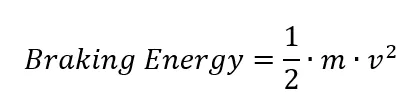
Where,
m = mass of the vehicle
v = velocity of the vehicle.
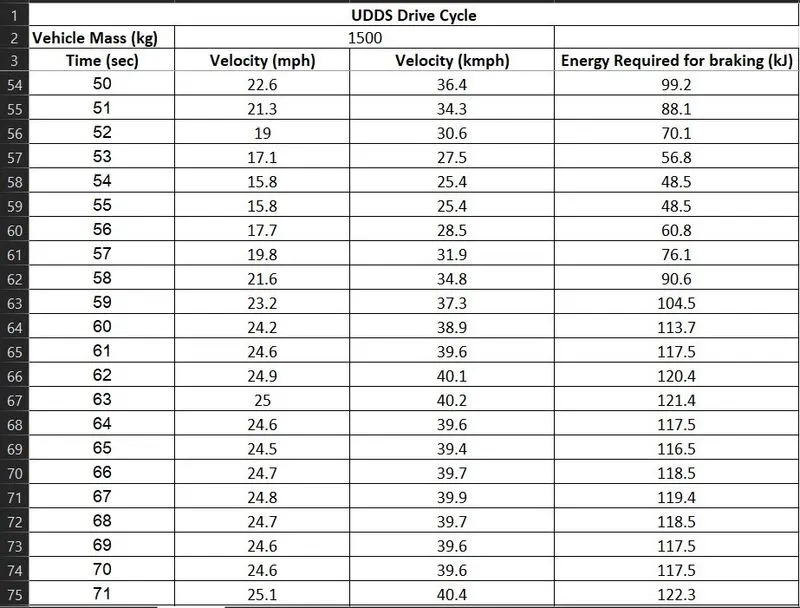
The calculation for braking energy were carried out on UDDS [1] drive cycle. As given in the UDDS cycle, for example at velocity 19 mph and considering mass of vehicle 1500 kg, the braking energy calculated is:
v = 19 mph
v = 30.6 kmph
m = 1500 kg
*the value was divided by 10,000 to convert it into kJ.
The excel calculation can be seen below:
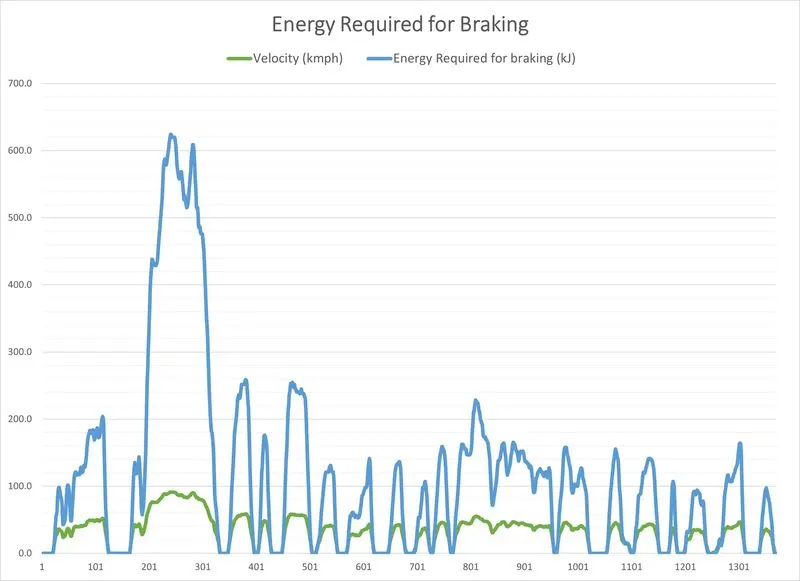
The Velocity and Braking Energy plotted against time for UDDS can be seen below:
Google Sheet: https://drive.google.com/file/d/1TMy9SNkZ8RN99SPs31-K1H4oQ5PbCcDX/view?usp=sharing
Part 2: To study why electric motor cannot develop braking torque at high speed similar to starting and how electric and mechanical brakes are coordinated.
The electric motor cannot develop braking torque at high speed similar to starting torque because once the electric supply is turned off from the motor it starts acting as a generator and due to flux weakening effect of the electric generator and the generator produces low torque as expected.
When the motor is at rest and has to operate from the stand still condition to reach the moderate speed, higher torque is required to bring the motor in operation. Whereas when the vehicle is already at higher speeds the capping or the limit is reached by the motor operation and thus any further higher torque could not be obtained when braking. The braking operation happens in the motion which is been distributed as per proportion in the brake energy and the regenerative braking.
How electric and mechanical brakes are co-ordinated?
There are different ways of co-ordinating between hydraulic brakes and regenerative braking. One of the brakes control strategies involves series connection where both brakes are connected together which implies that in this scenario both the brakes are applied one after another and the other one is parallel braking where either of the two brakes are operated simultaneously, depending on the braking requirements.
Series Braking: In this case regenerative braking and mechanical brakes, both are applied one after another.
Parallel Braking: In this case both regenerative and mechanical brakes are applied simultaneously.
In real time scenario we need both electrical and mechanical brakes. In emergency braking or in parking brake we need mechanical brake. Mechanical brake is the conventional disc or drum brake which uses friction braking, whereas electric braking is used to reduce speed of the motor depending upon the flux or torque which can be done by different methods such as plugging type, dynamic type, or regenerative braking.
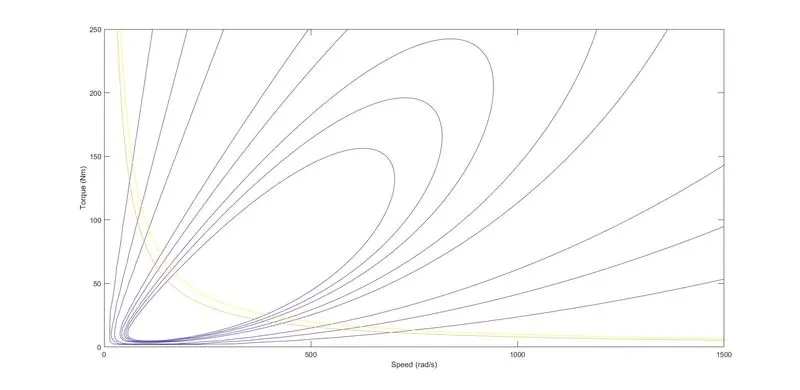
Part 3: To write a MATLAB program that plots contour of given motor speed, torque, and efficiency values.
A counter plot of a motor, where a motor has various types of losses, which are listed below:
- Copper losses
- Iron losses
- Windage losses
- Constant losses
The above listed losses have different equations listed below.
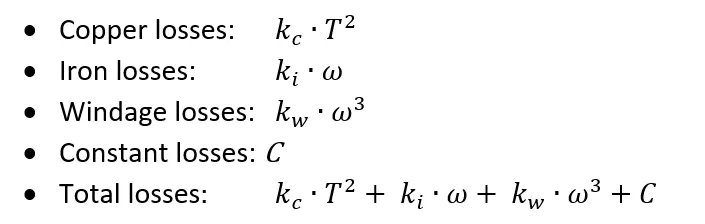
Electric motors are modelled as per above given losses, which does not apply to permanent magnet motors, however, applies to other motors and induction motors.
The Matlab program to plot a contour of a motor is as below:
% To plot a contour for calculating the losses of a motor

clear all
close all
clc

w = linspace(0,1500); % Motor Speed (rad/s) not rpm
T = linspace(0,250); % Torque (Nm)

% Motor loss constants
kc = 0.2; % Copper loss constant
ki = 0.008; % Iron loass constant
kw = 0.00001; % Windage loss constant
Conl = 20; % Constant motor loss

% To create a mesh
[X,Y] = meshgrid(w,T);
Output_power = (X.*Y); % Torque * Speed = Power
B = (Y.^2)*kc; % Copper losses
C = (X.^3)*kw; % Windage losses
D = X*ki; % Iron losses
Input_power = Output_power + B + C + D + Conl;
Z = Output_power./Input_power;

% Setting efficiencies for which the contours will be plotted
V = [0.70, 0.80, 0.85, 0.90, 0.91, 0.92, 0.925, 0.93];
box off
grid off
contour(X,Y,Z,V);
xlabel('Speed (rad/s)');
ylabel('Torque (Nm)');
hold on
V = [8000,10000];
contour(X,Y,Output_power,V);
The output plot can be seen below:
Conclusions:
- Braking energy was plotted and calculated for UDDS drive cycle.
- The study on electric and mechanical brakes was carried out with the study of coordination of electric with mechanical brakes.
- The motor losses were calculated and a contour was plotted for a given motor.
References:
[1] https://www.epa.gov/sites/production/files/2015-10/uddscol.txt