Car Crash Simulation Using Ansys Workbench
OBJECTIVE
- To assign the stainless-steel material to the car body, and the structural steel to the wall.
- To give the different thickness to the car body, for three different cases.
- To mesh the model, and apply the boundary condition.
- To collect the results and interpret.
PROCEDURE
This simulation was performed to check the behavior of deformation of the car body when different thicknesses are used. The simulation was solved using the explicit dynamics module of Ansys. The material was imported before proceeding further using Engineering data.
 |
|
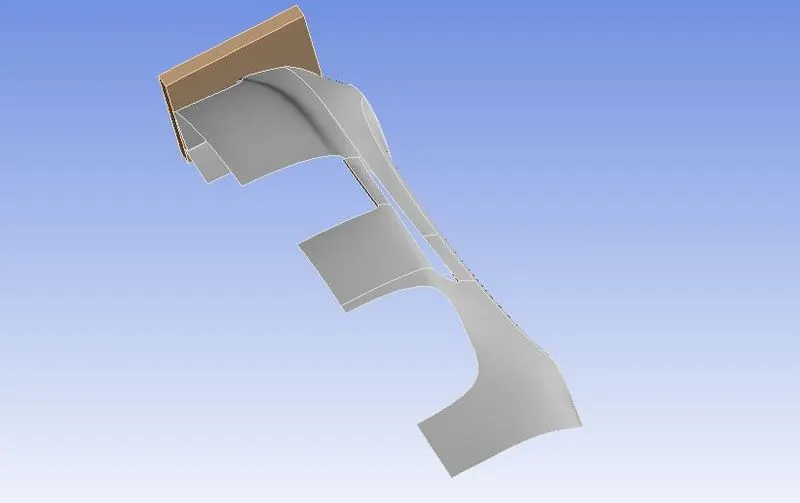
Figure 1: The half model of the car and the wall, in Ansys GUI. |
The Mesh section of the explicit dynamics module was opened. In the figure above, it can be observed that the model is half portion of the car and the wall. Thus, symmetry was defined to solve the problem for a complete car body, and not just half. Further, the material of the car body was set to stainless steel, and the material of the wall was kept as default (structural steel).
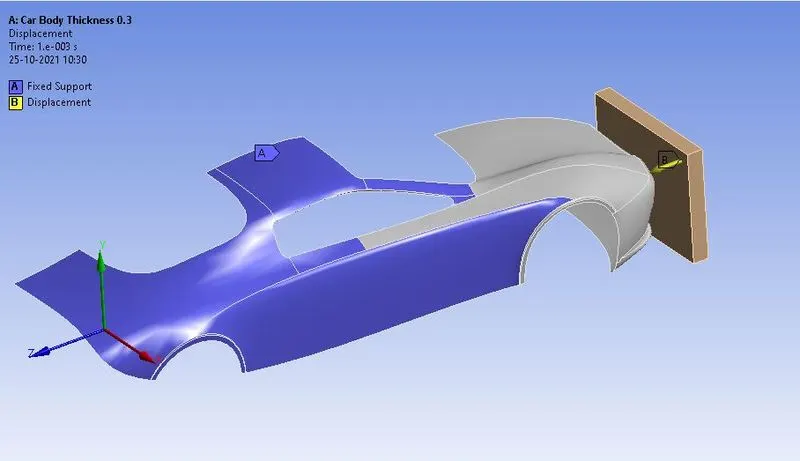
Further, the automatically created contact cards were deleted, as it was not required. Then mesh was created for the model with a default element size of 56 mm. The analysis was set to terminate at 0.001 s. In boundary conditions, the body of the car was fixed, and the displacement (ramped) of 500 mm was applied to the bullet as shown in the figure.
 |
|
Figure 2: Fixed support for the car body and a displacement of 500 mm was given to the wall. |
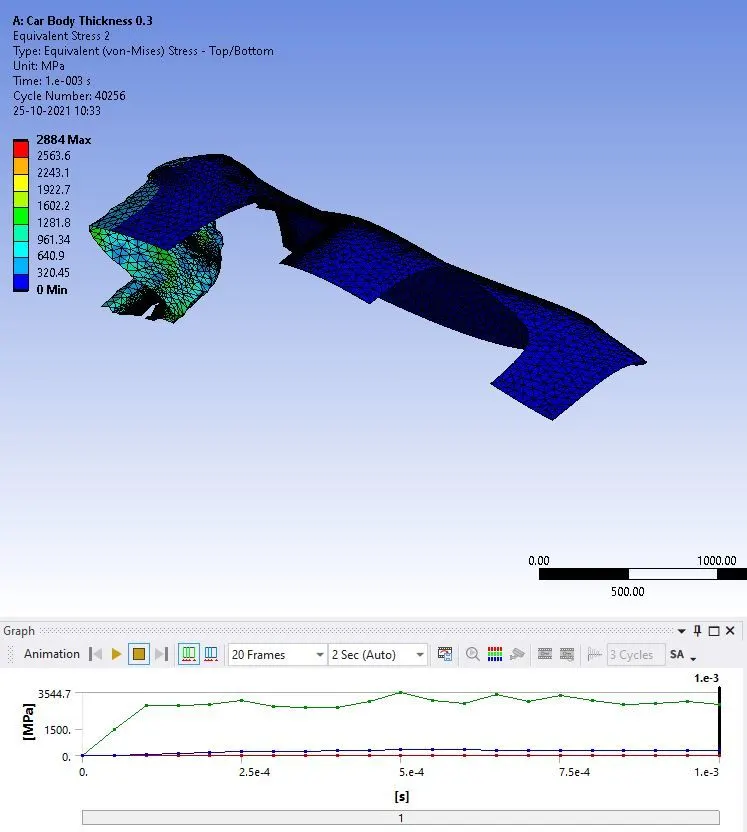
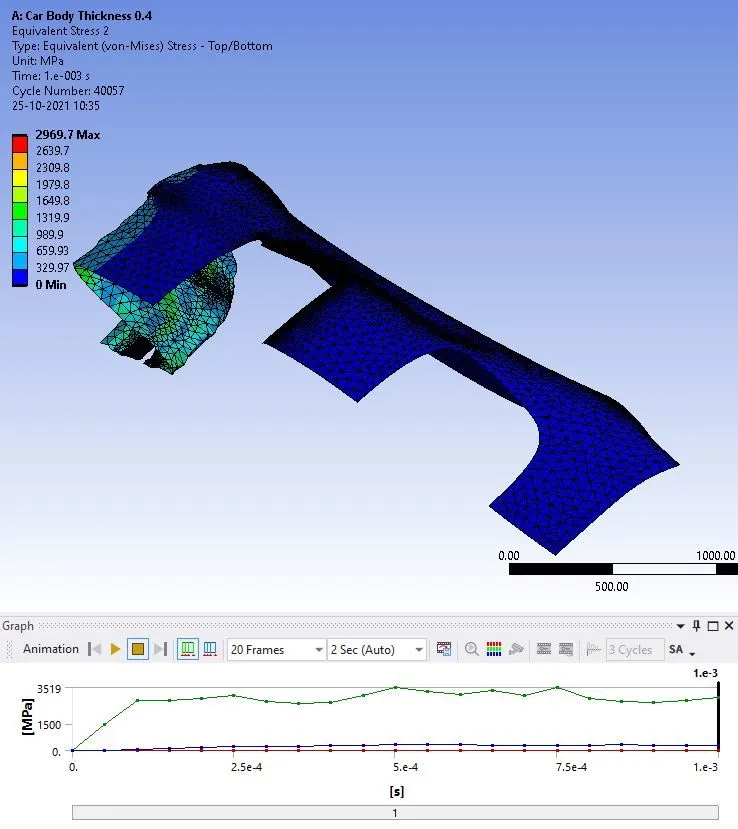
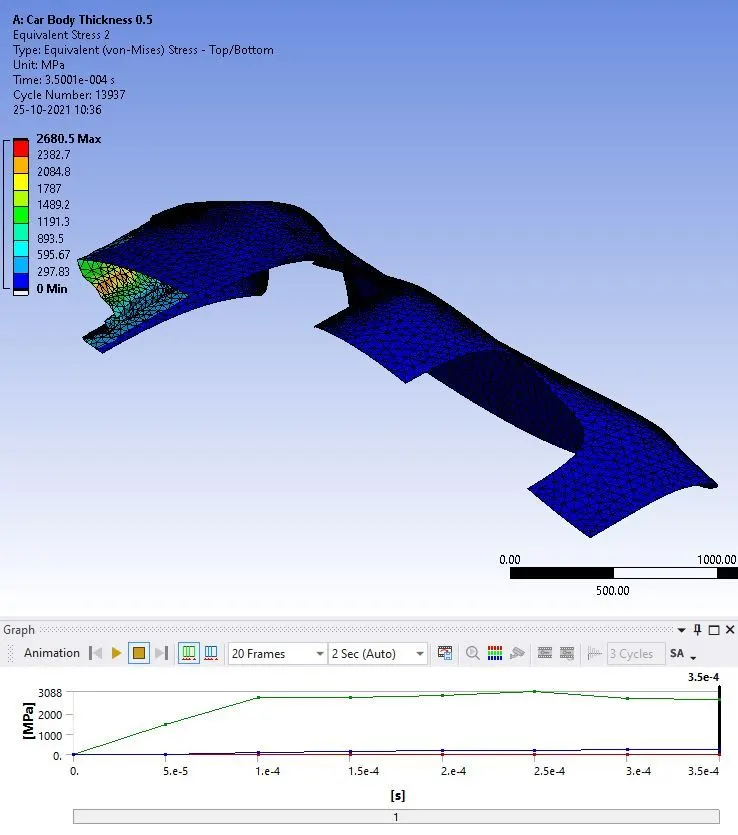
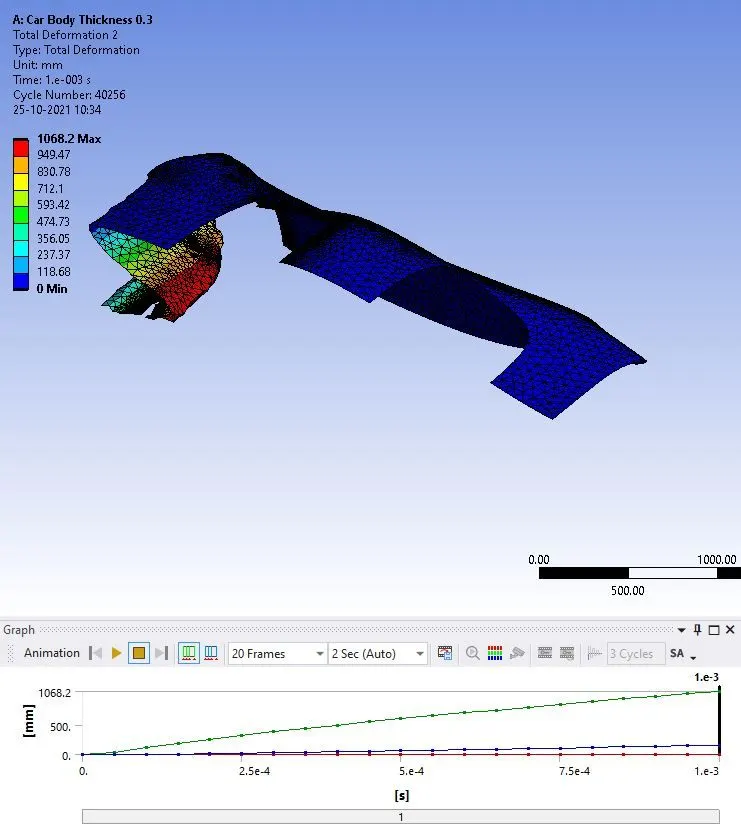
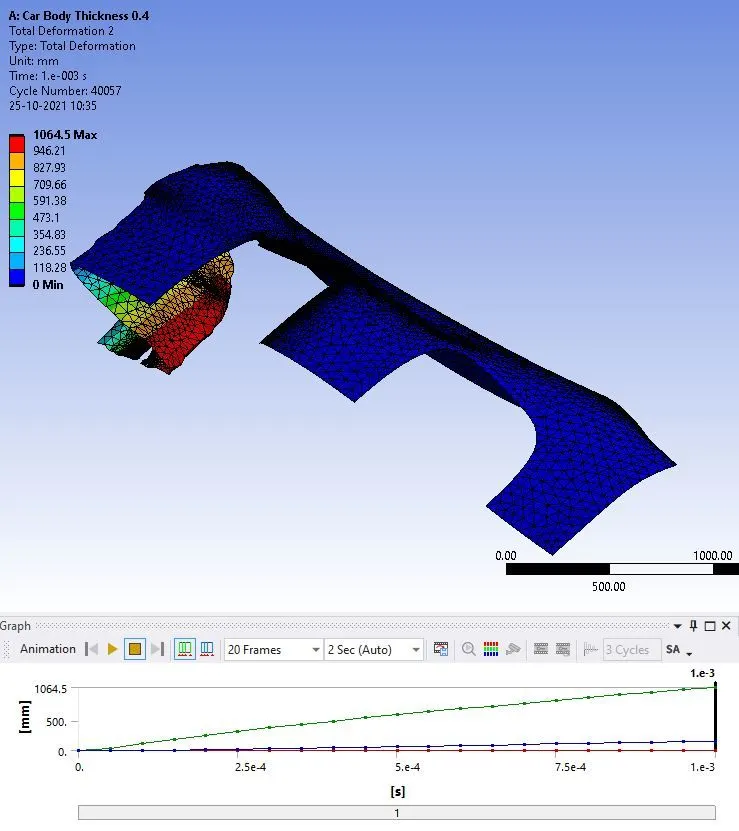
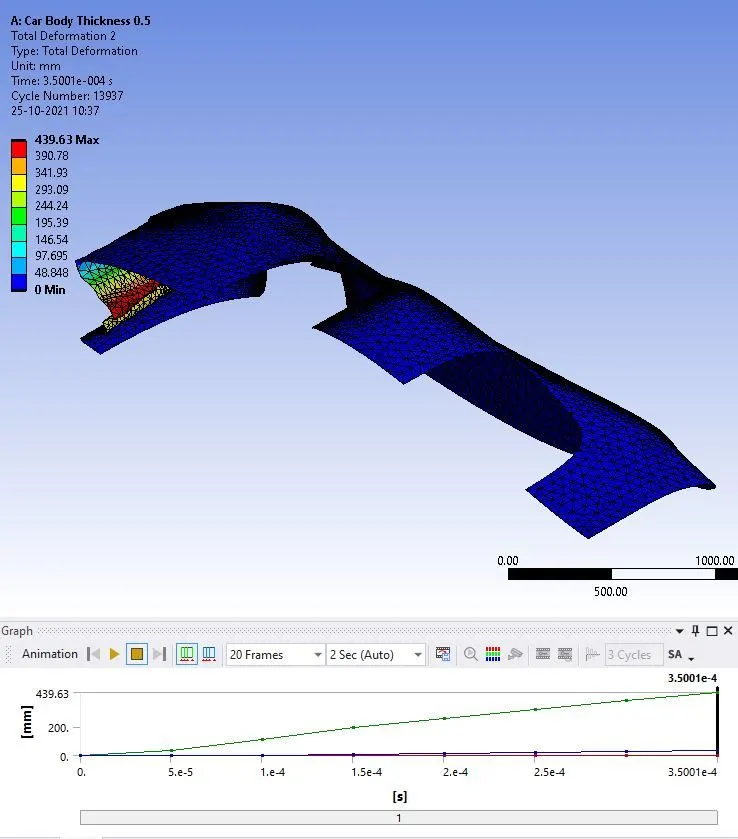
In the solution, the results for equivalent stress, and total deformation was requested. The results of each three cases, when the thickness of the car body was 0.3 mm, 0.4 mm, and 0.5 mm, are shown in the figures below.
 |
 |
 |
|
Thickness = 0.3 mm |
Thickness = 0.4 mm |
Thickness = 0.5 mm |
|
Figure 3: Equivalent stress in the car body, when the different thicknesses were used. |
||
|
|
|
|
|
Thickness = 0.3 mm |
Thickness = 0.4 mm |
Thickness = 0.5 mm |
|
Figure 3: Deformation in the car body, when the different thicknesses were used. |
||
CONCLUSION
In this work, a frontal car crash test was performed for the body of a car. The work was performed with three different cases, i.e., three different thicknesses of the body of a car. The thicknesses were 0.3 mm, 0.4 mm, and 0.5 mm. In the results, if observed carefully, there was no significant difference in the results when 0.3 mm, and 0.4 mm thicknesses were used. But with 0.5 mm thickness, the deformation was reduced by more than 50%. The stress was also reduced by approximately 15%. Thus, it can be concluded that a minimum of 0.5 mm thickness is required for the body of a car, to keep the other parts of the car, and thus the passengers safe.