Week 10 Thermal Management
Week 10 - Thermal Management
Objective
To study the various electric car battery pack thermal management techniques and to summarize them in a report.
Introduction
The performance of an EV is greatly dependent on its battery pack. It is important to maintain the battery pack at its optimum temperature range in order to obtain maximum efficiency and performance. If the thermal management is poor then it'll be affecting the performance and efficiency of the battery, the charge and discharge power of the battery pack will be affected, cycle life and cell balancing will also be affected. Thus Thermal management is much needed for a battery pack to an EV efficiently.
The relationship between degradation and temperature can be formulated by an Arrhenius-type behavior where degradation rate increases exponentially with temperature: “The exact relation depends on the specific electrochemistry and design of the battery. Therefore, there is no single life model that models all different chemistries.”
Although the capacity increases as the operating temperature is raised, the degree of capacity fade also increases. On the other hand, poor performance is observed at low operating temperatures. In addition, excessive or uneven temperature rises in a system or pack reduce its lifecycle significantly.
As an industry reference, EV batteries reach their last days once they reach a 20 percent capacity loss or 30 percent internal resistance growth, and both active and passive battery thermal management systems (BTMS) are the main cards that engineers play to tackle battery overheating and poor performance.
Functions of Thermal management systems for batteries
Battery thermal management systems are designed with four main essential functions to ensure the restriction of the thermal behavior of the lithium-ion cells within their allowable limits.
Cooling - Cooling is an obvious essential function because when batteries are operating outside their limits, they become inefficient and generate unwanted heat. This heat has to be removed from the battery if the temperature of the cell has dropped below or exceeded a certain level. So, the BTMS needs to be able to cool the battery pack before its temperature can cross its allowable limits.
Heating - Opposite to the cooling requirement, there are instances when the temperature of the battery pack may become too low which will also impair its performance. This may occur in environments with cold climates. As a result, the BTMS must have a heat function to increase the battery pack's temperature before it gets too low and keep it within the allowable limits so that its performance won't be affected.
Ventilation - Ventilation is needed for two reasons. The first is that it will allow for cooling of the battery pack when it gets too hot and the other one is that the hazardous gases produced by the battery pack need to be removed and this is combined with the ventilation and cooling systems.
Insulation - Insulation is important because if the temperature difference between the environment and the cell is too great, then the cell will get influenced by the environment's temperature. For instance, if the environment is hotter than the cell, the cell temperature will increase. Conversely, if the environment is much colder than the cell, the cell temperature will decrease. In either case, there is a risk of the cell temperature falling outside the allowable limits, and the BTMS needs to have insulation to prevent this.
Types of thermal management systems
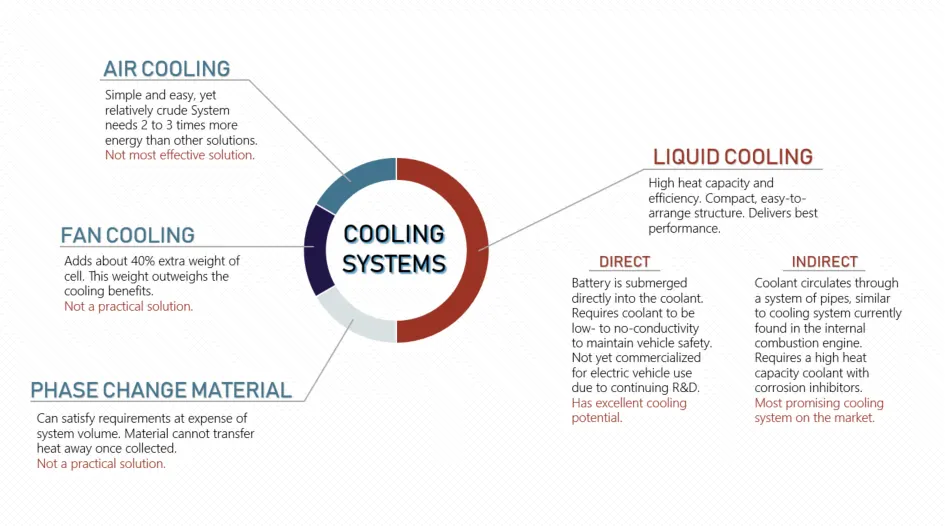
Cooling fins
Cooling fins increase surface area to increase the rate of heat transfer. Heat is transferred from the battery pack to the fin through conduction, and from the fin to the air through convection. Fins have high thermal conductivity and can achieve cooling goals, but they add a lot of additional weight to the pack. The use of fins has found a lot of success in electronics, and traditionally they have been used as an additional cooling system on internal combustion engine vehicles. Using fins to cool the electric car battery has fallen out of favor since the additional weight of the fins outweighs the cooling benefits.
Thermoelectric cooling (TEC)
The first method for effective heat mitigation in Li-ion batteries is the choice of the electrode materials, which is inherent to the battery cell technology. One BTMS that is drawing attention in the EV industry is thermoelectric cooling or TEC. This is due to some benefits relating to their solid cooling capabilities and dependable working potential, besides being quiet, stable, and allowing easier control of temperature by just adjusting the voltage supply.
Thermoelectric element
Thermoelectric coolers are based on the conversion of voltage to the temperature difference. This Peltier–Seebeck effect, together with the Thompson effect, belongs to the thermoelectric effect. “The thermoelectric effect refers to all of the transformation processes from heat to electricity, and vice versa." Besides, thermoelectric cooling can be combined with other battery thermal management systems, such as forced air cooling and liquid cooling.
Phase change material (PCM)
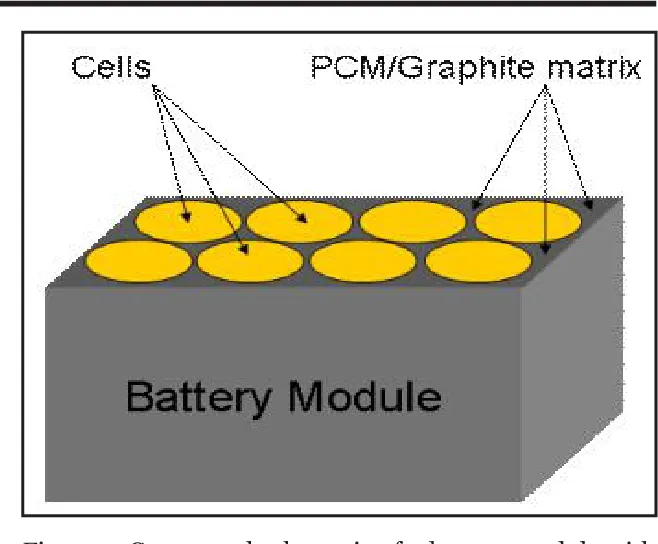
Phase change material absorbs heat throughout the melting process and saves it as latent heat till it reaches a maximum value. For a period, the temperature is kept at a melting point and then the temperature increase is delayed. Therefore, PCM is used as a conductor and buffer in the BTMS. Also, the PCM is always combined with another BTMS system such as liquid cooling or air cooling system to manage the battery core temperature.
Heat Pipe
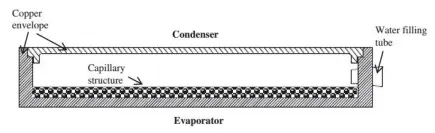
The flat copper envelope of the heat pipe was under partial vacuum. The capillary structure is made of sintered copper powder. The heat pipe uses water as the working fluid. Water on the evaporator side will absorb heat and become vapor lower 100°C due to low pressure inside. Water on the condenser will dissipate heat to the surrounding and become liquid again. This cycle repeats again and again.
Air Cooling and Heating:
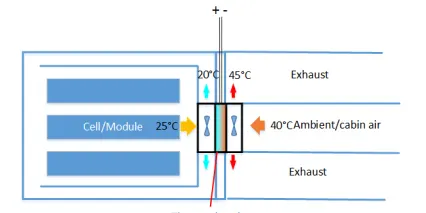
The Air system uses air as the thermal medium. The intake air could be direct either from the atmosphere or from the cabin and could also be conditioned air after a heater or evaporator of an air conditioner. The former is called a passive air system and the latter
is an active air system. Active systems can offer additional cooling or heating power. A passive system can offer hundreds of watts of cooling or heating power and active system power is limited to 1 kW. Because in both cases the air is supplied by a blower, they are also called forced air systems. The following figure shows a schematic description of systems.
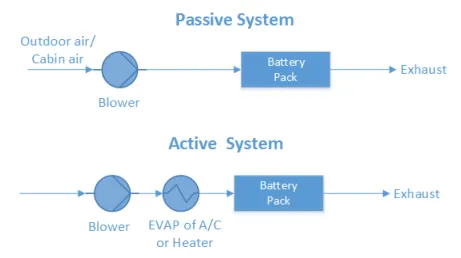
In the passive system, we can see that outdoor air or cabin air is taken in by the blower and supplied directly to the battery pack. The used air becomes hot and is made to exit the air system through an exhaust port. This is the same process used in active systems with the only difference being that the blower will supply the evaporated air of the AC or the heater to the battery pack before leaving through the exhaust.
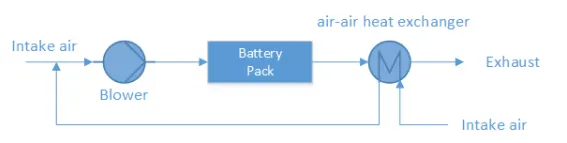
Air systems will provide the main functions of heating, cooling, and ventilation with the exception of insulation. The air leaving through the exhaust port cannot be reused by the air system. With the help of a modification, the air system can be fitted with an air-air heat exchanger to recover the heat from the exhaust air and prevent the exhaust air from mixing with the intake air. This is very useful as it can provide the heating function to warm up a battery if it gets too cold. Also, this feature increases the efficiency of the air system in that the heat removed is used again. The diagram of this modified system is shown below:
Forced air systems are beneficial in that they have good reliability and low maintenance, although they have poor thermal management. During high ambient temperatures, the battery pack operating temperature becomes even greater than that of the ambient temperature and this leads to thermal runaway. The temperature gradient between the ambient air and cells is affected by the flow rate of air out of the forced air systems. At higher flow rates, the maximum temperature difference between the cells increases which influences degradation and a decrease in the working life. Air also has a much lower heat transfer coefficient than water and for it to be able to dissipate as much heat as water can, it needs a higher flow rate which will take up more space and more power.
Liquid cooling and heating
Besides air, the liquid is another heat transfer fluid to transfer heat. There are generally two groups of liquids applied for thermal management systems. One is a dielectric liquid (direct-contact liquid) that can contact the battery cells directly, such as mineral oil. The other is conducting liquid (indirect-contact liquid) which can only contact the battery cells indirectly, such as a mixture of ethylene glycol and water. Depending on the different liquids, different layouts are designed. For direct-contact liquid, the normal layout is to submerge modules in mineral oil. For indirect-contact liquid, a possible layout can be either a jacket around the battery module, discrete tubing around each module, placing the battery modules on a cooling/heating plate, or combining the battery module with cooling/heating fins and plates. Between these two groups, indirect contact systems are preferred in order to achieve better isolation between the battery module and surroundings and thus better safety performance. By different heat-sinks for cooling, liquid systems can also be categorized into either passive systems or active systems.
In a passive liquid system, the heat-sink for cooling is a radiator. This system has no ability to heat. Heat transfer fluid is circulated by the pump within a closed system. The circulating fluid absorbs heat from the battery pack and releases heat via a radiator. The cooling power depends strongly on the temperature between ambient air and battery. Fans behind the radiator can improve the cooling performance, but if the ambient air is higher than the battery temperature or the difference between them is too small, the passive liquid system becomes ineffective.
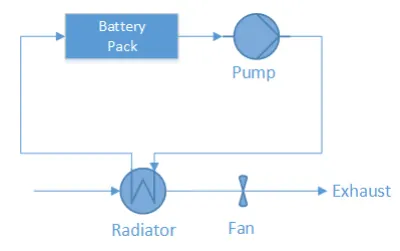
Passive liquid system
In an active liquid system, there are two loops. The upper is called the primary loop and the lower the secondary loop. The primary loop is similar to the loop in a passive liquid system, where the heat transfer fluid is circulated by a pump. The secondary loop is actually an air conditioning loop (A/C loop). The upper heat exchanger instead of being a radiator works as an evaporator (EVAP) for cooling operation and connects both loops. During heating operation, the 4-way valve will be switched, and the upper heat exchanger works as a condenser (COND) and the lower heat exchanger works as an evaporator. The heating operation loop is also called the heat pump loop.
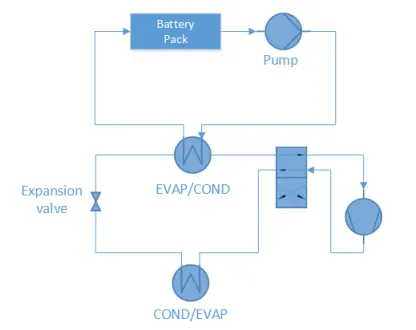
Active liquid system
Potential alternatives
Liquid Immersion
In direct liquid immersion cooling of the battery, the battery cells are entirely immersed in a dielectric heat-transfer fluid (dielectric coolant). This cooling method is also called Single-phase Liquid Immersion Cooling (SLIC). The dielectric coolant is typically circulated with a pump to ensure that it flows continuously throughout the device architecture and comes in continuous contact with all cell walls, tabs, and electrical wiring within the battery module. Direct coolant flow absorbs the heat produced by the cells by direct conduction. It is then transferred to a heat transfer system such as a radiator or heat exchanger to transfer the heat energy to the atmosphere. If the heat load is sufficiently low, battery module cell walls can passively cool it utilizing convective airflow. Full immersion of battery cells also ensures the highest thermal contact and consistency.
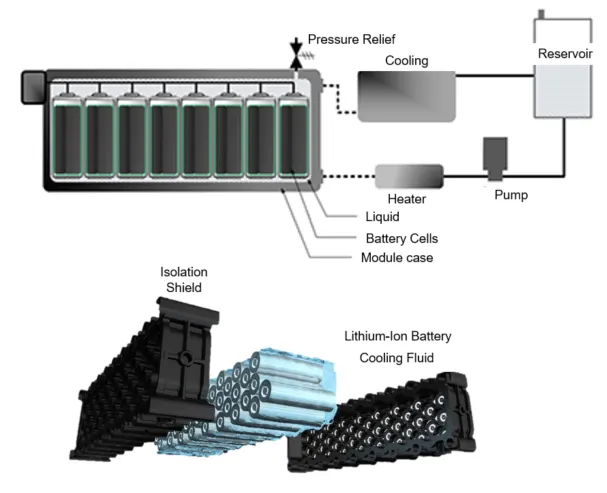
An essential safety benefit of dielectric coolants over water-glycol and other conductive coolants is that they can be brought into direct contact with all device components without causing cell thermal runaway, minimizing electronics failure or user shock risk. Moreover, the safety and environmental problems associated with leakage and disposal of dangerous aqueous glycol coolants are avoided with biodegradable, non-toxic, food-grade rated dielectric liquid coolants.
Companies like M&I Material, Solvay, and 3M have developed specially designed dielectric fluid for EV batteries.