Thermal Management
AIM: Thermal Management
Objective: Prepare a report summarizing thermal management techniques for electric car battery pack.
Why do EVs needs Thermal Management System
EVs use large packs of Li-ion batteries due to their reasonable energy density, power density, and efficiency metrics. During the battery charge/discharge process, current flows within the cells; and depending on the internal resistance, different levels of heat can be generated (especially during rapid charging or extreme driving conditions)
Moreover, Li-ion batteries require an optimum temperature to perform efficiently without any internal and external thermal instability. Temperatures less than 5°C or more than 50°C can lead to significant battery degradation and thermal runaway. A publication in Energy Reports stated that the best operating temperature for Li-ion batteries is 25-40°C, with an internal temperature difference within 5°C. Therefore, a proper battery thermal management system (BTMS) is crucial.
Different cooling methods
BTMS development for EVs accounts for several aspects: cell temperature difference, rise in temperature, energy consumption by the coolant, and the additional weight and size of the cooling system. Different well-studied cooling methods include
Air cooling system:
The lowest cost method for EV battery cooling is with air. A passive air-cooling system uses outside air and the movement of the vehicle to cool the battery. Active air-cooling systems enhance this natural air with fans and blowers. Air cooling eliminates the need for cooling loops and any concerns about liquids leaking into the electronics. The added weight from using liquids, pumps and tubing is also avoided.
The lowest cost method for EV battery cooling is with air. A passive air-cooling system uses outside air and the movement of the vehicle to cool the battery. Active air-cooling systems enhance this natural air with fans and blowers. Air cooling eliminates the need for cooling loops and any concerns about liquids leaking into the electronics. The added weight from using liquids, pumps and tubing is also avoided.
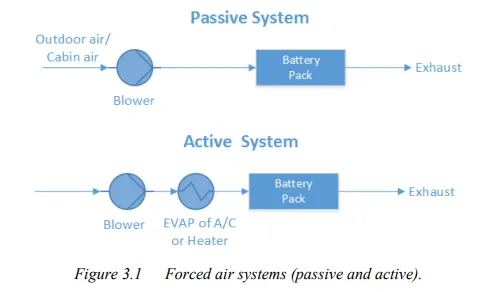
Still, air-cooling solutions have their roles and value. An example is the custom-built Volkswagen EV race car that finished first in the Pikes Peak International Hill Climb in Colorado Springs, Colo. To optimize performance, the car was designed to combine minimum weight, as much downforce as possible, and maximum power. Volkswagen used air-cooling systems to reduce weight. It used thermal software in virtual driving tests along the entire race to ensure the air-cooling system would perform sufficiently.
Liquid cooling system:
Liquid cooling systems provide better battery thermal management because they are better at conducting heat away from batteries than air-cooling systems. One downside is the limited supply of liquid in the system compared with the essentially limitless amount of air that can flow through a battery.
Tesla’s thermal management system (as well as GM’s) uses liquid glycol as a coolant. Both the GM and Tesla systems transfer heat via a refrigeration cycle. Glycol coolant is distributed throughout the battery pack to cool the cells. Considering that Tesla has 7,000 cells to cool, this is a challenge.
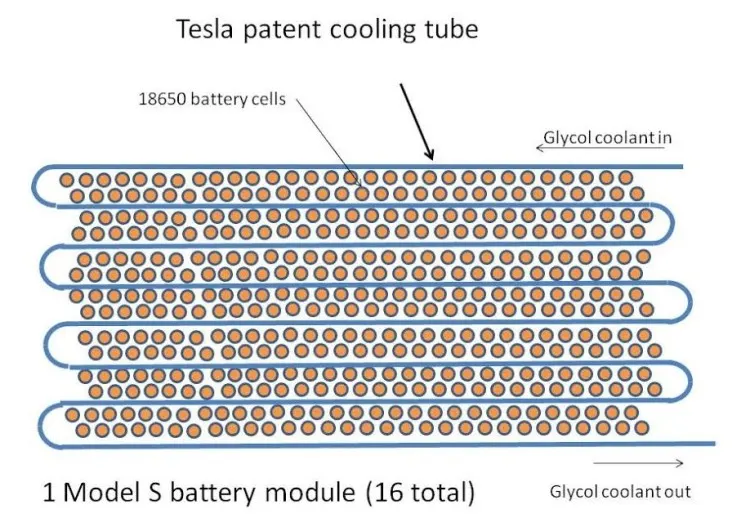
The Tesla Model S battery cooling system consists of a patented serpentine cooling pipe that winds through the battery pack and carries a flow of water-glycol coolant; thermal contact with the cells is through their sides by thermal transfer material.
General Motor’s Chevrolet Volt features a liquid cooling system to manage battery heat. Each rectangular battery cell is about the size of a children’s book. Sandwiched between the cells is an aluminum cooling plate. There are five individual coolant paths passing thru the plate in parallel, not in series as the Tesla system does. Each battery pouch (cell) is housed in a plastic frame. The frames with coolant plates are then stacked longitudinally to make the entire pack.
The liquid cooling system can be direct or indirect. Indirect liquid cooling typically involves circulating a water-glycol mixture through tubing around the battery pack. Several current models (such as Tesla, Chevy Volt, BMW i-3 and i-8, Jaguar I-pace) use this system. The Tesla Model 3 uses a machine assembled tubing (also called “bandolero”), which has significant improvements over the previous models. Audi e-tron has a more sophisticated cooling system for maintaining an optimum battery temperature and cooling the motor parts. It uses 5.8 gallons of coolant circulating through a 40 meter tube in combination with a typical heat pump.
Liquid Immersion
Instead of snaking coolant through lines and chambers within a battery pack’s case, XING Mobility takes a different approach by immersing its cells in a non-conductive fluid with a high boiling point. The coolant is 3M Novec 7200 Engineered Fluid, a non-conductive fluid designed for heat transfer applications, fire suppression and supercomputer cooling.
XING’s batteries take the form of 42 lithium-ion-cell modules that can be put together to build larger battery solutions. The complete XING battery houses 4,200 individual 18,650 lithium-ion cells encased in liquid-cooled module packs
Phase change materials (PCMs)
Phase change material absorbs heat energy by changing state from solid to liquid. while changing phase, the material can absorb large amounts of heat with little change in temperature. Phase change material cooling systems can meet the cooling requirements of the battery pack, however the volume change that occurs during a phase chnage restricts its application.
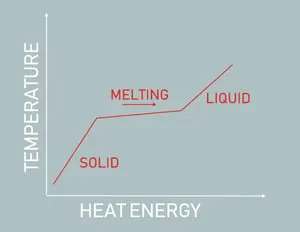
During melting, heat is absorbed by PCM and is stored as latent heat until the latent
heat is up to the maximum. The temperature is kept at melting point for a period and
the temperature increase is delayed. Therefore, PCM is used as conductor and buffer in
battery thermal management systems.