Week - 10 Hyperelastic Material Models
Aim: To calculate the Mooney Rivlin and Ogden material constants and compare the both using stress-strain data from a Dogbone specimen tensile test with 100 percent strain.
Explanation:
The Mooney-Rivlin and Ogden material models are commonly used in the field of nonlinear elasticity to describe the mechanical behaviour of materials, particularly elastomers and rubber-like materials. These models allow engineers and scientists to capture the nonlinear stress-strain response of these materials under deformation. Both models are characterized by material constants that need to be determined experimentally or through other means. Here's an overview of the material constants for each model:
1. **Mooney-Rivlin Material Constants**:
The Mooney-Rivlin model is a strain energy density function commonly used to describe the nonlinear behaviour of rubber-like materials. It is expressed as:

Where:
WMR is the strain energy density function.
C10 and C01 are the material constants.
I1and I2 are the first and second strain invariants, respectively, which are functions of the principal stretches.
For the Mooney-Rivlin model, the material constants need to be determined experimentally. They are related to the material's stiffness and resistance to volumetric changes under deformation.
2. **Ogden Material Constants**:
The Ogden model is another strain energy density function used to describe the nonlinear behaviour of rubber-like materials. It is more versatile than the Mooney-Rivlin model and can capture a wider range of material behaviours. The Ogden model is expressed as:

Where:
- Wo is the strain energy density function.
- µand α are material constants.
- λ are the principal stretches.
- N is the number of terms in the Ogden model, typically chosen based on the desired level of accuracy in describing the material behaviour.
Similar to the Mooney-Rivlin model, the material constants in the Ogden model need to be determined experimentally. These constants govern the material's nonlinear response and its sensitivity to different modes of deformation.
In summary, both the Mooney-Rivlin and Ogden material models require the determination of material constants through experimental testing or other calibration methods. These constants play a crucial role in accurately capturing the nonlinear mechanical behaviour of rubber-like materials.
Theory:
- Hyper elastic materials are the material which has the capability to stretch with more than 100 % strain without any sort of failure.
- These materials are hard to replicate as the strain value are high. These materials have Poisson’s ratio of almost 0.5.
- Various material models like Mooney Rivlin, Ogden, Yeoh etc are used to model these materials.
- These materials can be defined using strain energy vs stretch relations, where strain energy is the area under stress-strain graph.
- Here we will discuss modelling of Mooney Rivlin and Ogden material using the given stress strain data.
PROCEDURE:
1. Import dogbone specimen data.
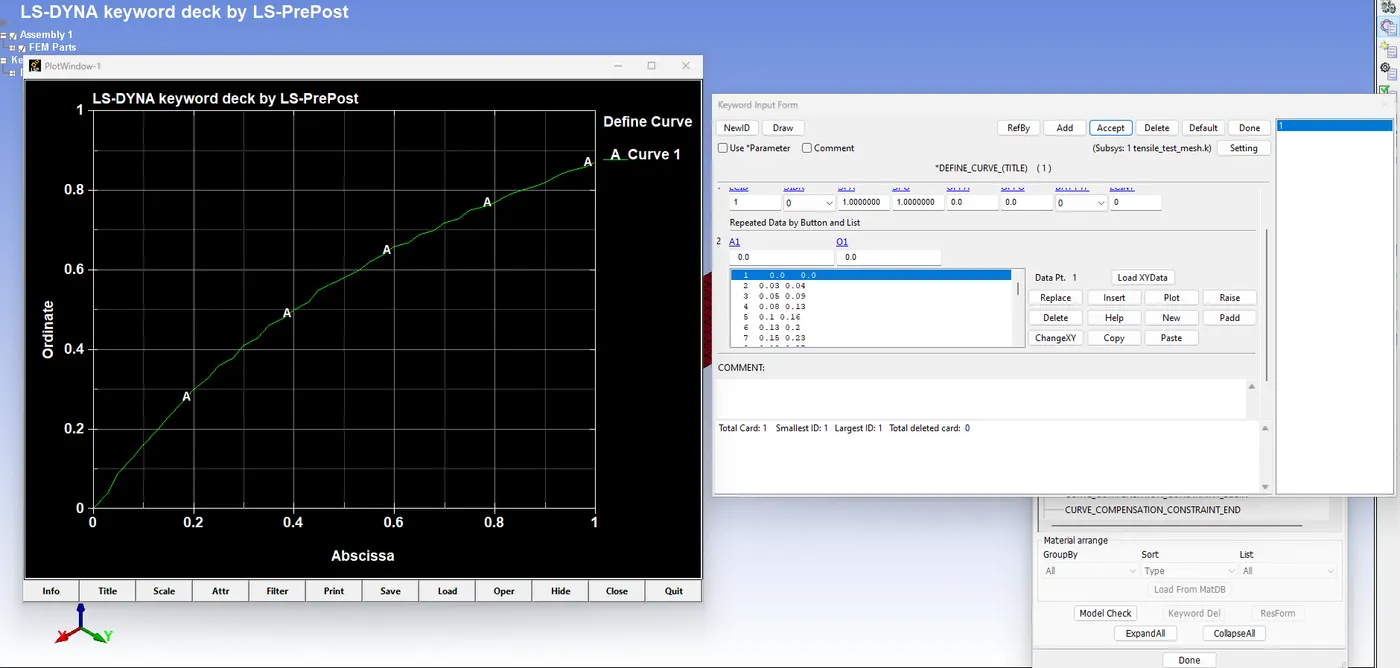
2. For the given experimental data define curve
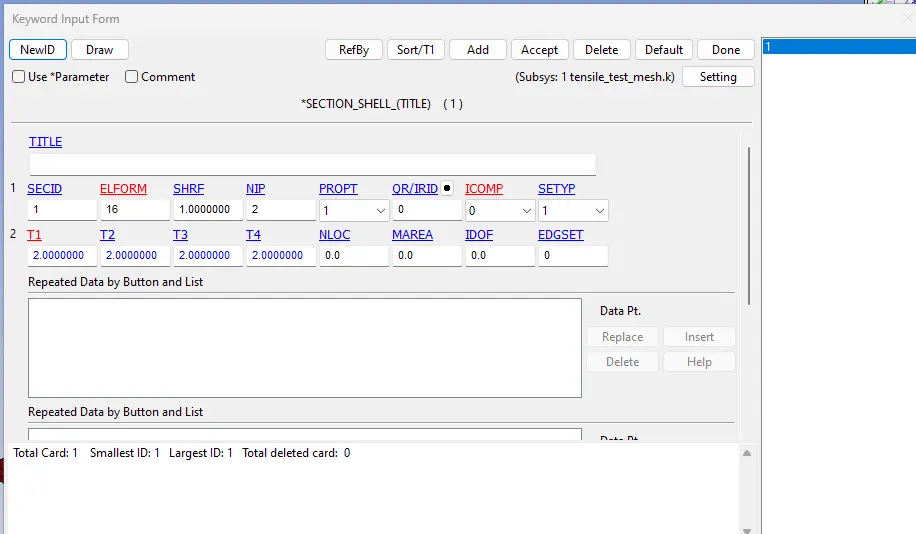
3. create section card
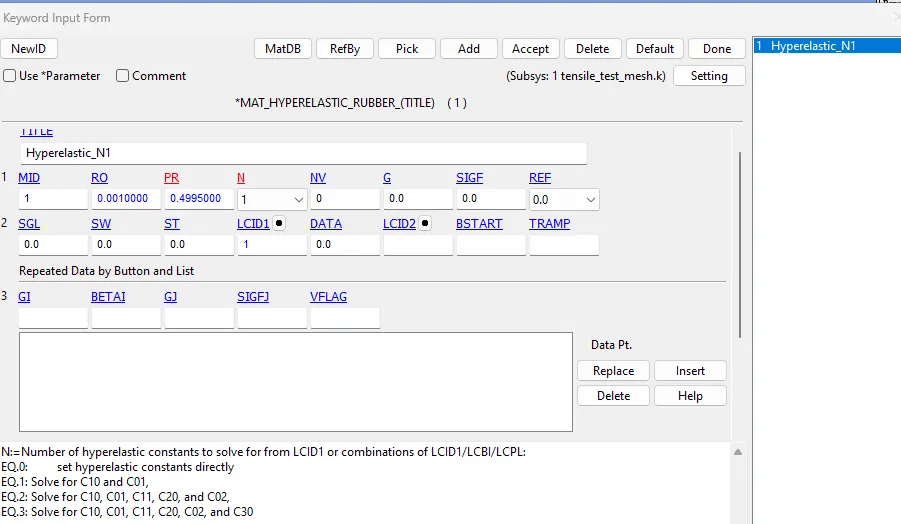
4. Material card for hyper elastic rubber (N=1) and ogden material
5. assign part, set the fixed boundary condition
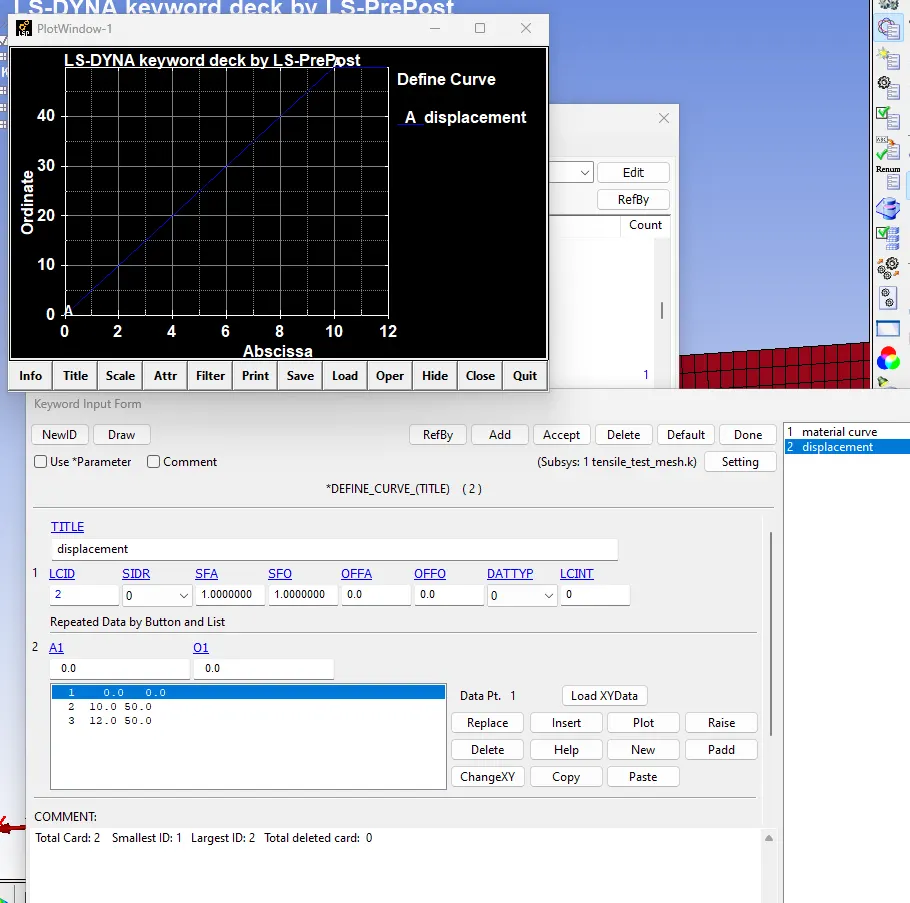
6. Creat curve for deformation
7. create boundary
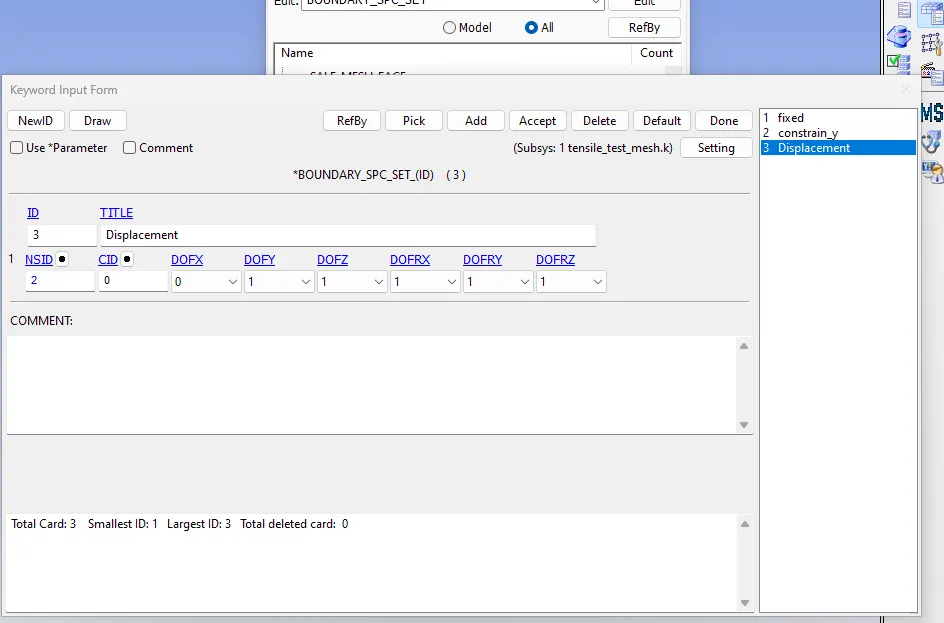
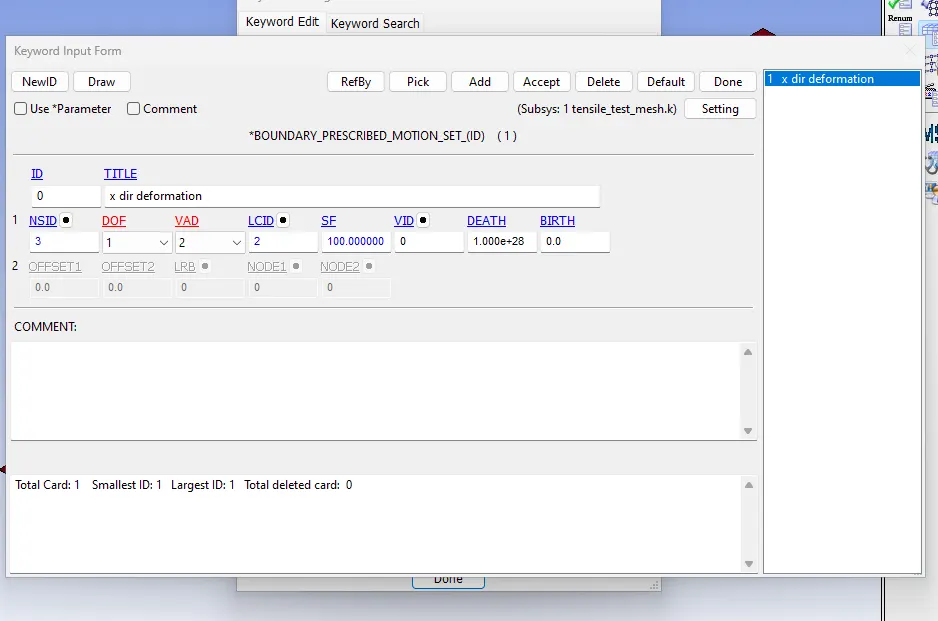
8. Run the simulation
Result
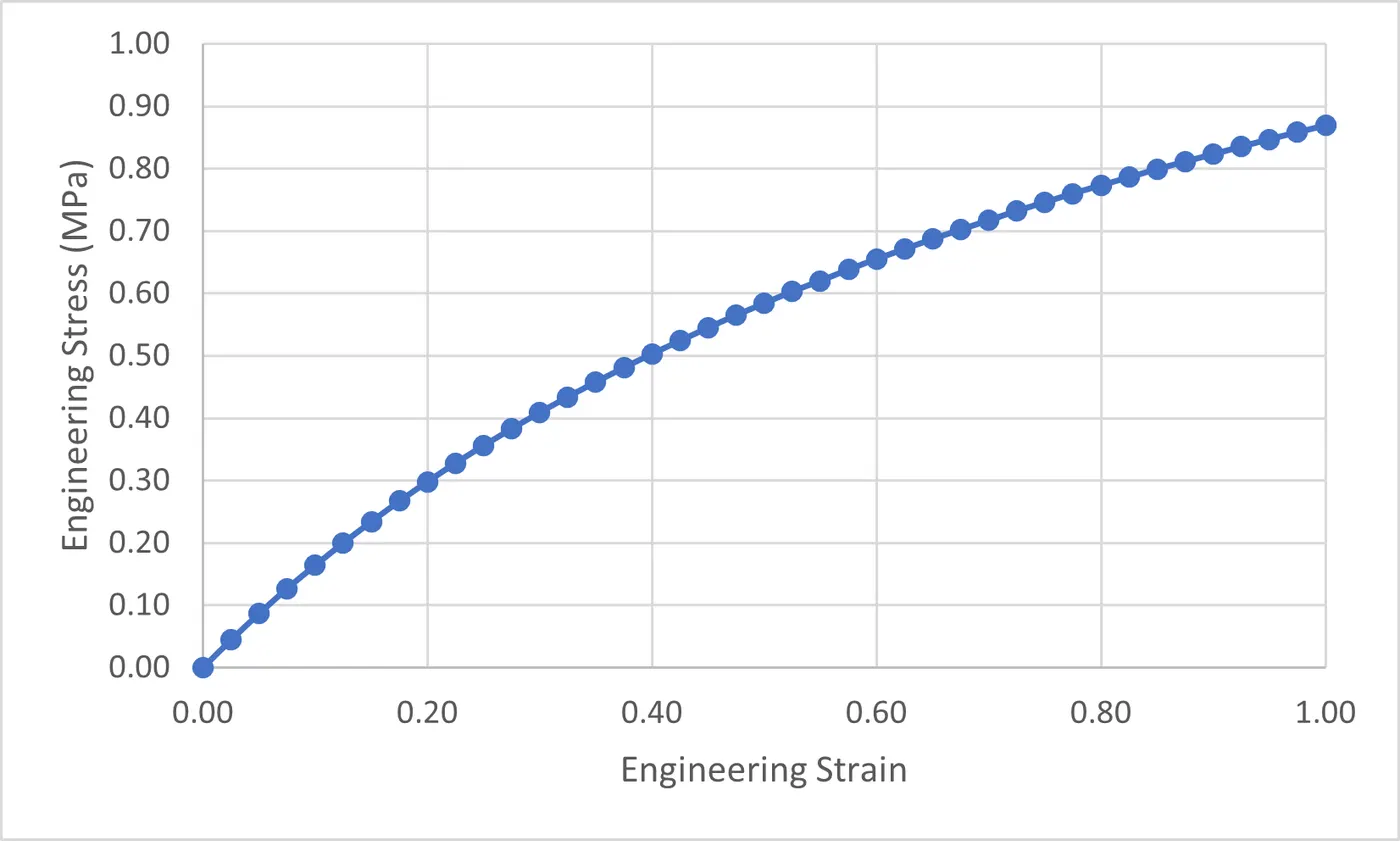
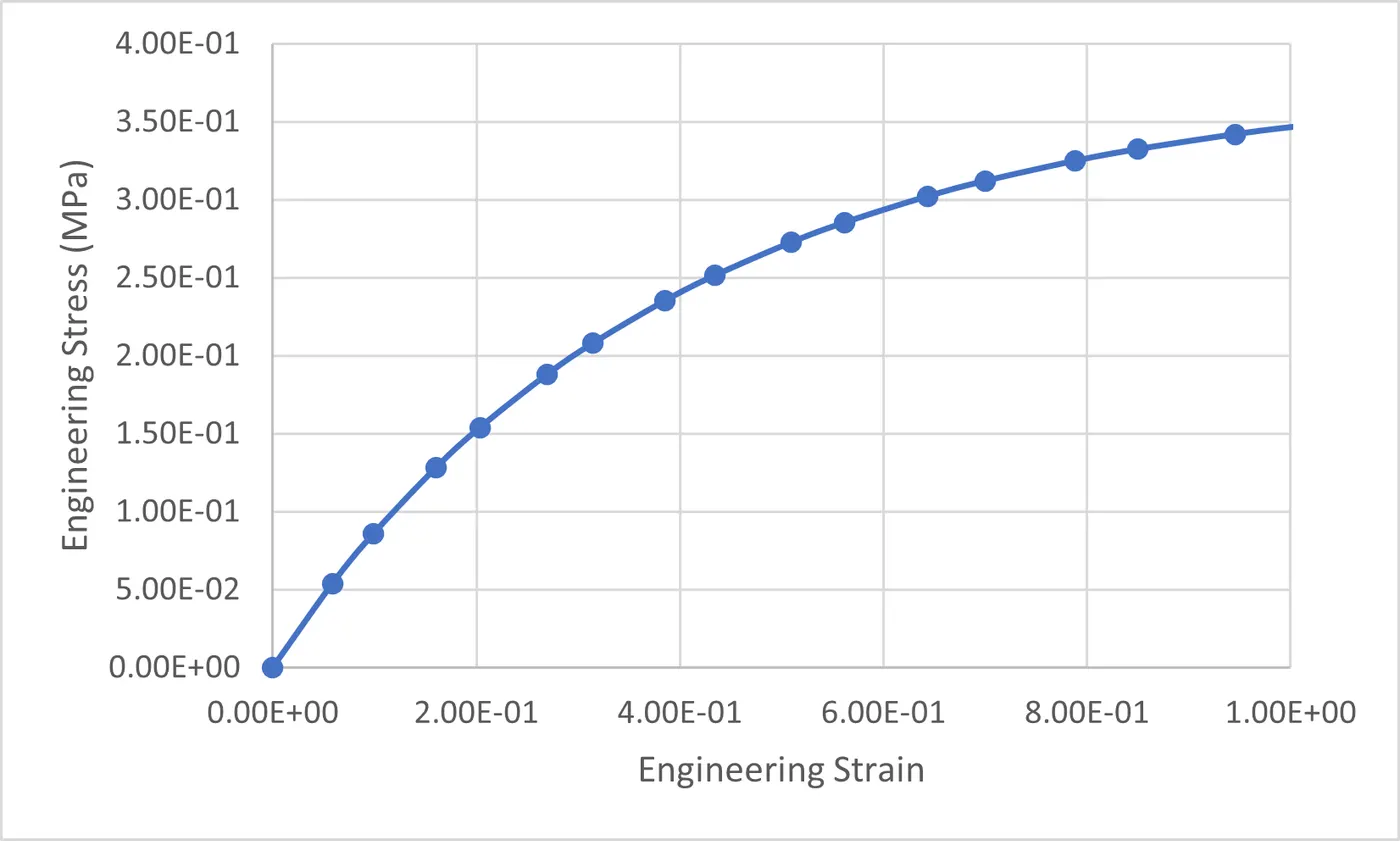
Actual result vs mooney
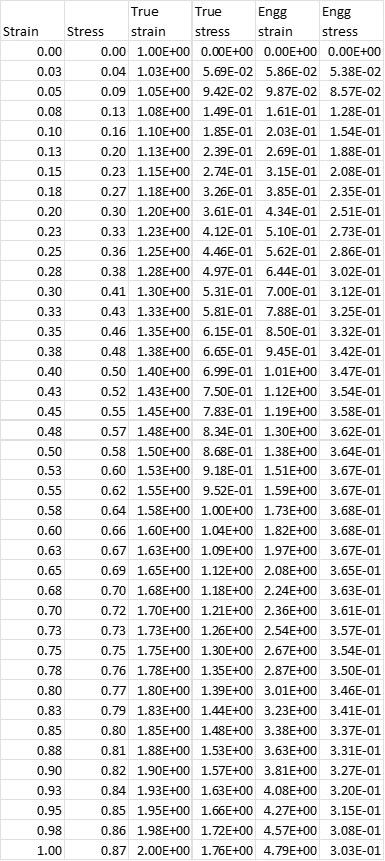
Actual
mooney mat
C1=0.1768
C2=0.1474
ogden material
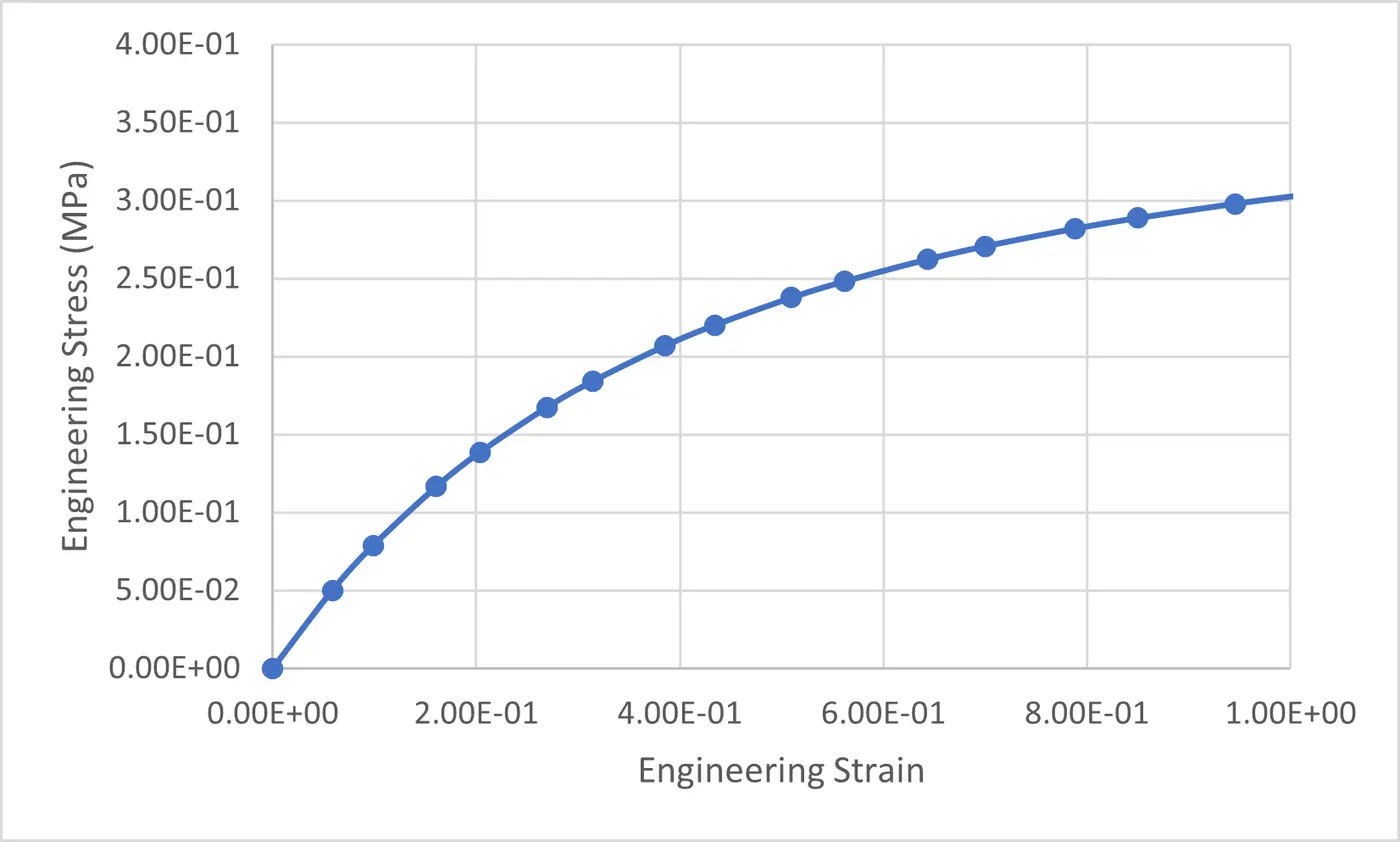
Ogden solution file:
Final approximate solution
mu(1)= 8.7676843462511E-01 alpha(1)= 1.3814348901289E+00
Test and fitted data
stretch ratio stress(input) stress(fitted)
1.0000000E+00 0.0000000E+00 0.0000000E+00
1.0300000E+00 4.0000000E-02 5.2681426E-02
1.0500000E+00 9.0000000E-02 8.5891942E-02
1.0800000E+00 1.3000000E-01 1.3309357E-01
1.1000000E+00 1.6000000E-01 1.6294990E-01
1.1300000E+00 2.0000000E-01 2.0551953E-01
1.1500000E+00 2.3000000E-01 2.3252886E-01
1.1800000E+00 2.7000000E-01 2.7115151E-01
1.2000000E+00 3.0000000E-01 2.9572568E-01
1.2300000E+00 3.3000000E-01 3.3096019E-01
1.2500000E+00 3.6000000E-01 3.5343670E-01
1.2800000E+00 3.8000000E-01 3.8574302E-01
1.3000000E+00 4.1000000E-01 4.0640080E-01
1.3300000E+00 4.3000000E-01 4.3616057E-01
1.3500000E+00 4.6000000E-01 4.5523197E-01
1.3800000E+00 4.8000000E-01 4.8276421E-01
1.4000000E+00 5.0000000E-01 5.0044415E-01
1.4300000E+00 5.2000000E-01 5.2601744E-01
1.4500000E+00 5.5000000E-01 5.4247053E-01
1.4800000E+00 5.7000000E-01 5.6631239E-01
1.5000000E+00 5.8000000E-01 5.8167855E-01
1.5300000E+00 6.0000000E-01 6.0398292E-01
1.5500000E+00 6.2000000E-01 6.1838173E-01
1.5800000E+00 6.4000000E-01 6.3931483E-01
1.6000000E+00 6.6000000E-01 6.5284906E-01
1.6300000E+00 6.7000000E-01 6.7255411E-01
1.6500000E+00 6.9000000E-01 6.8531253E-01
1.6800000E+00 7.0000000E-01 7.0391354E-01
1.7000000E+00 7.2000000E-01 7.1597321E-01
1.7300000E+00 7.3000000E-01 7.3357805E-01
1.7500000E+00 7.5000000E-01 7.4500614E-01
1.7800000E+00 7.6000000E-01 7.6170905E-01
1.8000000E+00 7.7000000E-01 7.7256437E-01
1.8300000E+00 7.9000000E-01 7.8844804E-01
1.8500000E+00 8.0000000E-01 7.9878227E-01
1.8800000E+00 8.1000000E-01 8.1391951E-01
1.9000000E+00 8.2000000E-01 8.2377827E-01
1.9300000E+00 8.4000000E-01 8.3823344E-01
1.9500000E+00 8.5000000E-01 8.4765711E-01
1.9800000E+00 8.6000000E-01 8.6148731E-01
2.0000000E+00 8.7000000E-01 8.7051178E-01
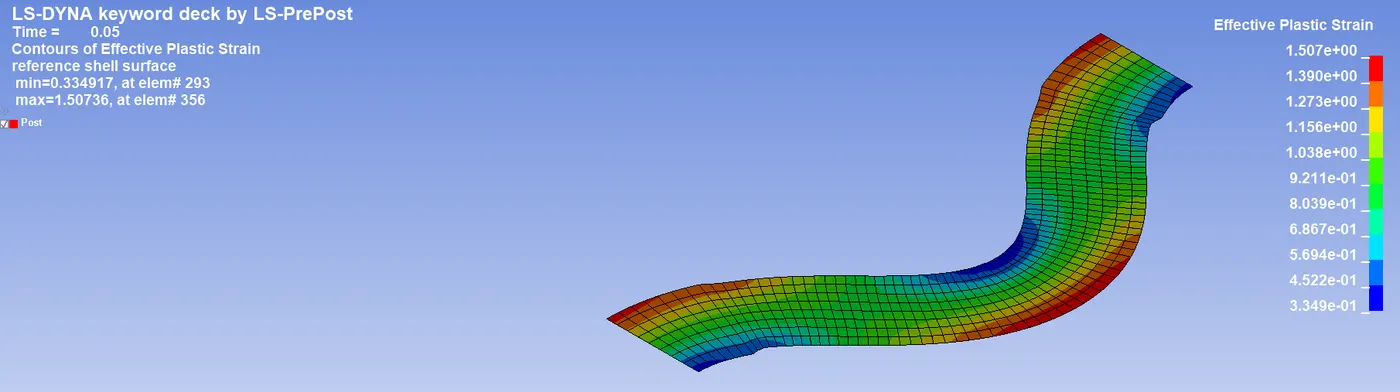
Conclusion
- The Mooney-Rivlin and Ogden material constants are obtained.
- The stretch stress curve data obtained for both hyperelastic constitutive models were verified with experimental material data and found to be a close fit.
- From the simulation results, both hyperelastic constitutive material models were found to be valid to describe the behaviour of the given material data.