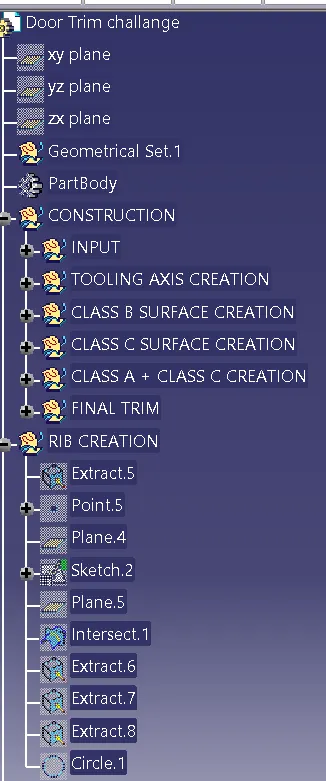
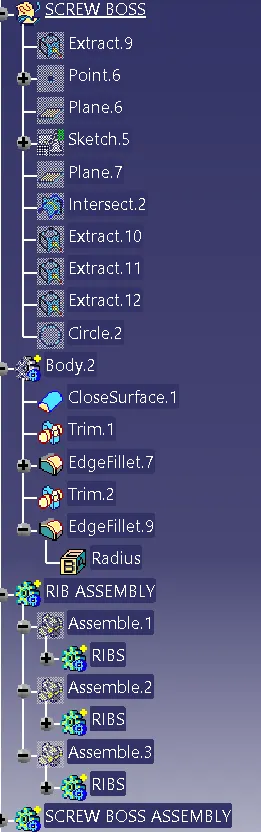
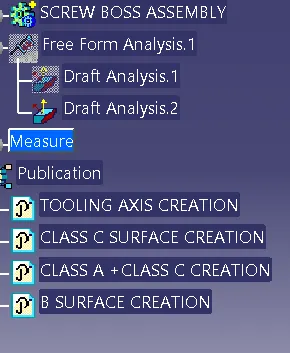
Week 10 - Challenge 1- Attachment Feature Creation (Ribs & Screw Boss)
ANSWER
DRAFT ANALYSIS OF CLASS A SURFACE
It offers recognition based on colour. This allows us to quickly distinguish between surfaces that are clean and those that are stuck using colour change. I've specified a 3-degree draught slope here. The outcome is determined by the surface's color, with green denoting a favourable surface (draft angle > 3 degrees). In cases where the hue is blue, the draught angle ranges from 3 to 0 degrees. You may proceed if this surface area is minimal. Red hue zones indicate that the draught angle is less than 0 degrees. Then, if it's feasible, you'll need to make tooling axes in another manner; if not, you can ask your design engineer to correct the design.
RIB DESIGN
Ribs offer a way to add strength and stiffness to moulded components at a reasonable cost without adding to their overall thickness. They additionally assist
- Locating and stopping assembly pieces.
- Providing alignment for parts that fit together.
- Serving as stops or guides for mechanisms.
Proper Rib design involves many issues which is consider carefully when designing-
- Thickness
- Height
- Location
- Quantity
- Manufacturability
DRAFT ANALYSIS
The Draft Analysis makes it simple for the user to check a component for the correct draught angle. The degree of taper for cast or moulded parts that runs perpendicular to the parting line is referred to as a draught angle. 3D part representations are suitable for draught analysis. The user must select part/surface and pull direction before they can make a draught analysis for any 3D part file. The path of the pull can be altered.
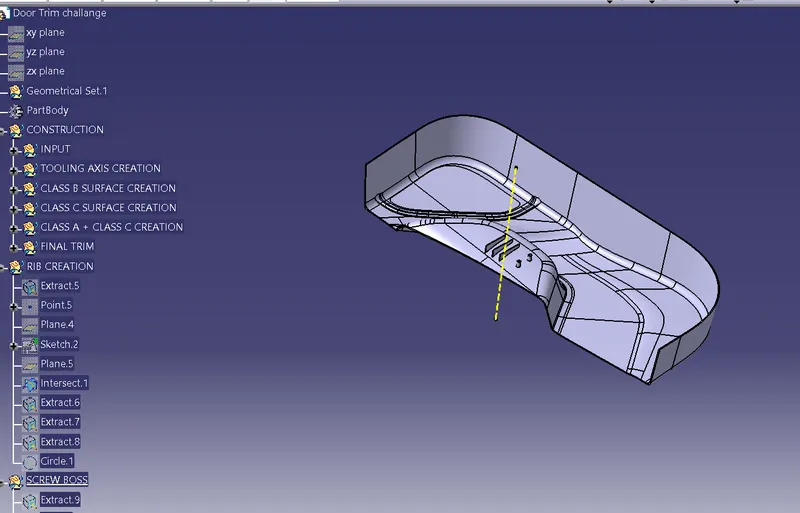
TREE STRUCTURE