Understanding Different Battery Chemistry
1Q.Prepare a table which includes materials & chemical reactions occurring at the anode and cathode of LCO, LMO, NCA, NMC, LFP and LTO type of lithium ion cells.
Ans=>
Lithium-ion battery chemistry :
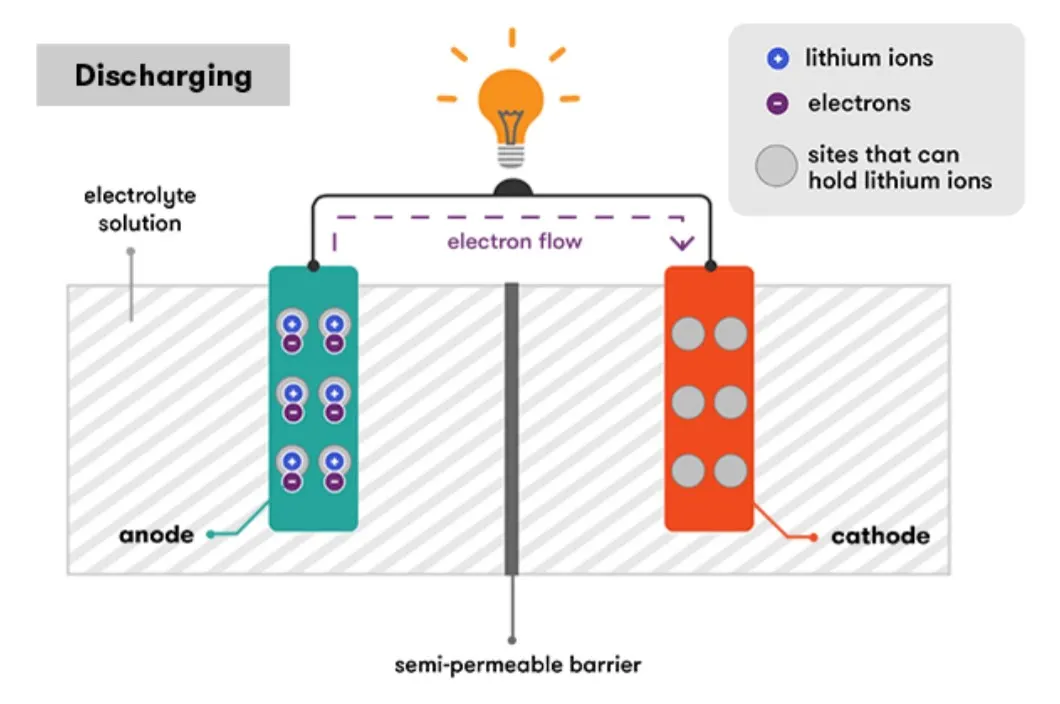
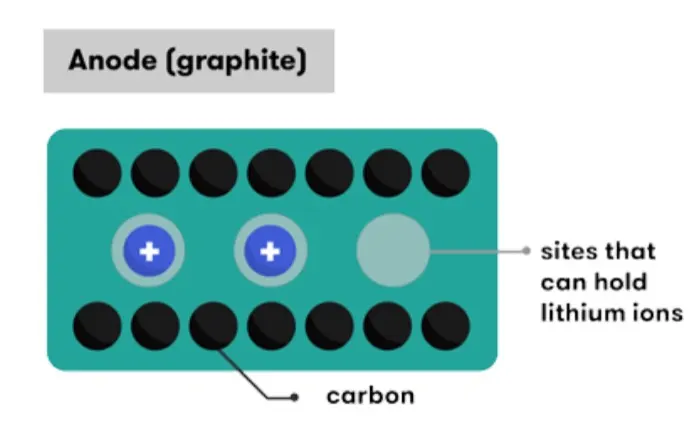
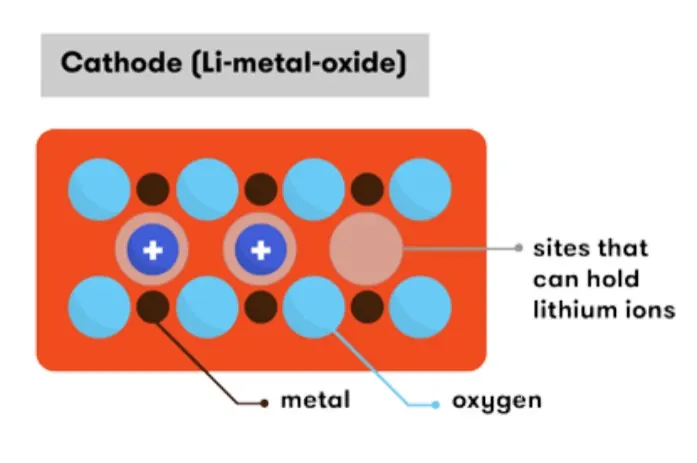
As the name suggests, lithium ions (Li ) are involved in the reactions driving the battery. Both electrodes in a lithium-ion cell are made of materials which can intercalate or ‘absorb’ lithium ions . Intercalation is when charged ions of an element can be ‘held’ inside the structure of a host material without significantly disturbing it. In the case of a lithium-ion battery, the lithium ions are ‘tied’ to an electron within the structure of the anode. When the battery discharges, the intercalated lithium ions are released from the anode, and then travel through the electrolyte solution to be absorbed (intercalated) in the cathode.
A lithium-ion battery starts its life in a state of full discharge: all its lithium ions are intercalated within the cathode and its chemistry does not yet have the ability to produce any electricity. Before you can use the battery, you need to charge it. As the battery is charged, an oxidation reaction occurs at the cathode, meaning that it loses some negatively charged electrons. To maintain the charge balance in the cathode, an equal number of some of the positively charged intercalated lithium ions are dissolved into the electrolyte solution. These travel over to the anode, where they are intercalated within the graphite. This intercalation reaction also deposits electrons into the graphite anode, to ‘tie’ up the lithium ion.
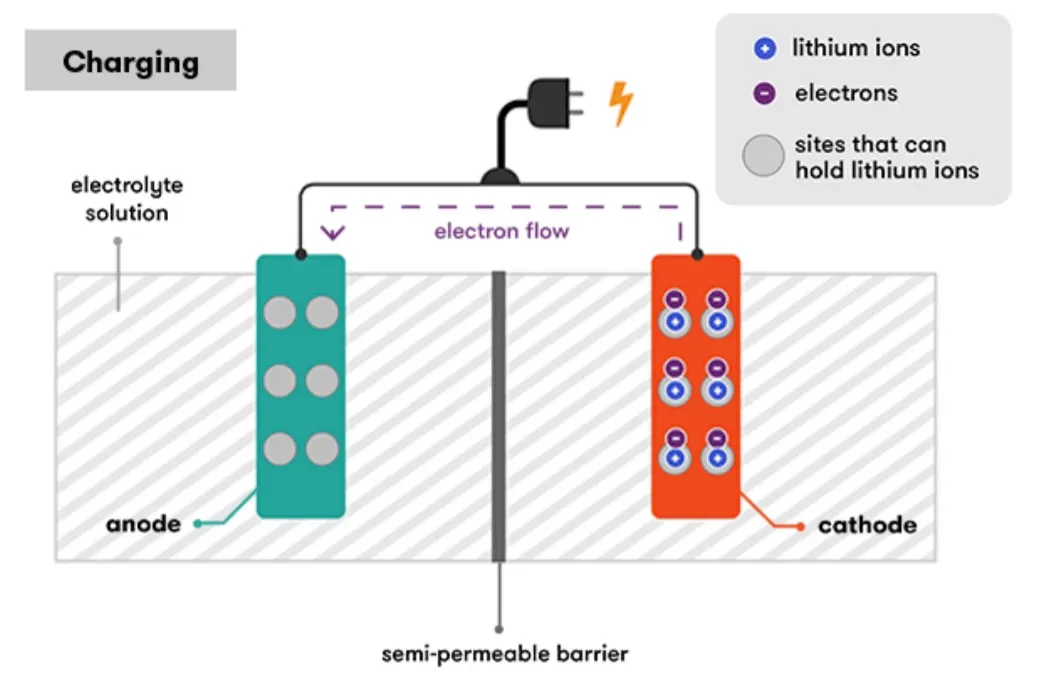
During discharge, the lithium ions are de-intercalated from the anode and travel back through the electrolyte to the cathode. This also releases the electrons that were tying them to the anode, and these flow through an external wire, providing the electric current that we used to do work. It’s the connection of the external wire that enables the reaction to proceed—when the electrons are free to travel, so are the positively charged lithium ions that will balance the movement of their negative charge.
When the cathode becomes full of lithium ions, the reaction stops and the battery is flat. Then we recharge our lithium-ion batteries again, and the external electric charge that we apply pushes the lithium ions back into the anode from the cathode.
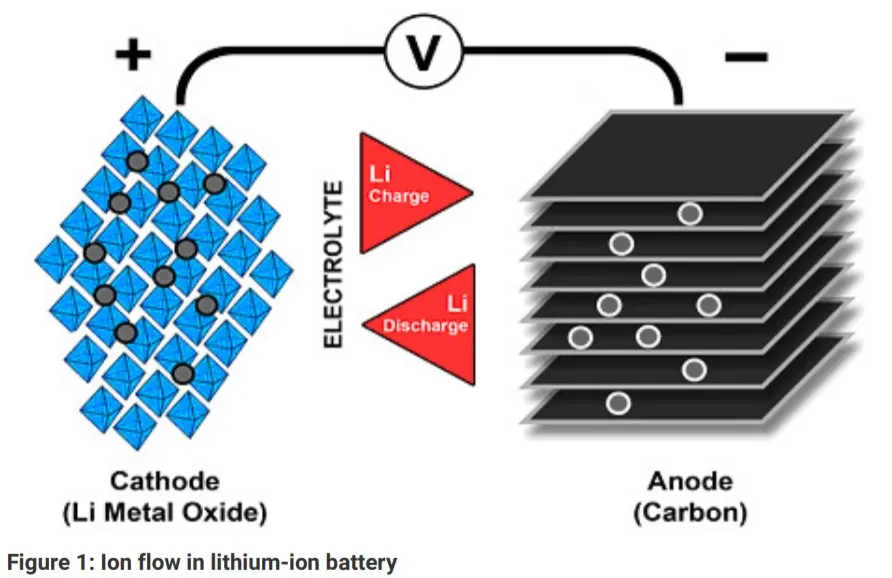
Types of Lithium-ion battery
- Lithium Cobalt Oxide(LiCoO2) — LCO
Its high specific energy makes Li-cobalt the popular choice for mobile phones, laptops and digital cameras. The battery consists of a cobalt oxide cathode and a graphite carbon anode. The cathode has a layered structure and during discharge, lithium ions move from the anode to the cathode. The flow reverses on charge. The drawback of Li-cobalt is a relatively short life span, low thermal stability and limited load capabilities (specific power). Figure 1 illustrates the structure
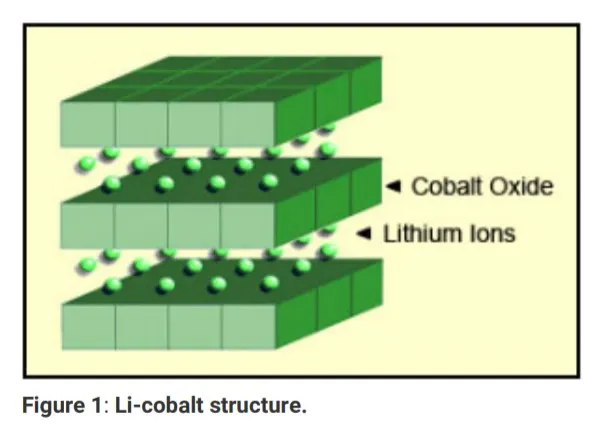
The cathode has a layered structure. During discharge the lithium ions move from the anode to the cathode; on charge the flow is from cathode to anode.
Reaction of LITHIUM COBALT OXIDE BATTERIES :
During Discharge
At the anode, lithium is oxidised.Lithium ions are released from the carbon, along with electrons:
LiC6 ==> xLi+ + xe- + C6
At the cathode, lithium-ions are absorbed by the lithium dioxide, and the electrode is reduced as it also receives the electrons from the circuit:
Li1-xCoO2 + xLi+ + xe- ==> LiCoO2
The overall reaction is :
C6 + LiCoO2 <==> LixC6 + Li1-xCoO2
- Lithium Manganese Oxide (LiMn2O4) — LMO:
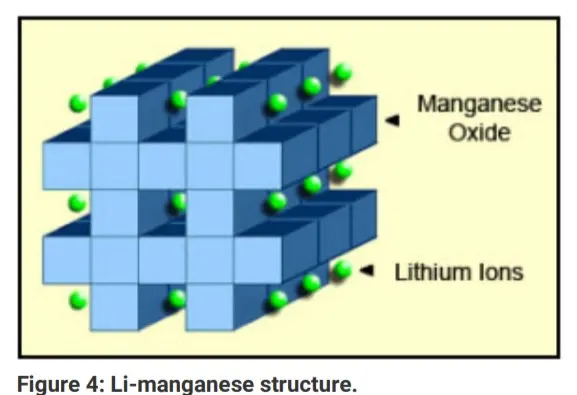
Li-ion with manganese spinel was first published in the Materials Research Bulletin in 1983. In 1996, Moli Energy commercialized a Li-ion cell with lithium manganese oxide as cathode material. The architecture forms a three-dimensional spinel structure that improves ion flow on the electrode, which results in lower internal resistance and improved current handling. A further advantage of spinel is high thermal stability and enhanced safety, but the cycle and calendar life are limited.
Low internal cell resistance enables fast charging and high-current discharging. In an 18650 package, Li-manganese can be discharged at currents of 20–30A with moderate heat buildup. It is also possible to apply one-second load pulses of up to 50A. A continuous high load at this current would cause heat buildup and the cell temperature cannot exceed 80°C (176°F). Li-manganese is used for power tools, medical instruments, as well as hybrid and electric vehicles.
Figure 4 illustrates the formation of a three-dimensional crystalline framework on the cathode of a Li-manganese battery. This spinel structure, which is usually composed of diamond shapes connected into a lattice, appears after initial formation.
Reaction of Lithium Manganese Oxide BATTERIES :
During Discharge
At the anode, lithium is oxidised.Lithium ions are released from the carbon, along with electrons:
LiC6 ==> xLi+ + xe- + C6
At the cathode, lithium-ions are absorbed by the lithium dioxide, and the electrode is reduced as it also receives the electrons from the circuit:
Li1-xMn2O4 + xLi+ + xe- ==> LiMnO2
The overall reaction is :
LiC6 + Mn2O4 <==>C6 + LiMnO2
- Lithium Nickel Manganese Cobalt Oxide (LiNiMnCoO2 ) — NMC
One of the most successful Li-ion systems is a cathode combination of nickel-manganese-cobalt (NMC). Similar to Li-manganese, these systems can be tailored to serve 4,000mAh and higher but at reduced loading capability and shorter cycle life. Silicon added to graphite has the drawback that the anode grows and shrinks with charge and discharge, making the cell mechanically unstable.
The secret of NMC lies in combining nickel and manganese. An analogy of this is table salt in which the main ingredients, sodium and chloride, are toxic on their own but mixing them serves as seasoning salt and food preserver. Nickel is known for its high specific energy but poor stability; manganese has the benefit of forming a spinel structure to achieve low internal resistance but offers a low specific energy. Combining the metals enhances each other strengths.
Reaction of Lithium Manganese Cobalt Oxide BATTERIES :
During Discharge
At the anode, lithium is oxidised.Lithium ions are released from the carbon, along with electrons:
LiC6 ==> xLi+ + xe- + C6
At the cathode, lithium-ions are absorbed by the lithium dioxide, and the electrode is reduced as it also receives the electrons from the circuit:
Li1-xMO2 + xLi+ + xe- ==> LiMO2
The overall reaction is :
Li1-xMO2 + LiC6 <==> Li1-xMO2 + C6
- Lithium Iron Phosphate(LiFePO4) — LFP
This cell has a high discharge rate and, because phosphate (PO ) can cope with high temperatures, the battery has good thermal
stability, improving its safety. This makes it a good choice for things like electric vehicles and power tools, and for storing energy at
power stations. It also has a long cycle life, meaning it can be discharged and charged many times. However, it has a lower energy
density than a lithium cobalt oxide cell, and a higher self-discharge rate.
A lithium iron phosphate battery cell is similar to the lithium cobalt oxide cell. The anode is still graphite and the electrolyte is also
much the same. The difference is that the lithium cobalt dioxide cathode has been replaced with the more stable lithium iron
phosphate. In fact, no lithium or iron ions remain in the iron phosphate (FePO4) cathode of a fully charged cell. The lithium ions can
intercalate into or out of the cathode material through well-defined tunnels in its structure without significantly altering the iron
phosphate framework.
Reaction of Lithium Iron Phosphate BATTERIES :
During Discharge
At the anode, lithium is oxidised.Lithium ions are released from the carbon, along with electrons:
LiC6 ==> xLi+ + xe- + C6
At the cathode, lithium-ions are absorbed by the lithium dioxide, and the electrode is reduced as it also receives the electrons from the circuit:
LiFe(III)PO4 + xLi+ + xe- ==> LiFe(II)PO4
FePO4 + Li+ + e- ==> LiFePO4
The overall reaction is :
LiFePO4 + 6C ==> LiC6 + FePO4
- Lithium Nickel Cobalt Aluminum Oxide (LiNiCoAlO2) — NCA
Lithium nickel cobalt aluminum oxide battery, or NCA, has been around since 1999 for special applications. It shares similarities with NMC by offering high specific energy, reasonably good specific power and a long life span. Less flattering are safety and cost. NCA is a further development of lithium nickel oxide; adding aluminum gives the chemistry greater stability.
High energy and power densities, as well as good life span, make NCA a candidate for EV powertrains. High cost and marginal safety are negatives.
Reaction of Lithium Nickel Cobalt Aluminum Oxide BATTERIES :
During Discharge
At the anode, lithium is oxidised.Lithium ions are released from the carbon, along with electrons:
LiC6 ==> xLi+ + xe- + C6
At the cathode, lithium-ions are absorbed by the lithium dioxide, and the electrode is reduced as it also receives the electrons from the circuit:
Li1-xMO2 + xLi+ + xe- ==> LiMO2
The overall reaction is :
Li1-xMO2 + LiC6 <==> Li1-xMO2 + C6
- Lithium Titanate (Li2TiO3) — LTO
Batteries with lithium titanate anodes have been known since the 1980s. Li-titanate replaces the graphite in the anode of a typical lithium-ion battery and the material forms into a spinel structure. The cathode can be lithium manganese oxide or NMC. Li-titanate has a nominal cell voltage of 2.40V, can be fast charged and delivers a high discharge current of 10C, or 10 times the rated capacity. The cycle count is said to be higher than that of a regular Li-ion. Li-titanate is safe, has excellent lowtemperature discharge characteristics and obtains a capacity of 80 percent at –30°C (–22°F).
LTO (commonly Li4Ti5O12) has advantages over the conventional cobalt-blended Li-ion with graphite anode by attaining zero-strain property, no SEI film formation and no lithium plating when fast charging and charging at low temperature. Thermal stability under high temperature is also better than other Li-ion systems; however, the battery is expensive.
Reaction of Lithium Titanate BATTERIES :
During Discharge
At the anode, lithium is oxidised.Lithium ions are released from the carbon, along with electrons:
Li4Ti5O12 ==> Ti5O12 + 4Li+ + 4e-
At the cathode, lithium-ions are absorbed by the lithium dioxide, and the electrode is reduced as it also receives the electrons from the circuit:
4Mn2O4 + 4Li+ + 4e- ==> 4LiMn2O4
The overall reaction is :
Li4Ti5O12 + 4Mn2O4 <==> 4LiMn2O4 + Ti5O12
2q.
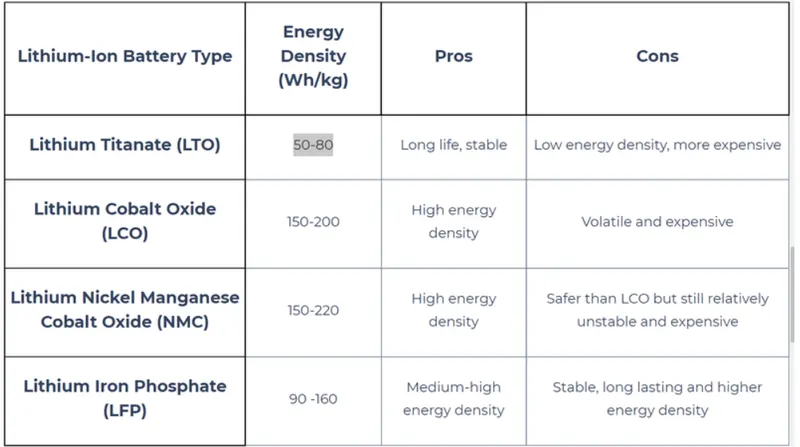
Summary Table=
Lithium ion Types of battery:
| Li-ion types | LCO | LMO | NMC | LFP | NCA | LTO |
| Chemical name | LiCoO2 | LiMn2O4 | LiNiMnCoO2 | LiFePO4 | LiNiCoAlO2 | Li2TiO3 |
| Full form | Lithium Cobalt Oxide | Lithium Manganese Oxide | Lithium Nickel Manganese Cobalt Oxide | Lithium Iron Phosphate | Lithium Nickel Cobalt Aluminum Oxide | Lithium Titanate |
| Anode Material | graphite | graphite | graphite | graphite | graphite | Li2TiO3 (titanate) |
| Cathode Material | LiCoO2 (~60% Co) | LiMn2O4 | LiNiMnCoO2 | LiFePO4 | LiNiCoAlO2 (~9% Co) | Cathode can be lithium manganese oxide or NMC |
| Anode Reaction(Discharge) | LiC6 ==> xLi+ + xe- + C6 | LiC6 ==> xLi+ + xe- + C6 | LiC6 ==> xLi+ + xe- + C6 | LiC6 ==> xLi+ + xe- + C6 | LiC6 ==> xLi+ + xe- + C6 | LiC6 ==> xLi+ + xe- + C6 |
| Cathode Reaction(Discharge) | Li1-xCoO2 + xLi+ + xe- ==> LiCoO2 | Li1-xMn2O4 + xLi+ + xe- ==> LiMnO2 | Li1-xMO2 + xLi+ + xe- ==> LiMO2 | LiFe(III)PO4 + xLi+ + xe- ==> LiFe(II)PO4 | Li1-xMO2 + xLi+ + xe- ==> LiMO2 | 4Mn2O4 + 4Li+ + 4e- ==> 4LiMn2O4 |
| Overall Reaction | C6 + LiCoO2 <==> LixC6 + Li1-xCoO2 | LiC6 + Mn2O4 <==>C6 + LiMnO2 | Li1-xMO2 + LiC6 <==> Li1-xMO2 + C6 | LiFePO4 + 6C ==> LiC6 + FePO4 | Li1-xMO2 + LiC6 <==> Li1-xMO2 + C6 | Li4Ti5O12 + 4Mn2O4 <==> 4LiMn2O4 + Ti5O12 |
| Electrolyte | Ethylene Carbonate | Lithium Halide | Lithium Salt | Ethylene Carbonate | Ethylene Carbonate | Lithium Salt |
| Seperator | Polyolefin | Polyolefin | Polyolefin | Polyolefin | Polyolefin | Polyolefin |
| Nominal Voltage & Operating Range | 3.60V nominal; typical operating range 3.0–4.2V/cell | 3.70V (3.80V) nominal; typical operating range 3.0–4.2V/cell | 3.60V, 3.70V nominal; typical operating range 3.0–4.2V/cell, or higher | 3.20, 3.30V nominal; typical operating range 2.5–3.65V/cell | 3.60V nominal; typical operating range 3.0–4.2V/cell | 2.40V nominal; typical operating range 1.8–2.85V/cell |
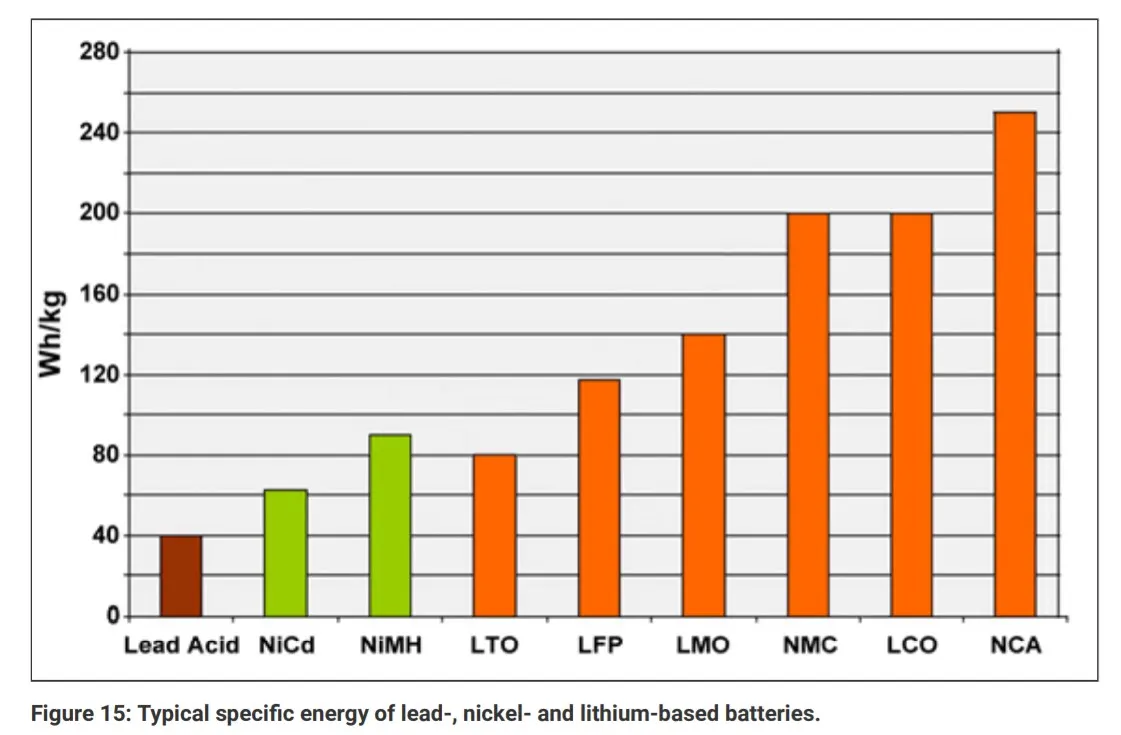
| Energy Capacity | 150–200Wh/kg. Specialty cells provide up to 240Wh/kg | 100–150Wh/kg | 150–220Wh/kg | 90–120Wh/kg | 200-260Wh/kg; 300Wh/kg predictable | 50–80Wh/kg |
| Life Cycle (related to depth of discharge, load, temperature) | 500-1000 | 300-700 | 1000-2000 | 2000 & higher | 500 | 3000-7000 |
| Thermal Runaway(Full charge promotes thermal runaway) | 150°C (302°F). | 250°C (482°F) typical | 210°C (410°F) typical | 270°C (518°F) | 150°C (302°F) typical | One of safest Li-ion batteries |
| Charge (C-rate) | 0.7–1C, charges to 4.20V (most cells); 3h charge typical. Charge current above 1C shortens battery life. | 0.7–1C typical, 3C maximum, charges to 4.20V (most cells) | 0.7–1C, charges to 4.20V, some go to 4.30V; 3h charge typical. Charge current above 1C shortens battery life. | 1C typical, charges to 3.65V; 3h charge time typical | 0.7C, charges to 4.20V (most cells), 3h charge typical, fast charge possible with some cells | 1C typical; 5C maximum, charges to 2.85V |
| Discharge (C-rate) | 1C; 2.50V cut off. Discharge current above 1C shortens battery life. | 1C; 10C possible with some cells, 30C pulse (5s), 2.50V cut-off | 1C; 2C possible on some cells; 2.50V cut-off | 1C, 25C on some cells; 40A pulse (2s); 2.50V cut-off (lower that 2V causes damage) |
1C typical; 3.00V cut-off; high discharge rate shortens battery life | 10C possible, 30C 5s pulse; 1.80V cut-off on LCO/LTO |
| Applications | Mobile phones, tablets, laptops, cameras | Power tools, medical devices, electric powertrains | E-bikes, medical devices, EVs, industrial | Portable and stationary needing high load currents and endurance | Applications Medical devices, industrial, electric powertrain (Tesla) | UPS, electric powertrain (Mitsubishi i-MiEV, Honda Fit EV), solar-powered street lighting |
| Comments | Very high specific energy, limited specific power. Cobalt is expensive. Serves as Energy Cell. Market share has stabilized. | High power but less capacity; safer than Li-cobalt; commonly mixed with NMC to improve performance. |
Provides high capacity and high power. Serves as Hybrid Cell. Favorite chemistry for many uses; market share is increasing. |
Very flat voltage discharge curve but low capacity. One of safest Li-ions. Used for special markets. Elevated self-discharge. |
Shares similarities with Li-cobalt. Serves as Energy Cell. | Long life, fast charge, wide temperature range but low specific energy and expensive. Among safest Li-ion batteries . |
Definitions:
Energy density is how much of energy a battery contains in proportion to its weight. This measurment is typiclally presented in watt-hours per kilogram(Wh/kg).
Specific energy or massive energy is energy per unit mass. It is also called as Gravimetric energy density or just energy density thoughenergy density more precisely means energy per unit volume.
Cycle- Each round of full discharge to full charge is one cycle.
Capacities - Batteries have different ratings for the amount of power given battery can store. When a battery is fully charged the capacity is the amount of power it contains.
Nominal Cell Voltage- The avg voltage of a cell outputs when charged. The nominal voltage of the battery dpends on the chemical reaction behind it
Shape- Batteries cam in many sizes and shapes.The term 'AA' references a specific shape and style of a cell.
Primary and Secondary- Primary batteries are synonymus with disposable. Once fully-drained primary cells can't be recharged. Secondary batteries are better known as rechargeable.These require another power house to fully charge backup.
Internal discharge rate- The rate at which battery discharges overtime itself is called internal discharge rate.
Safety- Because batteries store power, they are basically very tiny explosives. To prevent harm batteries are designed to be harmless as possible.