Week 1 Understanding Different Battery Chemistry
Objective:
Study of different materials and chemical reactions occurring at the anode and cathode of LCO, LMO, NCA, NMC LFP and LTO type of lithium ion cells.
Tabulate the difference between each type of lithium ion batteries based on their characteristics
Theoretical study:
Lithium ion Battery:
Lithium (Li0 is the third lightest material with atomic number 3. It is a soft and silvery white alkali metal that reacts with organic and inorganic reactants in many ways.
As lithium is not found freely in nature, lithium is mined from hard rocks and underground brine deposits. Spodumene is the most important lithium ore.
A lithium ion battery is a rechargeable battery that can be charged as power source for electronic devices and electric vehicles.
A lithium ion battery’s chemical composition plays a pivotal role in making the battery powerful, resilient and safe for wide variety of applications. Based on the chemical composition the lithium ion batteries are classified as,
- Lithium cobalt oxide or LCO (LiCoO2)
- Lithium Manganese oxide or LMO (LiMn2O4)
- Lithium Nickel Manganese cobalt oxide or NMC (LiNiMnCoO2)
- Lithium Nickel Cobalt Aluminium Oxide or NCA (LiNiCoAlO2)
- Lithium Iron Phosphate LFP (LiFePO4)
- Lithium Titanate or LTO (Li2TiO3)
Lithium cobalt oxide or LCO (LiCoO2)
Known since 1991
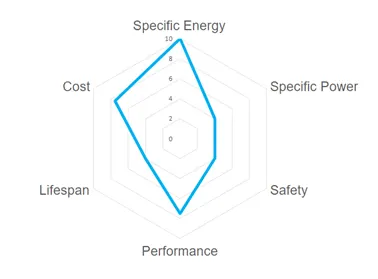
It is also known as a “Lithium cobaltate or Lithium ion cobalt battery”. A lithium cobalt oxide battery has a graphite carbon anode and a cobalt oxide cathode with a layered structure for ion movement. The lithium cobalt battery’s high specific energy makes it a popular choice for consumer electronics.
Limitations include low specific power, low safety, and low lifespan.
Lithium Manganese oxide or LMO (LiMn2O4)
Known since 1996
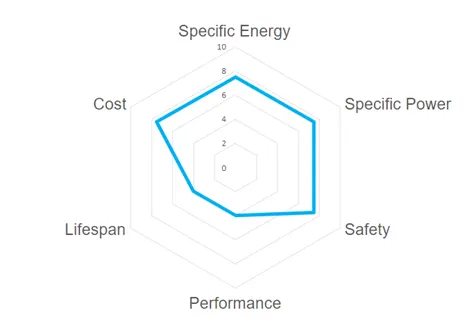
Commonly known as “Lithium Manganite, Lithium ion manganese and manganese spinel”. LMO battery architecture forms a three dimensional spinel structure or cathode crystalline framework of lithium manganese oxide that appears after initial formation.
Li Manganese designs have been successful in maximizing the battery for improved lifespan, safety and specific power. As blending the battery chemistries improves the lifespan and specific energy.
Lithium Nickel Manganese cobalt oxide or NMC (LiNiMnCoO2)
Known since 2008
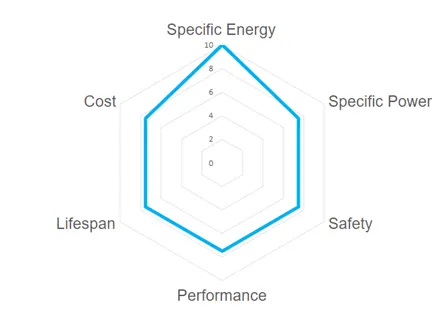
A NMC battery has one of the most successful Li ion cathode combinations of nickel manganese cobalt.
Combining the individual competencies of nickel and manganese makes the NMC battery the preferred choice for e bikes power tools and other electric powertrains.
Lithium Nickel Cobalt Aluminium Oxide or NCA (LiNiCoAlO2)
Known since 1999
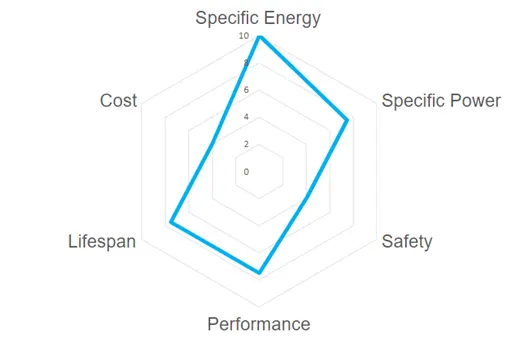
NCA batteries are commonly used for EV powertrains owing to their high specific energy, Impressive specific power and a relative long lifespan. NCA’s main disadvantages are cost, safety and recent supply chain issues.
The NCA battery gains greater stability with the addition of aluminium. In a study NCA was found to have the highest specific energy. NCA can deliver a relatively high amount of current for extended periods. However significant drawback is the low level safety.
Lithium Iron Phosphate LFP (LiFePO4)
Known since 1996
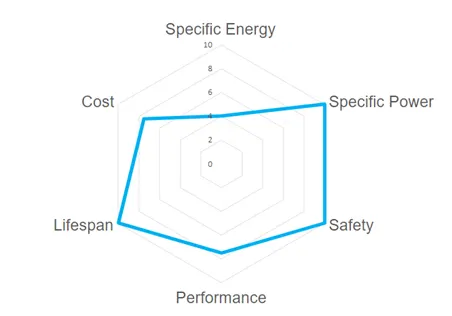
The discovery of phosphate as a cathode material in 1996 led to development of rechargeable lithium batteries with one of the well-known battery material.
The battery’s lower nominal voltage reduces the specific energy below that of cobalt blended lithium ion battery. LFP batteries are mainly used for energy storage and other applications that require a higher level of safety, a large amount of power and a long lifespan.
Lithium Titanate or LTO (Li2TiO3)
Known since 2008
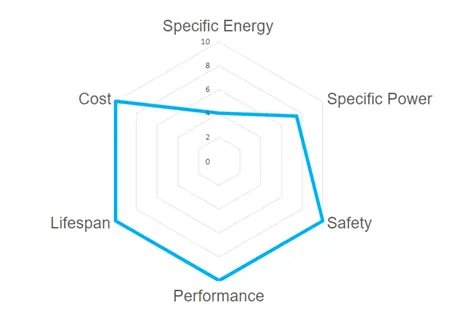
The lithium titanate battery is one of the safety Li ion batteries with excellent performance. Compared to conventional cobalt blended Li ion battery, and LTO battery exhibits zero strain property.
In an LTO battery Li titanate replaces the graphite in the anode while lithium manganese oxide or NMC acts as the cathode material. Other notable feature includes thermal stability under high temperature, fast charging and a high discharge current.
Advantages and disadvantages of Li ion Battery
|
Advantages |
Disadvantages |
|
Light weight battery |
Risky sourcing of lithium |
|
Impressive high energy density |
Extraction is unable to meet the growing demand |
|
High adaptability |
Expensive from other batteries |
|
As there is no memory effect, no need to fully drain |
Temperature sensible battery |
|
Withstand greater number of charge/discharge cycles |
Flammable liquid electrolyte may lead to explosion |
|
Low self-discharge rate |
Highly fragile with a risk of perforation |
|
Easy maintenance |
Difficult transportation |
|
Slow loss of charge when not in use |
Need protection circuitry to maintain safe charging. |
|
Have a long lifespan |
Improper disposal may lead to environmental contamination. |
Materials and chemical reactions of different lithium ion batteries
|
Type |
Chemical Name |
Cathode Material |
Anode Material |
Chemical reactions |
|
Lithium Cobalt Oxide (LCO) |
LiCoO2 |
Lithium Cobalt Oxide |
Graphite Carbon |
 |
|
Lithium ion Manganese oxide (LMO) |
LiMn2O4 |
Lithium Manganese Oxide |
Graphite Carbon |
 |
|
Lithium Nickel cobalt aluminium oxides (NCA) |
LiNiCoAlO2 |
Lithium Nickel cobalt aluminium oxide |
Graphite Carbon |
 |
|
Lithium Nickel Manganese Cobalt oxides (NMC) |
LiNiMnCoO2 |
Lithium Nickel Manganese Cobalt oxide |
Graphite Carbon |
 |
|
Lithium Iron Phosphate (LFP) |
LiFePO4 |
Lithium Iron Phosphate |
Graphite Carbon |
 |
|
Lithium Titanite Oxide (LTO) |
Li2TiO3 |
Manganese Oxide |
Graphite Carbon |
 |
Comparison between the Batteries
|
Specification/Battery |
LCO |
LMO |
NCA |
NMC |
LFP |
LTO |
|
Voltage |
3.6 V Nominal |
3.7 V Nominal |
3.6V Nominal |
3.6-3.7 V Nominal |
3.2-3.3 V Nominal |
2.4 V Nominal |
|
Specific energy (Capacity) |
150-200Wh/Kg |
100-150Wh/Kg |
200-260Wh/Kg |
150-220Wh/Kg |
90-120Wh/Kg |
50-80Wh/Kg |
|
Charge (C-Rate) |
0.7-1C |
0.7-1C |
0.7C |
0.7-1C |
1C |
1C |
|
Discharge (C-Rate) |
1C |
1C |
1C |
1C |
1C |
10C |
|
Cycle Life |
500-1000 |
300-700 |
500 |
1000-2000 |
2000 and higher |
3000-7000 |
|
Thermal runaway |
150⁰ C |
250⁰ C |
150⁰ C |
210⁰ C |
270⁰ C |
One of the safest Li ion batteries |
|
Applications |
Phone, tablets, laptop etc |
Power tools, medical devices |
Medical devices, Industrial, EVs (Tesla) |
E bikes, medical devices |
Portable and stationary needs high load current |
UPS, electric powertrain, Solar powered street lights |
Conclusions:
The study investigated 6 different types of lithium ion batteries. The classification is based on cathode materials. All battery types are listed and studied in details.
Advantages and disadvantages are listed. Comparison between the battery types are charted.
References:
- https://batteryuniversity.com/article/bu-205-types-of-lithium-ion
- https://www.targray.com/li-ion-battery/cathode-materials/cathode-active-materials
- https://www.blackridgeresearch.com/blog/what-is-a-lithium-ion-battery-what-are-the-types-of-lithium-ion-battery-chemistries
- https://www.science.org.au/curious/technology-future/lithium-ion-batteries
The detailed report is attached in pdf format.