Week 1 Understanding Different Battery Chemistry
Understanding Different Battery Chemistry
1. Prepare a table which includes materials & chemical reactions occurring at the anode and cathode of LCO, LMO, NCA, NMC, LFP and LTO type of lithium ion cells. Give your detailed explanation on it.
Ans.
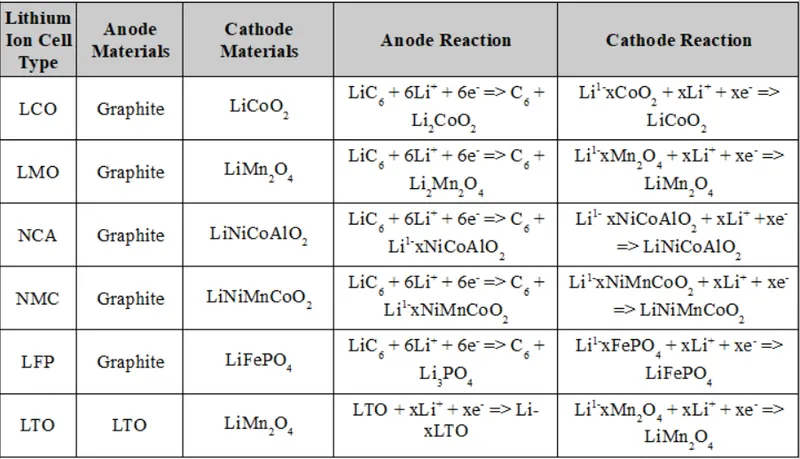
The negative electrode in a lithium-ion battery is the anode, and the positive electrode is the cathode. Different chemical processes take place at the anode and cathode during the charging and discharging process.
Graphite serves as the anode and LiCoO2 serves as the cathode in an LCO cell. Lithium ions move from the anode to the cathode during discharge, where they combine with the cathode substance to form Li1-xCoO2. As lithium ions and released electrons from the graphite anode combine, LiC6 is created.
Graphite serves as the anode while LiMn2O4 serves as the cathode in LMO cells. Lithium ions migrate from the anode to the cathode during discharge, where they interact with the cathode substance to create LiMn2O4. As lithium ions and electrons are released from the graphite anode mix, LiC6 is created.
Graphite serves as the cathode material and LiNiCoAlO2 serves as the anode material in NCA cells. Lithium ions migrate from the anode to the cathode during discharge, where they interact with the cathode substance to create LiNiCoAlO2. Li1-xNiCoAlO2 is created when lithium ions mix with released electrons from the graphite anode.
Graphite serves as the anode and LiNiMnCoO2 serves as the cathode in NMC cells. Lithium ions migrate from the anode to the cathode during discharge, where they interact with the cathode substance to generate LiNiMnCoO2. Electrons are released by the graphite anode in the interim.
2. Compare the differences between each type of Li+ion batteries based on their characteristics.
Ans. There are several types of lithium-ion batteries available in the market, and each type has its own set of characteristics. Here are the key differences between the six types of lithium-ion batteries mentioned earlier in terms of their characteristics:
-
LCO (Lithium Cobalt Oxide): This type of battery offers high energy density, which means it can store a lot of energy in a small space. It is also relatively inexpensive and has a long cycle life. However, it can be unstable and is prone to overheating, which can lead to safety issues.
-
LMO (Lithium Manganese Oxide): LMO batteries have a lower energy density than LCO batteries, but they are more stable and safer to use. They are also less expensive and have a longer cycle life. However, their power density is lower, which means they cannot deliver as much power as LCO batteries.
-
NCA (Lithium Nickel Cobalt Aluminum Oxide): NCA batteries offer higher energy density than LCO and LMO batteries and can deliver high power. They also have a longer cycle life and are more stable than LCO batteries. However, they are more expensive and have a lower power density than LCO batteries.
-
NMC (Lithium Nickel Manganese Cobalt Oxide): NMC batteries are similar to NCA batteries in terms of their characteristics, but they are less expensive and have a higher power density. They also have a longer cycle life and are more stable than LCO batteries.
-
LFP (Lithium Iron Phosphate): LFP batteries have a lower energy density than LCO, LMO, NCA, and NMC batteries, but they are more stable and safer to use. They are also less expensive and have a longer cycle life. However, their power density is lower, which means they cannot deliver as much power as other types of batteries.
-
LTO (Lithium Titanate Oxide): LTO batteries have a low energy density and a high-power density, which means they can deliver high power but cannot store as much energy as other types of batteries. They are also more stable and safer to use and have a longer cycle life. However, they are more expensive than other types of batteries.
In summary, the choice of lithium-ion battery type depends on the specific application and the trade-off between energy density, power density, cycle life, stability, and cost. LCO and NCA batteries are suitable for high-performance applications that require high energy density and high power, while LFP and LMO batteries are suitable for applications that require high safety and long cycle life. NMC and LTO batteries offer a balance between energy density and power density and are suitable for a wide range of applications.