Week 1 Understanding Different Battery Chemistry
1.
Li-io Batteries -
Lithium ion batteries are rechargeable batteries and commonly used in portable electronics and automotive applications. Lithium ion batteries has consists of anode(Negative electrode), Cathode (Positive positive), electrolyte, and separator. The cathode is metal oxide and anode consists of porus carbon or mettalide alloys.
Working of Lithium ion battery-
During Charging - Anode is a negative electrod and consists of lithium metal oxide and cathode is a negative electrode and consisits of graphite for insance, When charging the lithium battery, Limo2 will be separated and forms as lithium ion and metal oxide and electrons. Electrons will flows through the cirtcuit path or through opposite direction to conventional current and Lithium ions flows throughs separtaor untill it reaches to anode and in anode the electrons and lithium ions combines and forms lithiated graphite. In this way battery will gets charge.
During Discharging - When load connected to the lithium ion battery, Litoiated graphite at cathode will be separated and froms as pgraphite and lithium ion and electrons and lithium ions will flow through the separator and reaches to anode and electrons will flow through the load or opposite direction to current and at anode metal oxide combiles with Li+ ions and elecrons and forms as Lithium metal oxide and in this battery gets discharging.
In simple way, During dicharge,Lithium ions and electrons flow from anode to cathode
During charge, Lithium ions and elecrons flows from cathode to anode and this is common for all types of lithium ion batteries
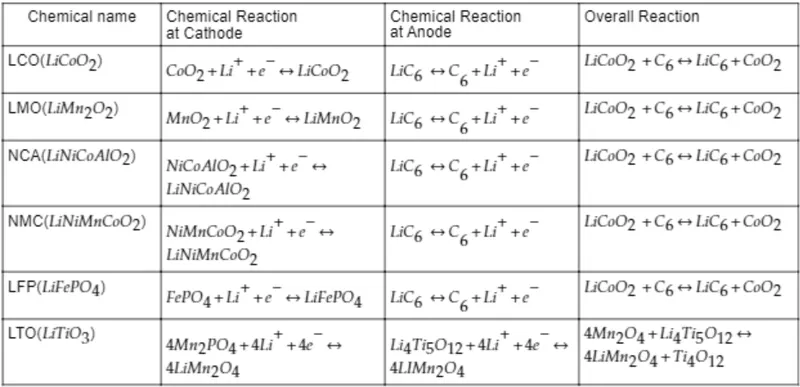
2.Differencebetween different types of lithium ion batteries
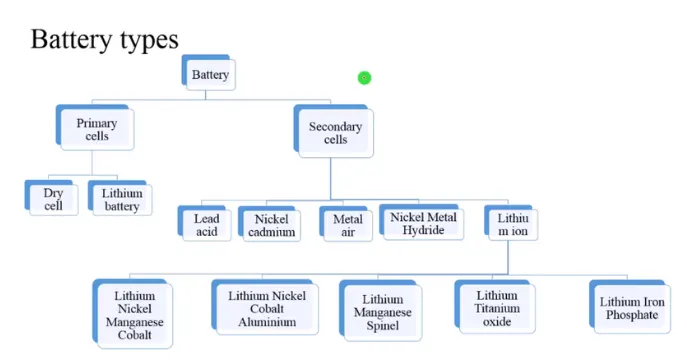
Lithium cobalt oxide(LiCoO2) - LCO -
| Battery type | Energy Density | Power density | Safety | Longevity |
| LCO(Lithium cobalt- oxide | High | High | Moderate | Moderate |
| LMO(Lithium manganese oxide) | Moderate | Moderate | High | High |
| NCA(Nicekl cobalt aluminium oxide) | High | Moderate | Moderate | Moderate |
| NMC(Nickel maganese cobalt oxide) | High | High | Moderate | High |
| LFP(Lithium iron phospate) | Low | Moderate | High | High |
| LTO(Lithium titanate Oxide) | Low | High | High | High |
- Enegy density refers to the amount of energy stored in the battery per unit volume or mass. high energy density means that more energy cane be stored in samll battery.
- Power density refers to the amount of power that can be delivered by the battery per unit volume or mass. High power density means that battery can deliver high power in same size compare to battery which has same volume or mass which has low power density.
- Safety refers to the risk of thermal runaway,fir, or explosion posed by the battery. Batteries with high safety are less likely to pose such risks, while batteries with moderate safety are pose to some risks.
- Lonevity refers to the battery's ability to retain its capacity over time and number of cycles it can under go before reaches to its end time. Batteries with high capacity can retain ttheir capacity for moe number of life cycles and have longer life span.
It is important to note that different types of batteries have different trade off based on these charecterstics, and the choice of the battery depends on the speific requirement of the application. For example LCO batteries are well suited for applications that require high energy densities, while LFP batteries are well suited for applications that requires high safety and longeivity.