Week 1 Understanding Different Battery Chemistry
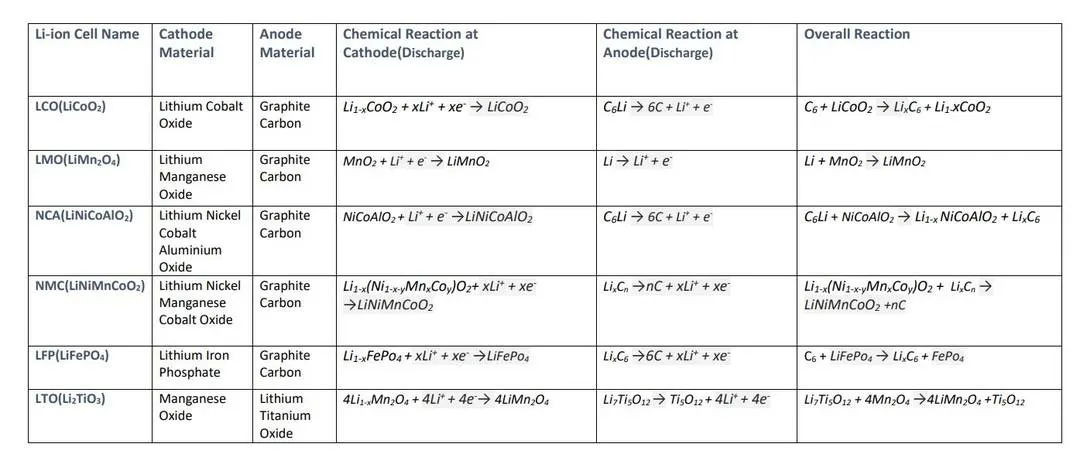
Aim: To prepare a table that includes materials & chemical reactions occurring at the anode and cathode of LCO, LMO, NCA, NMC, LFP, and LTO type of lithium-ion cells. Give your detailed explanation of it and also to compare the differences between each type of Li+ion battery based on their characteristics.
Solution:
What exactly is Lithium-Ion Battery?
A lithium-ion or Li-ion battery is a type of rechargeable battery which uses the reversible reduction of lithium ions to store energy. It is the predominant battery type used in portable consumer electronics and electric vehicles. It also sees significant use for grid-scale energy storage and military and aerospace applications. Compared to other rechargeable battery technologies, Li-ion batteries have high energy densities, low self-discharge, and no memory effect (although a small memory effect reported in LFP cells has been traced to poorly made cells).
Components:
1) Cathode: Cathode materials are generally constructed from LiCoO2 or LiMn2O4. The cobalt-based cathodes are ideal due to their high theoretical specific heat capacity, high volumetric capacity, low self-discharge, high discharge voltage, and good cycling performance. Limitations include the high cost of the material and low thermal stability.
2) Anode: Negative electrode materials are traditionally constructed from graphite and other carbon materials, although newer silicon-based materials are being increasingly used (see Nanowire battery). In 2016, 89% of lithium-ion batteries contained graphite, 7% contained amorphous carbon (either soft carbon or hard carbon), 2% contained lithium titanate (LTO) and 2% contained silicon or tin-based materials. Graphite is the dominant material because of its excellent performance.
3) Electrolyte: Electrolyte alternatives have also played a significant role, for example, the lithium polymer battery. Polymer electrolytes are promising for minimizing the dendrite formation of lithium. Polymers are supposed to prevent short circuits and maintain conductivity.
4) Cells: Li-ion cells (as distinct from entire batteries) are available in various shapes, which can generally be divided into four groups:
- Small cylindrical (solid body without terminals, such as those used in most e-bikes and most electric vehicle batteries and older laptop batteries); there a several standard lithium-ion cylinder sizes.
- Large cylindrical (solid body with large threaded terminals)
- Flat or pouch (soft, flat body, such as those used in cell phones and newer laptops; these are lithium-ion polymer batteries.[127]
- Rigid plastic case with large threaded terminals (such as electric vehicle traction packs).
5) Batteries: A battery (also called a battery pack) consists of multiple connected lithium-ion cells. Battery packs for large consumer electronics like laptop computers also contain temperature sensors, voltage regulator circuits, voltage taps, and charge-state monitors. These components minimize safety risks like overheating and short-circuiting. To power, larger devices, such as electric cars, connecting many small batteries in a parallel circuit is more effective and more efficient than connecting a single large battery.
Working:
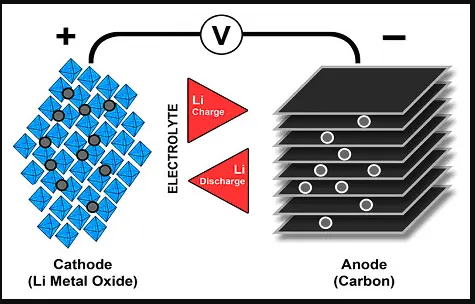
A battery is made up of an anode, cathode, separator, electrolyte, and two current collectors (positive and negative). The anode and cathode store the lithium. The electrolyte carries positively charged lithium ions from the anode to the cathode and vice versa through the separator. The movement of the lithium ions creates free electrons in the anode which creates a charge at the positive current collector. The electrical current then flows from the current collector through a device being powered (cell phone, computer, etc.) to the negative current collector. The separator blocks the flow of electrons inside the battery.
CHARGE/DISCHARGE:
While the battery is discharging and providing an electric current, the anode releases lithium ions to the cathode, generating a flow of electrons from one side to the other. When plugging in the device, the opposite happens: Lithium ions are released by the cathode and received by the anode.
| Voltages | 3.60V nominal; typical operating range 3.0–4.2V/cell |
| Specific energy (capacity) | 150–200Wh/kg. Specialty cells provide up to 240Wh/kg. |
| Charge (C-rate) | 0.7–1C, charges to 4.20V (most cells); 3h charge typical. Charge current above 1C shortens battery life. |
| Discharge (C-rate) | 1C; 2.50V cut off. Discharge current above 1C shortens battery life. |
| Cycle life | 500–1000, related to the depth of discharge, load, temperature |
| Thermal runaway | 150°C (302°F). Full charge promotes thermal runaway |
| Applications | Mobile phones, tablets, laptops, cameras |
2) Lithium Manganese Oxide (LMO): Lithium manganese oxide batteries are sometimes known as lithium manganate or lithium-ion manganese batteries, or li-manganese or manganese spinel batteries. The technology for this sort of battery was initially discovered in the 1980s, High-temperature stability distinguishes lithium manganese oxide batteries from others, which are also safer than other lithium-ion battery types. As a result, they’re frequently found in medical equipment and devices, but they can also be used in power tools, electric motorcycles, and other applications. Lithium manganese oxide batteries can also be used to power laptop computers and electric vehicles.
| Voltages | 3.70V (3.80V) nominal; typical operating range 3.0–4.2V/cell |
| Specific energy (capacity) | 100–150Wh/kg |
| Charge (C-rate) | 0.7–1C typical, 3C maximum, charges to 4.20V (most cells) |
| Discharge (C-rate) | 1C; 10C possible with some cells, 30C pulse (5s), 2.50V cut-off |
| Cycle life | 300–700 (related to the depth of discharge, and temperature) |
| Thermal runaway | 250°C (482°F) typical. High charge promotes thermal runaway |
| Applications | Power tools, medical devices, electric powertrains |
3) Lithium Iron Phosphate (LiPo or LFP): Phosphate is used as a cathode in lithium iron phosphate batteries, often known as li-phosphate batteries. They have low resistance qualities, which improve their thermal stability and safety. Durability and a long lifecycle are other advantages – fully charged batteries can be kept with no effect on the battery’s overall charge life. When the lengthy battery life of Li-phosphate batteries is considered, they are frequently the most cost-effective option. As a result, these batteries are frequently used in electric bikes and other applications requiring a long lifecycle and high levels of safety. These batteries are also commonly used in electric vehicles.
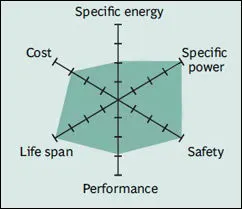
| Voltages | 3.20, 3.30V nominal; typical operating range 2.5–3.65V/cell |
| Specific energy (capacity) | 90–120Wh/kg |
| Charge (C-rate) | 1C typical, charges to 3.65V; 3h charge time typical |
| Discharge (C-rate) | 1C, 25C on some cells; 40A pulse (2s); 2.50V cut-off (lower than 2V causes damage) |
| Cycle life | 2000 and higher (related to the depth of discharge, temperature) |
| Thermal runaway | 270°C (518°F) Very safe battery even if fully charged |
| Cost | ~$580 per kWh |
| Applications | Portable and stationary needing high load currents and endurance |
4) Lithium Nickel Manganese Cobalt Oxide (NMC): Lithium Nickel Manganese Cobalt Oxide batteries, often known as NMC batteries, are constructed of a variety of materials that are universal in lithium-ion batteries. A cathode constructed of a mix of nickel, manganese, and cobalt is included.
NMC batteries, like other lithium-ion battery types, can have a high specific energy density or a high specific power. They can’t have both features, though. This battery is most commonly seen in power tools and automobile powertrains. Because of its low self-heating rate, this battery type is often used in electric vehicles.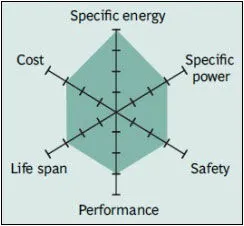
| Voltages | 3.60V, 3.70V nominal; typical operating range 3.0–4.2V/cell, or higher |
| Specific energy (capacity) | 150–220Wh/kg |
| Charge (C-rate) | 0.7–1C, charges to 4.20V, some go to 4.30V; 3h charge typical. Charge current above 1C shortens battery life. |
| Discharge (C-rate) | 1C; 2C possible on some cells; 2.50V cut-off |
| Cycle life | 1000–2000 (related to the depth of discharge, temperature) |
| Thermal runaway | 210°C (410°F) typical. High charge promotes thermal runaway |
| Cost | ~$420 per kWh |
| Applications | E-bikes, medical devices, EVs, industrial |
5) Lithium Nickel Cobalt Aluminum Oxide (NCA): NCA batteries, or lithium nickel cobalt aluminum oxide batteries, are making their way into electric vehicles and grid storage. Although NCA batteries are not widely used in consumer electronics, they have great potential in the automobile industry. NCA batteries offer a high-energy choice with a long lifespan, but they are less safe than other lithium-ion battery types and are rather expensive. To ensure driver safety, NCA batteries must be accompanied by monitoring systems.
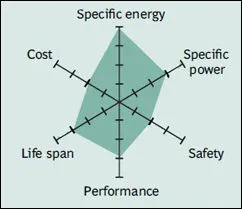
| Voltages | 3.60V nominal; typical operating range 3.0–4.2V/cell |
| Specific energy (capacity) | 200-260Wh/kg; 300Wh/kg predictable |
| Charge (C-rate) | 0.7C, charges to 4.20V (most cells), 3h charge typical, fast charge possible with some cells |
| Discharge (C-rate) | 1C typical; 3.00V cut-off; high discharge rate shortens battery life |
| Cycle life | 500 (related to the depth of discharge, temperature) |
| Thermal runaway | 150°C (302°F) typical, High charge promotes thermal runaway |
| Cost | ~$350 per kWh |
| Applications | Medical devices, industrial, electric powertrain (Tesla) |
6) Lithium Titanate (LTO): Finally, lithium titanate, often known as li-titanate, is a type of battery that has a growing number of uses. Because of its superior nanotechnology, the lithium-titanate battery has an extremely rapid recharge time. Li-titanate batteries are being employed by makers of electric vehicles and bicycles, and this type of battery has the potential to be used in electric buses for public transit. However, these batteries have a lower intrinsic voltage or energy density than other lithium-ion battery types, which might cause problems when it comes to efficiently powering automobiles. These batteries could be used for military and aerospace applications, as well as storing wind and solar energy and constructing smart grids.
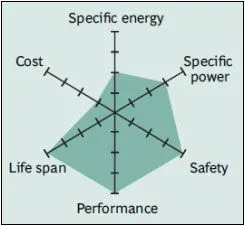
| Voltages | 2.40V nominal; typical operating range 1.8–2.85V/cell |
| Specific energy (capacity) | 50–80Wh/kg |
| Charge (C-rate) | 1C typical; 5C maximum, charges to 2.85V |
| Discharge (C-rate) | 10C possible, 30C 5s pulse; 1.80V cut-off on LCO/LTO |
| Cycle life | 3,000–7,000 |
| Thermal runaway | One of the safest Li-ion batteries |
| Cost | ~$1,005 per kWh |
| Applications | UPS, electric powertrain (Mitsubishi i-MiEV, Honda Fit EV), solar-powered street lighting |
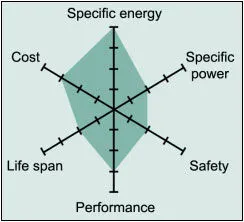
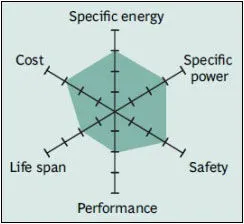
Figure 1 compares the specific energy of lead-, nickel- and lithium-based systems. While Li-aluminum (NCA) is the clear winner by storing more capacity than other systems, this only applies to specific energy. In terms of specific power and thermal stability, Li-manganese (LMO) and Li-phosphate (LFP) are superior. Li-titanate (LTO) may have low capacity but this chemistry outlives most other batteries in terms of life span and also has the best cold temperature performance. Moving towards the electric powertrain, safety, and cycle life will gain dominance over capacity. (LCO stands for Li-cobalt, the original Li-ion.)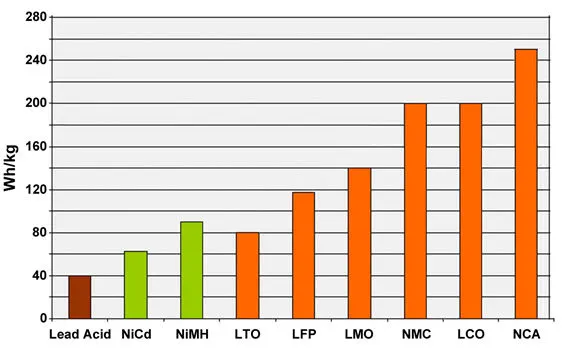
Comparing with the help of a chart-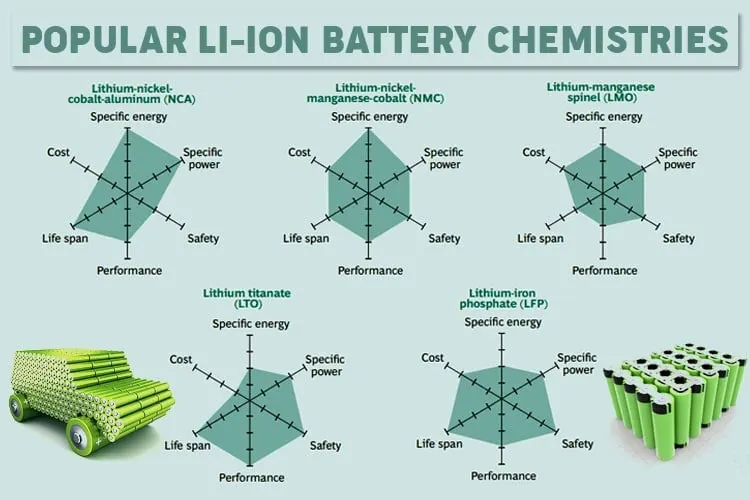
Detailed comparison-
The separator used in these battery types - Polyolefin