Week 1 Understanding Different Battery Chemistry
ANSWERS
Lithium-Ion Batteries
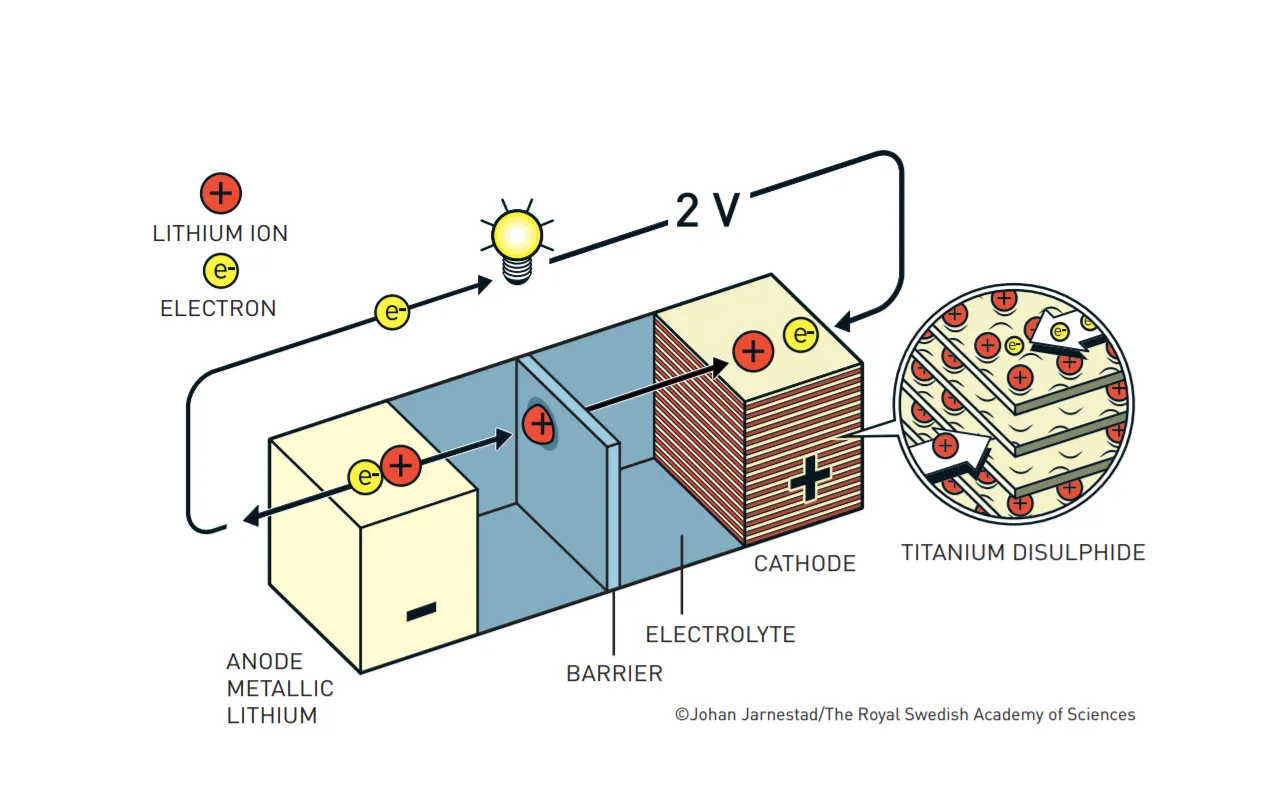
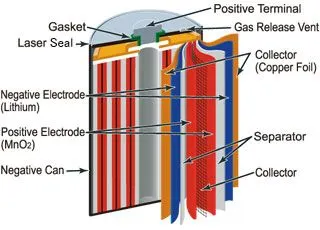
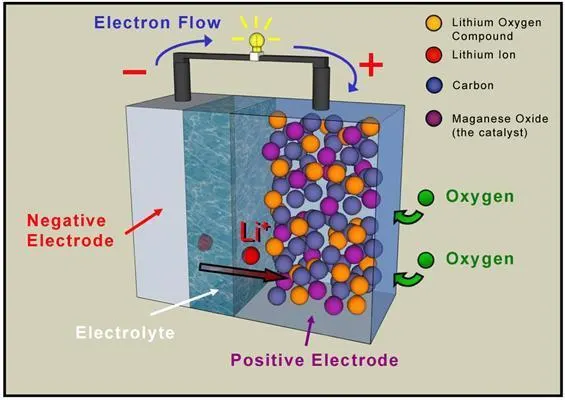
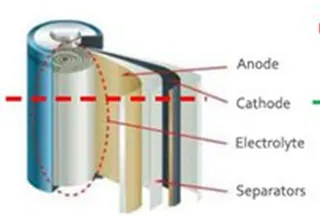
Lithium-ion batteries power the lives of millions of people every day. From laptops and mobile phones to hybrid and electric vehicles, the technology is growing in popularity because it is lightweight, energy dense and rechargeable. A battery consists of an anode, a cathode, a separator, an electrolyte, and two current collectors (positive and negative). The anode and cathode store lithium. The electrolyte transports positively charged lithium ions from the anode to the cathode and vice versa through the separator. Lithium ion migration creates free electrons at the anode and a charge on the positive current collector. Current then flows from the current collector through the powered device (cell phone, computer, etc.) to the negative current collector. A separator blocks the flow of electrons in a battery.
COMPARISON OF DIFFERENT LITHIUM-ION BATTERIES
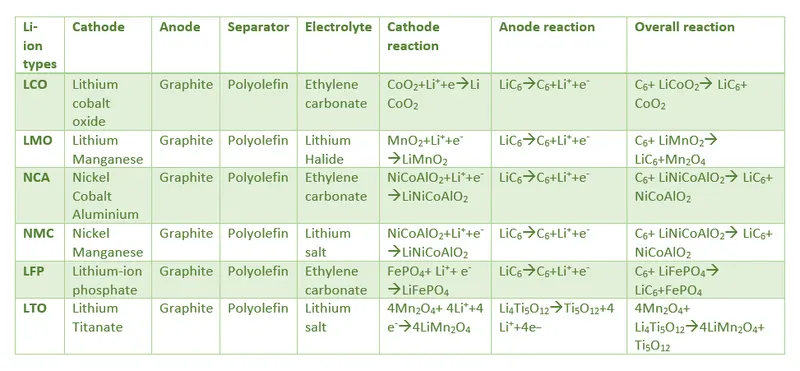
DIFFERENT TYPES OF LITHIUM-ION BATTERIES
LCO(Lithium Cobalt Oxide)
Lithium cobalt oxide batteries are made from lithium carbonate and cobalt and are also known as lithium cobalt or lithium ion cobalt batteries. These batteries are used in mobile phones, laptops and electronic cameras due to their high specific energy. It has a cobalt oxide positive electrode and a graphite carbon negative electrode, and lithium ions migrate from the negative electrode to the positive electrode during discharge, reversing the flow when the battery is charged.
This battery has some drawbacks such as short battery life and low specific power. I would also like to point out that these batteries are not as safe as other types of batteries. Nevertheless, its properties make it popular for mobile phones and other portable electronic devices.
LMO(Lithium Manganese oxide)
Lithium manganese oxide batteries are known as lithium manganate or lithium ion manganese batteries or lithium manganese or manganese spinel batteries. This type of battery technology was first discovered in his 1980s and first published in the Materials Research Bulletin in 1983. Moli Energy manufactured the first commercial lithium ion cell in 1996 using lithium manganese oxide as the cathode material.
High temperature stability is what differentiates it from other Lithium Manganese Oxide batteries, making it safer than other Lithium Ion battery types. As such, they are commonly found in medical equipment and devices, but can also be used in power tools, electric motorcycles, and other applications. Lithium manganese oxide batteries can also be used to power laptops and electric vehicles.
NCA(Lithium-Nickel Cobalt Aluminium Oxide)
NCA batteries, or Lithium Nickel Cobalt Aluminum Oxide batteries, are employed in electric vehicles and grid storage.Although NCA batteries are not widely used in consumer electronics, they have great potential in the automotive industry. NCA batteries offer a high-energy, long-lasting option, but are less safe than other types of lithium-ion batteries and are significantly more expensive. To ensure driver safety, the NCA battery must be fitted with a monitoring system.
NMC(Lithium-Nickel Manganese Cobalt Oxide)
Lithium Nickel Manganese Cobalt Oxide batteries, often known as NMC batteries, are made from a variety of materials common in lithium-ion batteries. It contains a cathode made from a mixture of nickel, manganese and cobalt.
60% nickel, 20% manganese, and 20% cobalt is a common cathode combination ratio. This means raw material costs are lower than other lithium-ion battery solutions as cobalt can be very expensive. Some battery makers plan to switch battery chemistries to those with higher nickel content to reduce cobalt usage, so prices for these batteries may drop further in the future. Due to their low self-heating, this type of battery is often used in electric vehicles.
LFP(Lithium Iron Phosphate)
Phosphate was identified in 1996 by the University of Texas (and other collaborators) as a cathode material for rechargeable lithium batteries. Lithium phosphate has low resistance and strong electrochemical performance. Nanoscale phosphate cathode materials make this possible. The main advantages are high ampacity and long service life, strong thermal stability, increased safety and compatibility against improper handling.
Lithium phosphate is more tolerant to full charge conditions and is less stressed than other lithium-ion systems when held under high voltage for extended periods of time. Due to the low nominal voltage of 3.2 V/cell, the specific energy is lower than cobalt-mixed Li-ion batteries.
Cold temperatures limit performance, and excessive storage temperatures shorten the life of most batteries. Lithium phosphate is no exception. Lithium phosphate batteries have a higher self-discharge than common lithium-ion batteries, which can make life balancing difficult. This can be addressed by purchasing higher quality cells or employing advanced control circuitry, both of which increase the cost of the package. Production cleanliness is critical to long-term success. The battery will only last 50 cycles if it cannot withstand moisture.
LTO(Lithium Titanium Oxide)
Finally, lithium titanate, also known as lithium titanate, is a type of battery with growing applications. With superior nanotechnology, the lithium titanate battery has a very fast charging time.Lithium titanate batteries are used by manufacturers of electric vehicles and bicycles, and this type of battery may be used in electric public transport buses. However, these batteries have a lower inherent voltage or energy density than other lithium-ion battery types, which can pose problems when efficiently powering vehicles. Nevertheless, lithium titanate batteries have the advantage of being denser than non-lithium ion batteries.
These batteries can be used not only for military and aerospace applications, but also for wind and solar energy storage and building smart grids. Additionally, according to Battery Space, these batteries could potentially be used for system-critical backups in power systems.
COMPARISON BASED ON CHARACTERISTICS
- Lithium cobalt oxide is suitable for laptops and mobile phones due to its high specific energy compared to other batteries. It also has moderate performance at a low cost. However, in all other aspects it is very unfavorable compared to other lithium-ion batteries. Low specific power, low safety and short service life.
- Lithium manganese oxide has moderate specific power, moderate specific energy, and moderate safety level compared to other types of lithium-ion batteries. It also has the advantage of low cost. The disadvantages are low performance and short service life. Typically used in medical equipment and power tools.
- Lithium Nickel Manganese Cobalt Oxide has two major advantages over other batteries. First, its high specific energy makes it suitable for electric powertrains, electric vehicles and e-bikes. Another is low cost. Compared to other lithium-ion batteries, it is moderate in terms of specific power, safety, lifespan and performance. Can be optimized to have either high specific power or high specific energy
- Lithium iron phosphate has the only major drawback compared to other types of lithium-ion batteries, which is its low specific energy. Apart from that, it has medium to high ratings for all other characteristics. It has high specific power, high safety, long service life and low cost. The performance of this battery is also moderate. It is widely used in electric motorcycles that require durability and high safety.
- Lithium Nickel Cobalt Alumina offers a strong advantage of high specific energy compared to the other five batteries. The rest of the characteristics such as performance, cost, specific power and lifespan are very moderate.The only drawback of this type of battery is low security. Suitable for electric powertrains due to its high specific energy and moderate life.
- Lithium titanate offers high safety, high performance and long life, the very important properties that all batteries should have. Its specific energy is lower than the other five lithium-ion batteries, but it makes up for this with moderate specific power. The only major drawback of lithium titanate compared to other lithium-ion batteries is its very high cost. Another key feature of this battery worth noting is its extremely fast charging time. It can be used to store solar energy and build a smart grid.