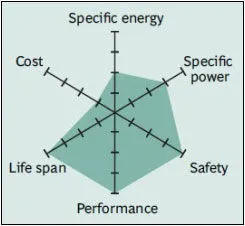
Week 1 Understanding Different Battery Chemistry
Objective-
1.Prepare a table which includes materials & chemical reactions occurring at the anode and cathode of LCO, LMO, NCA, NMC, LFP and LTO type of lithium ion cells.Give your detailed explanation on it
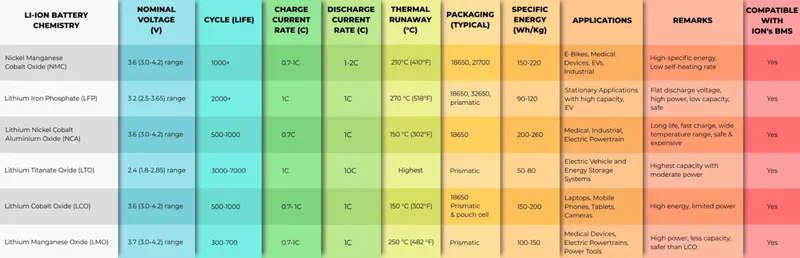
2.Compare the differences between each type of Li+ion batteries based on their characteristics
Report
- Lithium cobalt oxide (LiCoO2) - LCO.
- Lithium Manganese oxide (LiMn2O4) - LMO.
- Lithium Nickel Manganese cobalt oxide (liNiMnCoO2) - NMC.
- Lithium Iron phosphate (LiFePO4) - LFP.
- Lithium Nickel Cobalt Aluminium Oxide (LiNiCoAlO2) - NCA.
- Lithium Titanate (Li2TiO3) - LTO.
Table
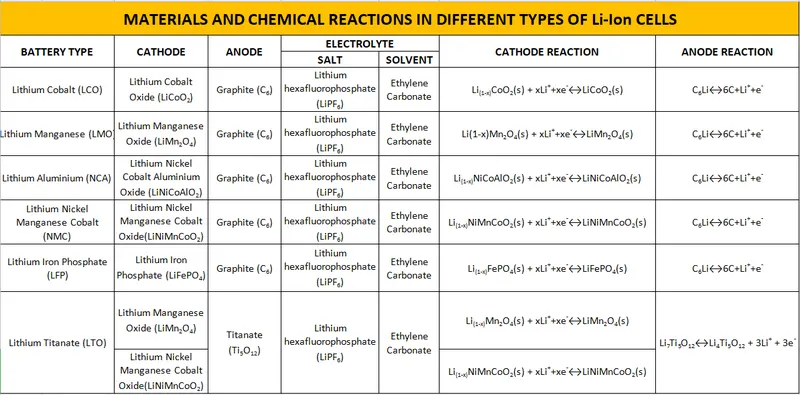
- In lithium cobalt oxide battery (LCO) anode(negative electrode) is graphite, the cathode (positive) is Lithium cobalt oxide and electrolyte is LiPF6 and ethylene carbonate. It is used in various applications including laptops and phone batteries.
- Lithium manganese battery (LMO) uses Lithium Managanese Oxide as cathode (positive electrode) and Graphite as anode (negative electrode). The battery inexpensive, non - toxic and has better thermal stability.
- Lithium Aluminium Battery (NCA) has Lithium Nickel Manganese Cobalt oxide as cathode and graphite as anode. It offers high specific energy, good specific power and a long life span.
- Lithium Nickel Manganese Cobalt Oxide (NMC) has lithium nickel managnese cobalt oxide as cathode and a electrolyte of lithium hexafluorophosphate and ethylene carbonate. NMC batteries have a high specific energy and power.
- Lithium iron phosphate battery (LFP) battery use lithium iron phosphate as cathode material and electrolyte of lithium hexafluorophosphate and ethylene carbonate. Have benefits such as low resistance properties, thermal stability and more safety.
- Lithium Titanate oxide (LTO) battery has Lithium managanese oxide and Lithium Nickel Manganese Cobalt oxide as cathode and Titanate as anode. It is a type of rechargable battery which has the advantage of being faster to charge than other lithium ion batteries but have a much lower energy density.
2) Compare the differences between each type of Li+ion batteries based on their characteristics
LCO;-
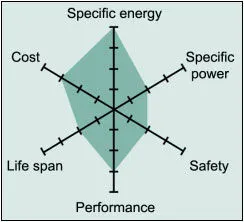
LM0;-
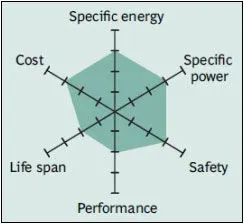
NMC:-
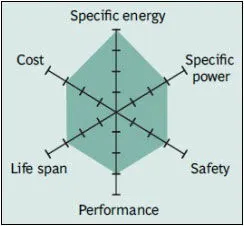
LFP:-
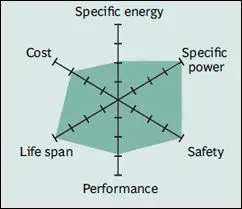
NCA:-
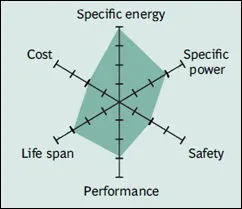
LTO:-