Week 1 Understanding Different Battery Chemistry
AIM:
To Prepare a table which includes materials & chemical reactions occurring at the anode and cathode of LCO, LMO, NCA, NMC, LFP and LTO type of lithium ion cells.
Compare the differences between each type of Li+ion batteries based on their characteristics.
INTRODUCTION OF THE BATTERY:
A battery is a device that can retain electrical energy in a chemical form and deliver the stored power when it is connected to a load. Batteries are classified into two different types such as primary cells and secondary cells.
CLASSIFICATION OF THE BATTERIES:
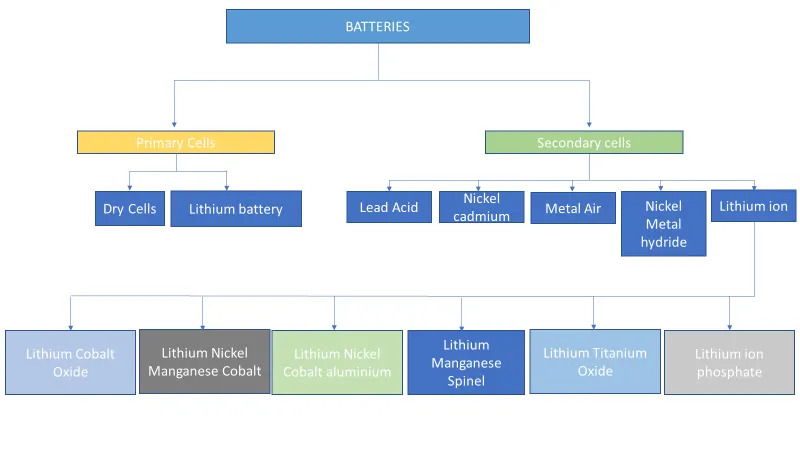
The First Lithium battery had proposed in the 1970s and produced commercially by Sony in 1991, lithium batteries are now used in mobile phones, airplanes, and cars.
The lithium-ion battery has ample variants of chemistry to perform good output for respective applications. LI-ion is the short form of the lithium-ion battery. Lithium batteries have a much higher energy density than other batteries. Lithium-ion batteries are one of the emerging battery variants among the batteries family.
LAYOUT OF LITHIUM-ION BATTERY:
WORKING NATURE OF LITHIUM-ION BATTERY :
A lithium battery is formed of four key components such as Cathode, Anode, Separator, Electrolyte.
CATHODE:
Cathode determines the capacity and voltage of the battery and is the source of the lithium ions.
ANODE :
The anode enables the electric current to flow through an external circuit and when the battery is charged, lithium ions are stored in the anode.
ELECTROLYTE:
COMPARSION TABLE:
| NAME OF THE BATTERY | NAME OF THE CATHODE MATERIAL | NAME OF THE ANODE MATERIAL | MERITS | DEMERITS | APPLICATIONS | CHEMICAL REACTIONS |
|
LITHIUM COBALT OXIDE (LCO) |
Lithium Cobalt Oxide (LiCoO2) |
Graphite (C6) |
High specific capacity |
Poor safety during the process of charging and discharging. Mostly used for low level energy cosuming devices. The battery is expensive due to cost of raw materials. |
Wall clock, Toy cars, Medical equipments, remotes, Laptops, All portable devices. |
At anode: LiC6 → Li+ + e- + C6 At cathode: CoO2 + Li+ + e- → LiCO2 |
|
LITHIUM MANGANESE OXIDE (LMO) |
Lithium Manganese Oxide (LiMn2O4) |
Graphite (C6) |
Rich resources, Low cost, No pollution, Good safety and good specific capability, Quick charging and discharge high power. |
The dissolution of manganese leads to poor high-temperature performance and cycling performance. |
Portable devices, Medical instruments, Hybrid and electric vehicles. |
At anode: LiC6 → Li+ + e- + C6 At cathode: Mn2O4 + Li+ + e- → LiMn2O4 |
|
NICKEL COBALT ALUMINIUM (NCA) |
Lithium Nickel Cobalt Aluminium Oxide (LiNiCoAIO2) |
Graphite (C6) |
The high-power density of NCA batteries makes them pretty durable. |
NCA batteries are quite expensive.
|
Hybrid and electric vehicles. |
At anode: LiC6 → Li+ + e- + C6 At cathode: NiCoAlO2 + Li+ + e- → LiNiCoAlO2 |
|
NICKEL MAGNESIUM COBALT (NMC) |
Lithium Nickel Manganese Cobalt Oxide. (LiNiMnCoO2) |
Graphite (C6) | It has longer range ouput. |
Poor safety, high temperature resistance, poor life, poor power discharge. Poor safety and short cycle life |
E-bikes, power tools, and other electronic power trains |
At anode: LiC6 → Li+ + e- + C6 At cathode: NiMnCoO2 + Li+ + e- → LiNiMnCoO2 |
|
LITHIUM IRON PHOSPHATE (LFP) |
Lithium Iron Phosphate (LiFePO4) |
Graphite (C6) |
Long lifespan, Good temperature performance, Safest battery, Depth of discharge, Environmental friendly. |
Balancing issues with aging may occur. Low nominal voltage. |
Low speed electrical vehicles |
At anode: LiC6 → Li+ + e- + C6 At cathode: FePO4 + Li+ + e- → LiFePO4 |
|
LITHIUM TITANIUM OXIDE (LTO) |
Lithium Manganese Oxide (LiMn2O4) OR Lithium Nickel Manganese Cobalt Oxide (LiNiMnCoO2) |
Titanate (Ti3O12) |
Extremely Long Lifetime. Rapid Battery Charging and Discharging. Enhanced Safety. Low-Temperature Performance |
Lower energy density |
Household electric devices. Electrical vehicles. |
At anode: Li2TiO3 → TiO3 + 2Li+ + 2e- At cathode: Mn2O4 + 2Li+ + 2e- → LiMn2O4 |
IMPORTANT PARAMETERS OF THE LI-ION BATTERIES:
LITHIUM COBALT OXIDE - (LCO) :
| VOLTAGE | SPECIFIC ENERGY | LIFE SPAN | THERMAL RUNAWAY | SAFETY | PRICE |
| Moderate | very high | moderate | high charging | low | high |
| 3.6V | 150-200Wh/kg |
500-1000 cycle |
150 celsius |
Lithium Cobalt Oxide batteries are not as effective as compared to other types of lithium-ion batteries.
LITHIUM MANGANESE OXIDE - (LMO) :
| VOLTAGE | SPECIFIC ENERGY | LIFE SPAN | THERMAL RUNAWAY | SAFTEY | PRICE |
| High | Low | Short | High charging | Low but safer than Li-Co | High |
| 3.70V | 100-150Wh/kg | 300-700 cycle | 250 celsius |
Lithium manganese batteries offer moderate performance as compared to other lithium-ion batteries.
NICKEL COBALT ALUMINIUM - (NCA)
| VOLTAGE | SPECIFIC ENERGY | LIFE SPAN | THERMAL RUNAWAY | SAFTEY | PRICE |
| High | Very High | Short | High charging | Average | High |
| 4.2V | 256Wh/Kg | 500 | 150 celsius |
NCA batteries are considered favorable for the automobile industry rather than consumer electronics.
NICKEL MAGNESIUM COBALT - (NMC)
| VOLTAGE | SPECIFIC ENERGY | LIFE SPAN | THERMAL RUNAWAY | SAFETEY | PRICE |
| Slightly lower | Very high | Longer | High Charging | Moderate | High |
| 3.6V | 150-220wh/kg | 1000-2000 cycle | 210 celsius |
NMC batteries offer a longer lifespan at a lower cost as compared to cobalt-based batteries.
LITHIUM IRON PHOSPHATE - (LFP)
| VOLTAGE | SPECIFIC ENERGY | LIFE SPAN | THERMAL RUNAWAY | SAFETY | PRICE |
| Low | Low | Very long | Stable | Highest | Moderate |
| 3.2V | 90-120 Wh/kg | More than 2000 cycles | 270 celsius |
LiFePO4 batteries are not that suitable for high load applications.
LITHIUM TITANIUM OXIDE - (LTO)
| VOLTAGE | SPECIFIC ENERGY | LIFE SPAN | THERMAL RUNAWAY | SAFETY | PRICE |
| Lowest | Lowest | Longest | Safest | Safest | Highest |
| 2.40V | 50-80Wh/Kg | 3000-7000 cycles |
LTO battery has Li-titanate as an anode, instead of graphite.
OVERVIEW OF LI-ION BATTERIES:
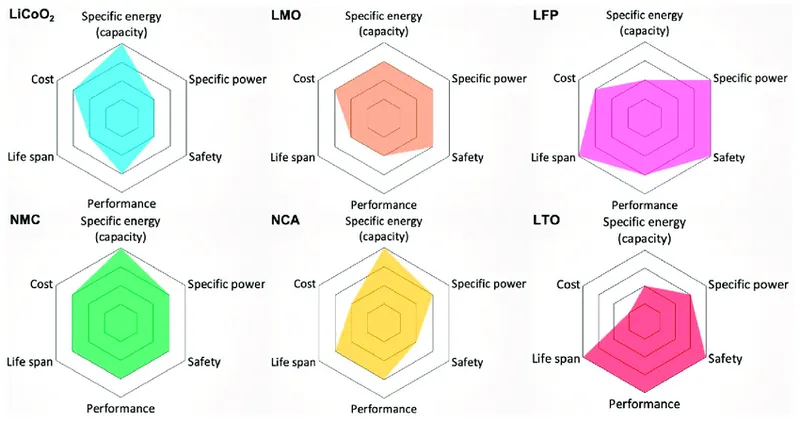
Crucial parameters of lithium-ion batteries in Radar view.
BAR CHART OF WATT-HOUR PER KG FOR LITHIUM BATTERIES:
CONCLUSION:
The batteries which are belonging to the Lithium-ion family have unique features compared to other batteries in the market. Each Li-ion cell has its own characteristic output. According to the application requirements, the battery should be selected.
There are a few parameters that should be considered when picking up the battery from the li-ion family such as specific energy, specific power, thermal runaway, lifetime, cost, and the cycle life of the battery.
Moreover, Make sure to go with a safety-proven battery for public place applications.
REFERENCES:
https://electricvehicle.wiki/technology/lithium-nickel-cobalt-aluminum-oxide-linicoalo%E2%82%82-nca/